
Test 19 of 25 · 20 questions · Free 2026
TX Permit Practice Test 19
Jump to the test ↓A fixed 20 question set from the Texas bank with answers and plain English explanations.
Question 1 of 20 · 0 right so far
All 20 questions in test 19
Every question below comes from the Texas question bank on this page. Open a question to see the correct answer and the explanation. Nothing here is hidden behind a signup.
1. An inspected Texas school bus runs a numbered rural highway. What is its limit?
- 70 mph, like passenger cars
- 50 mph, like uninspected buses
- 60 mph
- 30 mph, like an urban district
Show answer
60 mph. Inspected school buses get their own table row. On Texas or U.S. numbered highways outside urban districts, school buses that passed a commercial vehicle inspection may travel at 60 mph, below the 70 mph car limit but above the 50 mph rule for uninspected buses or unnumbered highways. Urban 30 has nothing to do with rural highways. The cue is the inspection sticker plus the route marker: numbered rural highway plus a passed inspection equals 60.
2. How do Texas unattended-vehicle rules treat remote starters?
- They must idle the car for ten minutes first
- The shutdown and key rules do not apply to them
- They must leave the key in the ignition
- They must disable the remote starter in cities
Show answer
The shutdown and key rules do not apply to them. Remote starters warm the car while the key stays in your pocket, so Texas excuses them from the shutdown rules. The requirements to turn off the engine, lock the ignition, and remove the key do not apply to a driver who starts the engine with a remote starter or similar device, though the key must be present before the vehicle can be operated. Idling minimums, keys left inside, and city bans are not stated. The cue is the fob start: warming up remotely is lawful, but driving still needs the key.
3. What is the main purpose of regulatory traffic signs?
- To instruct drivers what they should or should not do
- To mark every railroad advance warning location
- To identify hazards that are immediately ahead
- To show only the route number of the highway
Show answer
To instruct drivers what they should or should not do. Regulatory signs communicate required or prohibited traffic behavior in particular circumstances, and the handbook says drivers must obey them in the same manner as traffic laws. A warning sign instead alerts drivers to a hazard or change ahead. Railroad advance signs are one specialized warning category, and route numbers serve guidance and identification. When a sign states a speed, turn, lane, or stopping restriction, read it as an enforceable direction rather than as general advice about what may be coming later.
4. How closely may you follow a fire truck answering an alarm with flashing red lights?
- You may follow within 100 feet if traffic is light
- You must stay at least 500 feet behind it
- You may follow closely after changing lanes
- There is no stated following restriction
Show answer
You must stay at least 500 feet behind it. Texas prohibits following within 500 feet of a fire truck answering an alarm when its flashing red lights are on. The distance protects emergency operations and gives the truck room to maneuver, stop, or change direction without a civilian vehicle crowding it. The smaller 100-foot option is not the handbook rule, and changing lanes does not remove the restriction. Use the flashing red lights as the cue to create substantial space and choose another route or speed until the emergency vehicle is well ahead.
5. What is the full Texas legal definition of intoxicated?
- Only a BAC above 0.15 counts
- 0.08 BAC or any loss of normal mental or physical faculties
- Only drivers under 21 can be intoxicated
- Only crashes prove intoxication
Show answer
0.08 BAC or any loss of normal mental or physical faculties. Texas intoxication has two independent doors. The legal limit is 0.08 BAC, or any amount causing loss of normal use of mental or physical faculties. High-only thresholds, age limits, and crash requirements all rewrite the law. The cue is the either-or test: fail the number or fail the faculties, and intoxication is established. Officers test both doors independently, and either one alone sustains the charge in court.
6. Which Texas cars need exhaust emission systems?
- All 1968 and later models need exhaust emission systems
- No car needs a muffler
- Only trucks need exhausts
- Emissions gear is optional
Show answer
All 1968 and later models need exhaust emission systems. Clean-air gear became mandatory with the 1968 model year. Texas requires all 1968 and later models to carry exhaust emission systems against air pollution. Muffler-free, truck-only, and optional readings all rewrite the rule. The cue is the model year: 1968 and newer means emissions equipment stays installed and working. Tampering with or removing emissions gear brings fines beyond inspection failure. Repairs must use certified parts installed to factory spec.
7. A passed Texas truck flashes its lights. What does it mean?
- It means the truck is angry
- It signals you to stop
- It signals room to pull back in front
- It means your lights are off
Show answer
It signals room to pull back in front. Truckers help you judge the clearance you cannot see. Texas says that if the driver flashes the truck lights after you pass, it signals room to pull back in front of the truck, though you must still move back only when safe. Anger, stop orders, and lamp warnings all misread the courtesy. The cue is the double flash in your mirror: the professional ahead is telling you the trailer is clear.
8. What can a Texas speed sign show besides one limit?
- Daytime and nighttime maximum speeds
- Only the time of day
- Only the road name
- Only the county name
Show answer
Daytime and nighttime maximum speeds. Some limit signs carry two numbers for two light conditions. Texas notes the sign can also show maximum speeds for daytime and nighttime. Time-only, name-only, and county-only readings miss the point. The cue is the dual number panel: obey the figure matching current light. Night maximums protect drivers when headlights shorten safe stopping distance. Obey whichever figure matches the current light conditions.
9. What does a driver have to do when approaching an emergency vehicle stopped with its lights activated on a multilane road?
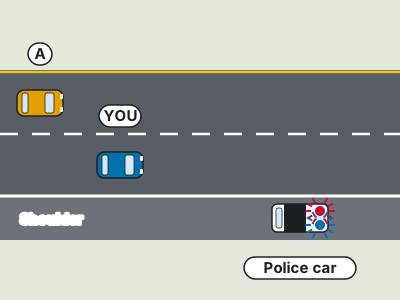
- Move out of the lane closest to the vehicle if possible
- Stop in the lane closest to the vehicle
- Maintain speed and pass on the shoulder
- Turn around before reaching the vehicle
Show answer
Move out of the lane closest to the vehicle if possible. Texas's Slow Down or Move Over rule gives a multilane-road option: leave the lane closest to the stopped emergency vehicle when lanes travel in the same direction. If that cannot be done, the driver must reduce speed by 20 mph below the posted limit. Stopping in the nearest lane creates the hazard the rule is intended to reduce. Passing on the shoulder or turning around is not the stated response. Scan ahead for activated lights, then create space by changing lanes safely or slowing as required.
10. What does a lane-ends warning tell a driver in the right lane?

- The roadway is adding a new lane on the right
- The right lane is reserved for slow traffic indefinitely
- The driver must stop before the lane narrows
- The lane ends ahead and the driver should merge into the left lane
Show answer
The lane ends ahead and the driver should merge into the left lane. The lane-ends warning means the right lane will disappear ahead. The handbook directs a driver in that lane to merge into the left, so waiting until the pavement ends is unsafe. This is not an added-lane message, a permanent slow-traffic rule, or an automatic stop command. Check mirrors and blind spots, signal, find a safe gap, and merge while there is still enough roadway to complete the movement smoothly.
11. Until what event does Phase Two restrict a provisional license holder’s driving privileges?
- The holder’s 16th birthday
- The holder’s 18th birthday
- The holder’s 21st birthday
- Six months after the provisional license is issued
Show answer
The holder’s 18th birthday. Phase Two restricts driving privileges until the holder’s 18th birthday after a provisional license is issued. The restriction is tied to reaching 18, not turning 16, completing a six-month period, or reaching 21. Passenger and nighttime limits should be read as teen restrictions that last through the stated birthday. In a duration question, identify the ending event first, then apply the specific condition governing what the driver may do during the phase.
12. A railroad crossing signal is clearly malfunctioning. Whom should you call?
- Ignore it, since trains will stop anyway
- Call DPS Communications at (800) 772-7677 or local law enforcement
- Fix the signal yourself with basic tools
- Report it only after a crash happens
Show answer
Call DPS Communications at (800) 772-7677 or local law enforcement. A broken crossing signal endangers every driver behind you, so Texas wants it reported at once. If you encounter a railroad grade crossing signal problem, call the DPS Communications Center at (800) 772-7677 or your local police department or county sheriff's office, noting the identifying number posted on the signal. Trains cannot stop for crossing traffic, so ignoring the fault is dangerous. Repairing railroad equipment yourself is illegal and unsafe. Waiting for a crash defeats the purpose. The cue is any malfunction: gates stuck, lights dead, or bell silent.
13. What does a Texas bridge-ice warning sign mean?
- The bridge is freshly painted
- Fishing is allowed below
- The bridge is closed to trucks
- Icy bridge hazard, posted all winter
Show answer
Icy bridge hazard, posted all winter. Bridges freeze before roads do. Texas posts the bridge-ice warning continuously through winter periods, telling drivers to slow down and avoid sudden braking or sharp movements. Paint, fishing, and truck bans are unrelated. The cue is the cold-season sign on the span: treat every bridge deck as glazed until proven otherwise. Shaded bridge decks can glaze while the approaching road stays merely wet and safe.
14. What must you give an injured person after a Texas crash?
- Your favorite color
- Your mother's maiden name
- Your horoscope sign
- Name, address, registration, and insurer to the injured
Show answer
Name, address, registration, and insurer to the injured. Victims need your identity and coverage at once. Texas requires giving your name, address, vehicle registration number, and liability insurer name to any person injured, plus operators, occupants, and attendants. Colors, maiden names, and horoscopes are useless. The cue is the exchange moment: identity and insurance flow to every harmed party. Offer the information even if the other party seems unhurt at first. Hidden injuries surface hours later and need the record.
15. The light changes while a pedestrian crosses in Texas. Who has priority?
- Still give the pedestrian the right-of-way
- Speed up before they finish
- Honk them off the road
- Turn into their path
Show answer
Still give the pedestrian the right-of-way. Started crossings keep their protection through the light change. Texas says that if the light changes after a pedestrian enters the crosswalk, drivers must still yield. Speeding, honking, and turning into walkers all endanger a legal crossing. The cue is the mid-crosswalk pedestrian under a fresh red: wait patiently until every foot reaches the far curb. Rushing a walker only saves seconds while risking a life and a felony record.
16. How should you secure your car at a Texas traffic stop?
- Park position, emergency brake, engine off, hazards on
- Stay in drive with music loud
- Leave the engine racing
- Turn all lights off
Show answer
Park position, emergency brake, engine off, hazards on. A stopped car must look stopped and stay stopped. Texas says to set park position, emergency brake, engine off, and hazard lights on. Drive gears, loud music, racing engines, and dark cars all signal flight or trouble. The cue is the officer's approach: a dark, braked, flashing car reads as compliant and safe. Keep your seatbelt fastened until the officer directs otherwise for safety. Sudden unbuckling can look like reaching for something hidden.
17. What is the Texas penalty for a second adult DWI?
- Same as the first offense
- A lighter penalty
- Up to $4,000, 30 days to 1 year jail, 180 days to 2 years suspension
- A free pass
Show answer
Up to $4,000, 30 days to 1 year jail, 180 days to 2 years suspension. The second DWI doubles money and stretches jail and suspension. Texas sets up to $4,000, 30 days to a year in jail, and 180 days to 2 years suspended. Same, lighter, and free readings deny the escalation table. The cue is the prior conviction: every number grows on the second round. Judges may also order ignition interlock for years after the suspension ends. Each repeat narrows every leniency option available.
18. What does the Texas handbook recommend if a vehicle's brakes fail?
- Panic and turn off the engine immediately
- Apply the parking brake as hard as possible at once
- Use the parking brake cautiously and shift to a lower gear
- Shift to neutral and coast without braking
Show answer
Use the parking brake cautiously and shift to a lower gear. If the brakes fail, the handbook advises using the parking brake and shifting to a lower gear. The parking brake should be applied cautiously so the wheels do not lock and throw the car into a skid. Panic is not a control method, an abrupt full-force pull can create a skid, and coasting in neutral removes the benefit of engine braking. Keep the vehicle pointed where you need it to go, reduce speed progressively, and use the available controls deliberately while looking for a safe place to stop.
19. Texas bars driving on the left side of the road within what distance of an intersection or railroad crossing?
- 50 feet
- 200 feet
- 500 feet
- 100 feet
Show answer
100 feet. Texas says never to drive on the left side of the road within 100 feet of or crossing an intersection or railroad crossing, and the same 100 foot rule applies near a bridge, viaduct, or tunnel. Fifty feet is too little distance. Two hundred feet is how far a vehicle parked on a highway must be visible, and 500 feet is the high beam dimming distance for oncoming vehicles. Left side driving is also barred on hills and curves where vision is limited.
20. What following distance does the Texas handbook recommend when you are driving behind a motorcycle?
- Two seconds, the same as for a car
- One full car length
- At least four to six seconds
- Ten seconds
Show answer
At least four to six seconds. The handbook warns that the slightest contact can mean a spill or injury for a rider, so allow more following distance, at least four to six seconds, when following a motorcycle. That gives the rider time to maneuver or stop in an emergency, and motorcycles can stop more quickly than cars in dry conditions. When you are stopped behind a motorcycle at an intersection, signal, or crossing, a full vehicle length of space is recommended.
QualitySpace is expanding to Texas
We are a California-based independent insurance brokerage working on licensing in more states. We cannot help with Texas insurance yet. Leave your email and we will let you know when we can.
Every question is written from the official Texas Driver Handbook. Need paper? Printable TX practice test with answer key.
Last verified 2026-09-07. How we check every question · Study all 500 as flashcards
Frequently asked questions
How many questions are on this Texas practice test?
This fixed set has 20 questions. It is test 19 of 25 from the 500 question Texas bank.
How does this fixed test relate to the full Texas bank?
Each numbered test is a fixed set of 20 questions in a fixed order, so you can retake the same test later and compare. Every test mixes road signs and the other topics in about the same proportion as the full bank. Tests 1 to 25 together cover every question in the Texas bank once. The full practice page mixes the whole bank at random.
Last verified 2026-09-07. See the Texas DMV facts page for sourced state details.