
Test 14 of 25 · 20 questions · Free 2026
TX Permit Practice Test 14
Jump to the test ↓A fixed 20 question set from the Texas bank with answers and plain English explanations.
Question 1 of 20 · 0 right so far
All 20 questions in test 14
Every question below comes from the Texas question bank on this page. Open a question to see the correct answer and the explanation. Nothing here is hidden behind a signup.
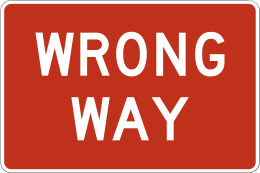
1. If a WRONG WAY sign faces you, what does it tell you about your vehicle's position?
- You are approaching a rough section of pavement
- You are entering a truck-only roadway
- You are opposing the flow on a one-way street
- You may continue if no headlights are visible
Show answer
You are opposing the flow on a one-way street. The handbook says a driver seeing this sign is going the wrong way on a one-way street and directly opposing traffic. The sign is not a pavement-condition warning and does not identify a truck route. Darkness or a temporarily empty roadway does not make the direction safe. The immediate cue is the message facing the driver: stop the wrong-way movement, pull over safely when possible, and correct the route without crossing into opposing traffic.
2. What does the Texas handbook say about caffeine and a drunk driver?
- It cannot make a drunk driver sober or improve their driving
- A cup of coffee restores sober driving ability
- Caffeine cancels one drink per cup
- Caffeine speeds up alcohol elimination
Show answer
It cannot make a drunk driver sober or improve their driving. While caffeine can help drowsy drivers stay alert, the handbook says it cannot make a drunk driver sober, and studies show ordinary amounts of caffeine do not improve a drunk driver's ability to operate a vehicle. Alcohol leaves the body only with time. The same chapter warns that tranquilizers and sedative hypnotics, including barbiturates, are powerful depressants and warns that mixing them with alcohol invites trouble on the road.
3. The gates are down at a railroad crossing. When may you cross?
- Cross as soon as the train's last car passes
- Proceed once the bell stops, even if gates stay down
- Weave through the gates if the far lane is clear
- Remain stopped until the train passes and the gates are raised
Show answer
Remain stopped until the train passes and the gates are raised. Gates stay down until the crossing is truly safe, which may include a second train. Texas requires remaining stopped with lowered gates until the train passes and the gates rise before crossing. Moving on the bell alone or the last visible car risks meeting hidden rail traffic. Weaving around gates is illegal as well as reckless. The cue is the gate arm itself: while it is down, your wheels stay still, and only its full rise plus a clear view of all tracks releases you.
4. You carry a weapon during a Texas traffic stop. What must you do?
- Tell the officer about any weapon in the vehicle
- Hide all weapons quickly
- Hand the weapon to the officer barrel-first
- Say nothing and hope
Show answer
Tell the officer about any weapon in the vehicle. Weapon honesty protects everyone at the window. Texas says to tell the officer if transporting any type of weapon. Hiding, handing over barrel-first, and silence all risk tragedy. The cue is the officer's first question: volunteer the weapon's presence and location, then follow directions exactly. State the weapon type and exact location without touching it at any point. Let the officer decide how to secure it safely.
5. What suspension follows a repeat minor alcohol offense in Texas?
- The suspension is always exactly one year
- Interlock devices are banned in Texas
- Judges may never reduce the period
- One year, or 90 days with a judge-ordered interlock
Show answer
One year, or 90 days with a judge-ordered interlock. Repeat minor alcohol offenses escalate, but interlock offers a shorter path. Texas sets suspension for one year, or for 90 days with a judge's order to install an ignition interlock device, and bars deferred outcomes on the third offense. Fixed one-year, interlock bans, and no-reduction readings all miss the alternative. The cue is the judge's order: accepting the breath-test device in the car trades nine months of suspension for monitored driving.
6. A steady green arrow points down at your Texas lane. What does it mean?
- Leave the lane at once
- You may drive in that lane
- Stop and wait for a red X
- Turn around in the lane
Show answer
You may drive in that lane. The green arrow blesses the lane below it. Texas says a steady downward green arrow means a driver is permitted to drive in the lane over which the signal sits. Fleeing, stopping, and turning around all contradict the permission. The cue is the green arrow overhead paired with red X marks over closed lanes: follow the arrows and your lane is the legal path.
7. How high can speed limits go on Texas limited-access highways?
- Never above 55 mph anywhere
- Exactly 70 mph on every highway
- 65 mph at night on all freeways
- Many post 75 up to 85 mph
Show answer
Many post 75 up to 85 mph. Texas lets top-tier highways climb far above the table. The Transportation Commission, regional mobility authorities, and local governments may raise or lower limits on traffic studies, and many limited-access highways carry 75 up to 85 mph postings. A 55 ceiling and a fixed 70 ignore the posted-limit rule. Night-specific 65 is not the Texas scheme. The cue is the sign on the freeway you are actually driving: obey the posted number, which on the fastest Texas toll roads reaches 85.
8. A 22-year-old in Texas buys beer for an 18-year-old friend. What penalty can the buyer face?
- A fine of up to $100
- A warning for a first offense
- A fine of up to $4,000 and/or up to one year in jail
- A 30 day license suspension only
Show answer
A fine of up to $4,000 and/or up to one year in jail. In Texas, anyone under 21 is a minor for alcohol purposes, so an 18-year-old counts. A person who buys, furnishes, or sells alcohol to a minor can be fined up to $4,000, jailed for up to one year, or both. A $100 fine and a warning badly understate the penalty. A 30 day suspension is the penalty for a minor's own first non-driving alcohol offense, not for the adult who supplied the alcohol.
9. What does an overhead exit sign tell a Texas lane?
- The lane merges ahead
- The lane becomes a parking row
- The signed lane exits ahead
- The lane requires a toll tag
Show answer
The signed lane exits ahead. Overhead exit panels mark the departing lane. Texas says the lane under the sign exits ahead. Merges, parking, and tolls are different messages. The cue is the panel with the exit number: stay in that lane only if leaving, or escape it early if staying. Missing the lane early forces a dangerous last-second dive across the gore. Decide at the first advance sign, a mile or more ahead.
10. What is the penalty for fleeing larger Texas crash damage?
- A thank-you note
- Class B misdemeanor up to $2,000 and up to 180 days in jail
- A high-five
- A discount coupon
Show answer
Class B misdemeanor up to $2,000 and up to 180 days in jail. Bigger damage means jail joins the fine. Texas punishes first failure-to-stop at $200 or more in damages as a Class B misdemeanor up to $2,000, up to 180 days in jail, or both. Notes, high-fives, and coupons mock the table. The cue is the $200 line: cross it and liberty itself is at stake. Jail time, even suspended, follows job and housing applications for years. Stopping and reporting avoids the criminal record entirely.
11. When may a vehicle use a parking space reserved for disabled individuals?
- When it has a disabled license plate or windshield identification card
- When its hazard lights are on
- When the driver stays in the vehicle
- When the space is unused at night
Show answer
When it has a disabled license plate or windshield identification card. A vehicle may use a parking space reserved for disabled individuals only when it displays a disabled license plate or windshield identification card. Hazard lights do not create an exception, and remaining behind the wheel does not change the restriction. An empty space is still reserved, including at night. Look for the required plate or windshield identification before entering the space, and choose ordinary parking when that authorization is absent.
12. What can an adult's breath or blood specimen determine after a qualifying DWI arrest?
- Only whether the driver has a valid license
- Whether alcohol is present, its amount, and whether other controlled substances or drugs are present
- Only the vehicle's mechanical condition
- Whether the driver committed a parking violation
Show answer
Whether alcohol is present, its amount, and whether other controlled substances or drugs are present. After a qualifying arrest, the handbook says a breath or blood specimen determines whether alcohol is present and identifies the amount in the person's system. It can also identify other controlled substances or drugs. A license check, vehicle inspection, or parking review is unrelated to the specimen's purpose. The key cue is the type of evidence being measured: the test analyzes the person's body, not the vehicle or driving records. This item asks what the specimen can determine, while implied consent explains why the test may be requested after the stated arrest.
13. A Texas driver who owns the vehicle is convicted a second time of driving without evidence of financial responsibility. What penalty applies?
- A $50 fine
- Only community service
- A warning because the first fine was paid
- License suspension, a $350 to $1,000 fine, and court impoundment of the vehicle
Show answer
License suspension, a $350 to $1,000 fine, and court impoundment of the vehicle. The handbook's penalty table for driving without evidence of financial responsibility lists a fine of $175 to $350 for a first conviction. A second or later conviction brings suspension of the driver license, a fine of $350 to $1,000, and court impoundment of the vehicle when the defendant owned it at the time of the offense and still owns it on the conviction date. A $50 fine, community service alone, or a warning understate a repeat insurance violation.
14. What does a steady green light allow when the movement is safe?
- Turn in every direction regardless of lane markings
- Proceed straight or turn unless another sign or signal prohibits it
- Remain stopped until the next cycle
- Ignore pedestrians because green always gives priority
Show answer
Proceed straight or turn unless another sign or signal prohibits it. A steady green light permits the driver to proceed if it is safe, including driving straight or turning unless another sign or signal prohibits the movement. The green display does not authorize every direction regardless of lane use, and it does not require the driver to wait through another signal cycle. Drivers must still watch for cars and pedestrians in the intersection, so ignoring pedestrians removes an important safety check. Use the green as permission to move, then scan the intersection before selecting the allowed path.
15. What speed range may appear on many limited access highways in Texas?
- 45 to 55 mph
- 55 to 65 mph
- 75 to 85 mph
- 90 to 100 mph
Show answer
75 to 85 mph. Many limited access highways in Texas have posted speed limits from 75 up to 85 mph. This is a range describing certain highways, not a statewide permission to drive at either number everywhere. The lower alternatives confuse these roads with slower roadway categories, and 90 to 100 mph exceeds the range stated in the handbook. Drivers must still obey the particular posted limit and adjust for traffic, weather, visibility, and other conditions. Read the sign on the road you are using rather than relying on a general maximum remembered from another highway.
16. How is a third non-driving alcohol offense graded for Texas ages 17 to 20?
- A Class C misdemeanor like the first two
- A Class B misdemeanor with $250 to $2,000 in fines
- A capital felony
- A $5 traffic ticket
Show answer
A Class B misdemeanor with $250 to $2,000 in fines. The third offense for older teens jumps a full misdemeanor class. Texas grades a third non-driving alcohol offense for ages 17 to 20 as a Class B misdemeanor with $250 to $2,000 in fines, plus possible jail and longer suspension. Same-class, capital, and ticket readings all miss the escalation. The cue is the age band: 17 to 20 year olds face adult-level money on the third strike.
17. How do you enter a Texas roundabout?
- Yield to traffic already driving in the circle
- Enter without looking
- Stop inside the circle to wait
- Circle clockwise to save time
Show answer
Yield to traffic already driving in the circle. Roundabout entries always lose to circulating traffic. Texas says to observe advisory speeds and yield to traffic driving in the circle, entering only on an acceptable gap and traveling counterclockwise. Blind entries, in-circle stops, and clockwise shortcuts all break the design. The cue is the yield line at the entrance: slow, watch the left, and join the flow only when the circle offers room.
18. Why is water across a Texas road especially dangerous?
- It always means the road is freshly paved
- It guarantees the bridge is inspected
- It may hide a missing roadbed or bridge
- It cools the tires for better grip
Show answer
It may hide a missing roadbed or bridge. Still-looking water can cover a void where the road washed away. Texas warns that water across a road may hide a missing segment of roadbed or a missing bridge. Fresh pavement, inspected bridges, and tire cooling all misread the danger. The cue is any water sheet over pavement: the surface below may be gone entirely, which is why barricades at flooded roads carry jail-time penalties for violators.
19. Where near a Texas safety zone is stopping prohibited?
- Between a safety zone and its curb, or within 30 feet opposite its end
- Beside any yellow curb for loading
- In a bus zone after 6 p.m.
- Next to a parking meter without paying
Show answer
Between a safety zone and its curb, or within 30 feet opposite its end. Safety zones shelter transit riders stepping off streetcars and buses. Texas bans stopping, standing, or parking between a safety zone and its adjacent curb, and within 30 feet of the curb point directly opposite the zone's end. Yellow curbs, bus zones, and meters follow separate rules. The cue is the marked boarding island: give it a wide berth on both the zone side and the opposite curb so riders can board and exit clear of your vehicle.
20. Who may carry a Texas white cane?
- Blind, partially blind, or disabled walkers
- Anyone wanting attention
- Children playing games
- Drivers seeking parking
Show answer
Blind, partially blind, or disabled walkers. The white cane signals vulnerability, not fashion. Texas reserves it for blind, partially blind, and disabled walkers, barring all other street display. Attention seekers, players, and drivers all violate the reserve. The cue is the tapping cane: yield fully and pass with wide care. Drivers must yield fully to cane users at every crossing without exception. Honking at a blind walker is both cruel and illegal.
QualitySpace is expanding to Texas
We are a California-based independent insurance brokerage working on licensing in more states. We cannot help with Texas insurance yet. Leave your email and we will let you know when we can.
Every question is written from the official Texas Driver Handbook. Need paper? Printable TX practice test with answer key.
Last verified 2026-09-07. How we check every question · Study all 500 as flashcards
Frequently asked questions
How many questions are on this Texas practice test?
This fixed set has 20 questions. It is test 14 of 25 from the 500 question Texas bank.
How does this fixed test relate to the full Texas bank?
Each numbered test is a fixed set of 20 questions in a fixed order, so you can retake the same test later and compare. Every test mixes road signs and the other topics in about the same proportion as the full bank. Tests 1 to 25 together cover every question in the Texas bank once. The full practice page mixes the whole bank at random.
Last verified 2026-09-07. See the Texas DMV facts page for sourced state details.