
Test 22 of 25 · 20 questions · Free 2026
TX Permit Practice Test 22
Jump to the test ↓A fixed 20 question set from the Texas bank with answers and plain English explanations.
Question 1 of 20 · 0 right so far
All 20 questions in test 22
Every question below comes from the Texas question bank on this page. Open a question to see the correct answer and the explanation. Nothing here is hidden behind a signup.
1. When does a Texas school zone speed limit take effect?
- The posted school speed applies while the yellow light flashes
- School limits apply only on weekends
- Flashing yellow means the school zone is closed
- The regular limit stays until children are visible
Show answer
The posted school speed applies while the yellow light flashes. The flashing yellow beacon switches the school limit on. Texas says the posted school zone speed is in effect when the yellow light flashes, with extreme care for children required. Weekend-only and closed-zone readings invert the signal's meaning. Waiting for visible children misses the point, since the light warns before children appear. The cue is the flashing beacon above the school sign: while it blinks, the lower number governs every driver passing through.
2. What does Texas say about stopping beside a car parked at the curb?
- It is allowed for quick passenger drop-offs
- It is prohibited to park, stop, or stand there
- It is allowed if hazard lights are on
- It is allowed for vehicles under 10 minutes
Show answer
It is prohibited to park, stop, or stand there. Double parking blocks a live lane for everyone behind you. Texas lists the road side of any vehicle already stopped or parked at the edge or curb among the places where you must not park, stop, or let a vehicle stand idling. Quick errands, hazard lights, and short stays create no exception. The cue is a car already at the curb: your vehicle belongs in a legal space or the flow of traffic, never floating in the lane beside a parked car.
3. A Texas minor uses a fictitious plate. What follows?
- It earns a prize
- It is legal on weekends
- It only affects trucks
- It brings automatic under-21 suspension
Show answer
It brings automatic under-21 suspension. Fake plates and stickers end young driving careers fast. Texas lists fictitious plates, registration certificates, and safety inspection stickers among offenses triggering automatic under-21 suspension. Prizes, weekends, and truck-only readings are nonsense. The cue is the counterfeit document: for minors it costs the license itself. Forged government documents can also draw felony fraud charges beyond licensing. Honest paperwork costs far less than counterfeit plates.
4. What do Texas no-passing zones and solid lines forbid?
- Never drive left where signs or markings forbid it
- Drive left whenever faster
- Ignore no-passing zones
- Cross solid lines freely
Show answer
Never drive left where signs or markings forbid it. Posted and painted bans on left driving are absolute. Texas forbids driving left where markings or signs prohibit it, naming no-passing zones and solid lane lines. Faster-driving, zone-ignoring, and line-crossing all violate the ban. The cue is the sign or solid stripe: the left side is closed there no matter the temptation. Motorcycles and bicycles must respect these bans exactly like cars do.
5. What is the farthest left Texas lane for?
- Cruise there at any speed
- Use it for slow sightseeing
- Keep out unless passing; it is for passing only
- Park there during jams
Show answer
Keep out unless passing; it is for passing only. The far left lane is a tool, not a home. Texas says slower traffic must use another lane, because the farthest left lane is for passing only. Cruising, sightseeing, and jam parking all clog the passing lane. The cue is the open left lane ahead: enter to pass, complete the move, and return right so the next passer can use it.
6. What follows a Texas minor's first confirming alcohol specimen?
- No suspension follows
- A warning letter only
- A $10 fine only
- 60 days suspension for the first failure
Show answer
60 days suspension for the first failure. Minors who provide a confirming specimen lose driving for two months. The Texas table suspends for 60 days on the first confirmed detectable-amount failure, rising to 120 and 180 days. No-action, letter, and $10 readings deny the table. The cue is the positive test: cooperation still costs the license. Hearings before an officer can contest the suspension within strict deadlines. Missing the request window forfeits the challenge entirely.
7. Where may Texans cross light-rail tracks?
- Cross only at designated crossings when safe
- Cross anywhere convenient
- Crawl under stopped trains
- Race the lowering gates
Show answer
Cross only at designated crossings when safe. Tracks are crossed only on marked, safe paths. The Texas light-rail table says to cross only at designated crossings and only when safe. Convenience crossings, train crawling, and gate races all court death. The cue is the marked crossing: wait for clear tracks and signals before stepping or driving over. Headphones off and phones down while crossing any set of rails. A looking pedestrian is a living pedestrian around trains.
8. After a property-damage-only crash when all vehicles can be safely driven, where should drivers move them?
- Leave them in the main lane until insurance arrives
- Drive directly home without exchanging information
- Move them only if the damage exceeds $10,000
- To a designated crash investigation site or another suitable nearby location
Show answer
To a designated crash investigation site or another suitable nearby location. For a crash involving only vehicle damage, when each vehicle can be normally and safely driven, drivers must move as soon as possible to a designated crash investigation site if available, a frontage road, the nearest suitable cross street, or another suitable location. Leaving vehicles in the main lane increases exposure to a second collision. Driving home skips the required exchange of information, and the handbook does not use a $10,000 threshold for this move. First protect traffic flow, then exchange names, insurance details, and vehicle information.
9. A Texas teen's learner license is suspended for 20 days during Phase One. How does that affect the six month holding period?
- It has no effect, because the calendar keeps running
- The six month period starts over from zero
- The teen must wait until 18 for a provisional license
- The six month period is extended by the number of days the license was suspended
Show answer
The six month period is extended by the number of days the license was suspended. Phase One requires holding a learner, hardship, or combined license for at least six months before a provisional license. A suspension in that time stretches the six months by the exact number of days the license was suspended, because the license is not valid while suspended. The calendar does not simply keep running, and the handbook does not restart the period from zero. Nothing in the rule forces the teen to wait until 18; the extension is day for day.
10. What penalty does Texas set for intoxication manslaughter?
- A Class C misdemeanor with a small fine
- Up to $10,000 and 2 to 20 years in TDCJ, plus suspension
- A warning and alcohol classes only
- Thirty days in county jail maximum
Show answer
Up to $10,000 and 2 to 20 years in TDCJ, plus suspension. Killing someone while intoxicated behind the wheel draws decades in prison. The Texas table sets intoxication manslaughter at up to $10,000, 2 to 20 years in TDCJ, and 180 days to 2 years of license suspension. Misdemeanor, warning, and 30-day readings collapse the felony. The cue is the death: impairment that kills is punished on a scale far above any ordinary DWI.
11. What do white crosswalk lines indicate?
- A lane reserved for buses
- Pedestrian crossing areas
- A no-passing zone
- A railroad stopping distance
Show answer
Pedestrian crossing areas. White crosswalk lines identify areas where pedestrians cross the road. A driver should scan the marked space, watch for people entering it, and be ready to stop when the surrounding traffic control requires it. The marking is not a bus lane, a center-line passing restriction, or a railroad measurement. The most useful roadside cue is the pair or set of white lines across the lane: reduce distractions near the crossing and give a person in the marked area the attention and space needed to cross safely.
12. On a frontage road beside a controlled-access highway, what must you do for highway traffic?
- Yield to vehicles entering the frontage road from the highway
- Speed up to block merging traffic
- Stop in the through lane to wave others in
- Claim priority because the frontage road is slower
Show answer
Yield to vehicles entering the frontage road from the highway. Frontage road drivers serve the highway traffic moving on and off it. Texas requires yielding to vehicles entering or about to enter the frontage road from the highway, as well as those leaving the frontage road for the highway. Speeding to block a merge or stopping in a live lane creates the exact conflict the rule prevents. Slower traffic gets no bonus priority. The cue is the ramp junction: watch for vehicles coming off the highway or heading onto it, and adjust your speed or lane so they can move smoothly.
13. A divided-highway-ends sign appears in Texas. What changes?
- The road becomes a runway
- One-way traffic begins
- Divided highway ends; two-way traffic resumes
- The highway disappears entirely
Show answer
Divided highway ends; two-way traffic resumes. Median protection is ending. Texas warns that the divided highway ends ahead and two-way traffic begins again, demanding care at the transition. Runways, one-ways, and vanishings misread the sign. The cue is the dying median: drift right, expect headlights ahead, and treat the center line as a wall. Head-on risk peaks right at the merge point, so guard the center line closely.
14. How should you adjust following distance for Texas winter pavement?
- Close up to read the road through the leader's tracks
- Lengthen the gap to match the pavement conditions
- Keep the dry-pavement gap to save time
- Tailgate so others cannot cut in
Show answer
Lengthen the gap to match the pavement conditions. Ice and packed snow stretch every stop, so the gap must stretch too. Texas winter guidance says to increase the distance from the vehicle ahead according to the conditions of the pavement, noting that many rear-end collisions happen on icy streets when drivers leave no room to stop. Closing up, holding dry gaps, and tailgating all assume grip that winter takes away. The cue is the surface sheen: the slicker it looks, the longer the interval you open.
15. What does a Texas advisory speed plate under a turn sign mean?
- The highest safe speed around the turn ahead
- The lowest legal freeway speed
- The speed limit for trains
- A fuel economy suggestion
Show answer
The highest safe speed around the turn ahead. Turn advisories work like curve advisories with a different plate. Texas says the advisory speed sign gives the highest safe speed around the turn ahead. Freeway minimums, train limits, and fuel tips are unrelated. The cue is the yellow plate beneath the turn warning: treat its number as the ceiling for that maneuver. Treat an unfamiliar turn as sharper than it looks until the road proves otherwise.
16. How close to the curb should a Texas parallel park finish?
- Three feet from the curb
- In the middle of the street
- About six inches from the curb
- Touching the car ahead
Show answer
About six inches from the curb. Tight to the curb keeps the lane clear. Texas says a finished parallel park should sit about six inches from the curb, and never more than 18 inches out. Three feet, mid-street, and bumper-touching all fail the measure. The cue is the curb beside your window: hug it close without scraping. Open your door slowly after parking to avoid striking the curb or a cyclist. A tight park still needs a careful exit for everyone.
17. How should you check for Texas motorcycles?
- Assume no motorcycles exist
- Listen only for loud pipes
- Visually check mirrors and blind spots for motorcycles
- Close your eyes and merge
Show answer
Visually check mirrors and blind spots for motorcycles. Small bikes vanish in mirrors and quick glances. Texas says to always make a visual check for motorcycles using mirrors and blind spots before entering or leaving lanes and at intersections. Assumptions, ears-only, and blind merges all kill riders. The cue is every lane change and turn: head-check the bike-sized gap deliberately. At night watch for the single headlight weaving slightly in traffic lanes. Give bikes a full lane of space in every maneuver.
18. Where should bikes ride on Texas one-way multi-lane roads?
- Ride the right edge always
- Ride near the left curb or edge
- Ride the center line
- Ride on sidewalks
Show answer
Ride near the left curb or edge. One-way multi-lane roads let bikes use the left edge. Texas tells cyclists there to ride as near as possible to the left curb or road edge. Right-only, center, and sidewalk readings miss the exception. The cue is the one-way arrows: the left edge is yours when lanes multiply. Signal all turns and stops with clear arm gestures well in advance. Predictability keeps multi-lane cycling safe for everyone.
19. You cannot get into the proper turn lane within one-half block of your planned turn. What does the Texas handbook say to do?
- Cut across the lanes at the corner
- Stop in your lane until a gap opens
- Skip the turn and continue straight ahead
- Make the turn from the lane you are in
Show answer
Skip the turn and continue straight ahead. Texas lists seven steps for a safe turn. One is to move into the proper lane as soon as possible, and the faster traffic is moving, the sooner you should move over. If you cannot get into the proper lane within one-half block before turning, the handbook says do not turn, and continue straight ahead. The handbook warns that many crashes are caused by drivers who do not turn properly, and says never to make a last minute turn because it is dangerous.
20. What does a railroad crossbuck identify and what should you do when approaching it?
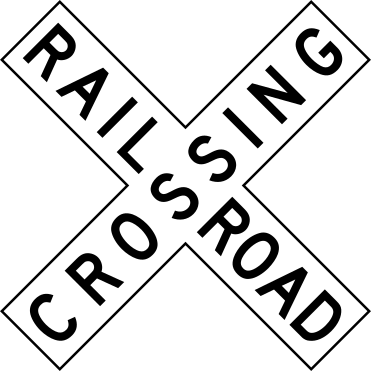
- A hospital entrance; stop and turn off the radio
- The location of train tracks; slow, look, listen, and be ready to yield
- A no-passing zone; accelerate before the tracks
- A work zone; pass the sign on the shoulder
Show answer
The location of train tracks; slow, look, listen, and be ready to yield. A crossbuck marks the location of railroad tracks. The handbook directs drivers to slow down, look, listen, and be prepared to yield to an approaching train. It is not a hospital or work-zone marker, and accelerating toward the tracks defeats the safety purpose. At the crossing, keep scanning both directions and be ready to stop. The X shape is the visual cue that rail traffic has priority when a train is approaching.
QualitySpace is expanding to Texas
We are a California-based independent insurance brokerage working on licensing in more states. We cannot help with Texas insurance yet. Leave your email and we will let you know when we can.
Every question is written from the official Texas Driver Handbook. Need paper? Printable TX practice test with answer key.
Last verified 2026-09-07. How we check every question · Study all 500 as flashcards
Frequently asked questions
How many questions are on this Texas practice test?
This fixed set has 20 questions. It is test 22 of 25 from the 500 question Texas bank.
How does this fixed test relate to the full Texas bank?
Each numbered test is a fixed set of 20 questions in a fixed order, so you can retake the same test later and compare. Every test mixes road signs and the other topics in about the same proportion as the full bank. Tests 1 to 25 together cover every question in the Texas bank once. The full practice page mixes the whole bank at random.
Last verified 2026-09-07. See the Texas DMV facts page for sourced state details.