
Test 21 of 25 · 20 questions · Free 2026
TX Permit Practice Test 21
Jump to the test ↓A fixed 20 question set from the Texas bank with answers and plain English explanations.
Question 1 of 20 · 0 right so far
All 20 questions in test 21
Every question below comes from the Texas question bank on this page. Open a question to see the correct answer and the explanation. Nothing here is hidden behind a signup.
1. What does Texas say about drugs and driving?
- Any drug can impair; mixing with alcohol courts disaster
- Drugs never affect driving
- Mixing drugs is safe
- Only alcohol impairs
Show answer
Any drug can impair; mixing with alcohol courts disaster. Every drug is a driving question mark. Texas warns any drug might affect driving ability, and mixing drugs, especially sedatives with alcohol, courts trouble on and off the road. Never, safe-mixing, and alcohol-only readings deny the pharmacology. The cue is the medicine cabinet: each pill plus each drink compounds the risk. Pharmacists can flag driving risks for every prescription you take home. Ask directly before the first dose, not after a crash.
2. How should Texas drivers treat bicycles when turning right?
- Cut them off to teach them
- Squeeze past closely
- Never cut across a bicycle's path
- Chase them off the road
Show answer
Never cut across a bicycle's path. Right turns must respect the bike lane's straight-through riders. Texas warns drivers the wrong way is cutting across a bicycle's path. Cutoffs, squeezes, and chases all endanger cyclists. The cue is the bike beside or ahead: merge right behind it, not through it. Signal your right turn early so the cyclist can plan around you safely. Patience at one turn prevents a lifetime of regret.
3. What tire standard does Texas require?
- Bald tires are fine
- Only winter tires count
- Proper safe tires with at least 2/32 inch tread
- Tires are optional
Show answer
Proper safe tires with at least 2/32 inch tread. Tread depth is law, not advice. Texas requires proper safe tires with at least 2/32 inch of tread. Bald, winter-only, and optional readings all fail inspection and safety. The cue is the wear bar: at 2/32 the tire is legally done. Check tread monthly with a penny: Lincoln head fully visible means replacement time. Uneven wear signals alignment or pressure problems too.
4. Which vehicles skip Texas turn-signal requirements?
- All cars need them regardless of age
- Only motorcycles are exempt
- Only trailers are exempt
- Narrow pre-1960 cars and trucks are exempt
Show answer
Narrow pre-1960 cars and trucks are exempt. Antique narrow cars predate signal mandates. Texas exempts passenger cars and trucks under 80 inches wide built before 1960 from electrical turn signals. All-cars, motorcycle-only, and trailer-only readings miss the vintage exception. The cue is the classic car: hand signals legally substitute on these narrow antiques. Hand signals remain legal for turns and stops on these exempt classics. Practice them, since modern drivers rarely recognize the gestures.
5. When entering a modern roundabout, what should a driver do before joining the circulating traffic?
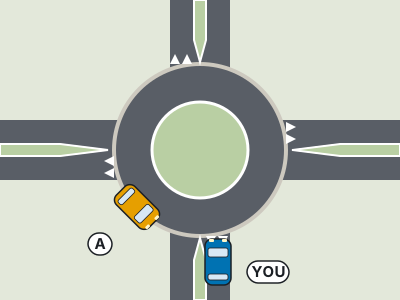
- Slow down and yield to traffic already in the circle
- Stop inside the circle until every approach is empty
- Travel clockwise to reach the nearest exit
- Enter first because circulating vehicles must yield at the entry
Show answer
Slow down and yield to traffic already in the circle. Texas describes a modern roundabout as a one-way circle controlled by yield signs instead of traffic lights. The entering driver slows down, gives priority to vehicles already circulating, waits for an acceptable gap, and then travels counterclockwise. Entering ahead of circulating traffic reverses the yield rule, while stopping in the circle creates a new obstruction. Clockwise travel is also contrary to the direction described in the handbook. Use a simple approach cue: reduce speed, check the circle, yield, enter counterclockwise, then signal for the exit.
6. If a vehicle cannot be moved off the road after a breakdown, what should happen first?
- Have everyone remain seated until another driver stops
- Get everyone out of the car and off the road
- Stand behind the car and wave at traffic
- Leave the vehicle in the travel lane with no warning
Show answer
Get everyone out of the car and off the road. When a disabled vehicle cannot be moved off the road, the handbook says to get everyone out of the car and off the road. People near a stranded vehicle are exposed to passing traffic, so moving them away reduces the immediate danger. The occupants should not wait inside a travel lane for help, stand in the lane to signal, or leave the vehicle without warning devices. Portable warning devices can alert approaching drivers, but protecting people from the roadway comes first in the sequence described.
7. How should you drive on Texas loose gravel?
- Go slow, keep control, avoid sudden brakes or turns
- Speed up to float over gravel
- Brake hard to test grip
- Swerve to find pavement
Show answer
Go slow, keep control, avoid sudden brakes or turns. Loose gravel rolls under tires like ball bearings. Texas says to go slow enough for complete control, without sudden braking or sharp turns. Floating, grip tests, and swerves all break traction at once. The cue is the crunch under your tires: straighten the wheel, bleed speed gently, and steer like the road is made of marbles. Following distance should double on gravel, since stops stretch far beyond normal.
8. At a stop sign, is slowing without stopping fully sufficient under the Texas handbook?
- Yes, if the intersection appears empty
- No, but only at a school crossing
- Yes, if the vehicle is traveling below 10 mph
- No, the driver must come to a complete stop
Show answer
No, the driver must come to a complete stop. The stop-sign description specifically says that slowing down is not adequate. Every vehicle reaching the sign must come to a complete stop, yield to pedestrians or other vehicles, and proceed carefully. An empty-looking intersection does not convert the sign into a yield, and a low speed still leaves the vehicle moving. The school-crossing limitation is also incorrect because the stop requirement applies wherever the stop sign is posted. Let the vehicle settle fully, then check the crosswalk and intersection before moving.
9. Where should you stop for Texas law enforcement?
- Stop in the travel lane
- Park on the right shoulder, or a lighted side street or lot
- Drive to the next county
- Park on a bridge
Show answer
Park on the right shoulder, or a lighted side street or lot. Traffic stops need safe harbor off the flow. Texas says to park on the right shoulder if available, or else a nearby well-lighted side street or parking lot away from heavy traffic. Lane stops, county flights, and bridge parks all endanger everyone. The cue is the flashing lights behind: exit the flow promptly to the nearest safe shoulder or lot.
10. What condition does the winding-road warning sign indicate?

- A bridge that narrows immediately
- A mandatory detour around construction
- A series of curves ahead
- A straight road with a passing lane
Show answer
A series of curves ahead. The winding-road symbol means that several bends are ahead, not just one isolated turn. The handbook advises driving slowly and carefully and not passing through this section. A narrow bridge, construction detour, or straight passing lane would be shown by a different warning. Treat the first curve as the beginning of the hazard, keep a consistent position, and look through the bends for changing roadway conditions. The useful cue is the repeated shape of the arrow, which signals that the need for control continues after the first turn.
11. What lights should a broken-down Texas car show?
- Emergency flashers, or taillights if flashers are missing
- No lights at all
- High beams into traffic
- Brake lights only by pumping
Show answer
Emergency flashers, or taillights if flashers are missing. A dead car must glow to survive. Texas breakdown guidance says to switch on emergency warning lights, or taillights if warning lights are absent, plus the dome light at night. Darkness, blinding beams, and pump-only brakes all hide or confuse. The cue is the silent engine: light every lamp you own before anything else. Raise the hood as an extra distress signal when no cloth is handy. Stay belted inside if the shoulder is narrow and fast.
12. Why must Texans never contest a train at crossings?
- They stop instantly
- They swerve around cars
- They cannot start or stop quickly
- They always yield
Show answer
They cannot start or stop quickly. Steel wheels and tons of mass defy quick moves. Texas warns that trains cannot start or stop quickly regardless of traffic flow. Instant stops, swerves, and yielding are fantasies. The cue is the approaching train: it will occupy the crossing on its own schedule, so never contest it. A loaded freight needs well over a mile to halt from track speed. Your car cannot win any argument with that mass.
13. What does a Texas advisory speed sign tell you?
- The minimum speed for the highway
- The highest safe speed around the curve ahead
- The speed trucks must exceed
- A suggested napping speed
Show answer
The highest safe speed around the curve ahead. Yellow advisory plates calibrate the curve, not the road. Texas says the advisory speed sign gives the highest speed for safe travel around the curve ahead. Minimums, truck floors, and naps all misread the plate. The cue is the yellow rectangle under the curve warning: it caps comfort and safety for that bend, whatever the white limit says. Slow to it before the bend begins, because braking mid-curve risks a skid.
14. What alcohol-related conduct does Texas zero tolerance prohibit for a minor?
- Purchasing alcohol is allowed if it is not consumed
- Possessing alcohol is allowed with a parent present
- Consuming alcohol is allowed when the minor is not driving
- Purchasing, consuming, or possessing an alcoholic beverage
Show answer
Purchasing, consuming, or possessing an alcoholic beverage. Texas says a minor may not purchase, attempt to purchase, consume, or possess an alcoholic beverage. The prohibition covers the conduct itself, and the handbook lists no parent exception for possession, while not driving does not make consumption lawful. When reviewing a minor scenario, identify any purchase, consumption, or possession first, then apply the zero-tolerance rule to that conduct. The same section also bars a minor from falsely claiming to be 21 or older to a seller of alcoholic beverages.
15. A driver fails to yield and causes bodily injury to another. What fine applies?
- A $50 ticket with no other consequence
- A fine of $500 to $2,000
- A written apology to the injured person
- Points only, with no fine
Show answer
A fine of $500 to $2,000. Failing to yield that hurts someone draws a heavy fine. Texas penalizes a driver who commits a traffic offense with failure to yield as an element and causes bodily injury with a fine of $500 to $2,000, rising to $1,000 to $4,000 for serious bodily injury. A $50 ticket and points-only outcomes badly understate the law. A written apology is not a penalty. The cue is the injury link: yield violations alone are bad, but a yield violation that injures another person triggers this specific fine range.
16. As you approach workers and equipment in a Texas work zone, what should you be prepared to do?
- Slow down or stop
- Speed up to clear the zone
- Close your windows and hold speed
- Move to the oncoming lane
Show answer
Slow down or stop. Orange zones demand readiness to halt. Texas tells drivers entering a construction and maintenance work zone to be prepared to slow down or stop as they approach workers and equipment. Speeding through to clear the zone endangers people on foot. Holding speed with closed windows ignores the hazard. Swerving into oncoming traffic trades one danger for a worse one. The cue is the first cone, barrel, or vest: cover the brake, drop speed early, and be ready to stop completely for a flagger or a worker stepping near your lane.
17. At a railroad crossing with flashing red lights, what must a driver do?
- Slow down, then cross before the gates begin to lower
- Stop and remain stopped until the train passes and the lights stop flashing
- Stop only if the train is already visible
- Drive around the gate after checking the nearest track
Show answer
Stop and remain stopped until the train passes and the lights stop flashing. Flashing red lights at a railroad crossing require a stop. If a train is approaching, the driver must remain stopped until the train passes and the lights stop flashing. Trying to beat a gate or relying only on whether the train is visible ignores the warning system and the possibility of another track or obstructed view. Driving around a lowered gate is especially dangerous. The cue is red crossing lights: stop before the crossing, wait through the warning, and proceed only after release.
18. A truck starts passing you on a Texas highway. What must you avoid?
- Never speed up while the truck passes
- Race it to the next exit
- Swerve toward it to hurry it
- Brake hard in front of it
Show answer
Never speed up while the truck passes. Being passed by a truck calls for steady cooperation. Texas says plainly not to speed up while the truck is passing, and to ease slightly slower to help. Racing, swerving, and brake-checking all turn a routine pass into a duel. The cue is the grille filling your mirror: hold steady or ease off, and let the truck complete its move.
19. How close to a fire hydrant may a vehicle be parked in Texas?
- No closer than 5 feet
- No closer than 30 feet
- No closer than 50 feet
- No closer than 15 feet
Show answer
No closer than 15 feet. Texas says that, whether occupied or not, you must not park or allow a vehicle to stand idling within 15 feet of a fire hydrant. The same list bars parking in front of a public or private driveway, within 20 feet of a crosswalk at an intersection, within 30 feet on the approach to a flashing signal, stop sign, yield sign, or traffic signal at the side of the road, and within 20 feet of a fire station driveway. Five feet is too close, and 30 and 50 feet belong to other rules.
20. According to the Texas handbook, how far does an average passenger car at 55 mph need to stop, compared with a fully loaded tractor trailer?
- About 100 feet for the car; 150 feet for the truck
- The same distance for both
- About 240 feet for the car; more than 400 feet for the truck
- About 400 feet for the car; 240 feet for the truck
Show answer
About 240 feet for the car; more than 400 feet for the truck. The Texas handbook says an average passenger car at 55 mph can stop in about 240 feet, roughly three fourths of a football field, while a fully loaded tractor trailer may need more than 400 feet, well over a football field. The distances are not equal, and the truck needs more, not less, so the reversed choice is wrong. One hundred feet is far too short for a car at highway speed. Never cut in front of a truck and then slow down.
QualitySpace is expanding to Texas
We are a California-based independent insurance brokerage working on licensing in more states. We cannot help with Texas insurance yet. Leave your email and we will let you know when we can.
Every question is written from the official Texas Driver Handbook. Need paper? Printable TX practice test with answer key.
Last verified 2026-09-07. How we check every question · Study all 500 as flashcards
Frequently asked questions
How many questions are on this Texas practice test?
This fixed set has 20 questions. It is test 21 of 25 from the 500 question Texas bank.
How does this fixed test relate to the full Texas bank?
Each numbered test is a fixed set of 20 questions in a fixed order, so you can retake the same test later and compare. Every test mixes road signs and the other topics in about the same proportion as the full bank. Tests 1 to 25 together cover every question in the Texas bank once. The full practice page mixes the whole bank at random.
Last verified 2026-09-07. See the Texas DMV facts page for sourced state details.