
Test 3 of 25 · 20 questions · Free 2026
TX Permit Practice Test 3
Jump to the test ↓A fixed 20 question set from the Texas bank with answers and plain English explanations.
Question 1 of 20 · 0 right so far
All 20 questions in test 3
Every question below comes from the Texas question bank on this page. Open a question to see the correct answer and the explanation. Nothing here is hidden behind a signup.
1. A Texas pedestrian crosses mid-block. Who must yield?
- Yield to all vehicles
- Demand cars stop for you
- Run across quickly
- Wave traffic through first
Show answer
Yield to all vehicles. Crossing outside a crosswalk flips the priority against the walker. Texas says pedestrians crossing at any non-crosswalk point must yield to all vehicles. Demanding stops, running, and waving cars through all misstate the duty. The cue is the mid-block curb: without stripes or signals, every car owns the right-of-way until you find a full gap. Marked crosswalks at intersections reverse the duty back onto drivers instead.
Study this in the handbook: Trucks, motorcycles, bicycles and pedestrians
2. A truck-crossing sign appears in Texas. What should you do?
- Slow down and watch for them
- Speed up past them
- Honk them off the road
- Ignore them fully
Show answer
Slow down and watch for them. Working trucks enter from hidden drives. Texas warns to slow down and watch for trucks entering or crossing the road. Speeding, honking, and ignoring all miss the hazard. The cue is the truck-crossing sign: cover the brake and scan every driveway. Gravel and mud on the pavement near driveways signal frequent truck crossings. Slow early and cover the brake through the zone.
3. No stop line is painted at a Texas signal. Where do you stop?
- Stop in the middle of the intersection
- Roll through slowly without stopping
- Stop past the crosswalk
- Stop before the crosswalk
Show answer
Stop before the crosswalk. Missing paint does not cancel the stop. Texas says that where stop lines are missing, drivers must stop before the crosswalk when signs, signals, or pedestrians require a stop. Mid-intersection, rolling, and past-crosswalk stops all endanger walkers. The cue is the bare pavement: imagine the line at the crosswalk edge and halt your front bumper behind it. Creep forward only after stopping, to gain sight lines around parked cars or hedges.
Study this in the handbook: Pavement markings and lanes
4. A narrow-bridge sign appears in Texas. What should you do?

- Speed up to clear the bridge
- Slow down and use caution
- Stop on the bridge to look
- Pass everyone on the bridge
Show answer
Slow down and use caution. Narrow bridges squeeze two-way traffic onto short pavement. Texas says the bridge ahead is narrower than the road, so slow down and use caution. Speeding, bridge stops, and bridge passes all gamble in the squeeze. The cue is the narrowing rails: ease off, center your lane, and cross without contest. Oncoming wide loads may need the center, so be ready to yield extra room.
5. When does Texas require headlights under the handbook's general rule?
- Only between midnight and 5 a.m.
- Only when another driver flashes headlights first
- Only on roads with posted limits above 55 mph
- From 30 minutes after sunset to 30 minutes before sunrise, or when visibility is limited
Show answer
From 30 minutes after sunset to 30 minutes before sunrise, or when visibility is limited. Texas requires headlights beginning 30 minutes after sunset and ending 30 minutes before sunrise. They are also required whenever people or vehicles cannot be seen clearly for at least 1,000 feet, so poor visibility can trigger the rule at any hour. The midnight-to-5 a.m. window is unrelated, and highway speed or another driver's action does not control this rule. Turn them on based on time and visibility, then use low beams in the situations listed by the handbook.
Study this in the handbook: Night and highway driving
6. During Phase Two, between which hours may a Texas provisional driver not drive unless an exception applies?
- Midnight to 5:00 a.m.
- 11:00 p.m. to 5:00 a.m.
- 10:00 p.m. to 6:00 a.m.
- 1:00 a.m. to 4:00 a.m.
Show answer
Midnight to 5:00 a.m.. Texas bars a Phase Two provisional driver from driving between midnight and 5:00 a.m. The exceptions are driving needed for work, for a school related activity, or because of a medical emergency. Starting at 11 p.m. or running from 10 p.m. to 6 a.m. would make the window longer than Texas law. One to four a.m. is too narrow, since it leaves out the first and last hour of the restricted window. The limit ends at the driver's 18th birthday.
Study this in the handbook: Learner license and the graduated license program
7. A Texas driver carries a 12-year-old in the open bed of a pickup truck on a city street. What fine applies to the driver?
- $25 to $200
- No fine, because pickups are exempt
- $500 to $750
- $4,000
Show answer
$25 to $200. Texas makes it an offense to drive an open bed truck while a child younger than 18 occupies the bed, and the fine of $25 to $200 falls on the driver. Pickups are not exempt; the handbook lists specific defenses to prosecution, such as a parade, an emergency, a beach, or moving farmworkers on certain roads. Five hundred to seven hundred fifty dollars is the disabled parking fine, and $4,000 belongs to serious misdemeanors, not this offense.
Study this in the handbook: Seat belts, phones and distracted driving
8. A Texas minor refuses a specimen a second time. What penalty applies?
- A warning letter only
- License suspended for 2 years
- A $25 fine with no suspension
- An extra driving test only
Show answer
License suspended for 2 years. Refusing the test the second time costs a minor two years of driving. Texas suspends the license, or denies the privilege if unlicensed, for 2 years on second and subsequent refusals, up from 180 days for the first. Warnings, small fines, and retests understate the repeat penalty. The cue is the refusal count: each refusal after the first doubles down to a two-year loss.
Study this in the handbook: Zero tolerance alcohol laws for minors
9. How should you drive near Texas bridges and tunnels?
- Drive left freely there
- Stay right within 100 feet of them
- Stop on the bridge
- Race through tunnels
Show answer
Stay right within 100 feet of them. Structures squeeze the road and the sight lines together. Texas bans left-side driving within 100 feet of a bridge, viaduct, or tunnel. Free driving, bridge stops, and tunnel races all violate the rule. The cue is the structure ahead: claim the right lane early and hold it through. Narrow shoulders on structures leave no escape if oncoming traffic drifts over. Holding right buys the margin that saves lives.
Study this in the handbook: Signaling, passing and turning
10. When passing on a two-lane Texas road, you must be able to return to the right lane before an oncoming car comes within what distance of you?
- 500 feet
- 100 feet
- 50 feet
- 200 feet
Show answer
200 feet. Before passing on a two-lane road, the handbook says to check well ahead for no passing zones and oncoming traffic, and to be sure you have enough time and space to overtake the car ahead and get back into the right lane before an approaching car comes within 200 feet of you. If you cannot finish the pass with that margin, stay behind and wait. The handbook warns that improper passing often ends in head on crashes that can be deadly.
Study this in the handbook: Signaling, passing and turning
11. How often do Texas interstate mileposts appear?
- Every ten miles on farm roads
- Only at state borders
- Every mile on interstate highways
- Every hundred feet downtown
Show answer
Every mile on interstate highways. Interstate mileposts tick by like clockwork. Texas erects them every mile on interstate highways. Farm roads, borders, and downtown blocks follow different marking schemes. The cue is the rising or falling number: each unit means one mile traveled along the route. Reset your trip odometer at a round-number post to track fuel range precisely. The steady rhythm also fights highway hypnosis on long hauls.
12. How should you record insurance after a Texas crash?
- Guess the details from memory
- Copy company and policy exactly from the proof card
- Invent a policy number
- Skip insurance entirely
Show answer
Copy company and policy exactly from the proof card. Insurance details must be exact to work later. Texas says to write the company name and policy number exactly as shown on the driver's proof-of-insurance card. Guessing, inventing, and skipping all corrupt the record. The cue is the card in the other driver's hand: transcribe it letter for letter. Photograph the card too, as a backup against smudged handwriting later. Keep your own card current and reachable before every trip.
Study this in the handbook: Breakdowns, skids and crashes
13. Who else may attend a Texas minor's alcohol course?
- The minor is freed at once
- The parent is jailed
- The parent may also have to attend the course
- The school is fined
Show answer
The parent may also have to attend the course. Underage drinking courses can pull parents in too. Texas notes that for minors under 18, the parent may also be required to attend the alcohol awareness course. Freedom, jailing, and school fines are not the rule. The cue is the young offender: the family learns alongside. Courses cover decision-making and peer pressure alongside the legal consequences. Families often report better talks after attending together.
Study this in the handbook: Zero tolerance alcohol laws for minors
14. The pavement narrows ahead on a Texas road. What should you do?

- Speed up to clear the narrow part
- Stop in the middle to measure
- Slow down and proceed with caution
- Close your eyes and steer straight
Show answer
Slow down and proceed with caution. Narrowing pavement squeezes every margin at once. Texas says the pavement narrows ahead means slow down and proceed with caution. Speeding through, mid-road stops, and blind steering all invite the squeeze. The cue is the funneling edge lines: ease off early, center in the remaining lane, and pass the pinch point under full control. Watch the mirrors too, since narrow points tempt risky passes from impatient followers.
15. What is a two-way left-turn lane intended for?
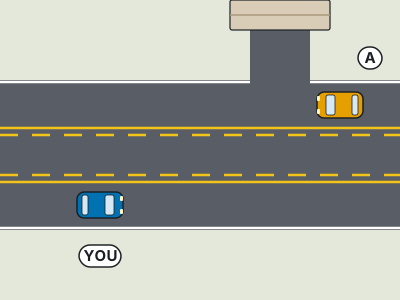
- Parking while waiting to turn
- Passing slower traffic straight ahead
- Driving through the lane for several blocks
- Preparing for a left turn from either direction
Show answer
Preparing for a left turn from either direction. Texas marks a center lane for left turns only. The handbook says the only time a vehicle should enter the center lane is at a point where it will have time to slow down or stop in order to make a safe left turn, and its note adds that the center lane should never be used for passing or as a through traffic lane. Parking is not a purpose the handbook gives the lane, so the lane's single job is preparing to turn left.
Study this in the handbook: Pavement markings and lanes
16. How should you wait during a Texas traffic stop?
- Jump out to greet the officer
- Reach under the seat quickly
- Stay inside, lower the window if safe, hands on the wheel
- Drive slowly toward the officer
Show answer
Stay inside, lower the window if safe, hands on the wheel. Stillness and visible hands keep stops safe. Texas says to remain in the car, lower the driver window if safe, and keep both hands clearly on top of the steering wheel. Exits, reaches, and rolling toward police all read as threats. The cue is the stopped car: freeze the tableau with hands high and wait for instructions. Passengers should also stay still with hands visible on laps or the dashboard. Coordinated calm from everyone keeps the stop routine.
17. An official sign prohibits stopping in Texas. What must you do?
- Stop there to read the sign
- Never stop where a sign prohibits stopping
- Idle briefly while deciding
- Park only on holidays
Show answer
Never stop where a sign prohibits stopping. A no-stopping sign bans even momentary halts. Texas lists any place where an official sign prohibits stopping among the never-stop locations. Sign-reading stops, decision idling, and holiday parking all violate the ban. The cue is the red-and-white prohibition: keep rolling past it to a legal stopping place. Delivery drivers and rideshares must plan legal loading spots instead of blocking signed curbs. Enforcement tows quickly where signs are explicit and clear.
Study this in the handbook: Where you may not park
18. When should you move toward a Texas freeway exit?
- Move to the exit lane as soon as possible
- Wait until the last second to cut across
- Stop on the freeway to read signs
- Back up to a missed exit
Show answer
Move to the exit lane as soon as possible. Exits reward early commitment. Texas says that planning to leave the freeway soon means changing to the exit lane as soon as possible, earlier as traffic grows. Last-second cuts, freeway stops, and backups all cause pile-ups. The cue is the first exit sign a mile or two out: start working right immediately so the exit arrives with you already placed.
Study this in the handbook: Night and highway driving
19. You stopped for a school bus with flashing red lights. When may you pass it?
- Pass as soon as children are out of sight
- Go once traffic behind you honks
- Follow the bus closely until it turns
- Wait until the bus moves, the driver signals, or the red lights stop
Show answer
Wait until the bus moves, the driver signals, or the red lights stop. Children around a stopped bus are unpredictable, so Texas keeps you waiting until one of three clear releases occurs. Do not pass until the school bus has resumed motion, you are signaled by the driver to proceed, or the red lights are no longer flashing. Children out of sight may still be crossing in front of the bus. Honking from behind never overrides the stop. Tailgating the bus endangers everyone. The cue is the bus itself: watch for motion, the driver's wave, or dark lights, and stay stopped until one of them happens.
Study this in the handbook: Right of way at intersections
20. When is it unnecessary to stop for a school bus under the Texas handbook?
- When passing on a different road or on a controlled-access highway where pedestrians cannot cross to the bus
- Whenever the driver cannot see children near the bus
- When the approaching vehicle is traveling under 15 mph
- Whenever the bus is on the opposite side of any road
Show answer
When passing on a different road or on a controlled-access highway where pedestrians cannot cross to the bus. Texas makes an exception when the driver is passing a school bus on a different road, or when the bus is in a controlled-access highway loading zone where pedestrians are not permitted to cross. The exception is not based on an ordinary opposite direction, low speed, or a driver's inability to see children. On the same road with flashing red lights, the stop duty remains. The cue is to identify the physical roadway relationship and whether pedestrians can cross before relying on the exception.
Study this in the handbook: School buses and railroad crossings
QualitySpace is expanding to Texas
We are a California-based independent insurance brokerage working on licensing in more states. We cannot help with Texas insurance yet. Leave your email and we will let you know when we can.
Every question is written from the official Texas Driver Handbook. Need paper? Printable TX practice test with answer key.
Last verified 2026-10-05. How we check every question · Study all 500 as flashcards
Frequently asked questions
How many questions are on this Texas practice test?
This fixed set has 20 questions. It is test 3 of 25 from the 500 question Texas bank.
How does this fixed test relate to the full Texas bank?
Each numbered test is a fixed set of questions in a fixed order, so you can retake the same test later and compare. Every test mixes road signs and the other topics in about the same proportion as the full bank. Tests 1 to 25 together cover every question in the Texas bank once. The full practice page mixes the whole bank at random.
Last verified 2026-10-05. See the Texas DMV facts page for sourced state details.