
Test 19 of 25 · 20 questions · Free 2026
MO Permit Practice Test 19
Jump to the test ↓A fixed 20 question set from the Missouri bank with answers and plain English explanations. The real MO exam is 25 questions, 80 percent to pass; take the full length version on the main practice page.
Question 1 of 20 · 0 right so far
All 20 questions in test 19
Every question below comes from the Missouri question bank on this page. Open a question to see the correct answer and the explanation. Nothing here is hidden behind a signup.
1. You are on a Missouri road with three lanes going your way, and many vehicles keep entering the right lane from ramps. Which lane does the guide suggest?
- The left lane, and stay there for the whole trip
- The center lane, leaving the right lane open
- The right lane, so entering cars have to wait
- Whichever lane lets you drive the fastest
Show answer
The center lane, leaving the right lane open. On a Missouri road with three or more lanes going the same direction, the general rule is to stay in the right lane except to pass. When a considerable amount of traffic is entering the right travel lane, the guide says to use the center travel lane instead. This gives merging vehicles room. The left-most lane is still meant for passing slower vehicles, not for cruising the whole trip.
Study this in the handbook: Pavement markings and lane use
2. Why does the Missouri guide advise against shifting gears while you are crossing railroad tracks?
- Shifting gears is illegal within 50 feet of tracks
- The noise could keep you from hearing a train
- It wears down the clutch on rough crossings
- Your vehicle could stall while it is on the tracks
Show answer
Your vehicle could stall while it is on the tracks. The Missouri guide says it is not wise to shift gears while crossing railroad tracks, in case your vehicle stalls. Pick the gear you need before reaching the crossing so you can drive across in one smooth motion. If your vehicle ever stalls on the tracks with a train approaching, the guide says to unfasten your seat belt, get out, and move off the tracks right away.
Study this in the handbook: Speed limits and minimum speeds
3. At a Missouri railroad crossing, the red lights are flashing and the gate is coming down, but the train still looks far away. What must you do?
- Stop, and do not cross until the train has passed
- Cross quickly before the gate is fully down
- Drive around the gate if no train is close
- Slow down and cross if the tracks look clear
Show answer
Stop, and do not cross until the train has passed. At Missouri crossings with flashing red lights or a lowering gate, you must stop and you cannot cross the tracks until the train has passed. Stop within 15 to 50 feet of the tracks, and never try to go around the gate. After the train passes, the lights may keep flashing, and if there are two or more tracks, look for a second train before you go.
Study this in the handbook: Road signs by shape and color
4. Unless a sign posts a different limit, what is the maximum speed on Missouri's lettered roads?
- 45 mph
- 55 mph
- 60 mph
- 65 mph
Show answer
55 mph. Missouri's speed guide lists maximum speeds by type of road for use unless posted limits say otherwise. Lettered roads have a maximum of 55 mph. Other roads and highways outside urbanized areas are listed at 60 mph, and rural expressways at 65 mph. A lower posted limit always controls, and you must slow down further when hills, curves, slick pavement, or traffic make the maximum unsafe.
Study this in the handbook: Speed limits and minimum speeds
5. You are on a Missouri highway divided by a grassy median. On the other roadway, going the opposite direction, a school bus stops with red lights flashing. What must you do?
- Stop, since every driver must stop for a school bus
- Stop and wait until the bus turns off its lights
- Pull onto the median until the bus leaves
- Continue with caution; you are not required to stop
Show answer
Continue with caution; you are not required to stop. Missouri does not require drivers traveling the opposite direction of a school bus to stop when the highway is divided by a median and each direction runs on a totally separate road. Traffic behind the bus on its own side must still stop. Keep watching for children near the road as you pass, and be ready to stop if one appears. Pulling onto the median is never part of the rule.
Study this in the handbook: Passing, turning and signaling
6. Your tires spin when you try to pull away on snow in Missouri. What does the guide suggest trying first?
- Press the gas pedal hard until the tires grab
- Let some air out of the tires for more grip
- Rock back and forth a few times to clear a path
- Have someone stand behind the wheels and push
Show answer
Rock back and forth a few times to clear a path. When your tires spin on snow or ice, Missouri suggests clearing a path by driving backward and forward a few times. If that does not help, spread an abrasive material such as salt, sand, or cat box litter around the wheels. Never let anyone stand in line with your wheels, because they can throw up gravel or ice and cause an injury. Start slowly and smoothly once you have traction.
Study this in the handbook: Night driving, rain, snow, fog and skids
7. You realize you just passed your exit on a Missouri interstate, and the shoulder is wide. What should you do?
- Take the next exit and come back
- Back up along the shoulder to the exit
- Stop and wait for a gap, then reverse
- Make a U-turn through the median
Show answer
Take the next exit and come back. If you miss your exit, Missouri says do not stop, back up, or try to turn around on the highway. Get off at the next exit and come back to the one you missed. A wide shoulder does not make backing up safe, because highway traffic is not expecting a vehicle moving backward. Crossing the median to turn around is just as dangerous.
Study this in the handbook: Highway driving, merging and breakdowns
8. What is *55 used for, according to the Missouri guide?
- Checking current road conditions
- Paying a traffic ticket by phone
- Calling for help in a highway emergency
- Reporting a burned out street light
Show answer
Calling for help in a highway emergency. Missouri's guide gives *55 as the cellular number to call in an emergency, such as a breakdown, and lists it with the Highway Patrol's toll free number for emergency assistance. It is also the number to dial for road rage, after first exiting to a safe area; in a metropolitan area, 911 is listed. Many roadways also post signs showing a CB channel or phone number to call.
Study this in the handbook: Highway driving, merging and breakdowns
9. A deer jumps onto a Missouri road right in front of you, and you cannot stop in time. What does the guide say to do?
- Swerve left into the other lane to miss it
- Swerve onto the shoulder away from traffic
- Do not swerve, since that can raise the risk of injury
- Speed up to get past it before it crosses
Show answer
Do not swerve, since that can raise the risk of injury. When a crash with a deer cannot be avoided, the guide says not to swerve. Swerving off the road or into the path of an oncoming car can increase the risk of injury. The guide also says to make sure all vehicle occupants wear seat belts and that children are properly restrained, which lowers the chance of serious injury if a crash does happen. Report the crash to local law enforcement afterward.
10. You are walking along a Missouri road that has no sidewalk. Which way should you walk?
- Facing the traffic coming at you
- In the same direction as traffic
- On whichever side is less busy
- On the right edge, like a bicycle
Show answer
Facing the traffic coming at you. Missouri tells pedestrians to walk facing traffic when no sidewalk is available. Walking toward oncoming cars lets you see each driver coming and step aside if one drifts toward the edge. Bicycles ride with traffic, but a person on foot does the opposite. Drivers should give people walking along roads extra space, especially children, who may move into the road quickly and without warning.
Study this in the handbook: Pedestrians, cyclists, motorcycles and trucks
11. A Missouri warning sign shows a side road with railroad tracks crossing it. What is the sign telling you?
- Trains have the right-of-way only on the side road
- The tracks ahead are no longer in use
- A train station is located on the side road
- Tracks cross very close to the intersection
Show answer
Tracks cross very close to the intersection. The Side Road Railroad Crossing sign warns of a railway crossing very close to the intersection, so a driver turning onto the side road will meet tracks right away. The guide says to use caution when crossing the tracks. Be ready to stop if the crossing has signals, and never start across until there is room for your vehicle on the other side. The sign gives no hint that the tracks are unused.
Study this in the handbook: Road signs by shape and color
12. You approach this sign at a Missouri railroad crossing that has no lights or gates, and a train is coming. What must you do?
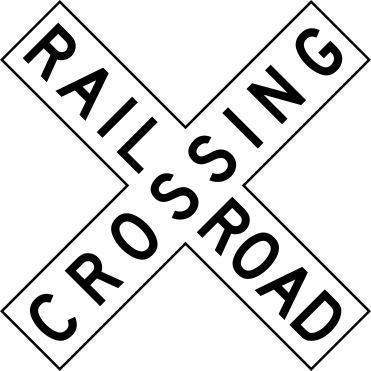
- Cross quickly, since there are no gates
- Stop only if the train blows its horn
- Yield and let the train pass before crossing
- Treat it like a speed limit of 15 mph
Show answer
Yield and let the train pass before crossing. The white X-shaped crossbuck at a Missouri railroad crossing has the same meaning as a yield sign: you must yield to trains. With a train approaching, slow down, stop if needed, and let it pass before crossing. Missing gates or lights do not remove that duty. Never try to beat a train, and if there are two or more tracks, check for a second train before you go.
Study this in the handbook: Road signs by shape and color
13. On a two-lane Missouri road, a fire truck is stopped on the shoulder with red lights flashing, and there is no other lane going your way. What must you do?
- Cross the center line into the oncoming lane
- Stop and wait until the fire truck leaves
- Keep your usual speed since you cannot change lanes
- Slow down and pass with caution at a safe speed
Show answer
Slow down and pass with caution at a safe speed. Missouri's Move Over law has two parts. On roads with at least four lanes, change into a lane not adjacent to the stationary emergency vehicle if it is safe. When changing lanes would be unsafe or impossible, as on this two-lane road, proceed with due caution and reduce your speed, keeping a safe speed for road conditions. Crossing into oncoming traffic or keeping full speed are both wrong.
Study this in the handbook: Right of way at intersections and roundabouts
14. Which phone use does Missouri law still allow while you are driving?
- Typing a quick text message at low speed
- Hands-free calls started with one touch or swipe
- Recording a video of the road for social media
- Holding the phone to your ear for a short call
Show answer
Hands-free calls started with one touch or swipe. Missouri's device law allows drivers to place or receive voice calls using voice-operated or hands-free functions that can be turned on or off with a single touch or swipe. Built-in speakers, in-car Bluetooth, or an earbud or headset are allowed, as are voice-to-text messages and GPS. Typing texts, recording or posting video, and holding the phone with any part of your body are prohibited while moving.
Study this in the handbook: Phones, distractions, fatigue and road rage
15. You need to check a paper map while driving in Missouri. What does the guide say to do?
- Pull safely off the road first, then look at it
- Hold it against the steering wheel and glance down
- Read it quickly while stopped at a green light
- Ask yourself to finish reading within ten seconds
Show answer
Pull safely off the road first, then look at it. Many crashes happen because drivers do not pay enough attention to their driving. Missouri says not to take your eyes off the road for more than a few seconds at any one time, and gives the example of a map: if you need to look at one, pull safely off the road rather than reading it while driving. Reading, including maps, also appears on the guide's list of distractions.
Study this in the handbook: Highway driving, merging and breakdowns
16. A Missouri driver has been drinking and plans to drive home after dark. Which effect on the eyes does the guide say alcohol can have?
- Sharper night sight, but weaker hearing as the effect builds
- Impaired night vision and slower eye muscle function
- Wider side sight that makes intersections easier to read
- No change in the eyes, only in balance and coordination
Show answer
Impaired night vision and slower eye muscle function. The guide says alcohol can affect vision in several ways: it can slow down eye muscle function, alter visual perception, and impair night vision. Alcohol also slows reflexes, decreases reaction time, and can cause drowsiness and decreased concentration. That matters after dark, because the guide notes that headlights do not let you see as far ahead as daylight does. Drinking and driving at night stacks these problems together.
Study this in the handbook: Alcohol limits and DWI penalties
17. You are in the right lane of a Missouri multi-lane highway, and a car is merging from an on-ramp. The lane to your left is empty. What does the guide suggest?
- Speed up so the merging car must slot in behind you
- Brake hard so the merging car can go ahead of you
- Move over a lane to make room for the merging car
- Hold your lane and speed, since merging cars must yield
Show answer
Move over a lane to make room for the merging car. Missouri tells drivers to make room for vehicles entering a multi-lane roadway. If no vehicle is in the lane next to you, move over a lane so the merging driver has space. Entering drivers must yield, but the guide still expects those already on the road to give them room when they can. Racing the merging car or braking hard creates new hazards for everyone around you.
Study this in the handbook: Seat belts, child seats and following distance
18. You are on a Missouri highway when traffic from a ramp joins beside you at this sign. Do you need to make room for it to merge?

- Yes, move over because your lane is ending
- Yes, slow down and let each car in front of you
- Yes, stop so the ramp traffic can enter
- No, the ramp traffic gets its own new lane
Show answer
No, the ramp traffic gets its own new lane. The Added Lane sign means traffic from another road will be entering, but no merging is necessary because a lane has been added for it. The entering vehicles continue in their own new lane beside you. This is different from the Merge sign, where entering traffic moves into your lane, and from Lane Ends, where a lane disappears. Still watch for drivers who change lanes after entering.
Study this in the handbook: Road signs by shape and color
19. You are behind a bicyclist near a Missouri corner where you want to turn right, and the rider is going straight. What should you do?
- Pass the rider, then cut right in front
- Stay behind the rider until you can turn
- Honk so the rider moves over
- Turn right beside the rider
Show answer
Stay behind the rider until you can turn. Missouri's guide says that if you are following a bicyclist and need to make a right turn, slow down and remain behind the cyclist until you are able to turn. Passing and then turning right across the rider's path puts your car directly in front of the bicycle. Cyclists often travel at surprisingly fast speeds, and riders have the same rights on the road as other vehicle operators.
Study this in the handbook: Pedestrians, cyclists, motorcycles and trucks
20. At a Missouri intersection where your light is red, a police officer waves you through. What should you do?
- Go as the officer directs
- Wait for the light to turn green
- Stop and ask the officer to repeat it
- Go only if no one is behind you
Show answer
Go as the officer directs. Missouri drivers must obey traffic officers at all times. When an officer is giving directions, do what the officer says and ignore traffic signs or signals. The guide's example is stopping at a green light when told to; the same rule means going through a red light when an officer waves you on. Proceed with care and watch the officer for any further signals.
Study this in the handbook: Pavement markings and lane use
Every question is written from the official Missouri Driver Guide. Need paper? Printable MO practice test with answer key.
Last verified 2026-10-05. How we check every question · Study all 500 as flashcards
Frequently asked questions
How many questions are on this Missouri practice test?
This fixed set has 20 questions. It is test 19 of 25 from the 500 question Missouri bank. The real MO exam asks 25 questions and you need 20 correct.
What is the passing score for the real Missouri test?
80% to pass That figure comes from the official Missouri source cited on the DMV facts page.
How does this fixed test relate to the full Missouri bank?
Each numbered test is a fixed set of questions in a fixed order, so you can retake the same test later and compare. Every test mixes road signs and the other topics in about the same proportion as the full bank. Tests 1 to 25 together cover every question in the Missouri bank once. The full practice page mixes the whole bank at random.
Last verified 2026-10-05. See the Missouri DMV facts page for sourced state details.
Return to the full Missouri practice test · Study road signs