
Test 3 of 10 · 20 questions · Free 2026
MO Permit Practice Test 3
Jump to the test ↓A fixed 20 question set from the Missouri bank with answers and plain English explanations. The real MO exam is 25 questions, 80 percent to pass; take the full length version on the main practice page.
Question 1 of 20 · 0 right so far
All 20 questions in test 3
Every question below comes from the Missouri question bank on this page. Open a question to see the correct answer and the explanation. Nothing here is hidden behind a signup.
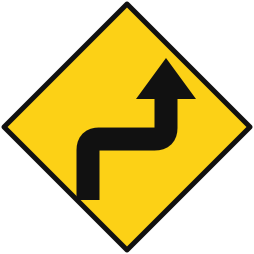
1. What road pattern does this warning symbol tell a driver to expect?
- Two turns in opposite directions, with the second possibly sharper
- A straight road with a lower speed limit ahead
- A bridge that narrows traffic to one direction
- A single lane ending at a railroad crossing
Show answer
Two turns in opposite directions, with the second possibly sharper. Missouri's reverse-turn warning identifies two turns that go in opposite directions. The second turn may be sharper than the first, so the driver should approach the sequence with controlled speed and attention to the roadway ahead. This is not a railroad, lane-ending, speed-limit, or bridge message. The practical cue is to expect a changing steering path rather than one isolated bend. Reduce speed before the first turn and be ready for the second one to demand more control.
Study this in the handbook: Road signs by shape and color
2. What clue do the shape and color of a Missouri traffic sign provide?
- They give clues to the type of information the sign provides
- They guarantee that the sign announces a parking restriction
- They show that the sign always identifies food or fuel nearby
- They prove that the sign marks a destination route
Show answer
They give clues to the type of information the sign provides. Missouri uses the shape and color of a traffic sign as a clue to the kind of information it carries. That visual information helps a driver recognize whether the sign concerns a warning, a rule, a railroad, a school, or guidance. The other choices turn one possible sign category into a universal promise, which the guide does not do. Use the visual design as an early classification cue, then read the lettering or symbol and respond to the particular condition ahead. A sign's appearance narrows the meaning before the driver reaches it.
Study this in the handbook: Traffic lights, arrows and officers
3. Outside agricultural work-related activities, what is the limit on unrelated passengers younger than 19 during the first six months of a Missouri intermediate license?
- Two passengers
- Three passengers
- One passenger
- Four passengers
Show answer
One passenger. During the first six months, an intermediate driver may not carry more than one passenger under 19 who is not an immediate family member. The two and three passenger options apply too many unrelated young riders during this initial period. After six months, the limit changes to three such passengers, which is why that number can sound familiar but is still wrong for the first period. Check both the elapsed time and the family relationship before deciding how many passengers may ride. These passenger limits may not apply while the driver is operating in agricultural work-related activities.
Study this in the handbook: Permits and the Graduated Driver License
4. What does the divided-highway warning sign announce?

- The road will soon become two-way traffic divided by a median or barrier
- U-turns are permitted across the median at the sign
- The median ends and opposing traffic will immediately share one lane
- The road becomes a one-way street for all vehicles
Show answer
The road will soon become two-way traffic divided by a median or barrier. The divided-highway warning sign announces that the road soon becomes two-way traffic separated by a median or barrier. Drivers should prepare for the changed roadway design and keep right of the separation once it begins. The sign does not permit U-turns across the median, create a single shared lane, or make every lane one-way in the same direction. Follow the lane markings and watch for the barrier as it develops. The split arrows are the visual cue that opposing flows will be separated ahead, not that a turn is available.
Study this in the handbook: Road signs by shape and color
5. What hazard does the yellow skidding-car sign warn about?

- A lane reserved for vehicles with traction devices
- A racing area where hard acceleration is expected
- A gravel road where braking is prohibited
- The road ahead becomes unusually slippery in wet weather
Show answer
The road ahead becomes unusually slippery in wet weather. The skidding-car sign warns that the road can become unusually slippery in wet weather. Drivers should respond by reducing speed, increasing following space, and avoiding abrupt steering or braking. It does not identify a racing area, prohibit braking on gravel, or reserve a lane for vehicles with special equipment. The warning is about reduced traction, so the response must begin before the pavement becomes visibly slick. Watch weather and road conditions, keep the vehicle controlled, and make gentle inputs through the marked area rather than waiting for a skid to begin.
Study this in the handbook: Road signs by shape and color
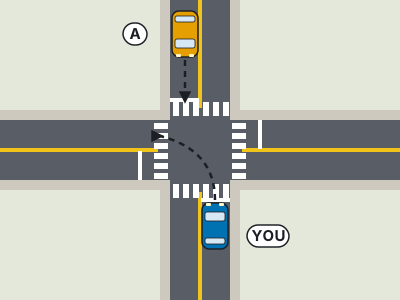
6. Before completing a left turn, which traffic must the turning driver yield to?
- Only vehicles behind the turning car
- Vehicles parked along the curb
- No traffic if the turn signal is on
- Oncoming vehicles traveling straight
Show answer
Oncoming vehicles traveling straight. A left turn crosses the path of opposing traffic, so the turning driver must yield to an oncoming vehicle that is proceeding straight. Signaling communicates intent but never gives permission to cut across that vehicle’s path. Parked cars and following traffic are not the central right-of-way conflict described here. Look ahead for an adequate gap, keep the wheels straight while waiting, and turn only after the opposing lane is clear.
Study this in the handbook: Right of way at intersections and roundabouts
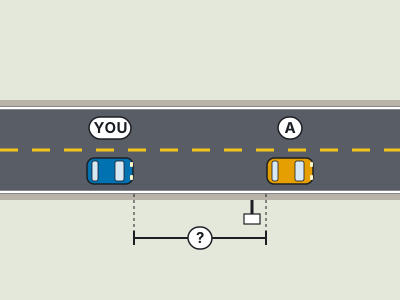
7. How can a Missouri driver measure a safe following distance in ordinary conditions?
- Stay one car length behind at every speed
- Use the three second rule with a roadside object
- Follow close enough to read the lead vehicle's plate
- Use a one second gap when traffic is moving
Show answer
Use the three second rule with a roadside object. The three second rule gives a practical way to judge space behind another vehicle. Pick a fixed object near the road, begin counting as the vehicle ahead passes it, and make sure your vehicle does not reach that object before the count ends. A single car length changes meaning with speed, while following close enough to read a plate removes useful reaction room. Increase the gap when weather, visibility, traffic, or vehicle condition makes stopping more difficult.
Study this in the handbook: Seat belts, child seats and following distance
8. An emergency vehicle approaches while you are inside a Missouri roundabout. What should you do?
- Reverse out of the roundabout
- Stop inside the roundabout
- Circle until the emergency vehicle passes
- Exit immediately and pull to the right
Show answer
Exit immediately and pull to the right. The Missouri guide tells a driver already in a roundabout when an emergency vehicle approaches to exit immediately and pull to the right so the responders can pass. Stopping inside the circle blocks the path, circling keeps you in the way, and backing up is not part of the guide's instruction. If you have not yet entered, the guide says not to enter the roundabout while an emergency vehicle is approaching. Always yield to emergency vehicles, then continue once they have passed and the way is clear.
Study this in the handbook: Right of way at intersections and roundabouts
9. How far before a turn should a Missouri driver ordinarily signal?
- At least 25 feet
- At least 100 feet
- Only after beginning the turn
- At least 50 feet
Show answer
At least 100 feet. The guide advises signaling at least 100 feet before turning so other drivers have time to recognize the intended movement. Signaling at 25 or 50 feet gives less notice than the stated practice, and activating the signal after the turn begins communicates too late. Check that the vehicle’s signals work, then signal early while also checking traffic and pedestrians. The number to remember is 100 feet, not the length of the turn itself.
Study this in the handbook: Passing, turning and signaling
10. What additional material is included in Missouri's Class E written examination?
- Only the motorcycle operator manual
- Only federal hazardous-material rules
- Commercial-vehicle information from Chapter 15
- No material beyond the road-sign test
Show answer
Commercial-vehicle information from Chapter 15. The Class E for-hire written examination covers the complete driver guide and also includes commercial-vehicle information from Chapter 15. It is therefore broader than a test limited to motorcycle material or federal hazardous-material rules. A driver preparing for Class E should review the ordinary traffic content and the commercial chapter together. The cue is the license class: for-hire testing adds Chapter 15 to the general guide material.
11. What option can the administrative alcohol notice provide to an eligible Missouri driver?
- A hearing request or an immediate 90-day Restricted Driving Privilege request
- A waiver of every court requirement
- A permanent exemption from alcohol laws
- An automatic license renewal without review
Show answer
A hearing request or an immediate 90-day Restricted Driving Privilege request. The notice can allow the driver to request a hearing or, if eligible, request an immediate 90-day Restricted Driving Privilege. Those are review or limited-driving pathways, not an automatic renewal and not a permanent exemption. The guide also explains that a hearing can preserve legal driving until 15 days after the decision is mailed. Read the notice carefully because eligibility and deadlines control which option is available.
Study this in the handbook: Alcohol limits and DWI penalties
12. Which point total leads Missouri to revoke a driving privilege for one year?
- 4 points in 12 months
- 18 or more points in 24 months
- 8 points in 18 months
- 6 points in 36 months
Show answer
18 or more points in 24 months. Revocation for one year follows 12 or more points in 12 months, 18 or more in 24 months, or 24 or more in 36 months. Four points in 12 months only brings an advisory letter, and 8 points in 18 months brings a suspension of 30 to 90 days rather than revocation. Six points in 36 months is not a trigger. Reinstatement after a non-alcohol revocation needs an SR-22 and a $20 fee.
Study this in the handbook: The point system and traffic penalties
13. How does a Missouri license show that the holder is an organ donor, and what does it cost?
- A green star on the back, for a $5 fee
- A separate donor card only
- A red heart with a green banner on the front of the license, at no fee
- A blue stripe, for $10
Show answer
A red heart with a green banner on the front of the license, at no fee. When you apply for a permit, license, or nondriver ID, you are asked about the donor registry and an optional indicator on the card. If you say yes to adding the organ donor symbol, a red heart with a green banner appears on the front of your instruction permit, driver license, or nondriver ID. The guide says there is no fee to place the symbol on the card or to place your name in the registry. It is not a star on the back, a blue stripe, or only a separate donor card, and it costs nothing.
14. How far before a turn should a Missouri driver signal so other drivers can be ready?
- About 25 feet before the turn
- Only as the wheel starts to turn
- At least 100 feet before the turn
- At least a quarter mile before the turn
Show answer
At least 100 feet before the turn. The Missouri guide says you should signal at least 100 feet before you turn so the other drivers can be ready. Signaling only 25 feet out or as the wheel starts to turn gives following traffic much less notice than the guide calls for. A quarter mile is not the stated distance and could suggest a turn well before the one you intend. Get into the correct lane, signal at least 100 feet ahead, and then slow for the turn, so other drivers can read your plan clearly.
Study this in the handbook: Passing, turning and signaling
15. A Missouri driver's license was revoked for refusing a chemical test. When is it returned?
- Automatically after 30 days
- Not until reinstatement requirements are completed and the driving privilege is reinstated
- As soon as a fine is paid
- At the next renewal
Show answer
Not until reinstatement requirements are completed and the driving privilege is reinstated. Refusing a chemical test in Missouri leads to a revocation. The guide says you will not receive your license back until you have completed your reinstatement requirements and your driving privilege has been reinstated. The revocation does not lift by itself after a set number of days, and paying a fine alone does not restore it. A revocation from a chemical test refusal is the one case where the guide lets you renew the license during the revocation, but renewing does not give you back the privilege to drive; only reinstatement does.
Study this in the handbook: Carrying, renewing and losing your license
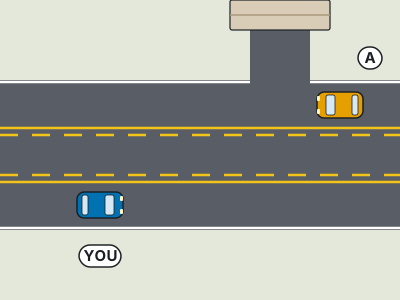
16. How may a driver use a two-way center left-turn lane?
- To travel straight through traffic for any distance
- To pass slower vehicles
- To prepare for a left turn from the main roadway
- To enter the roadway from a side street
Show answer
To prepare for a left turn from the main roadway. A two-way center left-turn lane is for preparing to slow or stop before making a left turn from the main roadway. It is not a through lane, passing lane, or place to enter the roadway from a side street. The guide also limits travel in this lane to no more than 500 feet. Enter it only when the path is clear, position for the turn, and leave it promptly. Yellow lines and opposing turn arrows are the cue that this space is shared for turns.
Study this in the handbook: Right of way at intersections and roundabouts
17. Your lane faces a red arrow at a Missouri signal. What must you wait for before you turn?
- A gap in traffic, regardless of the arrow
- The vehicle ahead to move
- A steady yellow arrow
- A green signal or a flashing yellow arrow
Show answer
A green signal or a flashing yellow arrow. A red arrow is a stop for that movement, and Missouri does not let a gap in traffic override it. You remain stopped until the signal for your lane changes to green or shows a flashing yellow arrow, which then allows the turn after yielding. Following the vehicle ahead is not a signal, and a steady yellow arrow means the protected turn is ending, not beginning. Treat the red arrow like a red light aimed at your lane alone, and watch for the flashing yellow that opens the permissive phase.
Study this in the handbook: Traffic lights, arrows and officers
18. When entering a Missouri highway through an acceleration lane, what should the driver generally do?
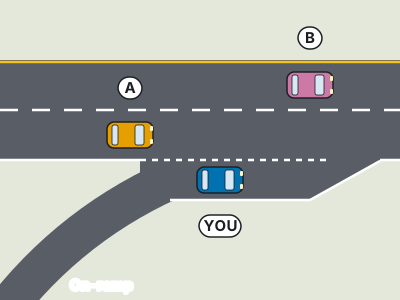
- Stop at the lane's end even when traffic is moving freely
- Increase speed to match highway traffic and merge through an opening
- Enter at a much lower speed than highway traffic
- Force into traffic because highway drivers must always stop
Show answer
Increase speed to match highway traffic and merge through an opening. An acceleration lane gives an entering driver room to build speed until it matches traffic on the highway. The driver should signal, find an opening, and merge smoothly rather than stopping at the end under ordinary conditions. Highway traffic should provide room, but an entering vehicle still must yield and must not force its way in. Use the lane for acceleration, then merge only when the gap is adequate.
Study this in the handbook: Highway driving, merging and breakdowns
19. Which record must a Missouri teen have to move from an instruction permit to an intermediate license?
- No parking tickets ever
- No traffic convictions in 30 days only
- No record requirement at all
- No alcohol-related convictions in 12 months and no traffic convictions in six months
Show answer
No alcohol-related convictions in 12 months and no traffic convictions in six months. To get an intermediate license, the teen must hold the permit at least 182 days, complete 40 hours of instruction with 10 at night, pass the driving test, and have no alcohol-related convictions in the last 12 months and no traffic convictions in the last six months. Parking tickets are not the standard, 30 days is too short, and there is a record requirement.
Study this in the handbook: Permits and the Graduated Driver License
20. What is the longest jail term a Missouri court may impose for a second DWI or BAC offense?
- Up to one year
- Up to 90 days
- Up to seven years
- Five to 15 years
Show answer
Up to one year. The court conviction chart in the Missouri Driver Guide says a second DWI or BAC offense can mean up to one year in jail. Up to seven years is the fourth offense limit, and five to 15 years is the fifth offense range. Ninety days is a license suspension length, not a jail term here. On the license side, a second offense means a one-year revocation, or a five-year denial when the second offense falls within five years.
Study this in the handbook: Alcohol limits and DWI penalties
QualitySpace is expanding to Missouri
We are a California-based independent insurance brokerage working on licensing in more states. We cannot help with Missouri insurance yet. Leave your email and we will let you know when we can.
Every question is written from the official Missouri Driver Guide. Need paper? Printable MO practice test with answer key.
Last verified 2026-10-05. How we check every question · Study all 201 as flashcards
Frequently asked questions
How many questions are on this Missouri practice test?
This fixed set has 20 questions. It is test 3 of 10 from the 201 question Missouri bank. The real MO exam asks 25 questions and you need 20 correct.
What is the passing score for the real Missouri test?
80% to pass That figure comes from the official Missouri source cited on the DMV facts page.
How does this fixed test relate to the full Missouri bank?
Each numbered test is a fixed set of questions in a fixed order, so you can retake the same test later and compare. Every test mixes road signs and the other topics in about the same proportion as the full bank. Tests 1 to 10 together cover 200 of the 201 questions in the Missouri bank, each once. The full practice page mixes the whole bank at random.
Last verified 2026-10-05. See the Missouri DMV facts page for sourced state details.
Return to the full Missouri practice test · Study road signs