
Test 21 of 25 · 20 questions · Free 2026
MO Permit Practice Test 21
Jump to the test ↓A fixed 20 question set from the Missouri bank with answers and plain English explanations. The real MO exam is 25 questions, 80 percent to pass; take the full length version on the main practice page.
Question 1 of 20 · 0 right so far
All 20 questions in test 21
Every question below comes from the Missouri question bank on this page. Open a question to see the correct answer and the explanation. Nothing here is hidden behind a signup.
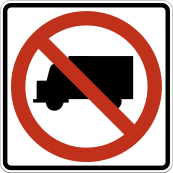
1. This sign is posted at the entrance to a Missouri street. What does it tell the driver of a large truck?
- Trucks must slow to 25 mph here
- Trucks may not use this street
- Trucks must use the right lane only
- A truck stop is located ahead
Show answer
Trucks may not use this street. Some Missouri regulatory signs show a red circle with a red slash over a symbol, meaning you cannot do what the symbol shows. With a truck symbol, the sign means no trucks, and No Trucks is one of the common regulatory signs listed in the guide. Cities and towns may prohibit commercial vehicles from using certain streets, so a truck driver seeing it should find another route.
Study this in the handbook: Road signs by shape and color
2. You see this sign on a Missouri street, and a person is starting across the crosswalk just past it. What should you do?

- Speed up to pass before the person reaches your lane
- Slow down and yield to the person
- Honk so the person waits on the sidewalk
- Keep going if the person is still on the far side
Show answer
Slow down and yield to the person. The Pedestrian Crossing warning sign tells Missouri drivers to slow down and yield to pedestrians walking in the crosswalk. Drivers must yield when a pedestrian is in a marked or unmarked crosswalk on or approaching their side of the road. A person on the far side may reach your lane quickly, so slow early and be ready to stop. Never pass a vehicle that has stopped for a pedestrian.
Study this in the handbook: Road signs by shape and color
3. A Missouri city posts a one-way sign on a street where state law has no such rule. Do you have to obey it?
- No, state signs outrank city signs, which can be ignored
- No, city signs apply just to residents of the city
- Yes, obey signs from the city, county, or state
- Yes, but just during the hours the sign shows
Show answer
Yes, obey signs from the city, county, or state. Local governments may make traffic ordinances in addition to the laws made by the state. Missouri says you must obey any traffic sign or regulation, whether it is set by a municipality, county, or the state. Cities and towns may, for example, set speed limits, set one-way streets, put stop signs at intersections, control turns, and control parking with meters. A sign does not lose its force because it comes from the city instead of the state.
Study this in the handbook: Right of way at intersections and roundabouts
4. A Missouri road has no posted minimum speed. Is it legal to drive so slowly that you block traffic behind you?
- Yes, without a posted minimum any speed is legal
- Yes, as long as your flashers are turned on
- Yes, if you are under the speed limit by any amount
- No, blocking traffic by driving too slowly is illegal
Show answer
No, blocking traffic by driving too slowly is illegal. Missouri's slow poke rule says that even where no minimum speed is posted, it is against the law to drive so slowly that you block traffic. If you need to drive more slowly and vehicles line up behind you, pull over and let them pass. The guide notes that many crashes are caused by slow drivers who block other traffic, and that slower is not always safer.
Study this in the handbook: Speed limits and minimum speeds
5. You stop at a red light on a Missouri street. There is no painted stop line, but a crosswalk is marked across the road. Where do you stop?
- Inside the crosswalk, to see cross traffic better
- Before reaching the crosswalk
- Past the crosswalk, as long as pedestrians have room
- Anywhere that gives a clear view of cross traffic
Show answer
Before reaching the crosswalk. When a sign or signal requires you to stop, Missouri says you must stop before your vehicle reaches the stop line or, if there is one, the crosswalk. With a marked crosswalk and no stop line, that means stopping before the crosswalk. Crosswalks show where pedestrians are to cross the roadway, and you must yield to pedestrians in or about to enter one. Stopping inside it would block their path.
Study this in the handbook: Pavement markings and lane use
6. You are in a dual-use lane at a Missouri signal that shows both a straight arrow and a turn arrow. You want to turn. May you go?
- No, wait until only the turn arrow shows
- No, dual-use lanes are for going straight
- Yes, but only after a full stop
- Yes, you may turn or go straight
Show answer
Yes, you may turn or go straight. Dual-use lanes have both a turn arrow and a straight arrow. Missouri says that when both arrows appear on the signal, you may either turn or go straight. If you want to turn and only the straight arrow is showing, you must wait for the turn arrow. Either way, you still yield to pedestrians and traffic that remain in the intersection.
Study this in the handbook: Pavement markings and lane use
7. Your right wheels drop off the pavement edge on a Missouri highway, and the car pulls to the right. What should you do first?
- Hold the wheel tightly and ease off the gas
- Brake hard and jerk back onto the road
- Speed up to climb back onto the pavement
- Steer sharply left right away
Show answer
Hold the wheel tightly and ease off the gas. When your wheels run off the paved edge, they may pull to the right. Missouri says to hold the steering wheel tightly and take your foot off the accelerator without hitting the brakes, using only gentle brake pressure if needed. Once the vehicle has slowed and you have control, turn back onto the pavement if the lane is free of traffic. Jerking the wheel or braking hard can cost you control.
Study this in the handbook: Brake failure, blowouts and other emergencies
8. At night on a Missouri highway, you are using high beams and catch up to a car about 250 feet ahead going your way. What should you do with your lights?
- Keep high beams on to see past it
- Flash high beams so it moves over
- Switch to your low beams now
- Turn off your headlights for a moment
Show answer
Switch to your low beams now. Missouri tells drivers to use low beams when following another vehicle within 300 feet. At 250 feet, your high beams would shine into the other driver's mirrors. Use low beams when you come within 500 feet of an oncoming vehicle as well. High beams are for times when no vehicles are close ahead or coming toward you. Flashing your lights or turning them off are not safe choices.
Study this in the handbook: Night driving, rain, snow, fog and skids
9. On a two-lane Missouri road, where in your lane does the guide say it is generally safest to drive?
- In the center of your lane
- Close to the center line
- Hugging the right edge line
- Over the edge, on the shoulder
Show answer
In the center of your lane. Missouri advises keeping as much space as you can between yourself and oncoming vehicles. On a two-lane road, that means not crowding the center line, and in general it is safest to drive in the center of your lane. This position leaves room on both sides of your vehicle, which you need in order to turn or change lanes. The shoulder is not a travel lane.
Study this in the handbook: Seat belts, child seats and following distance
10. You plan to turn right into a parking lot in Missouri, but a driveway sits between you and the lot entrance. When should you signal?
- As soon as the driveway comes into view
- Only once you are already turning in
- After you have passed the driveway
- A full block before the parking lot
Show answer
After you have passed the driveway. Missouri asks drivers to signal as early as they can, at least 100 feet before the move. But if other streets, driveways, or entrances lie between you and where you want to turn, wait until you have passed them to signal. Otherwise a driver waiting in that driveway could misread your signal as a turn into it. Signaling only as you turn gives others no warning at all.
Study this in the handbook: Seat belts, child seats and following distance
11. Why does the Missouri guide say not to use cruise control on wet pavement?
- It burns more fuel when the road surface is wet
- It switches off the anti-lock brake system
- It makes the windshield wipers run more slowly
- It keeps powering the tires if they lose traction
Show answer
It keeps powering the tires if they lose traction. When rain mixes with dust and oil, the road becomes slick, and Missouri warns against using cruise control on wet pavement. The cruise control keeps delivering power to the tires even if they lose traction, which may cause you to lose control. The same advice applies on snow and ice. Slow down yourself and leave more distance, since stopping takes longer on wet roads.
Study this in the handbook: Night driving, rain, snow, fog and skids
12. Your car stalls on Missouri railroad tracks with a train coming from your right. After you get out, why should you run toward the right, the direction the train is coming from?
- So debris from the crash is less likely to hit you
- So the engineer can see you and stop the train
- So you can push the car off from the other side
- So you reach the nearest crossing gate quickly
Show answer
So debris from the crash is less likely to hit you. If your vehicle stalls on railroad tracks and a train is approaching, Missouri says to unfasten your seat belt, get out, and get off the tracks, then run in the direction the train is coming from. If you run the way the train is heading, you may be hit by debris when the train strikes your vehicle. Do not stay to push the car once a train is near.
Study this in the handbook: Brake failure, blowouts and other emergencies
13. You are taking your dog on a drive in Missouri. What does the guide recommend?
- Let it ride on your lap so it stays calm
- Let it roam the car if the windows are up
- Secure it in a carrier, kennel, or pet harness
- Keep it in the front seat with the window open
Show answer
Secure it in a carrier, kennel, or pet harness. Missouri's guide says a loose pet in a moving vehicle can be very dangerous. Secure your pet in a pet carrier, a portable kennel, or a specially designed pet harness when you drive, and never allow a pet to sit on your lap while driving. Children, friends, and pets can all distract a driver, so plan ahead so that nothing in the car pulls your attention from the road.
Study this in the handbook: Phones, distractions, fatigue and road rage
14. A Missouri school bus ahead of you turns on its flashing amber lights. What do the amber lights tell you?
- The bus will soon stop to load or unload children
- The bus is about to pull away from a stop
- You may pass the bus quickly before it stops
- The bus has a mechanical problem
Show answer
The bus will soon stop to load or unload children. Missouri school buses flash amber warning lights about 500 feet before a designated stop to warn drivers that a stop is coming. When the bus actually stops, the alternate flashing red lights and stop arm come on, and traffic must stop. Treat the amber lights as your cue to slow down and prepare to stop, not as a chance to rush past before the red lights start.
Study this in the handbook: Right of way at intersections and roundabouts
15. In a Missouri flagging operation work zone, what situation should you expect?
- A closed shoulder with all lanes still open to traffic
- One of two lanes closed, with flaggers at both ends
- A moving work vehicle with a flashing arrow panel
- A full detour, with the road closed to all traffic
Show answer
One of two lanes closed, with flaggers at both ends. Missouri describes several types of work zones. A flagging operation takes place on a two-lane, two-way road with one lane closed, and flaggers stand at the beginning and end of the work zone to control oncoming traffic. Be prepared to stop as you approach and follow the flagger's instructions, since traffic from each direction must share the one open lane. Shoulder work and mobile work zones are set up differently.
16. You are about to turn right on red at a Missouri intersection. Besides traffic from the left, what does the guide tell you to watch for?
- Drivers behind you who may want to go straight
- Pedestrians or bicyclists coming up on your right
- Cars stopped in the left-turn lane across the street
- Signals changing for the cross street a block away
Show answer
Pedestrians or bicyclists coming up on your right. When preparing for a right turn, and especially a right turn on a red signal, Missouri tells drivers to be cautious of pedestrians or bicyclists approaching on the right. Drivers often look only left for a gap in traffic and miss someone stepping off the curb or riding up beside them. A right turn on red is allowed only after a complete stop and only when the way is clear of pedestrians and traffic.
Study this in the handbook: Pedestrians, cyclists, motorcycles and trucks
17. About how much distance may a fully loaded tractor-trailer need to come to a complete stop, according to the Missouri guide?
- About 140 feet
- About 200 feet
- Almost 1,000 feet
- Almost 400 feet
Show answer
Almost 400 feet. Large trucks take longer to stop than cars traveling at the same speed. Missouri's guide says a fully loaded tractor-trailer may need almost 400 feet to come to a complete stop, while an average car at 55 mph stops in about 130 to 140 feet. Cutting in front of a truck and then slowing down leaves its driver far too little room. If you need to turn or change lanes, slow down and go behind the truck instead.
Study this in the handbook: Pedestrians, cyclists, motorcycles and trucks
18. Two cars facing each other at a Missouri intersection both want to turn left. What does the guide tell each driver?
- Wait until the other car finishes, since only one may turn at a time
- Cut the corner sharply so you are out of its path quickly
- Leave room for the oncoming car to turn left in front of you
- Swing wide to the right so the other car can pass behind you
Show answer
Leave room for the oncoming car to turn left in front of you. On a left turn, Missouri drivers should not cut the corner so sharply that they hit someone approaching from the left. At the same time, they must leave room for oncoming vehicles to turn left in front of them. When each driver keeps a proper path, both turns can be made together. Waiting for the other car to finish is not required, and cutting the corner is exactly what the guide warns against.
Study this in the handbook: Passing, turning and signaling
19. You are stopped behind a school bus on a Missouri road, and its red lights are still flashing. The bus driver waves you ahead. What should you do?
- Go on with caution, and watch for children by the road
- Stay stopped until every child is out of sight
- Wait until the red lights stop flashing, whatever the driver does
- Pass on the left slowly without signaling
Show answer
Go on with caution, and watch for children by the road. After you stop for a school bus that is unloading children, you must remain stopped until the bus moves or the bus driver signals for you to proceed. A wave from the driver is that signal, so you may go on. Even then, the guide says to watch for school children walking along the side of the road and to proceed with caution. Passing without the driver's signal would break the rule to stay stopped.
Study this in the handbook: Passing, turning and signaling
20. A Missouri truck driver operating a commercial vehicle has a BAC of 0.05%. Is that legal?
- Yes, the limit for everyone is 0.08%
- Yes, commercial drivers may reach 0.06%
- No, commercial drivers must be at 0.00%
- No, the commercial limit is 0.04%
Show answer
No, the commercial limit is 0.04%. Missouri's guide lists three BAC thresholds: 0.08% or more for most drivers, 0.04% for commercial vehicle drivers, and 0.02% for drivers under 21. A commercial driver at 0.05% is over the 0.04% commercial limit even though a regular adult driver at the same level would be under the general limit. The guide adds that even one drink is likely to affect your ability to drive safely.
Study this in the handbook: Alcohol limits and DWI penalties
Every question is written from the official Missouri Driver Guide. Need paper? Printable MO practice test with answer key.
Last verified 2026-10-05. How we check every question · Study all 500 as flashcards
Frequently asked questions
How many questions are on this Missouri practice test?
This fixed set has 20 questions. It is test 21 of 25 from the 500 question Missouri bank. The real MO exam asks 25 questions and you need 20 correct.
What is the passing score for the real Missouri test?
80% to pass That figure comes from the official Missouri source cited on the DMV facts page.
How does this fixed test relate to the full Missouri bank?
Each numbered test is a fixed set of questions in a fixed order, so you can retake the same test later and compare. Every test mixes road signs and the other topics in about the same proportion as the full bank. Tests 1 to 25 together cover every question in the Missouri bank once. The full practice page mixes the whole bank at random.
Last verified 2026-10-05. See the Missouri DMV facts page for sourced state details.
Return to the full Missouri practice test · Study road signs