
Key points
Even facing a green light, yield to all pedestrians in the intersection.
Source: Handbook p. 30
“Even when you are facing a green light you must yield the right-of-way to all pedestrians in the intersection.”
Missouri Driver Guide, Handbook p. 30You must come to a complete stop for a pedestrian crossing with a guide dog or a white cane.
Source: Handbook p. 31
“When a pedestrian is crossing a street or highway guided by a dog or carrying a white cane (or a white cane with a red tip), vehicles must come to a complete stop.”
Missouri Driver Guide, Handbook p. 31Do not pass a vehicle that has stopped or slowed down for a pedestrian.
Source: Handbook p. 30
“Do not pass a vehicle that has stopped or slowed down for a pedestrian.”
Missouri Driver Guide, Handbook p. 30Obey the slower school zone speed limit when the lights are flashing or children are present.
Source: Handbook p. 30
“You must obey a slower speed limit in a school zone when lights are flashing or children are present.”
Missouri Driver Guide, Handbook p. 30Do not share a lane with a motorcycle; the rider needs the entire lane.
Source: Handbook p. 28
“You should not share a lane with a motorcycle. The motorcyclist needs the entire lane for safety reasons.”
Missouri Driver Guide, Handbook p. 28You may cross a bicycle lane to turn or enter the road, but you must yield to bicyclists in it.
Source: Handbook p. 31
“You may cross a bicycle lane when turning or when entering or leaving the roadway. You must yield to bicyclists in a bicycle lane.”
Missouri Driver Guide, Handbook p. 31If you cannot see a truck driver in the truck's mirrors, the driver cannot see you.
Source: Handbook p. 29
“you are driving behind a truck or a bus and cannot see the driver in his or her rearview mirrors, the driver of that vehicle cannot see you.”
Missouri Driver Guide, Handbook p. 29A car at 55 mph needs about 130 to 140 feet to stop, while a loaded tractor trailer may need almost 400 feet.
Source: Handbook p. 29
“The average passenger car traveling at 55 mph can stop in about 130 140 feet, almost half the length of a football field. A fully loaded tractortrailer may take almost 400 feet”
Missouri Driver Guide, Handbook p. 29Do not drive between vehicles in a funeral procession while they are moving.
Source: Handbook p. 34
“Do not drive between the vehicles that are part of the procession when they are in motion.”
Missouri Driver Guide, Handbook p. 34
Numbers to know
| Number | What it means | Manual |
|---|---|---|
| 55 mph | speed used for the car and truck stopping distance comparison | Handbook p. 29 |
| 130 to 140 feet | stopping distance of an average car at 55 mph | Handbook p. 29 |
| 400 feet | stopping distance of a fully loaded tractor trailer | Handbook p. 29 |
| 25 feet at 10 mph | distance bicycle brakes must stop within | Handbook p. 33 |
| 3 to 4 feet | clearance cyclists should leave when passing parked cars | Handbook p. 28 |
Recognize these signs

Pedestrian crossing 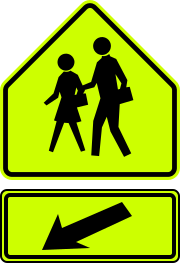
School crossing
3 questions from the Missouri practice test
1. What must vehicles do when a blind pedestrian is crossing with a white cane or guide dog?
- Continue after sounding the horn
- Come to a complete stop
- Stop only if a traffic signal is red
- Pass before the pedestrian reaches the lane
Show answer
Come to a complete stop. A white cane or guide dog identifies a pedestrian who is blind, and Missouri requires vehicles to come to a complete stop while that person crosses. A horn does not replace yielding, and a traffic signal does not remove the driver’s duty to protect the crossing. Stop early enough to leave the pedestrian a safe path, then wait until the crossing is complete. The cane or dog is the immediate cue to stop fully.
2. At a crosswalk, what is a driver's duty when a pedestrian is about to enter?
- Sound the horn and continue
- Pass another vehicle stopped nearby
- Yield to the pedestrian
- Proceed first if the crosswalk is unmarked
Show answer
Yield to the pedestrian. Missouri says you must yield to pedestrians in or about to enter a crosswalk. The rule applies even when paint is absent, because the guide notes that not all crosswalks are marked, so be alert for pedestrians at intersections without defined crosswalks. Sounding the horn does not replace yielding, and the guide separately says not to pass a vehicle that has stopped or slowed for a pedestrian. Before crossing an intersection, reduce speed and look for people near both edges of the roadway, and wait while a person steps toward the crossing.
3. What must a driver outside an organized funeral procession avoid doing while the procession is moving?
- Yielding at intersections
- Watching for emergency vehicles
- Waiting until the procession has passed
- Driving between vehicles in the procession
Show answer
Driving between vehicles in the procession. Vehicles outside an organized funeral procession must not drive between the procession vehicles while they are moving. The guide also says not to join a funeral procession to obtain the right of way and not to pass any vehicle in the procession except where a passing lane is specifically provided. An organized procession has the right of way at intersections regardless of traffic control devices, except for emergency vehicles or law enforcement direction. A line of vehicles using flashing emergency lights is the cue to wait.
Practice this topic
Lock it in with right of way questions from the free Missouri practice test. Every answer comes with a plain English explanation.
Source: the Missouri Driver Guide, Chapter 4: Sharing the Road. This lesson is a plain English summary, not the law itself; where it differs, the manual and the statute govern. Last checked 2026-09-27.