
Key points
The round advance warning sign tells you a railroad crossing is ahead.
Source: Handbook p. 50
“The round advance warning sign tells you that you are nearing a railroad crossing.”
Missouri Driver Guide, Handbook p. 50Never try to beat a train, and never start across until there is room for your vehicle on the other side.
Source: Handbook p. 50
“Never try to beat a train across the tracks. Never start to cross the tracks until there is room for your vehicle on the other side of the tracks.”
Missouri Driver Guide, Handbook p. 50The white X shaped crossbuck means the same as a yield sign: yield to trains.
Source: Handbook p. 51
“This sign has the same meaning as a “yield” sign; therefore, you must yield to trains at crossings.”
Missouri Driver Guide, Handbook p. 51You must stop if the red lights are flashing or the gate is down.
Source: Handbook p. 51
“You must STOP if the red lights are flashing or the gate is down.”
Missouri Driver Guide, Handbook p. 51When you must stop, stop within 15 to 50 feet of the tracks and never go around the gate.
Source: Handbook p. 51
“You must stop within 15 to 50 feet before the railroad tracks. DO NOT try to go around the gate.”
Missouri Driver Guide, Handbook p. 51If there are two or more tracks, look for a second train before crossing.
Source: Handbook p. 51
“If there are two or more tracks, look for a second train before you cross.”
Missouri Driver Guide, Handbook p. 51Vehicles carrying hazardous materials must stop at all railroad crossings, so be ready.
Source: Handbook p. 29
“Vehicles carrying hazardous materials must stop at all railroad crossings. Be prepared.”
Missouri Driver Guide, Handbook p. 29
Numbers to know
| Number | What it means | Manual |
|---|---|---|
| 15 to 50 feet | where to stop before the tracks when required | Handbook p. 51 |
Recognize these signs

Railroad crossing ahead 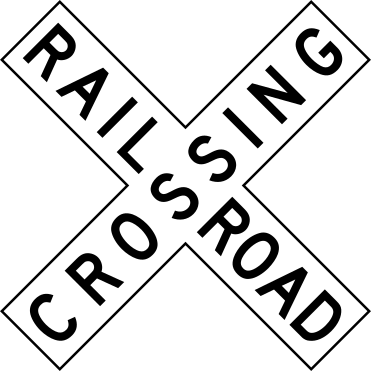
Railroad crossbuck
3 questions from the Missouri practice test
1. At the X-shaped railroad crossbuck, what rule applies to approaching trains?
- Treat the tracks as a stop only when a gate is down
- Speed up to cross before a train reaches the roadway
- Yield to trains as you would at a yield sign
- Stop on the tracks to look for a second train
Show answer
Yield to trains as you would at a yield sign. A railroad crossbuck is located at the crossing and has the same meaning as a yield sign. The driver must yield to trains, never race a train, and avoid entering the tracks unless there is room on the other side. Waiting only for a lowered gate misses the crossbuck's standing rule, while speeding or stopping on the tracks creates extreme danger. Slow before the crossing, look and listen in both directions, and make sure the vehicle can clear every track before proceeding. A second train may be present where multiple tracks cross the road.
2. What hazard does the round yellow railroad advance-warning sign identify?
- A bicycle-only route
- A roundabout that must be entered immediately
- A railroad crossing ahead
- A no-passing zone that ends at the next hill
Show answer
A railroad crossing ahead. The round yellow advance-warning sign tells the driver that a railroad crossing is approaching. It is placed before the crossing so the driver has time to reduce speed, look for a train, and prepare to stop. It is not a bicycle instruction, a command to enter a roundabout, or a notice about the end of a passing restriction. The round shape is a strong railroad cue, but the driver should also watch for a crossbuck, lights, or a gate closer to the tracks. Never begin crossing without space on the far side.
3. Where must a driver stop when a sign or signal requires a stop?
- Past the crosswalk so the front bumper is visible
- Beside the traffic sign regardless of pavement markings
- Only before the intersection when pedestrians are present
- Before the stop line or, if there is one, the crosswalk
Show answer
Before the stop line or, if there is one, the crosswalk. Missouri places the stopping point before the stop line or, when a stop line is absent, before the crosswalk. Stopping beyond the crosswalk can block pedestrians and places the vehicle farther into the conflict area. The sign's physical location is not automatically the stopping point, and pedestrians are not the condition that activates this placement rule. Approach early enough to brake smoothly, keep the crosswalk open, and use the marked line as the primary reference.
Practice this topic
Lock it in with road signs questions from the free Missouri practice test. Every answer comes with a plain English explanation.
Source: the Missouri Driver Guide, Chapter 7: Pavement Markings, Traffic Signs, and Signals. This lesson is a plain English summary, not the law itself; where it differs, the manual and the statute govern. Last checked 2026-09-27.