
Key points
Yield to police, fire, ambulance or other emergency vehicles using a siren or air horn and a red or blue flashing light.
Source: Handbook p. 23
“You must yield the right-of-way to police, fire, ambulance, or any other emergency vehicles using a siren or air horn, and a red or blue flashing light.”
Missouri Driver Guide, Handbook p. 23If you are in an intersection, drive through it before pulling over, then stay stopped until the emergency vehicle passes.
Source: Handbook p. 23
“If you are in an intersection, drive through the intersection before you pull over. Remain stopped until the emergency vehicle passes.”
Missouri Driver Guide, Handbook p. 23Emergency vehicles may follow each other, so move again only when the way is clear.
Source: Handbook p. 23
“Emergency vehicles may follow each other so proceed only when the way is clear.”
Missouri Driver Guide, Handbook p. 23For a stopped emergency vehicle with red or red and blue lights on a road with at least 4 lanes, move to a lane not next to it if safe.
Source: Handbook p. 23
“make a lane change into a lane not adjacent to the stationary vehicle (if on a roadway having at least four lanes with not less than two lanes proceeding in the same direction”
Missouri Driver Guide, Handbook p. 23If changing lanes is unsafe or impossible, slow down and proceed with caution.
Source: Handbook p. 23
“Proceed with due caution and reduce the speed of the vehicle, maintaining a safe speed for road conditions, if changing lanes would be unsafe or impossible.”
Missouri Driver Guide, Handbook p. 23A school bus flashes amber warning lights 500 feet before a stop.
Source: Handbook p. 23
“Amber warning lights will flash 500 feet before the bus comes to a designated stop.”
Missouri Driver Guide, Handbook p. 23When the red lights flash and the stop arm is out, oncoming and following traffic must stop before reaching the bus.
Source: Handbook p. 23
“Oncoming and following traffic must stop before they reach the bus when these signals are activated.”
Missouri Driver Guide, Handbook p. 23You need not stop when traveling the opposite direction of a school bus on a highway with 4 or more lanes.
Source: Handbook p. 24
“When you are traveling the opposite direction of a school bus on a highway containing four or more lanes of traffic;”
Missouri Driver Guide, Handbook p. 24Failing to stop for a school bus loading or unloading students brings 5 points.
Source: Handbook p. 24
“Any driver convicted of an offense of failing to stop for a school bus that is receiving or discharging students shall be assessed five points.”
Missouri Driver Guide, Handbook p. 24If an emergency vehicle comes while you are in a roundabout, exit immediately and pull to the right.
Source: Handbook p. 27
“If an emergency vehicle approaches while you are in the roundabout, exit immediately and pull to the right.”
Missouri Driver Guide, Handbook p. 27
Numbers to know
| Number | What it means | Manual |
|---|---|---|
| 4 lanes | road size where you must move to a lane not next to a stopped emergency vehicle | Handbook p. 23 |
| 500 feet | distance before a stop that school bus amber lights start flashing | Handbook p. 23 |
| 5 points | points for failing to stop for a school bus | Handbook p. 24 |
| 90 days | suspension for a second school bus offense within 5 years | Handbook p. 24 |
| 180 days | suspension for a third or later school bus offense within 5 years | Handbook p. 24 |
Recognize these signs
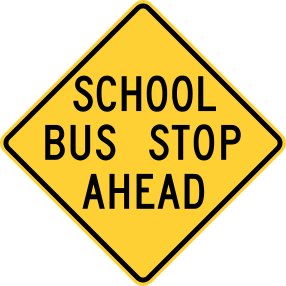
School bus stop ahead
3 questions from the Missouri practice test
1. When a Missouri emergency vehicle approaches with its siren or air horn sounding and a red or blue flashing light, what should you do?
- Stop immediately in the intersection and leave the vehicle there
- Speed up so the emergency vehicle can pass on the shoulder
- Yield, move as far right as possible, stop, and remain stopped until it passes
- Turn left across traffic and follow the emergency vehicle
Show answer
Yield, move as far right as possible, stop, and remain stopped until it passes. Missouri requires drivers to yield to an approaching emergency vehicle, move to the right side of the roadway when possible, and stop until the vehicle has passed. The choice about speeding onto the shoulder is unsafe because it creates another moving obstacle and does not provide the required stopped position. Stopping in an intersection can block the emergency vehicle's path, while turning left across traffic adds a collision risk. When you hear the siren or air horn or see the flashing red or blue light, check traffic, clear the intersection if needed, pull right, and wait for the emergency vehicle to go by.
2. When approaching a stationary emergency vehicle on a Missouri road with at least four lanes, what lane change is required when safe?
- Move toward the stationary vehicle's lane
- Move into a lane not adjacent to the stationary vehicle
- Change into the oncoming traffic lane
- Remain beside the vehicle at the same speed
Show answer
Move into a lane not adjacent to the stationary vehicle. On a roadway with at least four lanes and at least two lanes moving in the approaching driver's direction, the driver should make a lane change into a lane not adjacent to the stationary emergency vehicle when that can be done safely. Remaining beside it leaves no buffer, and moving toward it increases exposure. The oncoming lane is not a safe or lawful substitute. The condition matters: change away when possible, then use the reduced speed and caution rule when a lane change cannot be made safely.
3. What should you do when an emergency vehicle approaches with a siren or flashing light?
- Follow it closely through the next intersection
- Pull to the right edge and remain stopped until it passes
- Stop immediately in the intersection
- Keep driving at the same speed in the left lane
Show answer
Pull to the right edge and remain stopped until it passes. Missouri drivers must yield to police, fire, ambulance, and other emergency vehicles using the listed warning equipment. Pull as near to the right edge as possible and remain stopped until the vehicle passes. If already in an intersection, clear that intersection before pulling over rather than stopping in the crossing path. Following the emergency vehicle is unsafe, and staying in the left lane blocks the responder. Check mirrors frequently so the response is recognized early and the maneuver is smooth.
Practice this topic
Lock it in with emergencies questions from the free Missouri practice test. Every answer comes with a plain English explanation.
Source: the Missouri Driver Guide, Chapter 3: Rules of the Road. This lesson is a plain English summary, not the law itself; where it differs, the manual and the statute govern. Last checked 2026-09-27.