
Test 18 of 25 · 20 questions · Free 2026
MO Permit Practice Test 18
Jump to the test ↓A fixed 20 question set from the Missouri bank with answers and plain English explanations. The real MO exam is 25 questions, 80 percent to pass; take the full length version on the main practice page.
Question 1 of 20 · 0 right so far
All 20 questions in test 18
Every question below comes from the Missouri question bank on this page. Open a question to see the correct answer and the explanation. Nothing here is hidden behind a signup.
1. Besides the round yellow advance warning sign, what else may warn Missouri drivers that a railroad crossing is near?
- A blue square sign showing a white train symbol
- Rumble strips cut into the center line of the road
- A pavement marking painted before the crossing
- A flashing green light hung above the travel lanes
Show answer
A pavement marking painted before the crossing. Many Missouri railroad crossings have signs or signals to warn drivers. The round advance warning sign tells you a crossing is near, and the guide adds that you may also see a pavement marking before a crossing that carries the same message. When you see either one, slow down, look for a train, and be ready to stop. Blue signs point to motorist services, not railroad crossings.
Study this in the handbook: Speed limits and minimum speeds
2. If no speed limit sign is posted, what is the speed limit in a Missouri city, town, or village?
- 20 mph
- 30 mph
- 35 mph
- 25 mph
Show answer
25 mph. Missouri sets the speed limit in any city, town, or village at 25 mph unless a different limit is posted. Cities and towns may set other limits by ordinance, so a posted sign controls when there is one. Near schools, playgrounds, parks, and in residential areas, children may run into the road without looking, so drive with extra care even at that speed.
Study this in the handbook: Speed limits and minimum speeds
3. On a cold Missouri morning, which part of the road is likely to freeze and become slippery first?
- Roads in direct sunlight
- Bridges and overpasses
- Freshly paved city streets
- Gravel roads in the country
Show answer
Bridges and overpasses. Missouri reminds drivers that bridges and overpasses will freeze and become slippery before other parts of the road. Even on roads that have been cleared, a few ice patches may still exist. Slow down before you reach a bridge in cold weather and brake gently and smoothly rather than slamming on the brakes. The guide's winter slogan sums it up: Ice and Snow, Take it SLOW.
Study this in the handbook: Night driving, rain, snow, fog and skids
4. Can a Missouri driver be charged with DWI for driving while impaired by a legal prescription medicine?
- Yes, impairment by any drug can bring a DWI charge
- No, DWI applies to alcohol and illegal drugs alone
- No, if the medicine was taken exactly as prescribed
- Yes, but only if alcohol was also involved
Show answer
Yes, impairment by any drug can bring a DWI charge. Missouri law allows a DWI charge for driving while impaired by alcohol, illegal drugs, prescription medication, over-the-counter medication, or any combination of these. The law does not distinguish between kinds of drugs; using any drug that impairs your ability to drive safely is illegal, and the penalties are the same whether the impairment comes from drugs or alcohol. Taking a medicine as directed does not make impaired driving legal.
Study this in the handbook: Alcohol limits and DWI penalties
5. You miss your exit while driving in a Missouri roundabout. What should you do?
- Stop in the circle and wait for a gap to back up
- Cut across the truck apron to reach the exit
- Take the next exit, then make a U-turn on that road
- Keep going around until you come back to your exit
Show answer
Keep going around until you come back to your exit. Missing an exit in a Missouri roundabout is not an emergency. The guide says to continue through the roundabout until you reach the exit you need. Do not stop inside the circle unless it is the only way to avoid a crash, and never back up. The truck apron in the middle is for the rear wheels of large trucks, not for cars. Going around one more time is the expected move.
Study this in the handbook: Right of way at intersections and roundabouts
6. How much room should you give a motorcycle when you pass it on a Missouri road?
- Half a lane, since motorcycles are narrow
- Enough to clear its mirror by about a foot
- A full lane width, without squeezing past
- Three feet, the same as for a parked car
Show answer
A full lane width, without squeezing past. Missouri tells drivers to give motorcycles a full lane width when passing and not to squeeze past them. A motorcyclist needs the entire lane for safety and may shift position to avoid manhole covers, debris, diagonal railroad tracks, or strong winds. Passing with only part of a lane leaves no room for those moves. If the lane is too narrow to share, wait for a clear stretch of road and then pass using the other lane.
Study this in the handbook: Pedestrians, cyclists, motorcycles and trucks
7. A bicyclist ahead of you on a Missouri street moves from the right edge toward the middle of the lane. Which reason does the guide accept for this?
- Bicyclists may ride anywhere they like at any time
- The rider wants to slow cars down on purpose
- Riders must move to the center at every intersection
- The lane is too narrow to share safely with a car
Show answer
The lane is too narrow to share safely with a car. Missouri asks bicyclists traveling slower than traffic to ride as near the right side as is safe, but it also lists times when they may move toward the middle or left of the lane. These include making a left turn, avoiding hazards such as gutters or gravel, a lane too narrow to share with another vehicle, and going straight next to a right-turn-only lane. A rider in the middle of the lane may be doing exactly what the law allows.
8. You need to turn right across a marked bicycle lane in Missouri. What does the law allow and require?
- You may never drive into or across a marked bicycle lane
- You may cross it to turn, yielding to cyclists in it
- You may cross it, and bicyclists must yield to you
- You may drive in it for one block before turning
Show answer
You may cross it to turn, yielding to cyclists in it. A bicycle lane is part of the roadway marked with striping for bicycles. Missouri lets drivers cross a bicycle lane when turning or when entering or leaving the roadway, but drivers must yield to bicyclists in that lane. Before turning, look for riders who may be coming up on your right. Using the bike lane as an extra driving lane is not part of the permission.
Study this in the handbook: Pedestrians, cyclists, motorcycles and trucks
9. In Missouri, how much care should you use when passing a bicyclist or a pedestrian on the road?
- The same care you use when passing a motor vehicle
- Less care than for a car, because they move much slower
- Very little, as long as they stay on the shoulder
- A horn tap is enough, and then you may pass at speed
Show answer
The same care you use when passing a motor vehicle. The Missouri guide tells drivers to pass a pedestrian or a bicyclist with the same care they would give a motor vehicle. Because these road users are slow, you may have to slow down and wait for a safe chance to pass, the same way you would behind any slow-moving traffic. Their low speed is a reason for patience, not a reason to squeeze by. A horn tap does not replace waiting for a clear and safe gap.
Study this in the handbook: Right of way at intersections and roundabouts
10. What does this yellow warning sign tell you about the road ahead in Missouri?

- Another road crosses yours, so watch for traffic
- A hospital is located at the next intersection
- Two highways are about to merge into one
- A railroad crosses the road just ahead
Show answer
Another road crosses yours, so watch for traffic. This Missouri warning sign marks an intersection ahead where another road crosses the one you are on. The guide says to watch carefully for traffic crossing your path. Hospitals are shown on blue service signs, a merge sign shows one lane joining another, and railroad crossings use a round yellow sign or an X-shaped crossbuck. Slow down and be prepared to yield or stop as you approach.
Study this in the handbook: Road signs by shape and color
11. A driver circling a Missouri roundabout turns on the right turn signal. What is that driver telling you?
- The driver is changing to the inside lane
- The driver is stopping inside the circle
- The driver wants you to pass on the left
- The driver is about to exit
Show answer
The driver is about to exit. Missouri tells drivers leaving a roundabout to use the right turn signal to let others know they are exiting. A driver signaling right in the circle is about to leave at the next exit, which can help a waiting driver judge the gap. Lane changes, stopping, and passing inside a roundabout are all things the guide says not to do, so the signal should not mean any of those.
Study this in the handbook: Right of way at intersections and roundabouts
12. You are driving on a Missouri two-lane road when an ambulance with its siren and flashing red lights comes up behind you. What should you do?
- Pull to the right edge, stop, and wait for it to pass
- Speed up so you stay well ahead of the ambulance
- Stop right where you are in the middle of your lane
- Pull to the left so it can pass on the right
Show answer
Pull to the right edge, stop, and wait for it to pass. Missouri law requires drivers to yield to emergency vehicles using a siren and red or blue lights by immediately driving to a position parallel to, and as far as possible to the right of, the traveled part of the road, then stopping and staying there until the emergency vehicle passes. Speeding up, stopping in your lane, or moving left all leave the vehicle without a clear path.
13. Why does the Missouri guide say roundabouts are safer than traditional intersections?
- Every driver must come to a full stop first
- They lower speeds and remove left turns across traffic
- Traffic signals control every lane change
- Pedestrians are not allowed to cross near them
Show answer
They lower speeds and remove left turns across traffic. Missouri explains that roundabouts are statistically safer than traditional intersections because they reduce fatal and injury crashes in two ways: lower speeds, and removing left turns in front of opposing traffic. Roundabouts use yield signs at every entering road rather than stops or signals, which also keeps traffic flowing with fewer stops. Pedestrians do cross at roundabouts, using crosswalks, and drivers must yield to them.
Study this in the handbook: Right of way at intersections and roundabouts
14. Your light is green and cross traffic has a red light at a Missouri intersection. What should you still do before entering?
- Look left and right for drivers who may not stop
- Nothing, since cross traffic must stop for the red
- Sound your horn to warn cross traffic you are coming
- Speed up to clear the intersection quickly
Show answer
Look left and right for drivers who may not stop. Missouri tells defensive drivers not to rely on traffic signals or signs to keep others from crossing in front of them, because some drivers do not obey them. At an intersection, look to the left and right even if other traffic has a red light or a stop sign. A green light gives you permission to go after yielding, not a promise that everyone else will stop.
Study this in the handbook: Seat belts, child seats and following distance
15. You get a flat tire on a Missouri highway, and the flat is on the side next to the travel lane. What does the guide advise?
- Do not change it if you would have to be in a traffic lane
- Change it quickly, as long as traffic looks light right now
- Change it, but only with your flashers on
- Change it after placing one flare behind the car
Show answer
Do not change it if you would have to be in a traffic lane. Missouri's breakdown advice says never to stand in the roadway and not to try changing a tire if doing so means being in a traffic lane. Flashers and flares help warn drivers, but they do not make standing in a live lane safe. Get the vehicle off the road if you can, signal for help by lifting the hood or tying a white cloth to the antenna, side mirror, or door handle, and call for assistance.
Study this in the handbook: Highway driving, merging and breakdowns
16. On Missouri traffic signs, what does the color red indicate?
- A warning about some hazard in the road ahead
- Directions and distances to towns and cities
- Stop, yield, or something that is prohibited
- Services such as gas, food, and rest areas
Show answer
Stop, yield, or something that is prohibited. Missouri gives each sign color a job. Red is used for stop, yield, or a prohibited action, which is why stop signs, yield signs, and the red circle and slash all use it. Yellow means warning, green gives direction and distance, blue points to motorist services, orange marks construction, and brown marks public recreation and cultural interests. Seeing red on a sign should make you think about stopping or about something you must not do.
Study this in the handbook: Traffic lights, arrows and officers
17. A Missouri three-year-old is large for her age and weighs 45 pounds. What restraint does the law require?
- A booster seat, since she is over 40 pounds
- A child restraint system suited to her
- A lap belt in the back seat
- Any seat belt, because of her weight
Show answer
A child restraint system suited to her. Missouri law says children less than four years old, regardless of weight, must be secured in a child passenger restraint system appropriate for that child. A three-year-old who weighs 45 pounds is still under four, so her weight does not move her into a booster seat or seat belt. Age and weight work as separate tests, and either one can require a child restraint system.
Study this in the handbook: Seat belts, child seats and following distance
18. You missed your turn and want to reverse direction at a Missouri intersection where this sign is posted. What should you do?
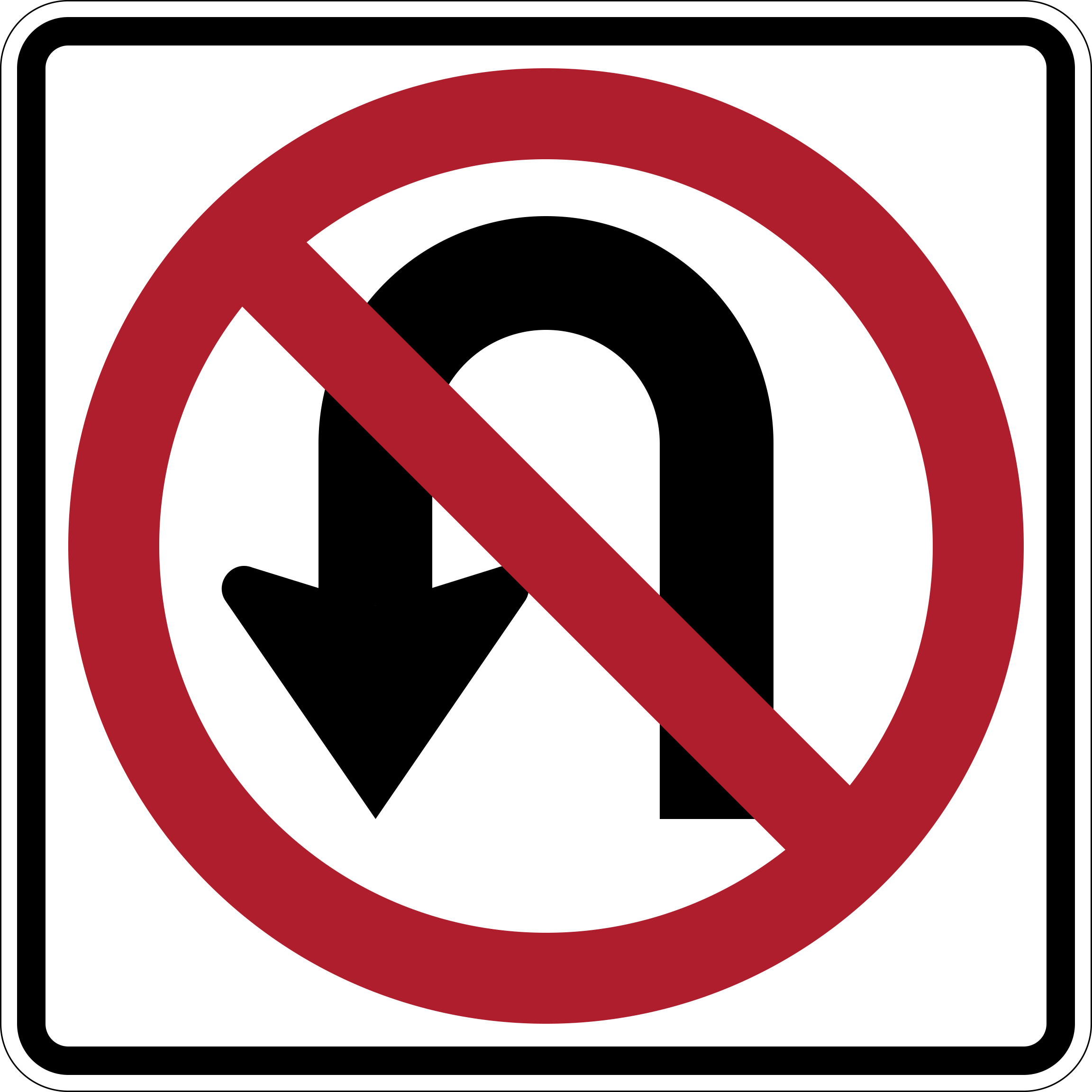
- Make the U-turn if no cars are coming
- Make the U-turn from the right lane
- Go on and turn around elsewhere
- Back up to the corner you missed
Show answer
Go on and turn around elsewhere. The red circle and slash over a U-shaped arrow means U-turns are prohibited at that location. Missouri says never to make a U-turn where a No U-Turn sign is posted, even when traffic is light. Continue to a place where turning around is legal and safe. Backing up to reach a missed turn is also something the guide tells drivers not to do in travel lanes.
Study this in the handbook: Road signs by shape and color
19. You hold a Missouri intermediate license, and a friend is riding with you in the back seat. Who must be buckled?
- You and front seat riders, but not the back
- Everyone in the car, front and back
- Riders under age 16 and nobody else
- Just you, the driver
Show answer
Everyone in the car, front and back. Missouri law requires the operator and front seat occupants of all passenger vehicles to wear a properly adjusted and fastened seat belt. The rule is stricter for new drivers: all passengers riding with an intermediate license holder must be properly restrained, including those in the back seat. The guide also urges every driver to make sure all passengers use seat belts or child restraints before driving.
Study this in the handbook: Seat belts, child seats and following distance
20. In a Missouri funeral procession, how closely should you follow the car ahead of you?
- At least five car lengths back
- Three seconds back, like normal driving
- As closely as is practical and safe
- Far enough for others to cut in
Show answer
As closely as is practical and safe. If you are driving in a funeral procession in Missouri, follow the vehicle in front of you as closely as is practical and safe, and use your flashing emergency lights. Keeping the line together supports the rule that drivers outside the procession must not drive between its moving vehicles. The procession has the right-of-way at intersections except for emergency vehicles or law enforcement directions.
Study this in the handbook: Right of way at intersections and roundabouts
Every question is written from the official Missouri Driver Guide. Need paper? Printable MO practice test with answer key.
Last verified 2026-10-05. How we check every question · Study all 500 as flashcards
Frequently asked questions
How many questions are on this Missouri practice test?
This fixed set has 20 questions. It is test 18 of 25 from the 500 question Missouri bank. The real MO exam asks 25 questions and you need 20 correct.
What is the passing score for the real Missouri test?
80% to pass That figure comes from the official Missouri source cited on the DMV facts page.
How does this fixed test relate to the full Missouri bank?
Each numbered test is a fixed set of questions in a fixed order, so you can retake the same test later and compare. Every test mixes road signs and the other topics in about the same proportion as the full bank. Tests 1 to 25 together cover every question in the Missouri bank once. The full practice page mixes the whole bank at random.
Last verified 2026-10-05. See the Missouri DMV facts page for sourced state details.
Return to the full Missouri practice test · Study road signs