
Test 8 of 10 · 20 questions · Free 2026
MO Permit Practice Test 8
Jump to the test ↓A fixed 20 question set from the Missouri bank with answers and plain English explanations. The real MO exam is 25 questions, 80 percent to pass; take the full length version on the main practice page.
Question 1 of 20 · 0 right so far
All 20 questions in test 8
Every question below comes from the Missouri question bank on this page. Open a question to see the correct answer and the explanation. Nothing here is hidden behind a signup.
1. Under Missouri's child passenger restraint classifications, which child must use a child passenger restraint system regardless of weight?
- A child at least eight years old and at least 80 pounds
- A child taller than 4 feet 9 inches
- A child less than four years old
- A child exactly four years old who weighs 80 pounds
Show answer
A child less than four years old. Missouri's classification makes age alone decisive for a child younger than four. That child must be secured in a child passenger restraint system regardless of weight. The option using age eight and weight 80 pounds describes the older-child category, where a vehicle safety belt or suitable booster seat is allowed. Height above 4 feet 9 inches also belongs to that older category. A child exactly four years old is outside the less-than-four rule, so the wording matters. Before driving, match the child to every applicable age, weight, and height threshold rather than relying on one number in isolation.
Study this in the handbook: Seat belts, child seats and following distance
2. What is the paved area on the inside of a Missouri roundabout called, and who is it for?
- A truck apron, for the rear wheels of large trucks that need more space
- A pedestrian refuge
- A bicycle lane
- A parking area for disabled vehicles
Show answer
A truck apron, for the rear wheels of large trucks that need more space. Large trucks need more space when driving in a roundabout. The truck apron, also known as off-tracking, is the paved area on the inside of the roundabout for the rear wheels of large trucks to use when turning. The guide says truck aprons are not to be used by cars, SUVs, or pickup trucks, and it tells drivers not to attempt to pass any vehicle in a roundabout, especially a large truck. The apron is not a bike lane, a pedestrian refuge, or a place to park a disabled vehicle.
Study this in the handbook: Right of way at intersections and roundabouts
3. What does a Missouri flashing red traffic signal require?
- The same action as a stop sign
- A slow roll through the intersection
- An immediate left turn
- A yield without stopping
Show answer
The same action as a stop sign. A flashing red signal has the same meaning as a stop sign. The driver must stop at the required location and may proceed only after yielding as the intersection rules require. Treating it as a flashing yellow or merely slowing leaves the vehicle moving when a full stop is required. The color and flash pattern provide the cue: red means stop, while yellow means slow and proceed with caution.
Study this in the handbook: Traffic lights, arrows and officers
4. Which Missouri driver must have an ignition interlock device installed before reinstatement?
- Any driver with one speeding ticket
- Every driver under 21
- Only commercial drivers
- A driver whose alcohol conviction involved a BAC of .15% or higher
Show answer
A driver whose alcohol conviction involved a BAC of .15% or higher. An ignition interlock is required before reinstatement for a driver with more than one intoxication-related contact, an alcohol conviction with a BAC of .15 percent or higher, or one that caused property damage or bodily harm. It must stay installed for at least six months after reinstatement with no violations in the last three months. Speeding tickets, age alone, and commercial status are not the triggers.
Study this in the handbook: Alcohol limits and DWI penalties
5. What suspension does Missouri set for a third conviction within five years of failing to stop for a school bus?
- 60 days
- 180 days
- 90 days
- Five years
Show answer
180 days. The school bus ladder is a court ordered suspension of 90 days or as designated for a first offense, 90 days for a second offense within five years, and 180 days for a third or later offense within five years. Ninety days belongs to the earlier steps. Sixty days is a point suspension figure, and five years is the look-back window, not the suspension. Each conviction also adds five points.
Study this in the handbook: Passing, turning and signaling
6. What does the black and white ONE WAY sign indicate?
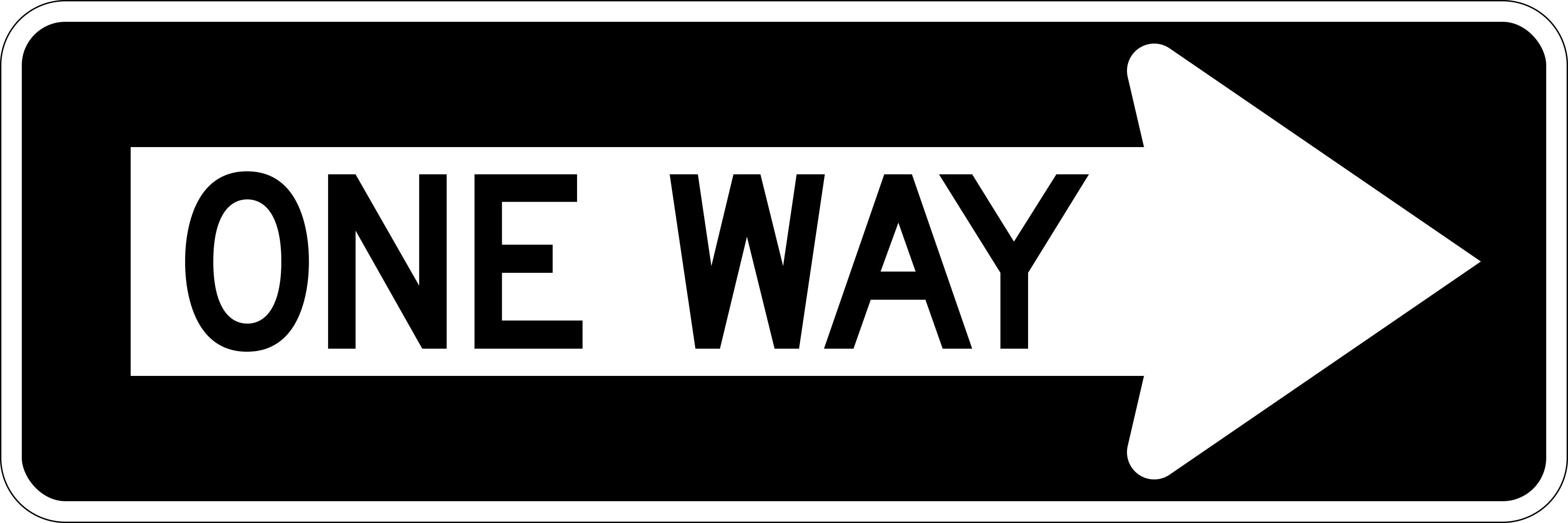
- A right turn is required at the next signal
- Traffic on the roadway or ramp travels in one direction only
- Drivers may reverse direction in the lane
- The road is reserved for buses during rush hour
Show answer
Traffic on the roadway or ramp travels in one direction only. A ONE WAY sign identifies a roadway or ramp where the guide says traffic is allowed in one direction only. The arrow on the sign shows that direction, so the driver should travel with that flow. The sign does not itself require a right turn at the next signal, it does not reserve the road for buses, and it never permits reversing against the indicated flow. The nearby lane control signs in the guide use arrows to tell you which way you can go from each lane, so check those too before turning onto the street.
Study this in the handbook: Road signs by shape and color
7. On Missouri's administrative action chart for a driver arrested for driving under the influence, what license action follows a second offense within a five year period?
- A ten year license denial
- A five year license revocation
- A one year license revocation
- A 30 day suspension
Show answer
A one year license revocation. The guide separates administrative actions, which follow an arrest and a BAC result, from court convicted actions. On the administrative chart, a second offense within a five year period brings a one year license revocation, and an ignition interlock device is required for reinstatement. The five year figure in the guide is a license denial that appears only on the court conviction chart, and a ten year denial belongs to a third or subsequent conviction. A 30 day suspension is a first minor in possession penalty, not this action.
Study this in the handbook: Alcohol limits and DWI penalties
8. What action does the pedestrian crossing warning sign call for?

- Honk so pedestrians leave the roadway
- Yield to pedestrians in the crosswalk and slow down
- Stop only if a traffic signal is also visible
- Use the shoulder to pass the crosswalk
Show answer
Yield to pedestrians in the crosswalk and slow down. The pedestrian crossing warning sign asks drivers to slow down and yield to pedestrians walking in the crosswalk. A horn is not a substitute for yielding, and the duty does not depend on a nearby traffic signal. Driving onto the shoulder to bypass the crossing puts pedestrians and other road users at risk. Approach with enough space to stop smoothly, check both sides of the crossing, and allow a pedestrian to finish crossing before continuing. The walking figure is the cue to look for people, not merely an instruction about a painted line.
Study this in the handbook: Road signs by shape and color
9. During which hours may a Missouri intermediate license holder not drive alone, unless the trip is for a school activity, job, or emergency or a licensed driver 21 or older rides along?
- From midnight to 6:00 a.m.
- From 1:00 a.m. to 5:00 a.m.
- From 11:00 p.m. to 5:00 a.m.
- From 10:00 p.m. to 6:00 a.m.
Show answer
From 1:00 a.m. to 5:00 a.m.. Missouri's intermediate license limits late night driving alone to protect new drivers during the riskiest hours. The guide sets the window from 1:00 a.m. to 5:00 a.m. During those hours the driver may still go to and from a school activity, job, or an emergency, or may drive when accompanied by a licensed driver 21 years of age or older. Midnight, 11:00 p.m., 10:00 p.m., and 6:00 a.m. are not the times the guide uses. Remember the window as one to five.
Study this in the handbook: Permits and the Graduated Driver License
10. For a Missouri driver older than 15 and under 21, what may a state court do after an alcohol related offense such as purchasing alcohol or driving with a BAC above .02%?
- Only issue a written warning
- Nothing until the driver turns 21
- Require a new vision test
- Suspend or revoke the driver license
Show answer
Suspend or revoke the driver license. Missouri gives its courts direct power over young drivers who break alcohol laws. For anyone over 15 and under 21, a conviction for buying or trying to buy alcohol, possessing it, being visibly intoxicated or driving with a BAC above .02% can bring a court ordered suspension or revocation of the driver license. A written warning is not among the listed consequences, a vision test has nothing to do with it, and the penalty is not deferred to age 21. Getting the license back later requires a fee and a substance awareness program.
Study this in the handbook: Underage drinking, Abuse and Lose, and getting your license back
11. At a Missouri J turn intersection, what path does a driver use to continue toward the opposite direction?
- Reverse through the intersection and reenter
- Cross directly through opposing traffic
- Turn left across the median immediately
- Turn right, merge into the far left lane, then turn left
Show answer
Turn right, merge into the far left lane, then turn left. A J turn replaces a direct crossing movement with a right turn in the same direction as traffic, a merge into the far left lane, and a left turn toward the intended destination. The direct crossing choice defeats the design's purpose of avoiding fast moving opposing lanes. Turning left immediately or reversing are not parts of the maneuver. Picture the shape as a right entry followed by a wide loop and a later left turn, with each movement made in the direction permitted by the roadway.
Study this in the handbook: Right of way at intersections and roundabouts
12. During the Missouri driving test, what is the farthest a parallel parked vehicle may be from the curb?
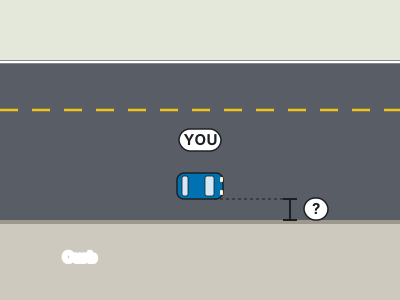
- No more than 6 inches
- No more than 18 inches
- No more than 3 feet
- Exactly 4 feet
Show answer
No more than 18 inches. The parallel parking part of the Missouri driving test is done in a space 25 feet long and seven feet wide, and one of the items the examiner checks is parking no more than 18 inches from the curb. Eighteen inches is the maximum gap, so three feet or four feet is too far. Six inches is close enough to pass, but it is not the limit the guide gives. The examiner also checks parking near the center of the space, not bumping the markers, and finishing within two minutes.
Study this in the handbook: The written, sign, vision and driving tests
13. How does Missouri mark a no passing zone on a two-lane road?
- With a broken white line
- With a broken yellow line
- With a solid yellow line
- With a solid white line along the right edge
Show answer
With a solid yellow line. The guide says two-lane roads may have no passing zones marked with a solid yellow line. These zones are on hills or curves where you cannot see far enough ahead to pass safely, and you must complete passing before you enter the zone. A broken line is the opposite signal: broken lines may be crossed in a passing maneuver. White lines separate traffic moving in the same direction, and a solid white line marks the right edge of many roads, so neither white marking creates a no passing zone.
Study this in the handbook: Pavement markings and lane use
14. What does the octagon shape tell a Missouri driver about a traffic sign?
- It indicates a stop requirement
- It identifies a school area
- It marks a no passing zone
- It marks a railroad crossing
Show answer
It indicates a stop requirement. Missouri uses the octagon as the shape clue for a stop sign. The shape matters even when a driver first notices the sign from a distance or in poor weather. A round sign points to railroad information, a pentagon identifies school information, and a pennant marks a no passing zone. The useful recognition habit is to associate eight sides with stopping, then look for the stop line or crosswalk where the vehicle must halt.
Study this in the handbook: Traffic lights, arrows and officers
15. When may opposing traffic avoid stopping for a school bus on a divided highway?
- When opposing traffic is traveling below 25 mph
- Whenever the median is painted with yellow lines
- Whenever the bus is more than one lane away
- When the two directions use totally separate roads divided by a median
Show answer
When the two directions use totally separate roads divided by a median. Opposing traffic may avoid the school bus stop only in the manual's listed divided-highway situation: the directions travel on totally separate roads divided by a median. A painted line, lane count alone, or a low speed does not create that exception. Following traffic still has to stop, and drivers must obey the bus signals. Identify whether the median separates independent roadways, then remain alert for children and resume only when the bus permits movement.
Study this in the handbook: Passing, turning and signaling
16. Why is continuing to drive while feeling tired especially dangerous?
- Fatigue makes decisions and reactions harder and may lead to falling asleep
- Fatigue only changes the vehicle's fuel consumption
- Fatigue improves concentration on long, repetitive roads
- Fatigue is harmless if the driver opens a window
Show answer
Fatigue makes decisions and reactions harder and may lead to falling asleep. The guide warns that tiredness makes it harder to make decisions and react to traffic, and a driver may fall asleep at the wheel. Opening a window or relying on the length of the trip does not remove that impairment. Fatigue is a safety problem, not a fuel-economy issue. The practical response is to pull off at the nearest rest stop or service area, and take a nap if needed. Treat heavy eyelids, missed signs, or drifting attention as a signal to stop driving.
Study this in the handbook: Phones, distractions, fatigue and road rage
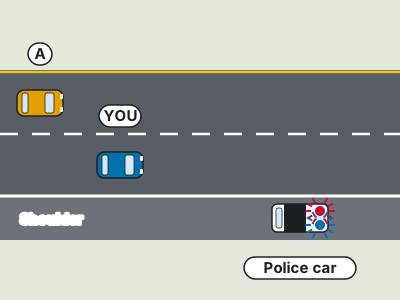
17. How should a Missouri driver handle a stationary emergency vehicle displaying red or red-and-blue lights?
- Use the shoulder at any speed
- Stop in the lane beside the emergency vehicle
- Maintain speed and pass without changing position
- Change to a nonadjacent lane when safe, or slow to a safe speed if changing lanes is unsafe
Show answer
Change to a nonadjacent lane when safe, or slow to a safe speed if changing lanes is unsafe. Missouri’s stationary-emergency-vehicle rule gives two safe responses. On a roadway with enough lanes, change into a lane that is not adjacent when that movement can be made safely. If a lane change is unsafe or impossible, proceed with due caution and reduce speed to a safe level for conditions. Stopping beside the vehicle or passing at unchanged speed leaves responders exposed. First assess the lane change, then slow if needed.
Study this in the handbook: Right of way at intersections and roundabouts
18. Which of these is listed as illegal parking in Missouri?
- Parking with the right wheels 6 inches from the curb
- Parking with your vehicle facing against traffic
- Parking in a lit parking lot at night
- Parking on a residential street
Show answer
Parking with your vehicle facing against traffic. Missouri's list of places you cannot park includes on a bridge, blocking a fire hydrant, blocking the normal flow of traffic or creating a hazard to other drivers, and parking with your vehicle facing against traffic. Facing against traffic is the listed violation among these choices. Right wheels six inches from the curb, a lit parking lot at night, and an ordinary residential street are not on that list. Handicapped spaces may be used only when the vehicle displays the proper placard or plate.
19. What is Missouri's recommended response when highway hypnosis makes a driver sleepy?
- Pull off the highway and stop at a rest area or service area
- Increase speed so the repetitive road ends sooner
- Keep driving while staring straight ahead to maintain focus
- Rely on loud music instead of taking a break
Show answer
Pull off the highway and stop at a rest area or service area. Highway hypnosis can make a driver sleepy and unaware of surrounding traffic. Missouri advises pulling off the highway when sleepiness appears, and taking a nap when the driver is really sleepy. Staring harder, increasing speed, or using loud music does not restore safe alertness and can shorten the time available to react. A concrete cue is a repetitive stretch of road combined with lost awareness of signs or traffic. Treat that feeling as a stopping signal, not as a reason to push farther.
Study this in the handbook: Highway driving, merging and breakdowns
20. About how far ahead do your headlights let you see at night, according to the Missouri guide?
- About 100 feet
- About 1,000 feet
- About 350 feet
- About one mile
Show answer
About 350 feet. The Missouri guide says your headlights only let you see about 350 feet ahead, and it warns drivers not to overdrive their headlights. That means driving slow enough to stop or turn within the distance the lights reveal. One hundred feet is far shorter than the stated reach, while a thousand feet or a mile is far longer. The same night driving list says to use high beams when there are no oncoming vehicles and to switch to low beams within 500 feet of an oncoming vehicle or 300 feet behind another vehicle.
Study this in the handbook: Night driving, rain, snow, fog and skids
QualitySpace is expanding to Missouri
We are a California-based independent insurance brokerage working on licensing in more states. We cannot help with Missouri insurance yet. Leave your email and we will let you know when we can.
Every question is written from the official Missouri Driver Guide. Need paper? Printable MO practice test with answer key.
Last verified 2026-10-05. How we check every question · Study all 201 as flashcards
Frequently asked questions
How many questions are on this Missouri practice test?
This fixed set has 20 questions. It is test 8 of 10 from the 201 question Missouri bank. The real MO exam asks 25 questions and you need 20 correct.
What is the passing score for the real Missouri test?
80% to pass That figure comes from the official Missouri source cited on the DMV facts page.
How does this fixed test relate to the full Missouri bank?
Each numbered test is a fixed set of questions in a fixed order, so you can retake the same test later and compare. Every test mixes road signs and the other topics in about the same proportion as the full bank. Tests 1 to 10 together cover 200 of the 201 questions in the Missouri bank, each once. The full practice page mixes the whole bank at random.
Last verified 2026-10-05. See the Missouri DMV facts page for sourced state details.
Return to the full Missouri practice test · Study road signs