
Test 12 of 25 · 20 questions · Free 2026
MO Permit Practice Test 12
Jump to the test ↓A fixed 20 question set from the Missouri bank with answers and plain English explanations. The real MO exam is 25 questions, 80 percent to pass; take the full length version on the main practice page.
Question 1 of 20 · 0 right so far
All 20 questions in test 12
Every question below comes from the Missouri question bank on this page. Open a question to see the correct answer and the explanation. Nothing here is hidden behind a signup.
1. You pass a crash scene on a Missouri highway. What does the guide warn about slowing to get a good look?
- Concentrating on it can distract you from driving
- Looking is helpful so you can report details
- It is safe if you are in the far left lane
- It is fine as long as you keep your speed up
Show answer
Concentrating on it can distract you from driving. Missouri's guide warns that looking out your window at what you are passing can be a distraction when you concentrate on getting a good look. A crash scene is the first example it gives, along with billboards, vehicles pulled over by police, construction work, scenic views, and street addresses. The guide's advice is simple: always focus on your driving and stay alert to reach your destination safely.
Study this in the handbook: Phones, distractions, fatigue and road rage
2. You parallel park on a busy Missouri street with children in the back seat. Which door should they use to get out?
- The door on the street side, if you watch traffic
- Whichever door is closest to where they sit
- The street side door, once you open yours first
- The curb side door, away from passing traffic
Show answer
The curb side door, away from passing traffic. Missouri asks drivers to check traffic before opening a door and, when possible, to get out on the curb side. Passengers, especially children, should always exit on the curb side. The guide also warns to watch for bicyclists, who often ride on the right side of travel lanes near parked cars, and to shut the door as soon as you can after getting out. A street side door puts a child next to moving traffic.
3. Traffic is backed up just past a Missouri railroad crossing. When may you start across the tracks?
- As soon as the car ahead of you starts across
- Only when there is room for your car on the far side
- When no train is visible, even if you must stop on the tracks
- When the crossing has no gates or lights
Show answer
Only when there is room for your car on the far side. Missouri says never to start across railroad tracks until there is room for your vehicle on the other side. If traffic stops while you are on the crossing, you could be trapped on the tracks when a train comes. Following the car ahead or seeing no train right now is not enough. Wait behind the crossing until the space beyond the tracks is clear, and never try to beat a train across.
Study this in the handbook: Speed limits and minimum speeds
4. You are passing a car on a Missouri highway. When is it safe to move back into the right lane?
- When the passed car shows in your rearview mirror
- As soon as your back bumper clears its front bumper
- When the other driver flashes headlights at you
- After you have been beside it for three seconds
Show answer
When the passed car shows in your rearview mirror. After passing on a Missouri highway, give plenty of room to the vehicle you just passed. The guide says not to return to the right lane until you can see that vehicle in your rearview mirror. Before moving over, look over your right shoulder to check your blind spot and use your signal. Cutting back in as soon as your bumper clears leaves the other driver almost no space.
Study this in the handbook: Passing, turning and signaling
5. This sign is posted on a Missouri road, but heavy rain is making it hard to see. What does the law require?

- Drive exactly 50, since that is the posted speed
- Drive 50 but turn on your hazard lights
- Drive up to 55, since the limit allows a small cushion
- Slow down below 50 as conditions demand
Show answer
Slow down below 50 as conditions demand. Missouri speed limit signs show the maximum speed allowed by law in ideal conditions. They do not mean every part of the road can be safely driven at that speed in every condition. Hills, curves, slippery roads, limited sight distance, pedestrians, and bicyclists can make the posted limit unsafe, and by law you must slow down when conditions demand it. Rain that cuts visibility is one of those times.
Study this in the handbook: Speed limits and minimum speeds
6. You and a car on your right reach an unmarked rural Missouri intersection at the same moment, with no sign or signal. What should you do?
- Yield and let the car on your right go first
- Go first, because the driver on the left has priority
- Go first if your road is the wider of the two
- Flash your lights and both go together
Show answer
Yield and let the car on your right go first. At a Missouri intersection with no stop sign or traffic signal, drivers must yield to vehicles coming from the right. Roundabouts are the exception, since there you yield to traffic already in the circle. The car on your right goes first here, even if your road looks bigger. The law only says who must yield, so the other driver should still watch for you before going.
Study this in the handbook: Right of way at intersections and roundabouts
7. You are halfway through passing a slow car on a two-lane Missouri road when you see a no passing zone starting just ahead. What must you do?
- Finish the pass inside the zone, since you started first
- Stay beside the car until the zone ends
- Be back in your lane before the zone begins
- Speed up past the limit to finish anywhere
Show answer
Be back in your lane before the zone begins. Missouri requires drivers to complete passing before they enter a no passing zone. No passing zones are on hills or curves where you cannot see far enough ahead to pass safely. If you cannot get back into your lane before the zone begins, ease off and drop back behind the car instead. Riding alongside or going over the speed limit only adds danger.
Study this in the handbook: Pavement markings and lane use
8. You are driving toward a T Intersection Ahead sign at night on an unfamiliar Missouri road. What must you get ready to do?
- Turn right or left, since your road ends
- Continue straight through the intersection
- Merge with traffic coming from the left
- Make a U-turn before the intersection
Show answer
Turn right or left, since your road ends. The T Intersection Ahead sign tells Missouri drivers that the road they are traveling does not continue, so they must turn either right or left. At night it is easy to miss where the road ends, so slow down early, signal, and be ready to stop or yield before turning. Continuing straight would take you off the road, and a U-turn is not what the sign calls for. Watch for cross traffic on the road you are turning onto.
Study this in the handbook: Road signs by shape and color
9. At a Missouri intersection, the green left-turn arrow lights up, but you are in the lane marked for going straight. What should you do?
- Cut across into the turn lane and go
- Turn left from your lane, since the arrow is green
- Do not turn; you are not in the proper lane
- Honk so the turn lane lets you merge in
Show answer
Do not turn; you are not in the proper lane. A green arrow tells Missouri drivers they can drive in the direction the arrow points, but only if they are in the proper lane and the way is clear of all traffic and pedestrians. The arrow is for drivers already in the turn lane. If you are in the straight lane, continue straight and find a legal way to turn later. Cutting across lane lines at the intersection puts you in the path of other drivers.
Study this in the handbook: Traffic lights, arrows and officers
10. Your brake pedal sinks to the floor, and pumping it does not help. What should you do next?
- Yank the parking brake as hard as you can
- Use the parking brake gradually and shift down
- Turn off the engine and coast to a stop
- Shift into park while the car is moving
Show answer
Use the parking brake gradually and shift down. If your brake pedal suddenly sinks to the floor, Missouri says to pump it fast and hard several times first. If that does not work, use the emergency or parking brake gradually, shift to a low gear, and look for a place to slow to a stop. Make sure the vehicle is off the road, then call for help instead of trying to drive to a garage.
Study this in the handbook: Night driving, rain, snow, fog and skids
11. You hear a loud bang and the steering wheel jerks as a tire blows out on a Missouri highway. What should you do?
- Brake hard at once to stop as quickly as you can
- Speed up slightly so the car pulls straight
- Steer quickly onto the shoulder while braking
- Hold the wheel tight and ease off the gas, no braking
Show answer
Hold the wheel tight and ease off the gas, no braking. A tire blowout may sound like a loud bang followed by a thump, thump, thump, and the steering wheel may jerk. Missouri says to hold the steering wheel tightly, take your foot off the accelerator, and not hit the brakes. Let the vehicle slow to a stop completely off the road, applying the brakes only when it is almost stopped. Then turn on your emergency flashers.
Study this in the handbook: Brake failure, blowouts and other emergencies
12. You are backing out of your driveway onto a Missouri street as a car approaches. Who must yield?
- You must yield to the car already on the street
- The approaching car must stop for you
- Whoever sounds the horn first gets to go first
- The approaching car, if you were moving first
Show answer
You must yield to the car already on the street. Missouri says drivers entering a road from a driveway, alley, or roadside must yield to vehicles already on the main road. That applies whether you are pulling forward or backing out. Wait until the approaching car passes and the way is clear, and remember that drivers crossing a sidewalk must also yield to pedestrians. Starting to move first does not give you the right-of-way.
Study this in the handbook: Right of way at intersections and roundabouts
13. While driving in Missouri, you notice the line to your left is yellow. What does that tell you about traffic on the other side of it?
- It is moving in your direction
- It is a bicycle lane going your way
- It is moving in the opposite direction
- It is a lane for buses and taxis only
Show answer
It is moving in the opposite direction. Line color tells you which way traffic flows in Missouri. Yellow lines separate traffic traveling in opposite directions, so a yellow line on your left means the vehicles on its other side are coming toward you. White lines separate traffic moving in the same direction. Knowing this helps you avoid drifting or passing into oncoming traffic, especially on unfamiliar roads or at night.
Study this in the handbook: Pavement markings and lane use
14. A friend says diet pills or pep pills will keep you alert for a long drive. What does the Missouri guide say?
- They keep a driver alert safely for many hours
- They are fine as long as no alcohol is used
- They improve vision for night driving
- They help briefly, then can leave you dizzy and unfocused
Show answer
They help briefly, then can leave you dizzy and unfocused. Missouri warns that pep pills, uppers, and diet pills can make a driver more alert for a short time, but later they can make a person nervous, dizzy, and unable to concentrate. They can also affect vision. They are not a safe substitute for rest. If you are tired, the guide's advice is to pull off at a rest stop or service area and take a nap if you are really sleepy.
Study this in the handbook: Alcohol limits and DWI penalties
15. On the outside edge of a turn on a Missouri road, you see a yellow sign with one large black arrow pointing sideways. What does it mean?
- A one-way street begins at the next block
- Slow down for a sharp change in direction
- The right lane is ending and you must merge
- A detour route begins and you must follow it
Show answer
Slow down for a sharp change in direction. Missouri uses the Large Arrow sign on the outside of a turn to warn of a sharp change in the direction of travel. When you see it, slow down before you reach the turn. A one-way street is marked with a black and white ONE WAY sign, and lane endings and detours have their own signs. Yellow warning signs like this one tell you to slow down and be prepared to stop if necessary.
Study this in the handbook: Road signs by shape and color
16. What does a lane control sign like this one tell Missouri drivers?
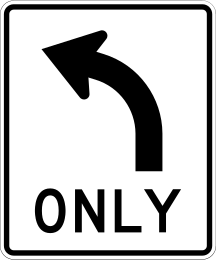
- Which direction you may go from each lane
- Where the road narrows to a single lane
- Which lane is closed for road work ahead
- Where U-turns are allowed on this street
Show answer
Which direction you may go from each lane. Lane control signs in Missouri use an arrow symbol to tell you which direction you can go from each lane. They may stand along the road or hang over it. A left arrow with the word ONLY means traffic in that lane must turn left, so choose your lane early and avoid last second changes. Narrowing roads and lane closures are shown on yellow warning or orange work zone signs instead.
Study this in the handbook: Road signs by shape and color
17. Your speed is rising past 35 mph on a rain-soaked Missouri road. What risk does the guide say now exists?
- Your brakes will lock automatically
- Your engine may flood from road spray
- Your tires may begin to hydroplane
- Your headlights will start to fog over
Show answer
Your tires may begin to hydroplane. Hydroplaning happens when your tires ride on the water instead of the pavement, causing a loss of traction and control. Missouri says it can happen at any speed over 35 mph, and in a severe rainstorm tires can lose all contact with the road at 55 mph. Slow down in rain, keep good tires properly inflated, and do not use cruise control.
Study this in the handbook: Night driving, rain, snow, fog and skids
18. Why does the Missouri guide tell you not to leave your car's motor running inside a garage?
- Idling in a small space can overheat the engine
- The exhaust contains carbon monoxide, a deadly gas
- The exhaust can stain and damage the garage walls
- Idling a cold engine drains the battery quickly
Show answer
The exhaust contains carbon monoxide, a deadly gas. Vehicle motors give off carbon monoxide, which is a deadly gas. To avoid carbon monoxide poisoning, the guide says not to leave the motor running in a garage. It also warns against leaving the motor running with the windows closed when you park, and against using the heater or air conditioner in a parked vehicle with the windows closed. Engine overheating, wall stains, and battery wear are not the danger the guide names.
Study this in the handbook: Speed limits and minimum speeds
19. At night on a Missouri road, an oncoming car is approaching. Within what distance should you switch to low beams?
- 300 feet, about a football field
- 500 feet, or about one block
- 200 feet, about half a block
- 1,000 feet, about two blocks
Show answer
500 feet, or about one block. Missouri tells drivers to use low beams when they come within 500 feet, about one block, of an oncoming vehicle. High beams at that range can blind the other driver. A shorter figure, 300 feet, applies when you are following another vehicle. When no oncoming vehicles are near, the guide says to use your high beams, while making sure you are not driving faster than your headlights let you see.
Study this in the handbook: Night driving, rain, snow, fog and skids
20. A driver is tailgating you on a two-lane Missouri road. Why should you avoid braking suddenly to make them back off?
- It is the fastest way to make them pass you
- It is fine as long as your brake lights work
- It is allowed only on roads with a right lane
- It increases your risk of being hit from behind
Show answer
It increases your risk of being hit from behind. Missouri says never to slow down quickly to discourage a tailgater, because it only increases your risk of being hit from behind. If there is a right lane, move over and let the driver pass. If there is no right lane, wait until the road ahead is clear and then reduce your speed slowly, which encourages the tailgater to go around you. Keeping a steady speed and signaling early also helps.
Study this in the handbook: Seat belts, child seats and following distance
Every question is written from the official Missouri Driver Guide. Need paper? Printable MO practice test with answer key.
Last verified 2026-10-05. How we check every question · Study all 500 as flashcards
Frequently asked questions
How many questions are on this Missouri practice test?
This fixed set has 20 questions. It is test 12 of 25 from the 500 question Missouri bank. The real MO exam asks 25 questions and you need 20 correct.
What is the passing score for the real Missouri test?
80% to pass That figure comes from the official Missouri source cited on the DMV facts page.
How does this fixed test relate to the full Missouri bank?
Each numbered test is a fixed set of questions in a fixed order, so you can retake the same test later and compare. Every test mixes road signs and the other topics in about the same proportion as the full bank. Tests 1 to 25 together cover every question in the Missouri bank once. The full practice page mixes the whole bank at random.
Last verified 2026-10-05. See the Missouri DMV facts page for sourced state details.
Return to the full Missouri practice test · Study road signs