
Test 11 of 25 · 20 questions · Free 2026
MO Permit Practice Test 11
Jump to the test ↓A fixed 20 question set from the Missouri bank with answers and plain English explanations. The real MO exam is 25 questions, 80 percent to pass; take the full length version on the main practice page.
Question 1 of 20 · 0 right so far
All 20 questions in test 11
Every question below comes from the Missouri question bank on this page. Open a question to see the correct answer and the explanation. Nothing here is hidden behind a signup.
1. What does it mean when a Missouri highway has controlled access?
- Only drivers with a special permit may use it
- Traffic signals control every intersection on it
- You can get on or off only at its ramps
- Trucks must use a separate set of lanes
Show answer
You can get on or off only at its ramps. A controlled-access highway in Missouri is one you can enter or leave only where there are entrance or exit ramps. Entrance ramps usually end in an acceleration lane for building speed, and exit ramps usually begin with a deceleration lane for slowing down. Since there are no other ways on or off, a driver who misses an exit must continue to the next one. No special permit is needed to use the road.
Study this in the handbook: Highway driving, merging and breakdowns
2. A cold medicine label says it may cause drowsiness or dizziness. What does the Missouri guide say about taking it before driving?
- Take a double dose so it wears off sooner
- It is fine if you drink coffee with it
- Do not take it before you drive anywhere
- It is fine because it was sold without a prescription
Show answer
Do not take it before you drive anywhere. Missouri warns that all medications, prescription and over-the-counter, can impair driving even when taken as directed. Over-the-counter cold and allergy medicines can make you drowsy, and any drug labeled may cause drowsiness or dizziness is one you should not take before driving. Read the warning label, ask a physician or pharmacist if you are unsure, and never mix medicine with alcohol.
Study this in the handbook: Alcohol limits and DWI penalties
3. The red lights are flashing at a Missouri railroad crossing, and you must stop. Which stopping spot is within the rule?
- 5 feet before the tracks
- 75 feet before the tracks
- Right at the edge of the first rail
- 30 feet before the tracks
Show answer
30 feet before the tracks. When the red lights are flashing or the gate is down at a Missouri railroad crossing, you must stop within 15 to 50 feet before the tracks. Thirty feet falls inside that range. Five feet is closer than the minimum, and seventy-five feet is farther back than the rule describes. Stay stopped until the train has passed, and never try to go around the gate.
Study this in the handbook: Road signs by shape and color
4. You are driving on a Missouri road and see a red and white WRONG WAY sign facing you. What has probably happened?
- The road ahead is closed to trucks
- A work zone is just ahead
- You have entered a lane of oncoming traffic
- The ramp ahead leads to a one-way street in your direction
Show answer
You have entered a lane of oncoming traffic. A WRONG WAY sign facing you means you made a wrong turn and have entered a lane of oncoming traffic. The guide tells you to pull off the road as quickly and safely as possible, turn around, and go back. The sign is not about trucks, work zones, or a one-way street that runs in your direction, so treat it as a warning to get out of the oncoming lane as soon as you can do so safely.
Study this in the handbook: Road signs by shape and color
5. Driving into thick fog on a Missouri highway at night, you notice your high beams make it harder to see. Which lights should you use?
- Low beams
- High beams
- Parking lights only
- No lights at all
Show answer
Low beams. Missouri says to keep your headlights on low beam in fog, because you will see less if your lights are on high beam. Reduce your speed and be alert and ready to stop. If the fog becomes so thick that you cannot see, pull off the road, stop, and leave your lights and emergency flashers on. Parking lights alone or no lights at all make you hard for others to see.
Study this in the handbook: Night driving, rain, snow, fog and skids
6. A funeral procession with flashing lights is going through a red light at a Missouri intersection where your light is green. What should you do?
- Wait and let the procession pass
- Go, since your light is green
- Drive between two of its cars
- Join the end to get through faster
Show answer
Wait and let the procession pass. An organized funeral procession in Missouri has the right-of-way at all intersections regardless of any traffic control device, except for emergency vehicles or when law enforcement directs otherwise. Drivers not in the procession must not drive between its moving vehicles, must not join it to get the right-of-way, and must not enter an intersection where it is going through a red light unless they can do so without crossing its path.
Study this in the handbook: Right of way at intersections and roundabouts
7. You are driving your grandmother's car, which has a disabled placard, but she is at home. May you park in a handicapped space while you shop?
- Yes, the placard makes it legal
- Yes, for 15 minutes or less
- Yes, if the lot is nearly empty
- No, the disabled person must be with you
Show answer
No, the disabled person must be with you. In Missouri, handicapped parking spaces may be used only when the vehicle displays a handicapped placard or plates and a physically handicapped person is in the vehicle at the time of parking, or is being dropped off or picked up. The law also makes it illegal to use a handicapped person's placard to park in a designated space when that person is not being transported. An empty lot or short stay does not change this.
8. You feel your car start to hydroplane on a wet Missouri highway. What should you do?
- Take your foot off the gas; do not hit the brakes
- Brake hard right away to regain traction
- Speed up so the tires cut through the water
- Turn the wheel sharply toward the shoulder
Show answer
Take your foot off the gas; do not hit the brakes. If you think your tires are hydroplaning, Missouri says to take your foot off the accelerator and slow down. Do not hit the brakes, because that may cause you to skid. Jerking the wheel can also make a skid worse once the tires grip again. To avoid hydroplaning, keep good tires with deep treads, keep them properly inflated, slow down in rain, and skip cruise control.
Study this in the handbook: Night driving, rain, snow, fog and skids
9. You are driving with high beams on a dark Missouri road when an oncoming car appears about one block away. What should you do?
- Keep high beams until it is 100 feet away
- Flash high beams to warn the driver
- Turn off all your lights
- Switch to your low beams right away
Show answer
Switch to your low beams right away. The Missouri rule is to dim to low beams within 500 feet, about one block, of a vehicle coming toward you. An oncoming car one block away is within that distance, so dim your lights now. Waiting until the car is much closer can blind the other driver. When no oncoming vehicles are near, use your high beams again so you can see farther ahead.
Study this in the handbook: Night driving, rain, snow, fog and skids
10. On a Missouri highway with two lanes your way, a driver is riding close behind you in the left lane, and the right lane is open. What should you do?
- Tap your brakes to warn the driver
- Move over to the right lane
- Speed up until the driver backs off
- Slow down sharply to make a point
Show answer
Move over to the right lane. If you are followed too closely, or tailgated, and there is a right lane, Missouri says to move over to the right and let the other driver go by. If there is no right lane, wait until the road ahead is clear and then reduce speed slowly. Never slow down quickly to discourage a tailgater, since that only increases your risk of being hit from behind.
Study this in the handbook: Seat belts, child seats and following distance
11. You feel unsafe driving at the minimum speed shown on this sign on a Missouri interstate, and conditions are normal. What does the guide suggest?
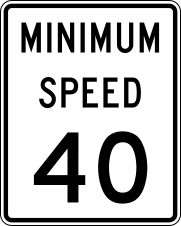
- Use another route instead of the interstate
- Drive on the shoulder with your flashers on
- Stay in the left lane so trucks can pass you
- Drive below the minimum but turn on your flashers
Show answer
Use another route instead of the interstate. Missouri interstates have minimum speed limits as well as maximums. Under normal roadway conditions you may not drive slower than 40 mph on an interstate, and the guide says that if the minimum speed is too fast for you, you should use another route. Driving below a posted minimum is allowed in bad weather, heavy traffic, or on a bad road. The shoulder is not a slow lane, and the left lane is for passing.
Study this in the handbook: Speed limits and minimum speeds
12. At a Missouri railroad crossing, a small sign is mounted just below the white X-shaped crossbuck. What does that small sign tell you?
- How many trains pass each day
- How far away the next train is
- How many tracks cross the road
- How many cars may wait on the tracks
Show answer
How many tracks cross the road. At Missouri railroad crossings, the white X-shaped crossbuck means you must yield to trains, just as at a yield sign. The sign mounted under the crossbuck tells you how many tracks cross the road. When there are two or more tracks, look for a second train before you cross, since the red lights may keep flashing after the first train passes. The small sign does not show train schedules or distances.
Study this in the handbook: Road signs by shape and color
13. You approach a Missouri lane closure work zone. Which two actions does the guide list?
- Stay in your lane and keep the normal speed limit
- Use the shoulder to pass the closed lane quickly
- Merge into an open lane and slow to the zone limit
- Stop and wait until a flagger waves you through
Show answer
Merge into an open lane and slow to the zone limit. In a Missouri lane closure, work takes place in a travel lane. The guide tells drivers to merge into the designated lane or a lane where work is not being performed and to reduce speed to the designated work zone speed limit. Stay alert, avoid distractions, obey the work zone signs, and watch for vehicles entering and leaving the work area. A flagger belongs to a different setup, the flagging operation.
14. This curve sign on a Missouri road carries an advisory speed plate. In which conditions does the guide say you should never take the curve faster than the plate shows?
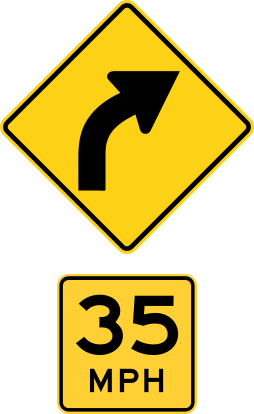
- In rain, snow, or icy conditions
- When another car is right ahead of you
- At night when you are on low beams
- When a police car is in sight
Show answer
In rain, snow, or icy conditions. Curve and turn signs in Missouri often carry an advisory speed plate that shows the recommended speed for the curve or turn. The guide admits you may feel comfortable going faster in fair weather, but says you should never do so in rain, snow, or icy conditions. Wet pavement makes it harder to stay on the road on curves, so treat the plate's number as a ceiling in bad weather.
Study this in the handbook: Road signs by shape and color
15. What does Missouri right-of-way law actually do for drivers?
- It grants the right-of-way to drivers on the busier road
- It says who must yield but gives no driver the right-of-way
- It lets a driver keep going once the right-of-way is theirs
- It gives the right-of-way to whoever reaches the spot first
Show answer
It says who must yield but gives no driver the right-of-way. Missouri law describes who must yield in places such as intersections and driveways, but it never hands any driver the right-of-way. A driver who believes it is their turn still has to be ready to let others go first. The guide adds that you must do everything you can to avoid striking a pedestrian or another vehicle, whatever the circumstances. Being on the busier road, arriving first, or already moving does not create a legal claim to go ahead.
Study this in the handbook: Right of way at intersections and roundabouts
16. A highway worker on a Missouri road is directing traffic with hand signals. Must you follow those directions?
- Yes, you must obey directions from highway personnel
- No, a worker's signals are just suggestions
- Yes, but just when they match the traffic light
- No, follow the posted signs instead of the worker
Show answer
Yes, you must obey directions from highway personnel. Missouri says traffic control can come from law enforcement, highway personnel, or school crossing guards, in addition to signals, signs, and pavement markings. You must obey directions from these persons. If a person's hand signals conflict with a sign or light, follow the person, just as the guide says to obey a traffic officer and ignore any signs or signals. Slow down and watch the worker closely.
Study this in the handbook: Pavement markings and lane use
17. Why does the Missouri guide call texting the most dangerous driving distraction?
- It drains the car's battery very quickly
- It takes your eyes, hands, and mind off driving
- It is the only distraction covered by law
- It makes the phone screen glare at night
Show answer
It takes your eyes, hands, and mind off driving. Missouri's guide lists many distractions, including eating, grooming, talking to passengers, and adjusting the radio. Text messaging stands out because it requires visual, manual, and cognitive attention from the driver: your eyes leave the road, your hands leave the wheel, and your mind leaves the drive. That is why the guide calls it by far the most high risk distraction, and Missouri law bars any driver from texting while driving.
Study this in the handbook: Phones, distractions, fatigue and road rage
18. Your car is failing on a Missouri highway and you cannot get it off the road. Where should you try to stop?
- Just past the top of a hill, out of the wind
- Just around a curve, where traffic slows down
- In the left lane, away from the shoulder
- Where other drivers have a clear view of it
Show answer
Where other drivers have a clear view of it. If a breakdown leaves your vehicle in the roadway, Missouri says to stop where other drivers have a clear view of it. Do not stop just over a hill or just around a curve, because drivers coming toward you will not see the car until it may be too late to stop. Turn on your emergency flashers and place flares behind the vehicle if you have them, so other drivers can change lanes in time.
Study this in the handbook: Highway driving, merging and breakdowns
19. On a busy Missouri highway, how often does the guide say you should check your rearview mirrors?
- About once a minute
- Every few seconds
- Only before you change lanes
- Only when a horn sounds behind you
Show answer
Every few seconds. The guide tells you to check your rearview mirrors every few seconds to keep track of the approaching traffic, and to make sure other drivers see you. This habit lets you notice vehicles that are closing in or changing lanes before you act. Mirrors do not cover your blind spots, which is why the guide also says to look over your shoulder before you change lanes or move back into a lane after passing.
Study this in the handbook: Passing, turning and signaling
20. May you drive a pickup truck onto the truck apron in the middle of a Missouri roundabout?
- Yes, any vehicle called a truck may use the apron
- Yes, whenever the circle is crowded with traffic
- Yes, if you need to go all the way around for a U-turn
- No, aprons are not for cars, SUVs, or pickup trucks
Show answer
No, aprons are not for cars, SUVs, or pickup trucks. A truck apron is the paved area on the inside of a Missouri roundabout that the rear wheels of large trucks use when turning, since big trucks need more space. The guide states that truck aprons are not to be used by cars, SUVs, or pickup trucks. Even when going all the way around, smaller vehicles stay in the travel lane to the right of the center island.
Study this in the handbook: Right of way at intersections and roundabouts
Every question is written from the official Missouri Driver Guide. Need paper? Printable MO practice test with answer key.
Last verified 2026-10-05. How we check every question · Study all 500 as flashcards
Frequently asked questions
How many questions are on this Missouri practice test?
This fixed set has 20 questions. It is test 11 of 25 from the 500 question Missouri bank. The real MO exam asks 25 questions and you need 20 correct.
What is the passing score for the real Missouri test?
80% to pass That figure comes from the official Missouri source cited on the DMV facts page.
How does this fixed test relate to the full Missouri bank?
Each numbered test is a fixed set of questions in a fixed order, so you can retake the same test later and compare. Every test mixes road signs and the other topics in about the same proportion as the full bank. Tests 1 to 25 together cover every question in the Missouri bank once. The full practice page mixes the whole bank at random.
Last verified 2026-10-05. See the Missouri DMV facts page for sourced state details.
Return to the full Missouri practice test · Study road signs