
Test 15 of 25 · 20 questions · Free 2026
MO Permit Practice Test 15
Jump to the test ↓A fixed 20 question set from the Missouri bank with answers and plain English explanations. The real MO exam is 25 questions, 80 percent to pass; take the full length version on the main practice page.
Question 1 of 20 · 0 right so far
All 20 questions in test 15
Every question below comes from the Missouri question bank on this page. Open a question to see the correct answer and the explanation. Nothing here is hidden behind a signup.
1. Your car stalls on railroad tracks in Missouri, and no train is in sight. What does the guide say to do?
- Wait in the car with your flashers on until help arrives
- Listen for a train, try to restart, or push it off in neutral
- Call for a tow truck and stay buckled in your seat
- Leave the car where it is and walk home for help
Show answer
Listen for a train, try to restart, or push it off in neutral. If your vehicle stalls on railroad tracks and no train is in sight, Missouri says to roll down your windows and listen for a train, try to start the engine, and if that fails, put the vehicle in neutral and push it off the tracks. If a train is approaching, the steps change: unfasten your seat belt, get out, get off the tracks, and run in the direction the train is coming from.
Study this in the handbook: Brake failure, blowouts and other emergencies
2. A Missouri family is driving with a 6-year-old who weighs 35 pounds. What restraint does the law require?
- A child passenger restraint system
- A regular seat belt, since the child is over four
- A booster seat or a seat belt, parent's choice
- No restraint if riding in the back seat
Show answer
A child passenger restraint system. Missouri's child restraint law says children weighing less than 40 pounds, regardless of age, must be secured in a child passenger restraint system appropriate for that child. A 35 pound six-year-old falls under that rule even though the child is over four. Booster seats and seat belts come into play only as a child grows past the weight and age thresholds in the law.
Study this in the handbook: Seat belts, child seats and following distance
3. What does the Missouri guide say about 12- and 15-passenger vans carrying more than ten passengers?
- They handle exactly like a regular family car
- They are safe as long as everyone wears a belt
- They become unstable when loaded that heavily
- They may not be driven on Missouri interstates
Show answer
They become unstable when loaded that heavily. Missouri's guide cites the National Transportation Safety Board, which found that 12- and 15-passenger vans are inherently unstable when loaded to the level they are designed for, carrying more than ten passengers. The board recommends that all drivers of these vans get specific training on how they handle and operate. Seat belts protect riders, but they do not change how a fully loaded van handles.
Study this in the handbook: Brake failure, blowouts and other emergencies
4. You use the three second rule behind another car in Missouri and reach the roadside sign before you finish counting. What does that mean?
- You are following too closely
- Your following distance is just right
- The other car is going too slowly
- You should pass the car right away
Show answer
You are following too closely. Missouri's three second rule works like this: pick an object near the road ahead, such as a sign or telephone pole. When the vehicle ahead passes it, count slowly, one-thousand one, one-thousand two, one-thousand three. If you reach the object before you finish counting, you are too close. Drop back and count again until you have at least three seconds of space.
Study this in the handbook: Seat belts, child seats and following distance
5. It is noon and sunny, but a passing shower makes you turn on your wipers on a Missouri highway. What about your headlights?
- Leave them off, since it is daytime
- Turn them on while the wipers are needed
- Turn them on only after sunset
- Use your hazard flashers instead
Show answer
Turn them on while the wipers are needed. Missouri law says you must use your headlights any time weather conditions require the use of your windshield wipers, day or night. A midday shower that calls for wipers also calls for headlights. Hazard flashers are for trouble, not a substitute for headlights. Wet pavement also makes stopping take longer, so slow down and leave more space ahead. Rain also mixes with oil on the pavement to make the road slick.
Study this in the handbook: Night driving, rain, snow, fog and skids
6. A tow truck with flashing amber lights is stopped on the right shoulder of a Missouri four-lane highway, and the left lane is open. What should you do?
- Stay in the right lane at full speed
- Stop behind the tow truck and wait
- Move into the left lane if it is safe
- Honk as you pass so the driver knows
Show answer
Move into the left lane if it is safe. Missouri's Move Over law also covers stationary vehicles displaying amber or amber and white lights, such as a stopped tow truck. On a road with at least four lanes and two going your direction, proceed with caution and change into a lane not adjacent to the stopped vehicle if it is safe. If a lane change would be unsafe or impossible, slow down and keep a safe speed for road conditions.
7. What causes highway hypnosis, according to the Missouri guide?
- The sameness of the road, traffic, and steady noise
- Driving too fast after drinking coffee
- Looking at oncoming headlights for a long time
- Driving with the windows rolled down in cold air
Show answer
The sameness of the road, traffic, and steady noise. Highway hypnosis makes a driver feel sleepy and unaware of nearby traffic. Missouri explains that it is caused by the sameness of the road and traffic, and that the hum of the wind, tires, and engine adds to it. Long, unchanging stretches of highway are where it shows up. The guide's defense is to keep your eyes moving, watch traffic and signs, and pull off the highway if you feel sleepy.
Study this in the handbook: Highway driving, merging and breakdowns
8. On many Missouri roads, what marks the right edge of the road?
- A broken yellow line
- A solid white line
- A double yellow line
- A broken white line
Show answer
A solid white line. Missouri pavement markings use a solid white line to mark the right edge of many roads. White lines relate to traffic moving in the same direction, while yellow lines separate opposite directions. At night, the guide suggests using the edge line as a guide, and if there is no edge line, using the center line instead. Broken lines are the ones that may be crossed in a passing maneuver.
Study this in the handbook: Pavement markings and lane use
9. A yellow sign near a Missouri highway exit shows the word EXIT and a number followed by MPH. What does it tell you?
- The minimum speed allowed on the highway
- The speed limit for the next town
- How many miles until the next exit
- The recommended speed for the exit ramp
Show answer
The recommended speed for the exit ramp. Missouri's Exit Speed Advisory sign tells you the highway exit ramp has a speed advisory, meaning a recommended speed for taking the ramp. Like other yellow warning signs, it alerts you to slow down for a condition ahead. Use the deceleration lane and the ramp itself to slow to that speed, and obey the speed advisory sign as the guide instructs. At the bottom of the ramp, be prepared to stop or yield.
Study this in the handbook: Road signs by shape and color
10. You park on a hill along a Missouri road. Which way should you turn your front wheels?
- Straight ahead, so the tires are not strained
- Sharply toward the middle of the road
- Slightly left, toward any oncoming traffic
- Sharply toward the side of the road you are on
Show answer
Sharply toward the side of the road you are on. Missouri tells drivers parking on a hill to turn the wheels sharply toward the side of the road. That way, if the vehicle starts to roll downhill, it will roll away from traffic instead of into it. Before leaving, also leave the vehicle in the proper gear, set the parking brake, and remove the keys. Wheels pointed toward the middle of the road would send a rolling car into traffic.
11. On a curvy Missouri back road, you see this sign but cannot yet see the intersection. What should you do?

- Slow down and prepare to stop
- Speed up to clear the curve sooner
- Watch for a yield sign, then merge
- Look for a traffic light that may be red
Show answer
Slow down and prepare to stop. The Stop Ahead sign warns that there is a stop sign ahead on the road you are on, so you should be prepared to stop. Warning signs like this give you time to react to a hazard you cannot see yet. Begin slowing early so you can stop smoothly at the stop line, crosswalk, or edge of the intersection. A traffic light ahead would be announced by a Signal Ahead sign instead.
Study this in the handbook: Road signs by shape and color
12. Which practice does the Missouri guide warn could lead to carbon monoxide poisoning?
- Driving with all the windows down on the highway
- Using the defroster on a cold morning while driving
- Parking outdoors with the engine switched off
- Running the heater in a parked car with the windows closed
Show answer
Running the heater in a parked car with the windows closed. Vehicle motors give off carbon monoxide, a deadly gas. Missouri lists ways to avoid poisoning: do not leave the motor running in a garage, do not idle with the windows closed when parked, do not run the heater or air conditioner in a parked car with the windows closed, do not leave vents open when following closely behind another vehicle, and do not drive with a defective muffler or exhaust system.
Study this in the handbook: Speed limits and minimum speeds
13. A yellow curve sign on a Missouri road has a 45 mph advisory plate. It is raining and the pavement is wet. How fast should you take the curve?
- At the road's posted limit, since the plate is only a suggestion
- No faster than the 45 mph shown on the plate
- About 5 mph over the plate, because the curve is gentle
- Whatever speed feels comfortable on the wet pavement
Show answer
No faster than the 45 mph shown on the plate. Curve and turn signs in Missouri carry an advisory speed plate that shows the recommended speed for the curve. In fair weather you may feel comfortable going faster, but the guide says you should never do so in rain, snow, or icy conditions. On a wet road the number on the plate is the most you should drive. Comfort is a poor guide, because wet pavement makes it harder to stay on the road in curves and takes longer to stop.
Study this in the handbook: Road signs by shape and color
14. As a pedestrian in Missouri, you are standing at the curb when the Don't Walk signal starts flashing. What should you do?
- Hurry to start across before it turns solid
- Start across if no cars are turning
- Wait at the curb; do not start across
- Start across if a car stops for you
Show answer
Wait at the curb; do not start across. Missouri tells pedestrians not to begin crossing when they face a Don't Walk signal or a red or yellow light. A pedestrian already in the street when the Don't Walk sign starts flashing may finish crossing, but someone still at the curb should wait for the next Walk signal. Even then, make sure drivers see you and stop before you step out. Drivers, in turn, must yield to pedestrians still in the intersection.
Study this in the handbook: Pedestrians, cyclists, motorcycles and trucks
15. You are on a four-lane Missouri road with two solid yellow center lines, stuck behind a slow car, and the oncoming lanes look empty. May you cross the yellow lines to pass?
- Yes, if the oncoming lanes are empty
- Yes, if you return within 100 feet
- No, never cross them to pass
- Yes, but only in daylight
Show answer
No, never cross them to pass. On a Missouri road with four lanes, the center marking is two solid yellow lines, which tell you traffic on the other side is moving the opposite way. The guide says you should never cross the two solid yellow lines to pass. With two lanes in your direction, pass using your own side of the road when it is clear, or simply wait. Empty oncoming lanes do not change the rule.
Study this in the handbook: Pavement markings and lane use
16. You see this sign on a Missouri highway early in the morning with no workers in sight. What should you do?
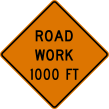
- Obey it and drive with extra care
- Ignore it until you actually see workers
- Speed up to get through the zone quickly
- Pull over and wait for a flagger
Show answer
Obey it and drive with extra care. Work zone signs in Missouri are fluorescent orange and indicate work is being performed on or alongside the roadway. The guide says to obey the work zone signs and be extremely careful, watching for reduced speed limits, narrow lanes, highway workers, and vehicles entering or leaving the zone. Not seeing anyone right away does not mean the work zone rules have stopped applying.
Study this in the handbook: Road signs by shape and color
17. You are pulling out of a Missouri parking lot, and a pedestrian is walking along the sidewalk across the exit. Who must yield?
- The pedestrian must yield because you are already moving
- Whoever reaches the sidewalk first has priority
- The pedestrian must yield unless a crosswalk is painted
- You must yield to the pedestrian on the sidewalk
Show answer
You must yield to the pedestrian on the sidewalk. Missouri requires drivers who cross a sidewalk, or who enter or leave a driveway, alley, or parking lot, to yield to pedestrians. The person on foot keeps priority even though no crosswalk is painted across the exit. Ease forward, stop before the sidewalk, and let anyone walking pass. The guide also notes that it is illegal to drive on a sidewalk except to cross it, so do not roll along it while waiting for a gap in traffic.
Study this in the handbook: Right of way at intersections and roundabouts
18. When no signs or lane markings control turning, which lanes should a Missouri driver use for a turn?
- From any lane at all, as long as you signal at least 100 feet ahead
- From the center lane into whichever new lane looks the widest
- From the far lane, so you can swing wide and see more traffic
- From the lane closest to where you are going, into the closest lane
Show answer
From the lane closest to where you are going, into the closest lane. With no signs or markings to guide you, Missouri tells drivers to turn from the lane closest to the direction they want to go and into the lane closest to the one they came from. Doing this crosses the fewest lanes of traffic. Move smoothly from one lane to the other without crossing lane lines, and change lanes only after the turn is complete. Signaling early is required too, but a signal does not make any lane acceptable.
Study this in the handbook: Passing, turning and signaling
19. You are about to enter a Missouri roundabout when you hear a siren and see an ambulance approaching. What should you do?
- Enter quickly so you are out of its way
- Do not enter the roundabout until it has passed
- Enter and stop inside the circle to let it by
- Enter and pull onto the truck apron to make room
Show answer
Do not enter the roundabout until it has passed. Missouri roundabout rules say to always yield to emergency vehicles and not to enter a roundabout when one is approaching. Waiting at the entrance keeps the circle clear. Drivers should never stop while inside a roundabout, so entering and then stopping is the wrong move, and the truck apron is not for cars. If an emergency vehicle shows up after you are already circling, the guide says to exit immediately and pull to the right.
Study this in the handbook: Right of way at intersections and roundabouts
20. When leaving a Missouri roundabout, at what point may you start to speed up?
- As soon as you pass the last car in the circle
- When you turn on your right turn signal
- Once you are beyond the pedestrian crossing at the exit
- Right after you enter the exit lane, before the crosswalk
Show answer
Once you are beyond the pedestrian crossing at the exit. Exits are where Missouri roundabouts meet crosswalks, so drivers leaving the circle should keep a slow speed to avoid losing control or striking traffic islands. The guide says not to accelerate until you are beyond the pedestrian crossing at the exit, and to watch for pedestrians and bicyclists crossing the street there. Turning on the right signal tells others you are leaving, but it is not a cue to speed up.
Study this in the handbook: Right of way at intersections and roundabouts
Every question is written from the official Missouri Driver Guide. Need paper? Printable MO practice test with answer key.
Last verified 2026-10-05. How we check every question · Study all 500 as flashcards
Frequently asked questions
How many questions are on this Missouri practice test?
This fixed set has 20 questions. It is test 15 of 25 from the 500 question Missouri bank. The real MO exam asks 25 questions and you need 20 correct.
What is the passing score for the real Missouri test?
80% to pass That figure comes from the official Missouri source cited on the DMV facts page.
How does this fixed test relate to the full Missouri bank?
Each numbered test is a fixed set of questions in a fixed order, so you can retake the same test later and compare. Every test mixes road signs and the other topics in about the same proportion as the full bank. Tests 1 to 25 together cover every question in the Missouri bank once. The full practice page mixes the whole bank at random.
Last verified 2026-10-05. See the Missouri DMV facts page for sourced state details.
Return to the full Missouri practice test · Study road signs