
Test 5 of 10 · 20 questions · Free 2026
MO Permit Practice Test 5
Jump to the test ↓A fixed 20 question set from the Missouri bank with answers and plain English explanations. The real MO exam is 25 questions, 80 percent to pass; take the full length version on the main practice page.
Question 1 of 20 · 0 right so far
All 20 questions in test 5
Every question below comes from the Missouri question bank on this page. Open a question to see the correct answer and the explanation. Nothing here is hidden behind a signup.
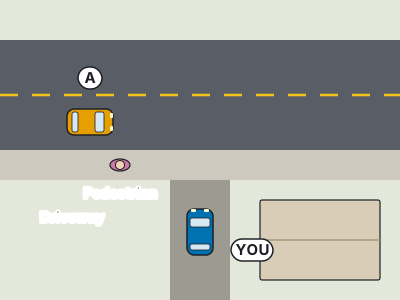
1. Who must yield when entering a main road from a driveway, alley, or roadside?
- Only pedestrians, never vehicles
- Vehicles already traveling on the main road
- The driver entering from the side location
- The driver traveling at the higher speed
Show answer
The driver entering from the side location. A driver emerging from a driveway, alley, or roadside must yield to vehicles already on the main road. Entering traffic is changing from a secondary location into an established flow, so it cannot claim priority merely by reaching the edge first. Speed does not reverse the rule, and the duty applies to vehicles as well as the broader need to avoid collisions. Stop or slow before the edge, look both ways, and enter only after the main road is clear.
Study this in the handbook: Right of way at intersections and roundabouts
2. How far may a vehicle travel in a Missouri two way left turn lane?
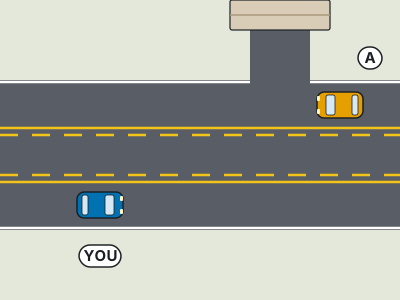
- No more than 100 feet
- No more than 250 feet
- No more than 500 feet
- Any distance if the lane is empty
Show answer
No more than 500 feet. The center two way left turn lane is for preparing to slow or stop before a left turn, not for ordinary travel. The guide limits a vehicle from traveling in it more than 500 feet. The smaller distances are not the stated limit, while the unlimited option ignores the lane's turning purpose. A driver should enter it only for the approaching left turn, make the maneuver promptly, and avoid using the center lane as a substitute for a through lane.
Study this in the handbook: Right of way at intersections and roundabouts
3. A tractor-trailer carrying hazardous materials reaches a railroad crossing. What must its driver do?
- Cross without stopping if no train can be seen
- Stop only when the crossing gates are lowered
- Use the shoulder to bypass the tracks
- Stop at the crossing before proceeding
Show answer
Stop at the crossing before proceeding. Missouri requires vehicles carrying hazardous materials to stop at all railroad crossings. The absence of a visible train does not remove that duty, and a shoulder is not a lawful shortcut around the crossing. Waiting for gates to lower would also miss the rule because the stop is required at every crossing, not only during an active warning. A useful cue is to connect the cargo with the crossing: hazardous materials means stop, check the tracks and signals, then proceed when safe.
Study this in the handbook: Pedestrians, cyclists, motorcycles and trucks
4. How should a driver approach a flashing yellow traffic signal?
- Stop and wait for a solid green signal
- Slow down and proceed with caution
- Accelerate because cross traffic must stop
- Treat it exactly like a flashing red signal
Show answer
Slow down and proceed with caution. A flashing yellow light calls for slowing down and proceeding with caution. It is not the same as a flashing red light, which has the meaning of a stop sign, and it does not direct every driver to wait for green. Speeding through the intersection assumes conditions that may not exist. Reduce speed, look for vehicles and pedestrians, and continue only when the path is safe. The flashing yellow pattern is the cue for caution rather than an automatic full stop.
Study this in the handbook: Traffic lights, arrows and officers
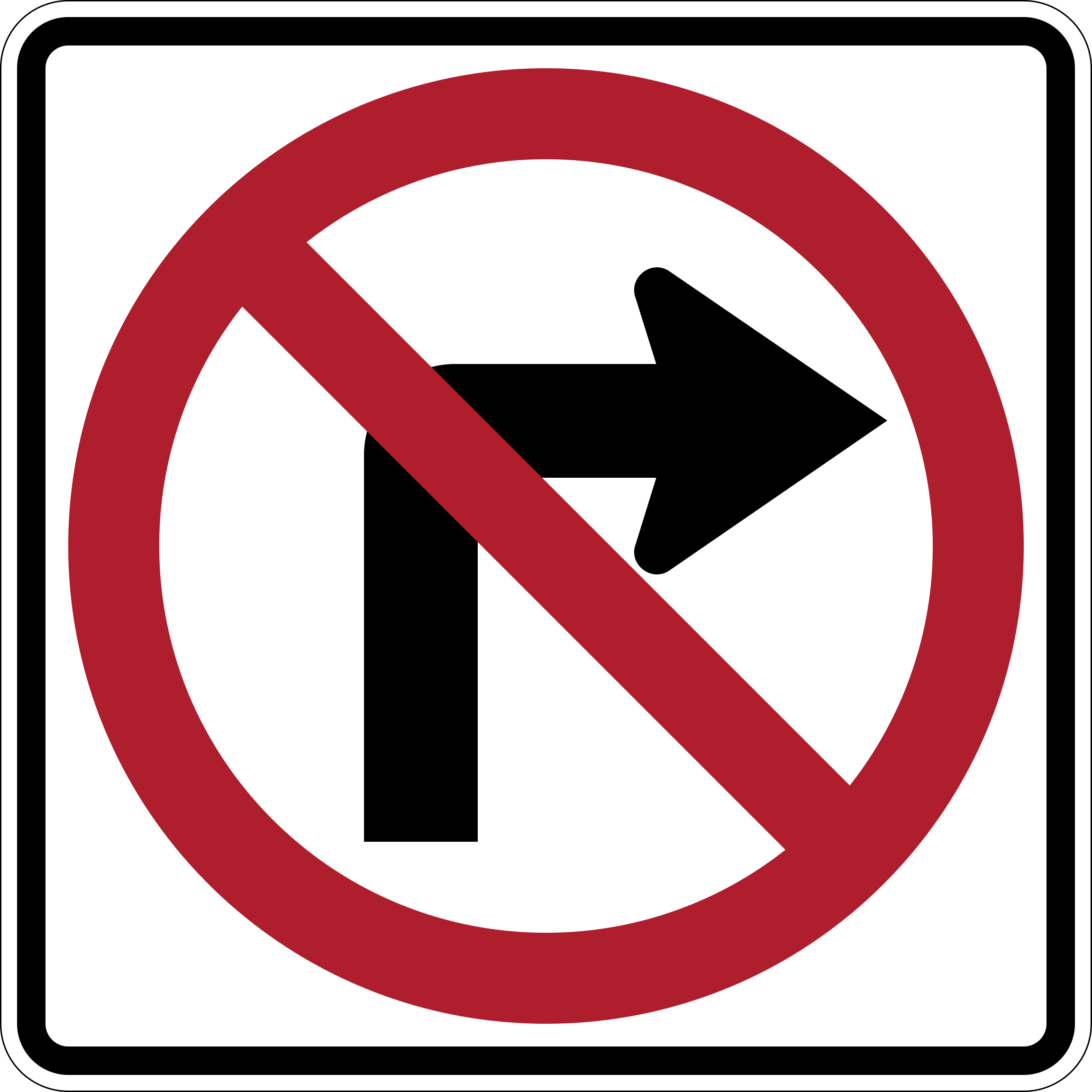
5. The crossed right-turn arrow shown tells the driver not to:
- Drive straight on the current roadway
- Park along the right side of the street
- Yield to a pedestrian in a crosswalk
- Turn right at the signed location
Show answer
Turn right at the signed location. This sign uses a red slash over a right-turn arrow, so the prohibited action is a right turn at the signed location. It does not make straight travel, curb parking, or pedestrian yielding illegal. The sign's white background and red symbol provide a regulatory cue, while the arrow identifies the exact movement being restricted. Continue only in a direction permitted by the other lane markings and signals. If a pedestrian is present, the separate duty to yield remains in force, even though this sign does not depict a crosswalk rule.
Study this in the handbook: Road signs by shape and color
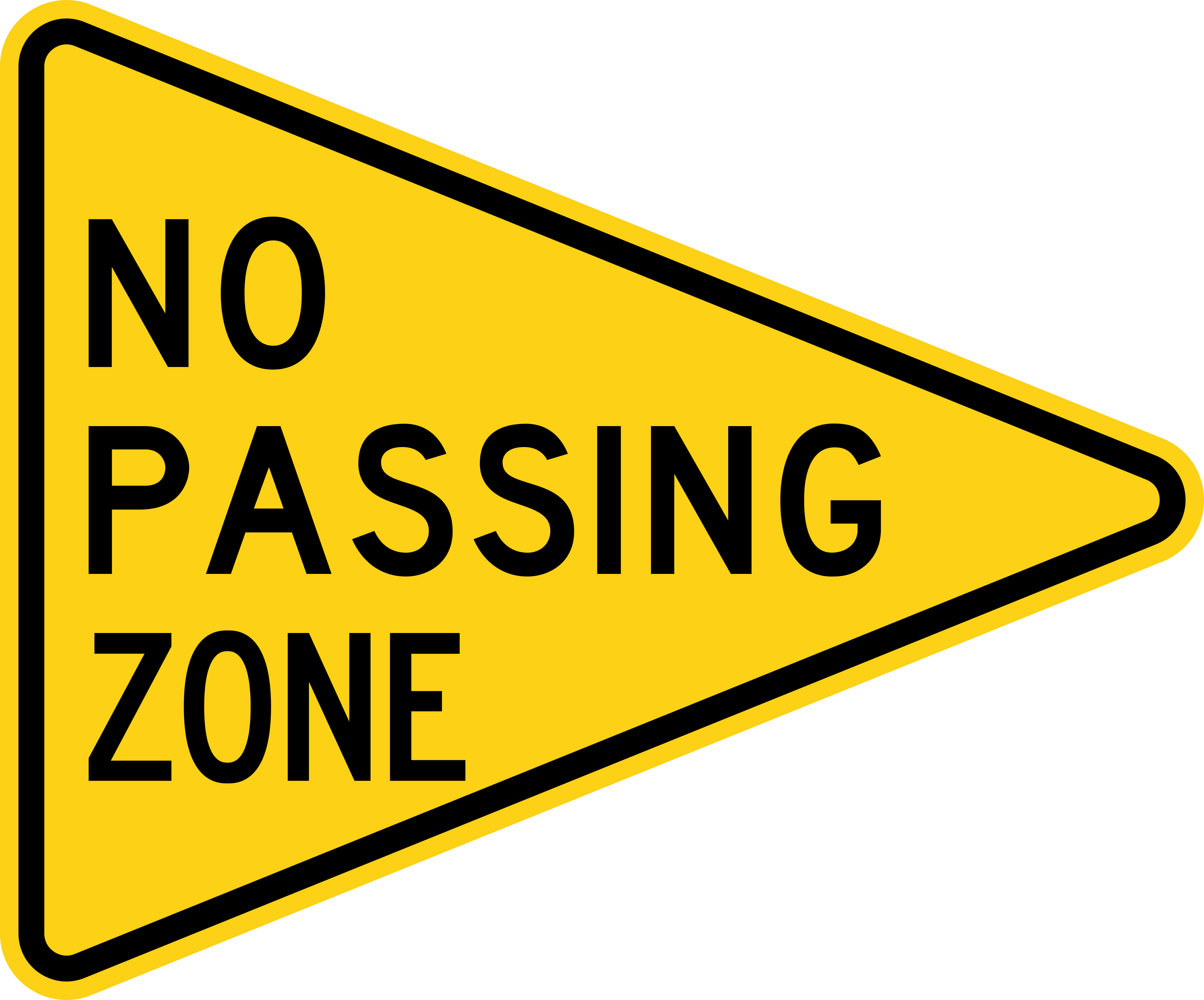
6. What restriction does a pennant-shaped sign identify?
- A scenic overlook where parking is encouraged
- A no-passing zone
- A railroad crossing ahead
- A school zone with flashing lights
Show answer
A no-passing zone. The pennant shape is Missouri's visual clue for a no-passing zone. It marks a section where passing is unsafe, commonly because the road is on a hill or curve and the driver cannot see far enough ahead. A scenic area, school zone, and railroad crossing use different signs and rules. When the pennant appears, keep your vehicle in its lane, hold a safe speed, and wait until the restriction has ended before attempting a pass. Shape recognition helps the driver react before reaching the hazard.
Study this in the handbook: Traffic lights, arrows and officers
7. What driving condition does this curved-arrow warning sign identify?

- A curve where the advisory speed is below the highway's posted limit
- A lane reserved for vehicles turning right
- A railroad crossing that requires a complete stop
- A no-passing area marked by a pennant sign
Show answer
A curve where the advisory speed is below the highway's posted limit. Missouri uses a curve sign when the road bends and the recommended speed is lower than the posted highway limit. That recommendation is a cue to reduce speed before entering the bend, especially when sight distance or traction is poor. The railroad choice describes a different warning category, while a reserved turning lane is a pavement or regulatory issue. The pennant-shaped sign identifies a no-passing zone, not the shape of the road. Read the advisory speed plate with the curve symbol and adjust early rather than braking sharply in the bend.
Study this in the handbook: Road signs by shape and color
8. If your headlights go out while driving, what should you try first?
- Keep driving at the same speed
- Open the hood in the travel lane
- Turn off all emergency lights
- Use the dimmer or headlight switch
Show answer
Use the dimmer or headlight switch. A sudden headlight failure may be corrected by trying the dimmer switch or headlight switch. If that does not restore the lights, use parking lights, emergency flashers, or turn signals, then pull off the road while leaving the emergency flashers on. Continuing at normal speed leaves other drivers little warning and poor visibility. Opening the hood in a lane creates a separate danger. The first cue is to try the vehicle's lighting controls while maintaining a steady, controlled path.
Study this in the handbook: Brake failure, blowouts and other emergencies
9. What administrative action may follow a Missouri BAC result of 0.08% or more?
- No action until a criminal conviction
- Only a verbal warning at the roadside
- The officer takes the license and gives a notice
- Automatic permanent revocation with no notice
Show answer
The officer takes the license and gives a notice. At or above 0.08% BAC, the guide says the officer takes the license and gives the driver a notice. The notice explains that a suspension or revocation will begin after 15 days and may include a 15-day driving permit when the officer indicates it. This administrative process is separate from waiting for a court conviction. Do not confuse the notice period with permission to ignore later license restrictions.
Study this in the handbook: Alcohol limits and DWI penalties
10. What minimum fine is listed for a second or subsequent speeding or passing offense in a Missouri work zone?
- $150
- $250
- The fine is waived for repeat offenses
- $300
Show answer
$300. A second or subsequent speeding or passing offense in a Missouri state construction or work zone carries a listed minimum of $300, in addition to any other authorized fine. The $250 amount belongs to a first offense, so it cannot be used for a repeat violation. The penalty does not decrease after the first event. A good cue is to treat every work-zone violation as costly, with the repeat minimum rising to $300.
Study this in the handbook: The point system and traffic penalties
11. Which event causes failure of the Missouri driving test even apart from the point total?
- Violating a traffic law during the test
- Driving below the limit while conditions require it
- Adjusting the mirror before moving
- Checking traffic before a turn
Show answer
Violating a traffic law during the test. A traffic-law violation is an independent reason for failing the Missouri skills test. It is listed alongside a fault crash, hitting a pedestrian, dangerously driving, or refusing the examiner’s direction. Mirror adjustment and traffic checks are normal preparation, while a lower speed can be appropriate when conditions require it. Keep the vehicle controlled, obey every sign and signal, and remember that a low point total cannot rescue an illegal maneuver.
Study this in the handbook: The written, sign, vision and driving tests
12. What must a driver do before passing on a Missouri two-lane road without a no-passing marking?
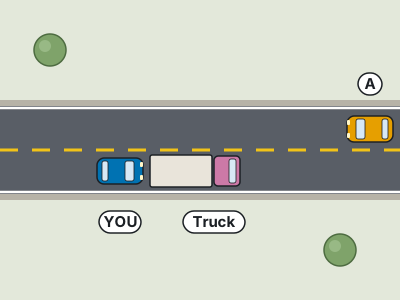
- Pass whenever the vehicle ahead is below the speed limit
- Use the shoulder if the opposing lane is occupied
- Confirm the road is clear for the full distance needed to pass
- Cross the center line briefly on every straightaway
Show answer
Confirm the road is clear for the full distance needed to pass. A missing no-passing line does not make a pass automatically safe. On a two-lane road, the driver must be able to see that the road is clear for the distance needed to complete the maneuver. The speed of the vehicle ahead is not permission to pass, and the shoulder is never a substitute for a clear opposing lane. Scan far ahead, account for your own speed, and wait when sight distance is limited.
Study this in the handbook: Pavement markings and lane use
13. When following another vehicle at night, when should high beams be changed to low beams?
- Only after closing to within 50 feet
- When following within 300 feet
- At 100 feet regardless of traffic direction
- High beams may remain on while following
Show answer
When following within 300 feet. Missouri requires low beams when following another vehicle within 300 feet. The same headlight list says to use low beams within 500 feet, about one block, of an oncoming vehicle, and to use high beams when there are no oncoming vehicles. Waiting until only 50 feet remains leaves the beams high for too long, and 100 feet is not the stated figure. Watch the distance to the vehicle ahead, dim promptly, and restore high beams only when the situation allows.
Study this in the handbook: Night driving, rain, snow, fog and skids
14. How many hours of driving instruction, and how many at night, must a Missouri teen complete before an intermediate license?
- 40 hours, including at least 10 at night
- 20 hours, including 5 at night
- 50 hours, including 10 at night
- 60 hours, all in daylight
Show answer
40 hours, including at least 10 at night. To obtain an intermediate license, a Missouri teen must have completed 40 hours of driving instruction with a parent, stepparent, legal guardian or certified trainer, and the required 40 hours must include at least ten hours of nighttime driving. Fifty and sixty hour totals do not match the figure the Missouri guide gives, and an all daylight total skips the night hours. The intermediate license, eligible at 16 to 18, carries restrictions on hours and passengers.
Study this in the handbook: Permits and the Graduated Driver License
15. How does the Missouri guide describe the appearance of a stop sign?
- Yellow with black letters and four sides
- Red with white letters and eight sides
- White with red letters and three sides
- Blue with white letters and a circular shape
Show answer
Red with white letters and eight sides. Missouri describes the stop sign as red with white letters and eight sides. The guide says the shape and color of traffic signs give clues to the type of information they provide, and it lists red for stop, yield, or prohibited. A yellow diamond is a warning sign, the red bordered white triangle is the yield sign, and blue signs point to services. When an eight sided red shape appears ahead, begin slowing early and plan a complete stop at the line or before the crosswalk.
Study this in the handbook: Road signs by shape and color
16. How should a driver respond to a steady yellow traffic light?
- Speed up whenever the light has just changed
- Stop in the middle of the intersection
- Stop unless already in the intersection or unable to stop safely
- Continue without checking for the coming red signal
Show answer
Stop unless already in the intersection or unable to stop safely. A steady yellow warns that the signal is changing from green to red. Missouri says to stop unless the vehicle is already within the intersection or is so close that stopping before entry cannot be done safely. The risky alternative is accelerating simply to beat the red, while an abrupt stop in the intersection creates a separate hazard. Check distance and speed, brake smoothly when there is room, and clear the intersection when stopping would be unsafe.
Study this in the handbook: Traffic lights, arrows and officers
17. Can a Missouri driver use the driver examination record alone as a legal permit to drive?
- Only if a parent signs it
- Yes, for 15 days
- Yes, until the permanent card arrives
- No, the record alone is not legal for driving
Show answer
No, the record alone is not legal for driving. The driver examination record is a test result, not the issued permit or license. The guide expressly says the record alone is not legal for driving, so the driver must complete the license office process and carry the actual credential. The two yes choices create temporary periods that the guide does not grant, and a parent signature cannot change the document's status. Treat the examination record as paperwork used to obtain the credential, never as permission to drive by itself.
Study this in the handbook: Permits and the Graduated Driver License
18. What is the longest jail term a Missouri court may impose for a first DWI or BAC conviction?
- Up to 30 days
- Up to one year
- Up to four years
- Up to six months
Show answer
Up to six months. The Missouri Driver Guide's court conviction chart says a first DWI or BAC offense can mean up to six months in jail. Up to one year is the second offense limit and up to four years is the third. Thirty days is not a figure in the chart. The same chart lists a fine of up to $500 for a first offense. On the license side, a first conviction also brings a 90 day suspension, and the driver may be eligible for a 90 day or 60 day Restricted Driving Privilege.
Study this in the handbook: Alcohol limits and DWI penalties
19. A Missouri driver convicted of driving while suspended keeps driving after the license is revoked. What can happen?
- A felony conviction and another one-year revocation
- Only a $20 fine
- A warning letter
- Nothing if no crash occurs
Show answer
A felony conviction and another one-year revocation. Driving while suspended can lead to a one-year revocation after conviction. Continuing to drive while revoked can bring a felony conviction and another one-year revocation. A $20 fee is a reinstatement fee, not the penalty. A warning letter and no consequence without a crash understate the law. Driving on a suspended or revoked license also carries 12 points, which alone is enough for a one-year revocation.
Study this in the handbook: The point system and traffic penalties
20. When confronted by another driver displaying road rage, the safest response is to:
- Chase the vehicle to report it immediately
- Remain calm and avoid reacting with similar behavior
- Use the horn repeatedly to challenge the driver
- Brake suddenly to force the driver to stop
Show answer
Remain calm and avoid reacting with similar behavior. Road rage can turn a disagreement into a crash or assault. The Missouri guide says to remain calm and not react with similar behavior. Chasing, repeated horn use, or sudden braking brings the other driver closer and may intensify the encounter. Instead, the guide suggests identifying the location, getting a description of the driver and vehicle, and reporting the incident to the nearest local authorities as soon as possible. With a cellular phone, exit the roadway to a safe area and dial *55, or 911 in a metropolitan area.
Study this in the handbook: Phones, distractions, fatigue and road rage
QualitySpace is expanding to Missouri
We are a California-based independent insurance brokerage working on licensing in more states. We cannot help with Missouri insurance yet. Leave your email and we will let you know when we can.
Every question is written from the official Missouri Driver Guide. Need paper? Printable MO practice test with answer key.
Last verified 2026-10-05. How we check every question · Study all 201 as flashcards
Frequently asked questions
How many questions are on this Missouri practice test?
This fixed set has 20 questions. It is test 5 of 10 from the 201 question Missouri bank. The real MO exam asks 25 questions and you need 20 correct.
What is the passing score for the real Missouri test?
80% to pass That figure comes from the official Missouri source cited on the DMV facts page.
How does this fixed test relate to the full Missouri bank?
Each numbered test is a fixed set of questions in a fixed order, so you can retake the same test later and compare. Every test mixes road signs and the other topics in about the same proportion as the full bank. Tests 1 to 10 together cover 200 of the 201 questions in the Missouri bank, each once. The full practice page mixes the whole bank at random.
Last verified 2026-10-05. See the Missouri DMV facts page for sourced state details.
Return to the full Missouri practice test · Study road signs