
Test 17 of 25 · 20 questions · Free 2026
MO Permit Practice Test 17
Jump to the test ↓A fixed 20 question set from the Missouri bank with answers and plain English explanations. The real MO exam is 25 questions, 80 percent to pass; take the full length version on the main practice page.
Question 1 of 20 · 0 right so far
All 20 questions in test 17
Every question below comes from the Missouri question bank on this page. Open a question to see the correct answer and the explanation. Nothing here is hidden behind a signup.
1. A funeral procession is going through a red light at a Missouri intersection when an ambulance with its siren on reaches the same intersection. Who goes first?
- The procession, since it has priority at intersections
- Whichever vehicle reaches the intersection first
- The ambulance; emergency vehicles are an exception
- Neither; both must stop and wait for a green light
Show answer
The ambulance; emergency vehicles are an exception. An organized funeral procession has the right-of-way at intersections regardless of any traffic control device, but the guide names exceptions: emergency vehicles, or a direction otherwise from law enforcement officials. So an ambulance using its siren does not have to give way to the procession. Other drivers should also remember to pull over to the right edge of the road and stay stopped until an emergency vehicle with a siren and red or blue lights has passed.
Study this in the handbook: Right of way at intersections and roundabouts
2. A Missouri driver claims texting while driving is legal for adults over 21. Is that right?
- No, it is illegal for any driver
- Yes, the ban covers drivers under 21 only
- Yes, at speeds below 25 mph
- Yes, on roads outside city limits
Show answer
No, it is illegal for any driver. Missouri's guide states that it is against the law for any person to read, write, or send a text message or electronic message while operating a vehicle. Texting is by far the most high risk distraction because it takes your eyes, hands, and mind off driving. The device law also bars holding or supporting a phone with any part of your body while the vehicle is moving.
Study this in the handbook: Phones, distractions, fatigue and road rage
3. You drive past a Missouri school on a Saturday. The school zone lights are off, but children are playing near the road. Does the slower school zone limit apply?
- No, the lights are not flashing
- No, school zones apply on weekdays only
- Yes, because children are present
- Yes, but just during class hours
Show answer
Yes, because children are present. Missouri says you must obey a slower speed limit in a school zone when lights are flashing or children are present. Either condition is enough, so children near the road bring the lower limit into effect even when the lights are off. Children may run into the road without looking, so be extra careful near schools, playgrounds, parks, and residential areas.
Study this in the handbook: Pedestrians, cyclists, motorcycles and trucks
4. Your brake pedal suddenly sinks to the floor. Of these steps from the Missouri guide, which do you do first?
- Use the parking brake gradually
- Shift to a low gear
- Call for help once stopped
- Pump the brake pedal fast and hard
Show answer
Pump the brake pedal fast and hard. Missouri lists brake failure steps in order. First, pump the brake pedal fast and hard several times. If that does not work, use the emergency or parking brake gradually, then shift to a low gear and look for a place to slow to a stop. Make sure the vehicle is off the road, and after it has stopped, call for help rather than trying to drive to a garage.
Study this in the handbook: Night driving, rain, snow, fog and skids
5. A Missouri road splits around a concrete island, and this sign stands at its tip. Which side should you drive on?
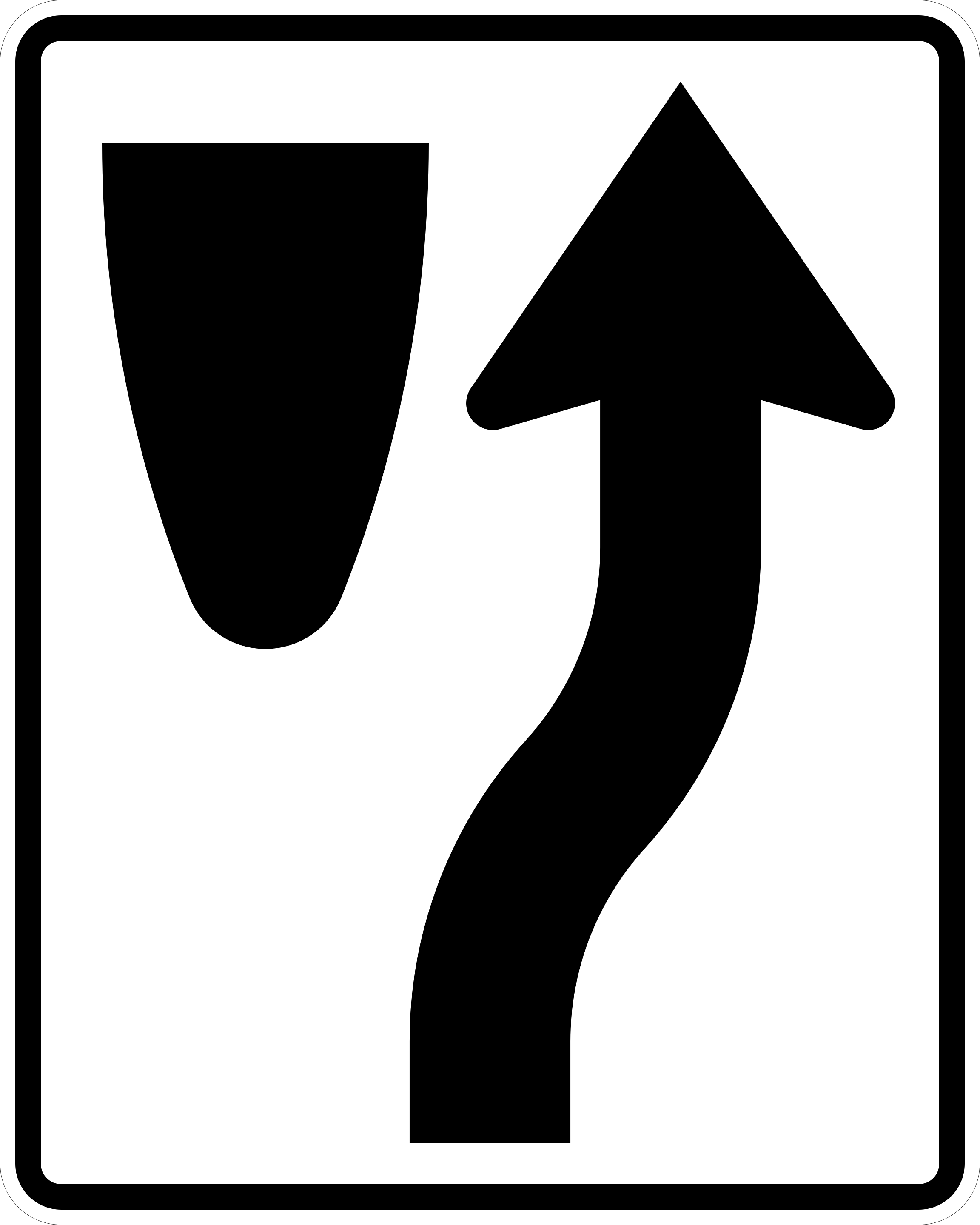
- Pass on whichever side is less crowded
- Pass on the left, then cut back right
- Pass on the right side of the island
- Stop and wait for a signal to tell you
Show answer
Pass on the right side of the island. The Keep Right sign tells Missouri drivers that traffic must pass only to the right side of a feature or obstruction, such as an island or barrier in the road. Going to the left of it is what the sign prohibits. Choosing the less crowded side or waiting for a signal is not what the sign asks. Stay to the right of the island and continue in your lane.
Study this in the handbook: Speed limits and minimum speeds
6. Sunset is at 7:30 p.m. on a Missouri evening. By what time must your headlights be on?
- 7:00 p.m.
- 9:30 p.m.
- 8:30 p.m.
- 8:00 p.m.
Show answer
8:00 p.m.. Missouri tells drivers to turn on headlights from half an hour after sunset until half an hour before sunrise. With sunset at 7:30 p.m., headlights must be on by 8:00 p.m. In the morning, they may go off half an hour before sunrise. Headlights are also required whenever the weather requires your windshield wipers, no matter what time it is.
Study this in the handbook: Night driving, rain, snow, fog and skids
7. Where does the Missouri guide say you must never make a U-turn, even if no sign is posted there?
- On a residential street where the limit is 25 mph
- At an intersection run by a signal or a police officer
- On any road that has a yellow center line painted
- At an intersection where all four ways have stop signs
Show answer
At an intersection run by a signal or a police officer. U-turns in Missouri should be made only where it is safe. The guide says never to make one where a No U-Turn sign is posted or at an intersection controlled by a traffic signal or a police officer. Some towns ban U-turns entirely, and they should not be made on curves or near the crest of a hill. A low speed limit, a yellow center line, or a four-way stop does not by itself forbid a U-turn under this rule.
Study this in the handbook: Passing, turning and signaling
8. A Missouri intersection has two left-turn lanes, and you are in the right-hand one of the two. Which lane should you end up in after the turn?
- The right lane of the road you are turning onto
- The left lane, next to the yellow dividing line
- Whichever lane the car beside you does not take
- The center turn lane, until traffic clears
Show answer
The right lane of the road you are turning onto. Some Missouri streets mark two lanes for left turns. Drivers in the left-side turn lane enter the left lane, just right of the yellow dividing line, and drivers in the right-side turn lane enter the right lane. Keeping to your own lane through the turn lets two lines of cars turn side by side without cutting each other off. Drifting into the left lane, or taking whatever lane the next car leaves open, invites a sideswipe.
Study this in the handbook: Right of way at intersections and roundabouts
9. Your car's turn signals have stopped working. What does the Missouri guide say is another way to signal a turn?
- Flash your high beams at the car behind you
- Tap the horn twice before you start to turn
- Blink your parking lights while you turn
- Signal with your hand and arm
Show answer
Signal with your hand and arm. Before you stop, turn, or change lanes, you must let other drivers know what you are going to do by signaling. The guide says you can signal with your hand and arm, or with your vehicle's turn signals and brake lights. It shows the correct hand signals for turning and stopping in pictures. By either method, signal at least 100 feet before you turn so the drivers around you have time to be ready.
Study this in the handbook: Passing, turning and signaling
10. What does the Missouri guide say about using four-wheel drive on ice?
- Do not use it; the vehicle can overturn easily
- Always use it, since it stops the vehicle faster
- Use it only above 35 mph for better grip
- Use it whenever the road looks wet or icy
Show answer
Do not use it; the vehicle can overturn easily. Missouri's winter advice says that if you have a four-wheel drive vehicle, you should not use four-wheel drive on ice, because four-wheel drive vehicles can easily overturn on ice. If you hit an icy patch while in four-wheel drive, take your foot off the accelerator. Even with snow tires or chains, the guide says, you cannot drive safely on snow or ice at normal speeds.
Study this in the handbook: Night driving, rain, snow, fog and skids
11. You are behind a tanker truck carrying hazardous materials as it approaches a Missouri railroad crossing with no train in sight. What should you expect?
- It will stop at the crossing even with no train
- It will speed up to clear the tracks quickly
- It will stop only if the gates are down
- It will pull onto the shoulder to let you pass
Show answer
It will stop at the crossing even with no train. Missouri's guide says vehicles carrying hazardous materials must stop at all railroad crossings, and it tells drivers to be prepared for this. Even with no train in sight and no gates down, expect the tanker to come to a stop before the tracks. Leave extra following distance and do not try to pass it at the crossing. A loaded truck may also take time to get moving again.
Study this in the handbook: Pedestrians, cyclists, motorcycles and trucks
12. An ambulance has just passed you while you are pulled over on a Missouri street. What should you do before pulling back out?
- Pull out right away and follow the ambulance
- Check that no other emergency vehicle is coming
- Wait exactly one minute, then drive on
- Turn on your hazard lights and merge quickly
Show answer
Check that no other emergency vehicle is coming. After yielding to an emergency vehicle in Missouri, remain stopped until it passes, and then look again before moving. The guide warns that emergency vehicles may follow each other, so proceed only when the way is clear. Pulling out right behind the ambulance or merging quickly can put you in front of a second vehicle running with lights and siren. There is no fixed waiting time; a clear road is the signal.
Study this in the handbook: Right of way at intersections and roundabouts
13. On which kinds of vehicles does the Missouri guide say you may see this sign?

- School buses and church vans
- Police cars and ambulances
- Farm and construction vehicles
- Taxis and delivery trucks
Show answer
Farm and construction vehicles. The reflective orange triangle on the rear of a vehicle means it is traveling less than 25 mph. Missouri's guide says you may see this sign on construction equipment or farm vehicles. When you come up behind one, slow down early, because you will close the distance quickly, and pass only where it is legal and safe. Patience on rural roads helps you avoid running up on these slow vehicles.
Study this in the handbook: Road signs by shape and color
14. You are on a two-lane Missouri highway, about 80 feet from an intersection, behind a slow car. May you pass it now?
- Yes, if no one is waiting at the intersection
- No, you are within 100 feet of the intersection
- Yes, if you finish before the intersection
- Yes, since the limit is 50 feet
Show answer
No, you are within 100 feet of the intersection. Missouri bars driving on the left side of the roadway when approaching within 100 feet of, or at, any intersection or railroad grade crossing. At 80 feet you are inside that zone, so wait until you are past the intersection and the road ahead is clear. Vehicles may pull out or turn there without expecting a passing car in the oncoming lane.
Study this in the handbook: Right of way at intersections and roundabouts
15. You need a hospital while driving on a Missouri highway. What color sign should you look for?
- Green with white letters
- Brown with white letters
- Yellow with black symbols
- Blue with white symbols
Show answer
Blue with white symbols. Missouri service signs are square or rectangular and blue with white letters or symbols. They show where to find services such as rest areas and hospitals. Green signs give directions and distances to places like cities and airports, brown signs point to parks, historical areas, and other recreation or cultural sites, and yellow signs warn of hazards ahead. Reading the color early lets you plan your exit.
Study this in the handbook: Road signs by shape and color
16. Your light turns yellow just as your front bumper reaches the crosswalk, too close to stop safely before the intersection. What should you do?
- Brake hard and stop in the middle of the crosswalk
- Continue carefully through the intersection
- Back up behind the stop line
- Speed up hard to beat the red light
Show answer
Continue carefully through the intersection. A steady yellow light means the signal is changing from green to red. Missouri says to stop for it unless you are already within the intersection or so close that you cannot safely stop before entering. If you are that close, continue through carefully. Slamming to a stop in the crosswalk or backing up creates new dangers, and racing to beat the red is never the goal.
Study this in the handbook: Traffic lights, arrows and officers
17. The climate control in your car needs adjusting while you are driving on a Missouri road. Which choice does the guide suggest?
- Glance down and change it quickly between two curves
- Reach for it only on a long, straight, empty stretch
- Ask a passenger to adjust it, or wait for a normal stop
- Slow to 10 mph under the limit, then adjust it yourself
Show answer
Ask a passenger to adjust it, or wait for a normal stop. The guide lists adjusting climate controls, the radio, or a navigation system as distractions that can lead to a crash or a near-crash. The best plan is to set your controls before you begin to drive. If something needs changing later, take advantage of normal stops to adjust controls, or ask your passengers to adjust the radio, climate control, or navigation system for you. The guide wants your eyes and hands free for driving while the car is moving.
Study this in the handbook: Phones, distractions, fatigue and road rage
18. After a gentle lane change in Missouri, your turn signal is still blinking. Why should you turn it off?
- Other drivers might think you plan to turn again
- It drains the battery within a few minutes
- Signals must stay on for 100 feet after the move
- The blinker sound distracts your passengers
Show answer
Other drivers might think you plan to turn again. After a turn or lane change, make sure your turn signal is off. Missouri notes that after small turns the signal may not cancel by itself, so turn it off if it has not clicked off. If you leave it blinking, other drivers might think you plan to turn again. Signals tell others what you are about to do, so a forgotten one sends the wrong message.
Study this in the handbook: Speed limits and minimum speeds
19. You approach a Missouri roundabout entrance. A car is already circling toward you from the left, and a pedestrian is in the crosswalk. What should you do?
- Enter first, since the circling car must yield
- Wave the pedestrian across and pull in ahead of the car
- Stop inside the circle to let the pedestrian cross
- Yield to both, then enter when there is a gap
Show answer
Yield to both, then enter when there is a gap. When approaching a Missouri roundabout, always yield to traffic already in the circle and to pedestrians in the crosswalks, then wait for a gap before entering. Vehicles inside the roundabout have the right of way. Look to your left as you approach, since circling traffic comes from that side. Never stop inside the roundabout unless it is the only way to avoid a crash.
Study this in the handbook: Right of way at intersections and roundabouts
20. On a two-lane Missouri road, a school bus is stopped on the opposite side with red lights flashing and its stop arm out. You are coming toward it. Must you stop?
- No, only traffic behind the bus must stop
- Yes, traffic from both directions must stop
- No, if you slow to 10 mph as you pass
- Yes, but only if a child is in the road
Show answer
Yes, traffic from both directions must stop. On a two-lane Missouri road where vehicles travel in both directions, the flashing red lights and stop arm on a school bus mean oncoming and following traffic must both stop before reaching the bus. Children may cross the road toward either side. Stay stopped until the bus moves or the driver signals you to proceed. The opposite-direction exemptions apply only to median-divided highways and roads with four or more lanes.
Study this in the handbook: Right of way at intersections and roundabouts
Every question is written from the official Missouri Driver Guide. Need paper? Printable MO practice test with answer key.
Last verified 2026-10-05. How we check every question · Study all 500 as flashcards
Frequently asked questions
How many questions are on this Missouri practice test?
This fixed set has 20 questions. It is test 17 of 25 from the 500 question Missouri bank. The real MO exam asks 25 questions and you need 20 correct.
What is the passing score for the real Missouri test?
80% to pass That figure comes from the official Missouri source cited on the DMV facts page.
How does this fixed test relate to the full Missouri bank?
Each numbered test is a fixed set of questions in a fixed order, so you can retake the same test later and compare. Every test mixes road signs and the other topics in about the same proportion as the full bank. Tests 1 to 25 together cover every question in the Missouri bank once. The full practice page mixes the whole bank at random.
Last verified 2026-10-05. See the Missouri DMV facts page for sourced state details.
Return to the full Missouri practice test · Study road signs