
Test 7 of 10 · 20 questions · Free 2026
MO Permit Practice Test 7
Jump to the test ↓A fixed 20 question set from the Missouri bank with answers and plain English explanations. The real MO exam is 25 questions, 80 percent to pass; take the full length version on the main practice page.
Question 1 of 20 · 0 right so far
All 20 questions in test 7
Every question below comes from the Missouri question bank on this page. Open a question to see the correct answer and the explanation. Nothing here is hidden behind a signup.
1. What stop requirement applies when a traffic signal flashes red?
- As a stop sign
- As permission to continue without stopping
- As a flashing yellow warning
- As a green light for the protected lane
Show answer
As a stop sign. A flashing red light has the same meaning as a stop sign. The driver must stop and then proceed only after checking that the intersection is clear and movement is safe. It is not interchangeable with a flashing yellow, which tells drivers to slow and use caution. Continuing through because the signal is flashing removes the required stop and can conflict with cross traffic. Look for pedestrians and vehicles before moving after the full stop.
Study this in the handbook: Traffic lights, arrows and officers
2. Where must a driver stop when a sign or signal requires a stop?
- Past the crosswalk so the front bumper is visible
- Beside the traffic sign regardless of pavement markings
- Only before the intersection when pedestrians are present
- Before the stop line or, if there is one, the crosswalk
Show answer
Before the stop line or, if there is one, the crosswalk. Missouri places the stopping point before the stop line or, when a stop line is absent, before the crosswalk. Stopping beyond the crosswalk can block pedestrians and places the vehicle farther into the conflict area. The sign's physical location is not automatically the stopping point, and pedestrians are not the condition that activates this placement rule. Approach early enough to brake smoothly, keep the crosswalk open, and use the marked line as the primary reference.
Study this in the handbook: Railroad crossings
3. A Missouri driver is convicted a second time within five years of failing to stop for a school bus. How long is the suspension?
- 30 days
- 180 days
- One year
- 90 days
Show answer
90 days. Failing to stop for a school bus that is loading or unloading students adds five points. A first offense brings a court ordered suspension of 90 days or as the court designates, a second offense within five years brings 90 days, and a third or later offense within five years brings 180 days. So 180 days is for the third offense. Thirty days and one year are not in this rule.
Study this in the handbook: Passing, turning and signaling
4. How should a driver treat a completely dark or malfunctioning traffic signal?
- As an uncontrolled intersection with no stopping rule
- As a green light for the major road
- As a four-way stop
- As a yield sign for every approach
Show answer
As a four-way stop. Missouri treats dark or nonworking traffic signals as a four-way stop. Each approach must be handled as a stop-controlled movement, with drivers checking other vehicles and pedestrians before proceeding. Treating the dark signal as permission to continue gives one approach an advantage the manual does not provide. Slow early, stop at the appropriate point, and proceed only after yielding according to the four-way-stop sequence. This response applies even when the outage appears temporary.
Study this in the handbook: Traffic lights, arrows and officers
5. You see a solid yellow line on your side of the center line. What action is prohibited?
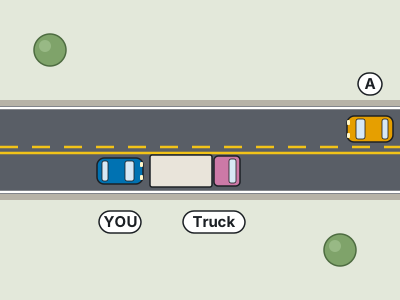
- Crossing that line to pass another vehicle
- Slowing down before a curve
- Stopping when directed by a traffic officer
- Continuing straight in your lane
Show answer
Crossing that line to pass another vehicle. A solid yellow line on the driver's side of the center line marks a no-passing condition. The instruction is not to cross it to pass, even when the driver feels the road ahead is open. Continuing straight, reducing speed for a bend, or obeying an officer can all be appropriate and do not inherently cross the line. Let the marking control the passing decision, then wait for a legal passing section with adequate visibility and no conflicting sign or hazard.
Study this in the handbook: Pavement markings and lane use
6. What should a driver try first when the brake pedal suddenly sinks to the floor?
- Turn off the ignition while still moving
- Pump the brake pedal fast and hard several times
- Apply the parking brake as hard as possible at once
- Accelerate to reach a repair shop quickly
Show answer
Pump the brake pedal fast and hard several times. For a sudden brake pedal failure, Missouri advises pumping the pedal fast and hard several times first. If that does not work, use the emergency or parking brake, but use it gradually, then shift to a low gear, look for a place to slow to a stop, and make sure the vehicle is off the road. The guide also says that if you have power steering or a locking steering wheel, never turn off the ignition key until you have come to a full stop. After stopping, call for help rather than driving to a garage.
Study this in the handbook: Brake failure, blowouts and other emergencies
7. Even with a green arrow, what must be true before a driver moves?
- The driver may use any lane because the arrow controls everyone
- The driver is in the proper lane and the way is clear of traffic and pedestrians
- Only opposing vehicles must be absent; pedestrians never affect the turn
- The driver must wait for a circular green light
Show answer
The driver is in the proper lane and the way is clear of traffic and pedestrians. A green arrow permits travel in the arrow's direction, but Missouri still requires the driver to be in the proper lane and confirms that traffic and pedestrians must be clear. The arrow does not make every lane appropriate, erase pedestrian conflicts, or require waiting for a circular green light. Before moving, check the lane position, crosswalk, and the path through the intersection. The arrow gives directional permission; it does not replace the final look for people or vehicles.
Study this in the handbook: Traffic lights, arrows and officers
8. At what age can a Missouri driver get an instruction permit, the first step of the graduated driver license program?
- 16
- 14
- 15
- 17
Show answer
15. The instruction permit is the first step in Missouri's Graduated Driver License program, and the eligible age is 15. It allows practice driving with a qualified adult. Anyone under 21 is issued a permit that identifies them as a minor. The intermediate license, the second step, has an eligible age of 16, and it requires 40 hours of driving instruction including at least 10 hours at night.
Study this in the handbook: Carrying, renewing and losing your license
9. When driving beside a motorcycle, which practice is required?
- Use part of the motorcycle's lane to pass closely
- Follow within one car length
- Do not share a lane with the motorcycle
- Assume the motorcycle will always yield
Show answer
Do not share a lane with the motorcycle. The Missouri guide says you should not share a lane with a motorcycle, because the motorcyclist needs the entire lane for safety reasons. When passing, give motorcycles a full lane width and do not squeeze past. Following within one car length leaves no room to react, and assuming the rider will always yield ignores the rider's right to the lane. Scan mirrors before changing position, wait for a clear opportunity, and give the motorcycle a complete lane when you pass. The full lane rule is the key cue.
Study this in the handbook: Pedestrians, cyclists, motorcycles and trucks
10. At what age is a Missouri teen eligible for the intermediate license, the second step of the graduated program?
- 16
- 15
- 17
- 18
Show answer
16. The intermediate license, Class F, is the second step in Missouri's Graduated Driver License program, and the eligible age is 16. It allows a young person certain restricted driving privileges after completing the instruction permit step, which starts at 15 and requires 40 hours of practice including 10 at night. The license is valid for up to two years based on document verification status.
11. A Missouri child is at least four but under eight years old, weighs 40 to under 80 pounds, and is shorter than 4 feet 9 inches. What restraint is required?
- A child passenger restraint system or booster seat appropriate for the child
- No restraint if the child is riding in the back seat
- A front-seat air bag without a belt
- A lap belt only, regardless of the vehicle seat
Show answer
A child passenger restraint system or booster seat appropriate for the child. This Missouri category requires a child passenger restraint system or booster seat because all three conditions are present: the child is at least four but under eight, weighs at least 40 but under 80 pounds, and is under 4 feet 9 inches tall. A lap belt alone does not satisfy the stated classification, and the back seat does not create an exemption. An air bag is protective equipment, not a substitute for a restraint. Check the child's age, weight, and height together before choosing the equipment, since changing any one of those measurements can place the child in a different category.
Study this in the handbook: Seat belts, child seats and following distance
12. What BAC threshold does the Missouri guide give for commercial vehicle drivers?
- 0.02%
- 0.04%
- 0.08%
- 0.06%
Show answer
0.04%. Commercial vehicle drivers are identified with a 0.04% BAC threshold. The 0.02% figure is the lower threshold for drivers under 21, and 0.08% is the ordinary adult figure. The guide therefore does not allow a commercial driver to use the general adult number as a safe legal benchmark. Before applying any BAC rule, identify the driver category first. Commercial operation moves the threshold to 0.04%, even when the driver is not under 21.
Study this in the handbook: Alcohol limits and DWI penalties
13. How many questions must an applicant answer correctly to pass Missouri's written test?
- 10 of 25
- 20 of 25
- 15 of 25
- All 25 without an error
Show answer
20 of 25. Missouri requires 20 correct answers on the 25-question written test. That is an 80 percent passing requirement, not a half-score and not perfect performance. The guide also says the questions come directly from its information, so studying the listed rules is more useful than guessing at a trick format. When practicing, track whether you can consistently reach at least 20 correct answers before scheduling the exam.
Study this in the handbook: The written, sign, vision and driving tests
14. When a school bus on a two-lane road activates its flashing red lights and stop arm, what must approaching traffic do?
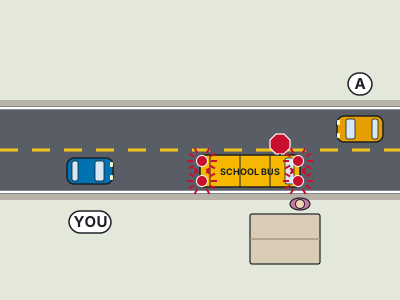
- Pass slowly in the opposite lane
- Stop only if traveling behind the bus
- Stop before reaching the bus
- Continue if no children are visible
Show answer
Stop before reaching the bus. On a two-lane road, both approaching and following traffic must stop before reaching a school bus when its red lights and stop arm are active. Passing slowly is unsafe and ignores the bus signal. The driver does not need to see a child in the roadway before stopping. Remain stopped until the bus moves or the driver signals that you may proceed, then continue carefully while watching for children near the road.
Study this in the handbook: Right of way at intersections and roundabouts
15. How long must a required Missouri ignition interlock stay installed after reinstatement?
- 30 days
- At least six months, with no violations in the last three months
- Exactly one year regardless of violations
- Until age 21
Show answer
At least six months, with no violations in the last three months. The ignition interlock must be maintained for at least six months from the reinstatement date, and the last three months must be free of violations. Failing to maintain it re-suspends the privilege, and getting it back needs proof of service and a $20 reinstatement fee. Thirty days is too short, a fixed year ignores the violation rule, and age 21 is unrelated. Courts may order longer use.
Study this in the handbook: Alcohol limits and DWI penalties
16. Which behavior does the Missouri guide list as an example of road rage?
- Slowing down to let a merging car in
- Keeping a four second gap
- Signaling early before a turn
- Flashing the headlights or pursuing another vehicle
Show answer
Flashing the headlights or pursuing another vehicle. The guide says drivers prone to road rage are usually aggressive individuals who fail to follow courteous driving practices. Its list of behavior associated with road rage begins with beeping the horn, pursuing another vehicle, and flashing the headlights, and goes on to aggressive gestures, tailgating, and braking suddenly. Letting a car merge, signaling early, and keeping a safe gap are courteous practices, not road rage. If you are confronted with road rage, the guide says to remain calm, do not react with similar behavior, and report the incident.
Study this in the handbook: Phones, distractions, fatigue and road rage
17. Under current Missouri law, how is a first littering offense classified when it creates no substantial risk of injury or property damage?
- A class C misdemeanor
- A class A felony
- A class A misdemeanor
- A warning with no penalty
Show answer
A class C misdemeanor. Missouri statute section 577.070 makes littering a class C misdemeanor. It becomes a class A misdemeanor when the littering creates a substantial risk of physical injury or property damage to another, or when the person has already been found guilty of littering. The offense covers placing glass, cans, garbage, trash, or rubbish on the right of way of a public road or state highway, in state waters, or on private land owned by another without consent. It is a criminal offense, not a felony and not a mere warning.
18. What does a yellow diamond-shaped Missouri traffic sign usually indicate?
- A mandatory parking fee
- A route distance only
- A prohibition that always uses a red circle
- A warning about a special situation or hazard ahead
Show answer
A warning about a special situation or hazard ahead. Yellow diamond-shaped signs are generally warning signs. They tell drivers that a special situation or hazard is ahead and advise slowing down while preparing to stop if necessary. They are not primarily route-distance markers, parking notices, or universal prohibition signs. The shape and color work together as a recognition cue: yellow diamond means look ahead, reduce speed, and anticipate a changed roadway condition.
Study this in the handbook: Road signs by shape and color
19. What does the yellow traffic-signal warning sign tell you to expect?
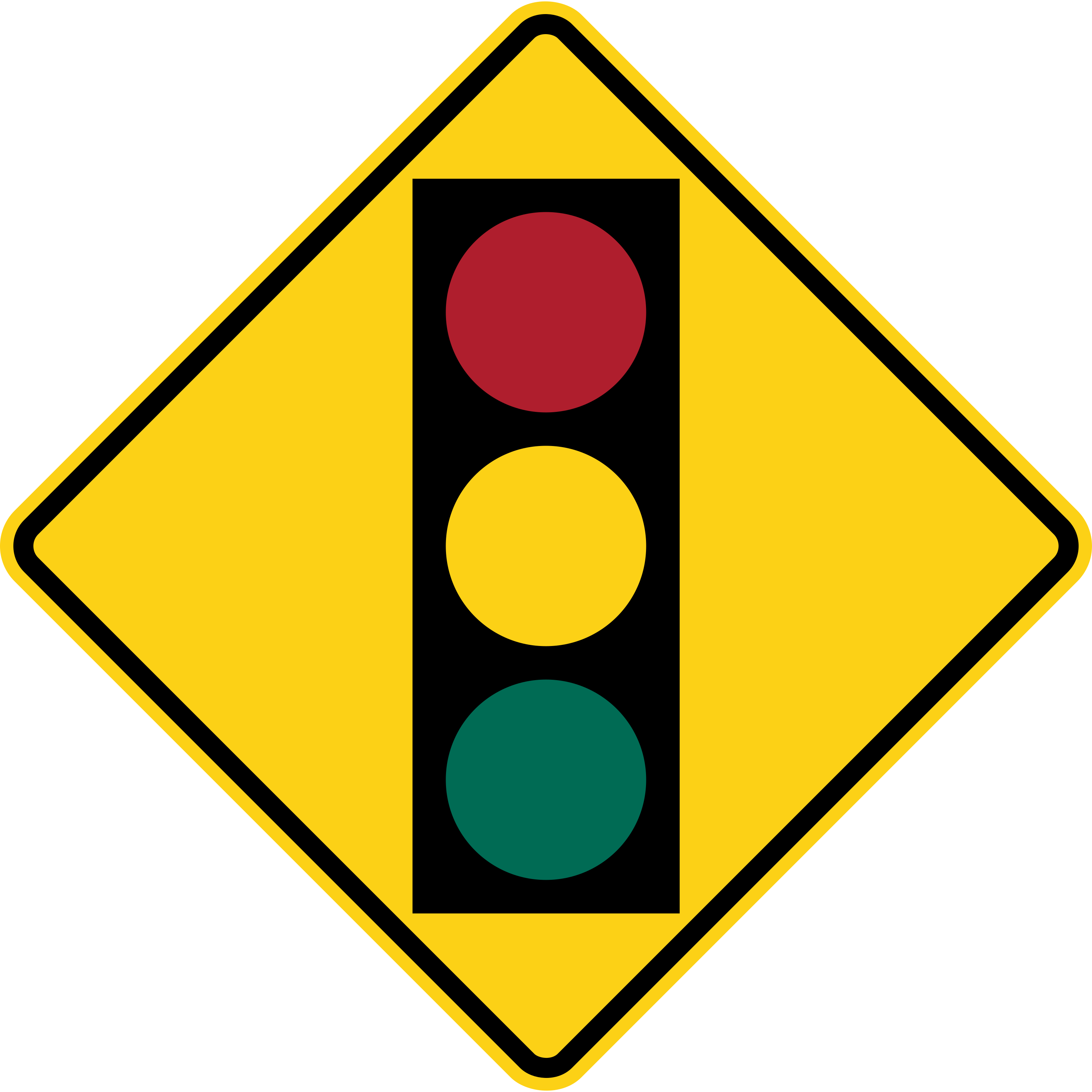
- A streetlight outage requiring the shoulder
- A police checkpoint at the next intersection
- A traffic light signal ahead, where you should be prepared to stop
- A green light that guarantees uninterrupted travel
Show answer
A traffic light signal ahead, where you should be prepared to stop. The signal-ahead warning sign places a traffic light farther along the road and tells drivers to be prepared to stop. It is not a report about broken streetlights or a police checkpoint, and it cannot guarantee that the upcoming light will stay green. Reduce speed as visibility and traffic require, watch the signal, and obey its actual indication when you reach it. The yellow warning background gives advance notice, while the pictured signal identifies the specific control ahead. Being ready to stop also prevents a late hard-braking response if the light changes.
Study this in the handbook: Road signs by shape and color
20. When the keep-right sign is posted beside an obstruction, where should traffic pass?
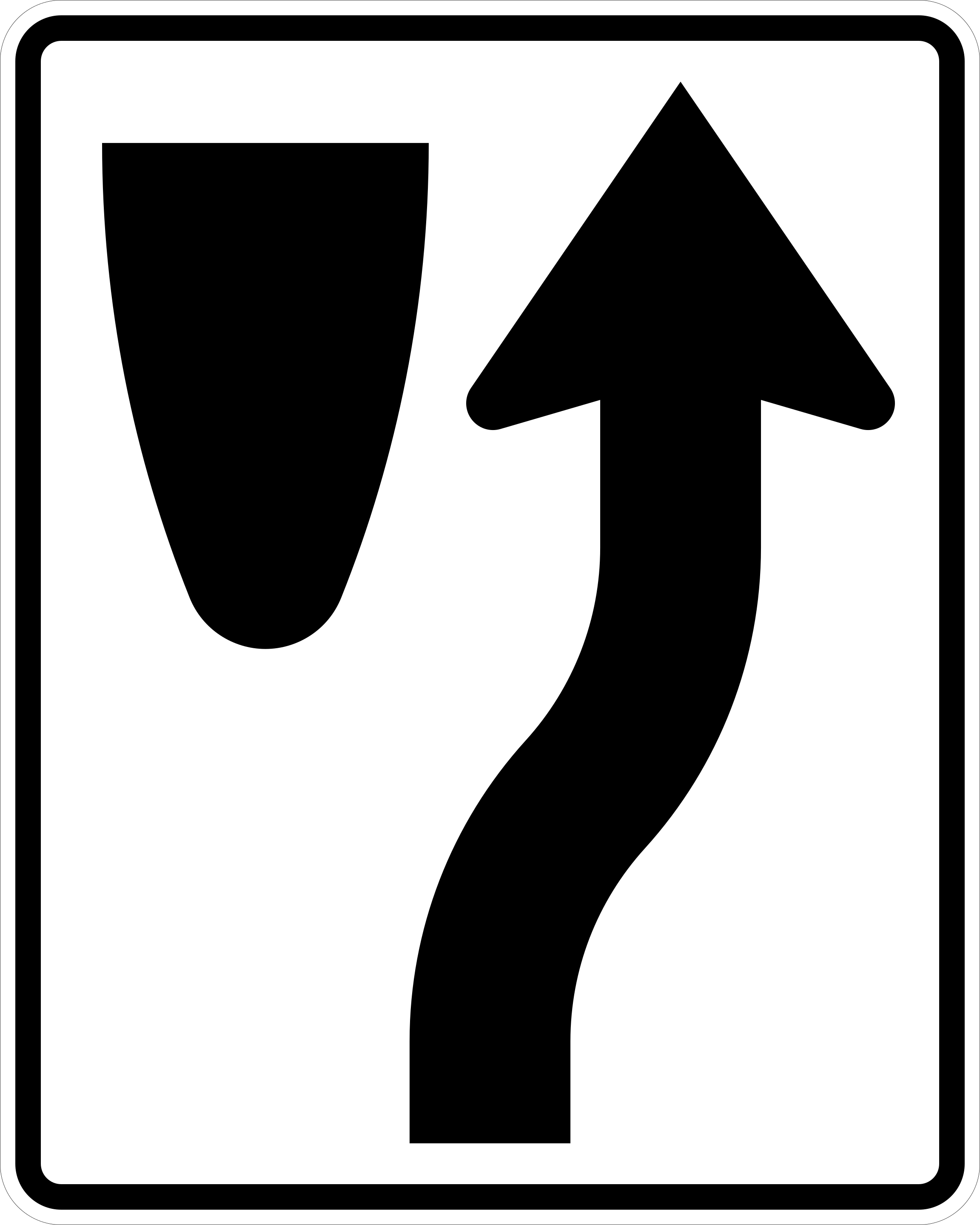
- To the left side unless a truck is approaching
- On either shoulder, whichever is shorter
- Into the opposing lane without checking traffic
- Only to the right side of the feature or obstruction
Show answer
Only to the right side of the feature or obstruction. The keep right sign marks a roadway location where, as the guide says, traffic must pass only to the right side of a feature or obstruction. It is not an instruction to use the left side, to cross into oncoming traffic, or to choose whichever shoulder looks shorter. The arrow on the sign curves around the object to show the required path. Reduce speed as needed, stay in your travel lane, and pass the feature or obstruction on its right side.
Study this in the handbook: Speed limits and minimum speeds
QualitySpace is expanding to Missouri
We are a California-based independent insurance brokerage working on licensing in more states. We cannot help with Missouri insurance yet. Leave your email and we will let you know when we can.
Every question is written from the official Missouri Driver Guide. Need paper? Printable MO practice test with answer key.
Last verified 2026-10-05. How we check every question · Study all 201 as flashcards
Frequently asked questions
How many questions are on this Missouri practice test?
This fixed set has 20 questions. It is test 7 of 10 from the 201 question Missouri bank. The real MO exam asks 25 questions and you need 20 correct.
What is the passing score for the real Missouri test?
80% to pass That figure comes from the official Missouri source cited on the DMV facts page.
How does this fixed test relate to the full Missouri bank?
Each numbered test is a fixed set of questions in a fixed order, so you can retake the same test later and compare. Every test mixes road signs and the other topics in about the same proportion as the full bank. Tests 1 to 10 together cover 200 of the 201 questions in the Missouri bank, each once. The full practice page mixes the whole bank at random.
Last verified 2026-10-05. See the Missouri DMV facts page for sourced state details.
Return to the full Missouri practice test · Study road signs