
Test 4 of 10 · 20 questions · Free 2026
MO Permit Practice Test 4
Jump to the test ↓A fixed 20 question set from the Missouri bank with answers and plain English explanations. The real MO exam is 25 questions, 80 percent to pass; take the full length version on the main practice page.
Question 1 of 20 · 0 right so far
All 20 questions in test 4
Every question below comes from the Missouri question bank on this page. Open a question to see the correct answer and the explanation. Nothing here is hidden behind a signup.
1. After a first court conviction for DWI or BAC in Missouri, what license action follows?
- A one-year revocation
- A ten-year denial
- No license action on a first offense
- A 90-day suspension, with a possible 90-day or 60-day Restricted Driving Privilege
Show answer
A 90-day suspension, with a possible 90-day or 60-day Restricted Driving Privilege. A first court-convicted DWI or BAC offense brings a 90-day suspension, and the driver may qualify for a 90-day or 60-day Restricted Driving Privilege. A one-year revocation applies to a second offense, and a ten-year denial to a third or later. Saying a first offense brings no license action is wrong. Points are also added to the record, and the driver is notified by mail when to stop driving.
Study this in the handbook: Alcohol limits and DWI penalties
2. How long must SR-22 proof of insurance stay on file after a Missouri DWI or BAC action?
- Six months
- One year
- Two years
- Five years
Show answer
Two years. Drivers facing DWI or BAC consequences must file proof of insurance, usually an SR-22, and keep it on file for two years. If it lapses, the license is suspended for the rest of the two years unless the driver files proof again and pays a $20 fee. Six months and one year are too short, and five years is too long. Minors with a first offense at .02 or more are exempt.
Study this in the handbook: Underage drinking, Abuse and Lose, and getting your license back
3. What must a Missouri driver's record show to move from an intermediate license to a full under-21 license at 18?
- No traffic convictions in the last 30 days
- At least one year without a crash, even if not at fault
- No alcohol-related offenses or traffic convictions in the last 12 months
- Nothing, the upgrade is automatic at 18
Show answer
No alcohol-related offenses or traffic convictions in the last 12 months. A full under-21 license at 18 requires a valid intermediate license, no suspension, revocation or denial at the time of application, and no alcohol-related offenses or traffic convictions in the last 12 months. The driver also passes vision and road sign tests. Thirty days is too short, a no-crash rule is not the stated test, and the upgrade is not automatic.
Study this in the handbook: Permits and the Graduated Driver License
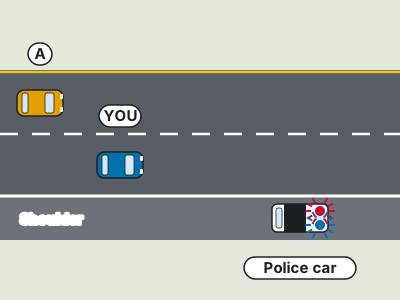
4. When passing a stationary emergency vehicle displaying red or red and blue lights on a roadway with four or more lanes, you should:
- Turn around before reaching it
- Stop in the lane beside it
- Drive faster without changing lanes
- Change to a lane not adjacent to it when safe
Show answer
Change to a lane not adjacent to it when safe. A stationary emergency vehicle with the specified warning lights deserves extra room. On a roadway with at least four lanes and at least two lanes moving in your direction, change into a lane that is not next to the emergency vehicle when doing so is safe. Stopping beside it exposes both you and responders to traffic. Speed alone does not create the required separation. Check mirrors early, signal, and make the lane change only when it will not create another hazard.
Study this in the handbook: Right of way at intersections and roundabouts
5. What does a broken roadway line permit during a passing maneuver?
- The line may never be crossed for any reason
- The line reserves the lane for emergency vehicles
- The line may be crossed when passing is otherwise safe
- The line requires a right turn at the next intersection
Show answer
The line may be crossed when passing is otherwise safe. Missouri describes broken lines as lines that may be crossed in a passing maneuver. That permission is conditional, not a guarantee that passing is safe or legal at every location. A solid line should not be crossed for passing, and pavement lines do not reserve ordinary lanes for emergency vehicles or force a turn. Before crossing a broken line, check sight distance, opposing traffic, intersections, and signs. The visual cue is the gap in the line, followed by a separate safety check before moving over.
Study this in the handbook: Pavement markings and lane use
6. Under Missouri's Move Over rule, what should a driver do when changing lanes around a stationary emergency vehicle is unsafe?
- Maintain speed and pass normally
- Drive onto the shoulder to get farther away
- Stop in the travel lane immediately
- Proceed cautiously at a safe speed for road conditions
Show answer
Proceed cautiously at a safe speed for road conditions. If changing lanes would be unsafe or impossible, Missouri requires the driver to proceed with due caution and reduce speed while maintaining a safe speed for road conditions. The normal speed choice ignores the danger, and stopping in the travel lane can create a new collision risk. Driving onto the shoulder is not the substitute named by the law. First look for a safe lane change; when that cannot be done, slow down and pass with careful control.
Study this in the handbook: Right of way at intersections and roundabouts
7. Which situation permits an intermediate license holder to drive alone between 1:00 a.m. and 5:00 a.m.?
- A school activity, job, or emergency
- A social visit with a same-age friend
- A full tank of fuel
- A trip made only on residential streets
Show answer
A school activity, job, or emergency. The intermediate-license curfew has narrow exceptions. A driver may travel during the 1:00 a.m. to 5:00 a.m. period for a school activity, job, or emergency. A licensed driver who is at least 21 may also accompany the driver, but an ordinary social trip does not qualify by itself. A useful planning cue is to identify the purpose before starting the late-night drive and carry the required license.
Study this in the handbook: Permits and the Graduated Driver License
8. At an intersection, what right-of-way does an organized funeral procession have?
- Priority only when its signal is green
- Priority regardless of traffic controls, with stated exceptions
- No priority over ordinary traffic
- Priority only on roads without stop signs
Show answer
Priority regardless of traffic controls, with stated exceptions. An organized funeral procession has priority at every intersection regardless of the traffic control device. The guide identifies two limits: an emergency vehicle may take priority, and law enforcement may direct traffic differently. A green light is not the condition that creates the procession’s right-of-way. Do not enter the moving line or cut between its vehicles. When you see the procession’s flashing lights, wait unless an officer directs you otherwise.
Study this in the handbook: Right of way at intersections and roundabouts
9. When must a Missouri driver turn on the headlights at night?
- From half an hour after sunset until half an hour before sunrise
- Only after full darkness
- Only when other vehicles have their lights on
- Only outside city limits
Show answer
From half an hour after sunset until half an hour before sunrise. Missouri's night driving tips start with the law: turn your headlights on from half an hour after sunset until half an hour before sunrise. Keep the headlights clean, working and correctly aimed, use high beams when there are no oncoming vehicles, and keep the windows clean to cut glare. Waiting for full darkness or for other drivers to switch on leaves your vehicle hard to see at dusk.
Study this in the handbook: Night driving, rain, snow, fog and skids
10. A white rectangular sign with black or red letters or symbols generally gives information about:
- Traffic rules for direction, lane use, turning, speed, or parking
- Nearby recreation areas and museums
- Temporary roadwork and lane closures
- Rest areas and hospitals
Show answer
Traffic rules for direction, lane use, turning, speed, or parking. Missouri uses white, often rectangular regulatory signs to state rules about movement and control, including direction, lane use, turns, speed, parking, and other special situations. A brown or green sign is the one associated with destinations or recreational and cultural places, so that distractor describes guide information instead. Orange identifies work activity, while blue identifies services such as hospitals and rest areas. When a white sign sets a limit, turn restriction, or lane instruction, treat its message as a traffic rule and follow it even when the road appears quiet.
Study this in the handbook: Road signs by shape and color
11. What does a reflective orange triangle on the rear of a vehicle mean in Missouri?

- The vehicle is carrying hazardous materials
- The vehicle is a student driver
- The vehicle travels at less than 25 mph
- The vehicle is oversize and needs a wide berth
Show answer
The vehicle travels at less than 25 mph. The Missouri guide says a reflective orange triangle on the rear of a vehicle means it is traveling less than 25 mph, and that you may see this sign on construction equipment or farm vehicles. It does not identify hazardous cargo, a student driver, or an oversize load; the guide treats hazardous materials separately, for example by requiring those vehicles to stop at all railroad crossings. When you see the triangle ahead, expect to close on the vehicle quickly, slow down, and pass only where passing is legal and the road ahead is clear.
Study this in the handbook: Road signs by shape and color
12. What traffic direction is indicated by a white line on the left?
- Traffic traveling in opposite directions
- Traffic traveling in the same direction
- A travel lane from a railroad track
- Only lanes reserved for buses
Show answer
Traffic traveling in the same direction. White pavement markings separate traffic moving in the same direction. This differs from yellow markings, which separate opposing directions. The color helps a driver interpret lane placement before changing lanes or preparing for a turn. White lines do not automatically mean every lane change is safe, and a solid white edge line may mark the road's right edge. Check the marking type, mirrors, blind spot, and surrounding traffic before crossing a white lane line.
Study this in the handbook: Pavement markings and lane use
13. According to the Missouri guide, about how far does an average passenger car traveling at 55 mph need to stop?
- About 50 feet
- About 130 to 140 feet, almost half a football field
- About 400 feet
- About one quarter mile
Show answer
About 130 to 140 feet, almost half a football field. At 55 mph the average passenger car can stop in about 130 to 140 feet, which the Missouri guide compares to almost half the length of a football field. The same passage says a fully loaded tractor trailer may take almost 400 feet to come to a complete stop, so 400 feet describes the truck rather than the car. Fifty feet is far shorter than the stated distance, and a quarter mile is far longer. The guide uses this comparison to warn that cutting off a truck is particularly dangerous.
Study this in the handbook: Pedestrians, cyclists, motorcycles and trucks
14. What minimum fine may apply to a first speeding or passing offense in a Missouri state construction or work zone?
- $100 in addition to other penalties
- No fine unless a worker is struck
- $500 instead of any other fine
- $250 in addition to other penalties
Show answer
$250 in addition to other penalties. The guide sets a minimum $250 fine for a first speeding or passing offense in a construction or work zone on Missouri state roadways. It is added to any other fine authorized by law, so the amount is not a replacement ceiling. A $100 figure understates the stated minimum, while waiting for an injury is not part of the condition. Orange work-zone signs should trigger immediate speed and lane discipline.
Study this in the handbook: The point system and traffic penalties
15. Under the Missouri guide's moped and bicycle equipment rules, within what distance must the brakes be able to stop you when traveling 10 mph?
- Within 5 feet
- Within 25 feet
- Within 250 feet
- Within 100 feet
Show answer
Within 25 feet. In its section on mopeds and bicycles, the Missouri guide sets a plain brake standard: the brakes must be able to stop you within 25 feet when traveling ten mph. The same passage notes that mopeds and bicycles do not need to be registered or inspected, yet Missouri law still requires certain equipment on them. Five, 100 and 250 feet are not the figure the guide gives. Test the brakes before a ride and have them serviced if they cannot meet the standard.
Study this in the handbook: Right of way at intersections and roundabouts
16. For a Missouri driver under 21, what can trigger the 90-day Abuse and Lose action?
- Renewing a license before its expiration date
- Driving below the posted speed limit
- Passing a vision test on the first attempt
- Altering, modifying, or misrepresenting a driver license
Show answer
Altering, modifying, or misrepresenting a driver license. Missouri’s Abuse and Lose law can take a license for 90 days from a person younger than 21 who alters, modifies, or misrepresents a driver license. The rule is not limited to impaired driving, and ordinary renewal, lawful speed, or test performance is not listed as a trigger. Treat license information as an official record. Changing or presenting it inaccurately can create a suspension even when no drinking-and-driving event occurred.
Study this in the handbook: Underage drinking, Abuse and Lose, and getting your license back
17. During Missouri's driving skills test, how many points may a driver lose before failing?
- More than 10 points
- More than 30 points
- More than 20 points
- Points are not used
Show answer
More than 30 points. The examiner subtracts points for driving errors throughout the skills test, and losing more than 30 points causes failure. The scoring rule works alongside separate automatic-failure events, so staying under the point threshold does not excuse a dangerous act or traffic-law violation. Do not treat the test as a single collision check. Practice smooth control, legal movements, and careful observation to avoid accumulating small errors.
Study this in the handbook: The written, sign, vision and driving tests
18. Who is the Missouri roundabout truck apron intended to accommodate?
- Rear wheels of large trucks turning
- Bicyclists entering the circle
- Cars making a sharper turn
- Any driver who misses an exit
Show answer
Rear wheels of large trucks turning. A truck apron is the paved area inside a roundabout that gives the rear wheels of large trucks room while they turn. Cars, SUVs, and pickup trucks are not supposed to use it. The car choice mistakes extra truck clearance for a general shortcut, and missing an exit is handled by continuing around the circle. Stay on the normal roadway around the center island unless you are operating the large vehicle for which the apron was designed.
Study this in the handbook: Right of way at intersections and roundabouts
19. What traffic condition does the merge warning sign identify?

- Your lane is ending immediately with no merging space
- The roadway prohibits all lane changes
- Traffic from another road may enter your lane
- A separate lane has been added and merging is unnecessary
Show answer
Traffic from another road may enter your lane. The merge warning sign means traffic from another road will be entering the roadway and may move into the driver's lane. It calls for attention and preparation, not an automatic stop or a blanket ban on lane changes. The added-lane sign is the opposite situation because it says another lane has been provided and merging is unnecessary. Keep a safe gap, check mirrors and blind spots, and adjust speed smoothly so entering vehicles can blend into the flow. The side arrow is the cue to anticipate traffic joining from another road.
Study this in the handbook: Road signs by shape and color
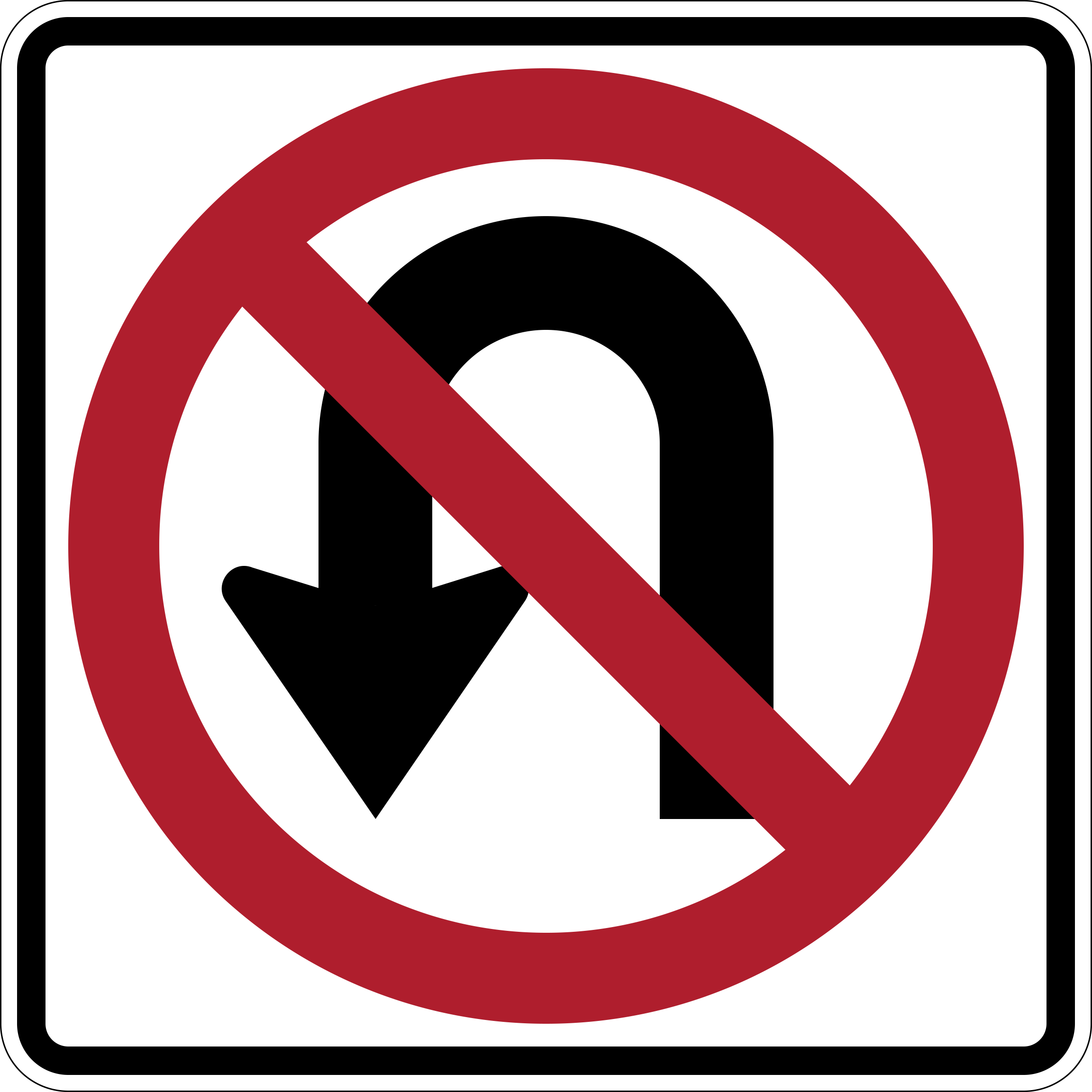
20. The red-slash symbol on the sign shown means that drivers must not:
- Turn left at any intersection
- Continue straight through the next block
- Pass another vehicle on a multilane road
- Make a U-turn
Show answer
Make a U-turn. The U-shaped arrow identifies a turn back toward the opposite direction, and the red slash prohibits that maneuver. It does not ban every left turn, ordinary passing, or straight travel. Regulatory signs with a red circle and slash apply to the pictured action, so the shape of the arrow is the key cue. A driver should plan a legal route ahead rather than attempting to reverse direction at the signed location. If a turn is needed, continue until another intersection or opening permits the maneuver under the posted controls and road conditions.
Study this in the handbook: Road signs by shape and color
QualitySpace is expanding to Missouri
We are a California-based independent insurance brokerage working on licensing in more states. We cannot help with Missouri insurance yet. Leave your email and we will let you know when we can.
Every question is written from the official Missouri Driver Guide. Need paper? Printable MO practice test with answer key.
Last verified 2026-10-05. How we check every question · Study all 201 as flashcards
Frequently asked questions
How many questions are on this Missouri practice test?
This fixed set has 20 questions. It is test 4 of 10 from the 201 question Missouri bank. The real MO exam asks 25 questions and you need 20 correct.
What is the passing score for the real Missouri test?
80% to pass That figure comes from the official Missouri source cited on the DMV facts page.
How does this fixed test relate to the full Missouri bank?
Each numbered test is a fixed set of questions in a fixed order, so you can retake the same test later and compare. Every test mixes road signs and the other topics in about the same proportion as the full bank. Tests 1 to 10 together cover 200 of the 201 questions in the Missouri bank, each once. The full practice page mixes the whole bank at random.
Last verified 2026-10-05. See the Missouri DMV facts page for sourced state details.
Return to the full Missouri practice test · Study road signs