
Test 9 of 10 · 20 questions · Free 2026
MO Permit Practice Test 9
Jump to the test ↓A fixed 20 question set from the Missouri bank with answers and plain English explanations. The real MO exam is 25 questions, 80 percent to pass; take the full length version on the main practice page.
Question 1 of 20 · 0 right so far
All 20 questions in test 9
Every question below comes from the Missouri question bank on this page. Open a question to see the correct answer and the explanation. Nothing here is hidden behind a signup.
1. Before entering a Missouri roundabout, which road users must a driver yield to?
- No one, because entering traffic has priority
- Only vehicles approaching from the right
- Only vehicles behind the entrance
- Traffic already in the circle and pedestrians in crosswalks
Show answer
Traffic already in the circle and pedestrians in crosswalks. Missouri tells drivers approaching a roundabout to always yield to traffic already in the circle and to pedestrians in the crosswalks, then wait for a gap in traffic before entering. Entering traffic has no priority, and the duty covers both groups, not only vehicles from one direction or cars behind the entrance. Slow before the entry, check the circulating traffic and the crosswalk, and merge only when there is a gap and both paths are clear.
Study this in the handbook: Right of way at intersections and roundabouts
2. Who may set a different speed limit within a Missouri city, town, or village?
- Only the federal government
- The local government, through an ordinance
- Only the Missouri Highway Patrol
- No authority may change the statewide limit
Show answer
The local government, through an ordinance. Missouri gives local governments a role in traffic control beyond state laws. A city, town, or village may set speed limits through its own ordinance, so a driver must read the posted sign instead of assuming the general statewide rule applies. The federal government does not set ordinary local street limits, and the Highway Patrol is not the only authority involved. As a practical cue, treat a municipal speed sign as legally binding even when it differs from a familiar number elsewhere in the state.
Study this in the handbook: Speed limits and minimum speeds
3. A Missouri turn warning sign is used for a turn with what recommended maximum speed?
- 45 mph or less
- 55 mph or more
- 30 mph or less
- Any speed, as long as it is posted
Show answer
30 mph or less. Missouri separates a turn sign from a curve sign by the recommended speed. A turn sign is used to warn of a sharp turn or a turn where the recommended maximum speed is 30 mph or less. A curve sign is used to warn of a curve where the recommended speed is less than the posted speed limit for the highway. Neither 45 mph nor 55 mph fits the turn sign rule, and the sign is not used at any speed. Curve and turn signs have an advisory speed plate that shows the recommended speed, so slow to it before the turn.
Study this in the handbook: Road signs by shape and color
4. At a circular green light, what must a driver do before making a left turn?
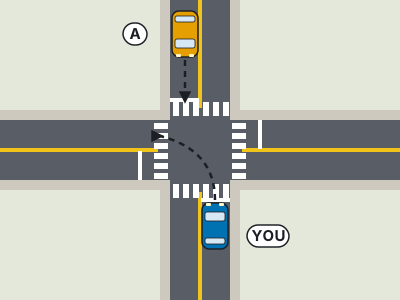
- Turn immediately because the circular green protects the turn
- Wait for a red light facing opposing traffic
- Wait for an adequate gap in opposing traffic
- Use the shoulder to get around oncoming vehicles
Show answer
Wait for an adequate gap in opposing traffic. A circular green signal gives permission to make a permissive left turn, but it does not remove the need to check opposing traffic. The driver must wait for an adequate opening and also watch for pedestrians. The tempting mistake is treating every green indication like a protected green arrow. A green arrow is the protected phase; a circular green requires the turning driver to choose a safe gap. Scan across the intersection, yield as needed, and turn only after the path is open.
Study this in the handbook: Traffic lights, arrows and officers
5. What vision standard must an applicant meet for a Missouri driver license acuity test?
- At least 20/80 with both eyes together
- Exactly 20/20 in each eye
- At least 20/160 in one eye only
- At least 20/40 with either or both eyes
Show answer
At least 20/40 with either or both eyes. Missouri uses a minimum acuity standard of 20/40 with either or both eyes for the vision test. That does not mean an applicant must have perfect 20/20 vision, and the much poorer 20/160 figure is associated with a restriction on taking the driving test when natural and corrected acuity are both worse than that level. If glasses or contacts are needed, bring them for testing. A practical reminder is to distinguish the ordinary minimum from the separate failure threshold.
Study this in the handbook: Carrying, renewing and losing your license
6. What happens after a Missouri driver fails the driving test three times?
- The applicant receives an automatic full license
- The applicant may take unlimited tests the same week
- Further testing requires written authorization and proof of additional training
- Only the vision test must be repeated
Show answer
Further testing requires written authorization and proof of additional training. Three driving-test failures trigger an additional approval step. The Department requires written authorization to test again, and the applicant must send proof of eligible behind-the-wheel training before receiving approval. A license is not issued automatically, and repeated failures do not remove the driving portion or reduce it to vision testing. Keep the examiner’s failure information in mind as a cue: three failures means training documentation plus Department permission before another attempt.
Study this in the handbook: The written, sign, vision and driving tests
7. When a Missouri driving privilege is reinstated after a point action, what happens to the point total?
- It is reduced to four
- It stays the same
- It is doubled
- It drops to zero
Show answer
It is reduced to four. On reinstatement, the Department reduces the point total to four. After that, each year without new points reduces the remaining points: by one-third after one year, by one-half after two years, and to zero after three years. Keeping the old total or doubling it is wrong, and dropping straight to zero skips the schedule. Some convictions stay on the record permanently even when points reach zero, so a clean point total is not the same as a clean record.
Study this in the handbook: The point system and traffic penalties
8. If another driver is following your vehicle too closely and a right lane is available, you should:
- Move over to the right
- Speed up until the other vehicle stops following
- Block the right lane so the driver cannot pass
- Brake suddenly to make the driver back off
Show answer
Move over to the right. When a tailgater is behind you and a right lane is available, move over to the right so the other driver can pass. This separates the vehicles without a sudden confrontation. Hard braking is dangerous because it removes the following driver's stopping margin, while speeding can encourage more aggressive driving. Check the right lane, signal, and move when safe. If no right lane exists, reduce speed gradually only after the road ahead is clear, never with an abrupt stop.
Study this in the handbook: Seat belts, child seats and following distance
9. How many points within 12 months cause Missouri to send a point accumulation advisory?
- 2 points
- 8 points
- 4 points
- 12 points
Show answer
4 points. A total of 4 points in 12 months brings a point accumulation advisory letter from the Department. Eight or more points in 18 months brings a suspension, and 12 or more in 12 months brings a one year revocation. Two points is below the advisory level. The advisory is a warning, not a suspension, so the driving privilege continues, but further convictions can move the driver toward the 8 point suspension level. Speeding, for example, carries 3 points in the state law table.
Study this in the handbook: The point system and traffic penalties
10. A Missouri driver refuses a chemical test to determine BAC. How long is the license taken away?
- One year
- 15 days
- 90 days
- Five years
Show answer
One year. If you refuse a chemical test to determine your BAC, the license is taken away for one year. Reinstatement then requires a $45 fee, a SATOP or comparable program, two years of SR-22 insurance, and possibly an ignition interlock. Fifteen days is the delay before an administrative suspension takes effect after a failed test. Ninety days is a first offense suspension, and five years is a repeat offense denial.
Study this in the handbook: Alcohol limits and DWI penalties
11. Which city street condition is listed by Missouri as allowing a driver to pass another vehicle on the right?
- A narrow street with parked cars
- Any street during daylight
- An unobstructed street wide enough for two or more lines of vehicles each way
- A street where the center line is solid yellow
Show answer
An unobstructed street wide enough for two or more lines of vehicles each way. Passing on the right is listed for a city street with unobstructed pavement wide enough for two or more lines of vehicles in each direction. Width and clear pavement are both important. A narrow street with parked cars does not provide the required room, and daylight alone does not create a legal condition. A solid yellow center line describes a separate restriction and does not authorize an unsafe right side pass. Check the street's usable width before considering this exception.
Study this in the handbook: Right of way at intersections and roundabouts
12. When fog requires the use of windshield wipers, what must the driver also use?
- High beams only, to illuminate farther ahead
- Parking lights without any headlights
- Hazard flashers while keeping all lights off
- Headlights, kept on low beam in fog
Show answer
Headlights, kept on low beam in fog. Missouri requires headlights whenever weather conditions require windshield wipers. In fog, the guide adds that low beams are the proper choice because high beams can reduce what the driver sees by reflecting through the fog. Parking lights alone do not satisfy the headlight requirement, and hazard flashers are not a substitute for seeing and being seen. The cue is straightforward: wipers needed for weather means headlights on, then select low beam and reduce speed if visibility is poor.
Study this in the handbook: Night driving, rain, snow, fog and skids
13. What is the Missouri emergency cellular number listed for reporting a highway vehicle breakdown?
- *55
- 511
- *911
- *77
Show answer
*55. The guide lists *55 as the cellular number to call in a highway emergency. That number is a reporting resource, not permission to handle a breakdown while standing in a travel lane. If possible, move the vehicle away from traffic, turn on emergency flashers, and warn approaching drivers. The memorable cue is the star followed by 55, while ordinary emergency response and travel-information numbers are different services.
Study this in the handbook: Highway driving, merging and breakdowns
14. What does the Missouri warning sign labeled Stop Ahead tell a driver to expect?
- A mandatory lane change immediately
- A stop sign ahead on the road being traveled
- A reduced speed limit that never requires stopping
- A railroad crossing behind the driver
Show answer
A stop sign ahead on the road being traveled. A Stop Ahead warning sign announces that a stop sign is farther ahead on the road you are using. It is an advance warning, not the stop itself, so the driver should reduce speed, scan for the intersection, and be ready to stop at the actual sign. It does not demand an immediate lane change or describe a railroad behind the vehicle. The key cue is preparation for the upcoming stop location.
Study this in the handbook: Road signs by shape and color
15. When may a Missouri driver turn right at a red light?
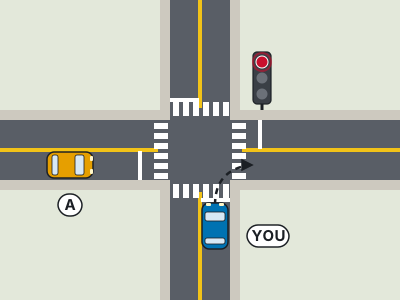
- Without stopping when no pedestrians are visible
- Only after the signal turns yellow
- Whenever a vehicle behind is waiting
- After a complete stop, if the way is clear and no prohibition sign is posted
Show answer
After a complete stop, if the way is clear and no prohibition sign is posted. Missouri permits a right turn on red only after a complete stop, and the path must be clear of pedestrians and traffic. A posted No Right Turn On Red sign removes that permission. A waiting vehicle behind you creates no special exception, and a clear-looking corner does not excuse the stop. Use the sequence stop, check, obey the sign, then turn only when the crossing and roadway are safe.
Study this in the handbook: Traffic lights, arrows and officers
16. What does the red and white triangular sign shown require?
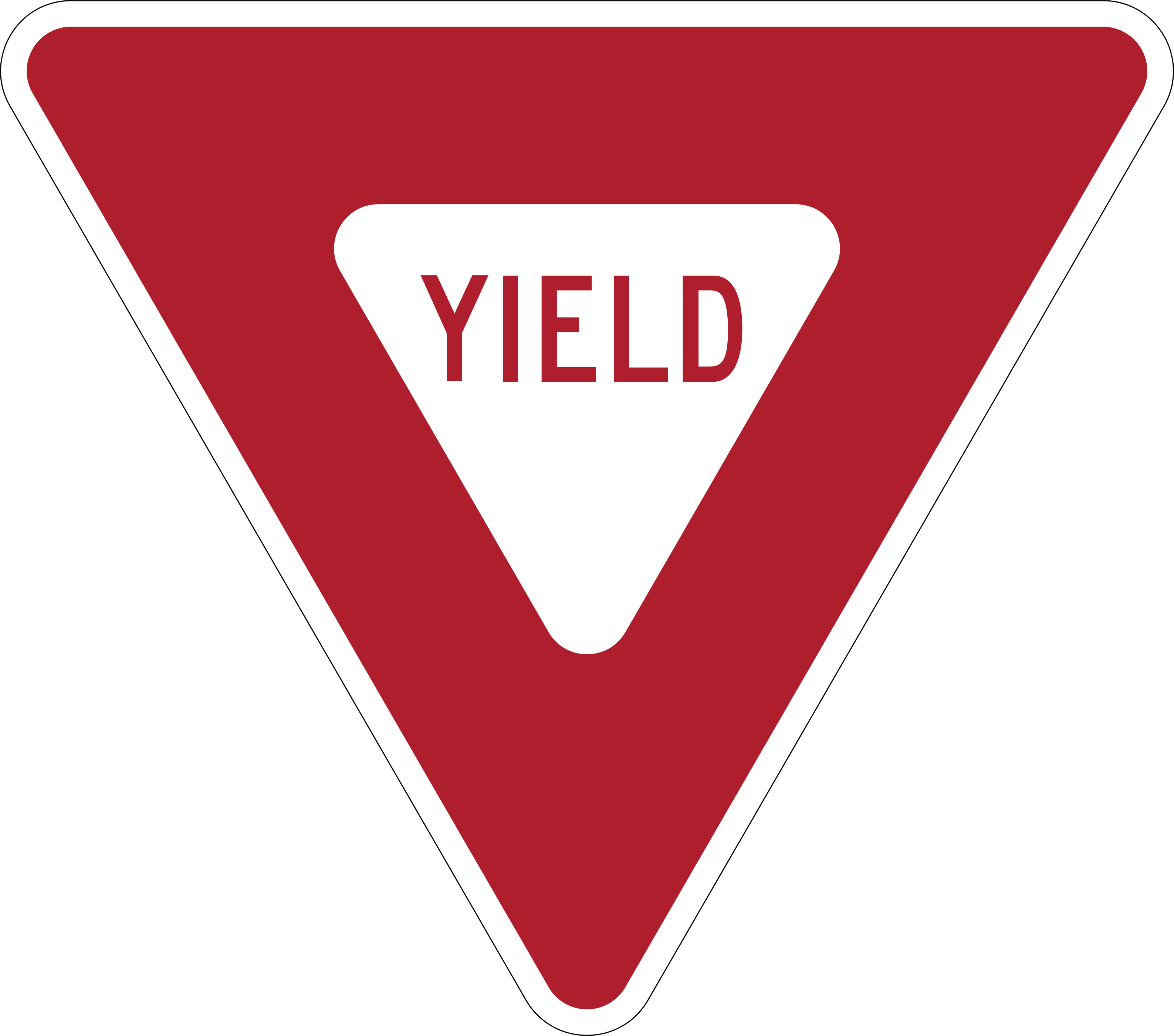
- A complete stop every time, even with no conflicting traffic
- Slow down and yield to traffic in the intersection or roadway being entered
- Entry is prohibited in both directions
- The lane is reserved for buses
Show answer
Slow down and yield to traffic in the intersection or roadway being entered. The yield sign calls for a slower approach and a right-of-way check. Traffic already in the intersection or on the roadway being entered has priority, so the driver must yield and stop if conditions require it. A full stop is not automatic in every clear approach, which separates this sign from a stop sign. The no-entry option describes a different regulatory sign, and a bus restriction has no connection to the triangle. Look left, right, and toward pedestrians before joining the crossing roadway, and be ready to stop if a conflict develops.
Study this in the handbook: Road signs by shape and color
17. What should a driver do when approaching the five-sided school crossing sign?

- Maintain speed because the sign applies only to school buses
- Slow down and watch for children crossing the road
- Turn around before entering the school zone
- Stop in the lane until a crossing guard waves through every car
Show answer
Slow down and watch for children crossing the road. The pentagonal school crossing sign warns that children may be crossing. Drivers should slow down and watch carefully for them. It does not apply only to school buses, and it does not require stopping in the travel lane when no crossing movement calls for a stop. A U-turn is also unrelated to the warning. The child figures and five-sided shape provide an early visual cue, but the necessary response depends on what is actually happening near the crossing. Scan the sidewalk, crosswalk, and road edges before continuing through the school area.
Study this in the handbook: Road signs by shape and color
18. What is the eligible age for a Missouri instruction permit?
- 17
- 14
- 16
- 15
Show answer
15. A Missouri instruction permit begins the graduated licensing process at age 15. The age 16 option describes the usual minimum age for the intermediate step, not the initial permit. The permit is a learning stage, so the driver must also meet the examination and supervision requirements before driving. Remember the sequence as permit first, intermediate next, and full under 21 license after that. When a question asks when a young driver can start the program, look for 15 rather than the age attached to the next license stage.
Study this in the handbook: Permits and the Graduated Driver License
19. After a Missouri MIP suspension, what must a young driver do to get the license back?
- Pay a $45 fee and attend a SATOP or comparable program
- Retake only the vision test
- Wait five years with no further action
- Pay a $500 fine and nothing else
Show answer
Pay a $45 fee and attend a SATOP or comparable program. Reinstatement after a minor in possession suspension has two parts in Missouri: a $45 reinstatement fee and completion of a Substance Awareness Traffic Offender Program or a comparable program. A vision test does not address the reason for the suspension, waiting alone does not restore the privilege, and there is no $500 fine in the reinstatement path. The guide's chart adds that if the privilege was revoked for one year, the driver must also provide proof of insurance for two years with an SR-22 filing and retake the driver exam.
Study this in the handbook: Underage drinking, Abuse and Lose, and getting your license back
20. When may a Missouri driver use a handicapped parking space?
- Whenever the lot is full
- Only when the vehicle displays a valid disabled placard or plate and is transporting the person with the disability
- For less than 10 minutes
- At night only
Show answer
Only when the vehicle displays a valid disabled placard or plate and is transporting the person with the disability. Handicapped parking spaces in Missouri may only be used when the vehicle displays a handicapped person placard or license plates and a physically handicapped person is the occupant at the time of parking, or is being dropped off or picked up. A full lot, a short errand, or the hour of the day never creates an exception, and violators can be punished by a fine. The guide also says it is illegal to park in the handicapped parking access aisles beside these spaces, so keep that striped area clear too.
QualitySpace is expanding to Missouri
We are a California-based independent insurance brokerage working on licensing in more states. We cannot help with Missouri insurance yet. Leave your email and we will let you know when we can.
Every question is written from the official Missouri Driver Guide. Need paper? Printable MO practice test with answer key.
Last verified 2026-10-05. How we check every question · Study all 201 as flashcards
Frequently asked questions
How many questions are on this Missouri practice test?
This fixed set has 20 questions. It is test 9 of 10 from the 201 question Missouri bank. The real MO exam asks 25 questions and you need 20 correct.
What is the passing score for the real Missouri test?
80% to pass That figure comes from the official Missouri source cited on the DMV facts page.
How does this fixed test relate to the full Missouri bank?
Each numbered test is a fixed set of questions in a fixed order, so you can retake the same test later and compare. Every test mixes road signs and the other topics in about the same proportion as the full bank. Tests 1 to 10 together cover 200 of the 201 questions in the Missouri bank, each once. The full practice page mixes the whole bank at random.
Last verified 2026-10-05. See the Missouri DMV facts page for sourced state details.
Return to the full Missouri practice test · Study road signs