
Test 10 of 10 · 20 questions · Free 2026
MO Permit Practice Test 10
Jump to the test ↓A fixed 20 question set from the Missouri bank with answers and plain English explanations. The real MO exam is 25 questions, 80 percent to pass; take the full length version on the main practice page.
Question 1 of 20 · 0 right so far
All 20 questions in test 10
Every question below comes from the Missouri question bank on this page. Open a question to see the correct answer and the explanation. Nothing here is hidden behind a signup.
1. How many points does Missouri assess for driving with a suspended or revoked license?
- 3 points
- 4 points
- 8 points
- 12 points
Show answer
12 points. Operating a vehicle with a suspended or revoked license is worth 12 points, the same as a felony involving a vehicle or getting a license by misrepresentation. Twelve points within 12 months also triggers a one-year revocation on its own. Three and four points belong to speeding and careless driving. Eight is the suspension threshold over 18 months, not a single violation value. Leaving the scene of a crash can also bring 12 points and revocation.
Study this in the handbook: The point system and traffic penalties
2. A Missouri instruction permit holder who is 16 or older is driving. Who must accompany the permit holder in the front seat?
- Any licensed driver of any age
- A parent only
- No one, once the holder turns 16
- A person at least 21 years old with a valid driver license
Show answer
A person at least 21 years old with a valid driver license. Missouri ties the supervising driver to age and licensing rather than to family. From age 16 the permit holder may drive with a person who is at least 21 and holds a valid driver license sitting in the front seat. A licensed 18 year old friend does not qualify, the rule is not limited to parents, and turning 16 does not remove the supervision requirement; that comes with the intermediate license. Younger permit holders face a stricter list of qualifying supervisors, so the age in the question matters.
Study this in the handbook: Permits and the Graduated Driver License
3. After a court conviction for DWI or BAC, what license consequence does the Missouri guide list for a third or subsequent offense?
- A ten year license denial
- A one year revocation
- A 30 day suspension
- A five year denial
Show answer
A ten year license denial. The guide's chart of court convicted actions for DWI or BAC lists a ten year license denial for a third offense and for third and subsequent offenses. A one year revocation is listed for a second offense, and a five year denial for a second offense within five years. The 30 day suspension belongs to the separate minor in possession chart. Denial means the person cannot get a license during the stated period, so a third conviction carries the longest listed loss of driving privilege.
Study this in the handbook: Alcohol limits and DWI penalties
4. What must a driver do when approaching a Missouri stop sign?
- Slow down only when another vehicle is nearby
- Stop after entering the intersection
- Make a full stop before proceeding
- Yield without stopping if the road looks clear
Show answer
Make a full stop before proceeding. Missouri requires a full stop whenever a driver sees a stop sign. The stop is not optional when the intersection appears empty, and merely reducing speed does not satisfy the rule. A driver should then check for crossing vehicles and pedestrians before moving again. The practical cue is the red, eight-sided sign: bring the vehicle to a complete halt, then continue only when the crossing area is clear. This differs from a yield sign, where slowing and yielding may be enough if no conflicting traffic is present.
Study this in the handbook: Road signs by shape and color
5. Which of these can lead to loss of a Missouri driver license, according to the guide's list?
- Stealing fuel from a gas station
- Getting a parking ticket
- Driving an older vehicle
- Moving to another county
Show answer
Stealing fuel from a gas station. Missouri's list of actions that can cost you your license goes beyond driving offenses. It includes failing to use an ignition interlock device when required, stealing fuel from a gas station, possessing any intoxicating liquor if you are a minor, submitting false proof of insurance, and failing to yield the right of way and causing injury. Parking tickets, vehicle age and a change of address are not on the list.
Study this in the handbook: Carrying, renewing and losing your license
6. What is a two-way left-turn lane in Missouri intended for?
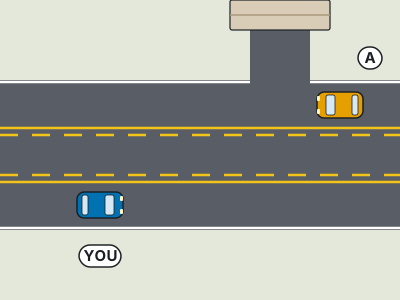
- Passing slower traffic in either direction
- Traveling through the lane for any distance
- Entering the roadway from a side street
- Preparing to slow or stop before making a left turn from the main roadway
Show answer
Preparing to slow or stop before making a left turn from the main roadway. A shared center lane marked for two-way left turns is a staging area for a driver preparing to slow or stop before turning left from the main roadway. It is not a passing lane or an ordinary travel lane, and the guide limits travel in it to no more than 500 feet. It also should not be used to enter the roadway from a side street. Enter only when preparing for the left-turn movement.
Study this in the handbook: Right of way at intersections and roundabouts
7. When your vehicle begins to skid, what steering response does the guide recommend?
- Turn sharply opposite the slide
- Gently steer in the direction the rear wheels are sliding
- Hit the brakes hard and hold them
- Accelerate to pull the vehicle straight
Show answer
Gently steer in the direction the rear wheels are sliding. During a skid, remove your foot from the accelerator and avoid hitting the brakes. Gently turn the steering wheel in the direction the rear wheels are sliding, then correct smoothly as traction returns. A sharp opposite turn can worsen the loss of control, and hard braking can make the slide worse. Look where you want the vehicle to travel, keep movements gradual, and avoid panic inputs. The rear of the vehicle moving sideways is the cue to steer into the skid.
Study this in the handbook: Night driving, rain, snow, fog and skids
8. How many driving tests may a Missouri applicant take in one day?
- One
- Two
- Three
- As many as the applicant can schedule
Show answer
One. An applicant may take only one driving test per day in Missouri. The daily limit is separate from the rule for repeated failures: after three failures, another test requires written authorization from the Department and additional behind-the-wheel training. Choosing two confuses the number allowed in a day with a later retest process. Schedule practice between attempts, and remember that a failed test does not permit another same-day try.
Study this in the handbook: The written, sign, vision and driving tests
9. What must every vehicle in a Missouri funeral procession do?
- Use its flashing emergency lights and follow the vehicle ahead as closely as is practical and safe
- Stop at every intersection
- Drive in the right lane only
- Sound the horn at intersections
Show answer
Use its flashing emergency lights and follow the vehicle ahead as closely as is practical and safe. If you are driving in a funeral procession, follow the vehicle in front of you as closely as is practical and safe, and every vehicle in the procession must use its flashing emergency lights. An organized funeral procession has the right of way at intersections, so other drivers must not cut through it. Sounding the horn and stopping at each intersection are not part of the procedure.
Study this in the handbook: Right of way at intersections and roundabouts
10. How many points may a Missouri driver receive for failing to stop for a school bus receiving or discharging students?
- Two points
- Five points
- Three points
- Ten points
Show answer
Five points. A conviction for failing to stop for a school bus that is receiving or discharging students carries five points on the Missouri driving record. The suspension consequences are separate from the point assessment, so a driver should not substitute the 90-day first-offense suspension for the number of points. When the bus’s red lights and stop arm are active, stop before reaching it and remain stopped until movement or a signal permits travel.
Study this in the handbook: Passing, turning and signaling
11. What should you do when an emergency vehicle approaches with a siren or flashing light?
- Follow it closely through the next intersection
- Pull to the right edge and remain stopped until it passes
- Stop immediately in the intersection
- Keep driving at the same speed in the left lane
Show answer
Pull to the right edge and remain stopped until it passes. Missouri drivers must yield to police, fire, ambulance, and other emergency vehicles using the listed warning equipment. Pull as near to the right edge as possible and remain stopped until the vehicle passes. If already in an intersection, clear that intersection before pulling over rather than stopping in the crossing path. Following the emergency vehicle is unsafe, and staying in the left lane blocks the responder. Check mirrors frequently so the response is recognized early and the maneuver is smooth.
Study this in the handbook: Emergency vehicles, Move Over and school buses
12. At a crosswalk, what is a driver's duty when a pedestrian is about to enter?
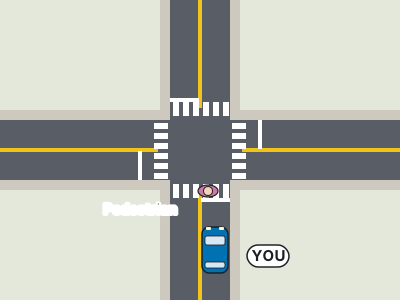
- Sound the horn and continue
- Pass another vehicle stopped nearby
- Yield to the pedestrian
- Proceed first if the crosswalk is unmarked
Show answer
Yield to the pedestrian. Missouri says you must yield to pedestrians in or about to enter a crosswalk. The rule applies even when paint is absent, because the guide notes that not all crosswalks are marked, so be alert for pedestrians at intersections without defined crosswalks. Sounding the horn does not replace yielding, and the guide separately says not to pass a vehicle that has stopped or slowed for a pedestrian. Before crossing an intersection, reduce speed and look for people near both edges of the roadway, and wait while a person steps toward the crossing.
Study this in the handbook: Pedestrians, cyclists, motorcycles and trucks
13. Where does the Missouri guide say a U-turn should never be made?
- On any two-lane road
- Anywhere without a traffic signal
- In any town
- On a curve or near the crest of a hill where your vehicle may not be seen
Show answer
On a curve or near the crest of a hill where your vehicle may not be seen. Only make a U-turn when it is safe. U-turns should not be made on any curve or near the crest of a hill when your vehicle may not be seen by other drivers, and some towns and cities do not allow U-turns at all, so check for signs. A two lane road without a curve or hill is not itself a ban, and signals are not required for a legal U-turn.
Study this in the handbook: Passing, turning and signaling
14. Which action matches a flashing yellow traffic signal rather than a flashing red signal?
- Slow down and proceed carefully
- Stop as though facing a stop sign
- Wait for a police officer before moving
- Treat the intersection as closed to all traffic
Show answer
Slow down and proceed carefully. Missouri distinguishes the two flashing signals: yellow means slow down and proceed with caution, while red means the same thing as a stop sign. That makes a full stop the wrong automatic response to yellow, although stopping may still be sensible if traffic or pedestrians require it. No officer is needed for ordinary operation, and the intersection is not closed. Remember the color pairing at the approach: flashing yellow is caution, flashing red is stop, then apply the rest of the roadway conditions.
Study this in the handbook: Traffic lights, arrows and officers
15. How close to a Missouri intersection or railroad grade crossing may you pass another vehicle?
- Up to 50 feet before it
- Right up to the crossing if clear
- Passing is not allowed within 100 feet of or at any intersection or railroad grade crossing
- Within 100 feet only on a two-lane road
Show answer
Passing is not allowed within 100 feet of or at any intersection or railroad grade crossing. Missouri bars passing when approaching within 100 feet of or at any intersection or railroad grade crossing. The same list also bars passing where there is a solid yellow line, and when the view is obstructed upon approaching within 100 feet of a bridge, viaduct, or tunnel. Fifty feet is inside the restricted distance, the rule is not limited to two lane roads, and a clear crossing does not lift it. Wait until you are past the crossing or intersection and can see that the road ahead is clear for the full distance you need.
Study this in the handbook: Passing, turning and signaling
16. When the lane-ends warning sign appears, what must a driver in the right lane do?

- Continue in the right lane and force left-lane traffic to stop
- Use the shoulder until the lane reappears
- Stop immediately in the lane without checking traffic
- Merge left, yielding to traffic already in the left lane
Show answer
Merge left, yielding to traffic already in the left lane. The lane-ends warning means two lanes will become one. A driver in the right lane must merge left and yield to vehicles already traveling in the left lane. The disappearing lane does not grant priority, and the shoulder is not a replacement travel lane. Stopping suddenly can create a rear-end crash, so the driver should signal, check mirrors and blind spots, adjust speed, and merge when a safe gap exists. The narrowing line on the sign is the advance cue to begin planning the merge rather than waiting until the lane physically ends.
Study this in the handbook: Road signs by shape and color
17. What hazard does the round yellow railroad advance-warning sign identify?

- A bicycle-only route
- A roundabout that must be entered immediately
- A railroad crossing ahead
- A no-passing zone that ends at the next hill
Show answer
A railroad crossing ahead. The round yellow advance-warning sign tells the driver that a railroad crossing is approaching. It is placed before the crossing so the driver has time to reduce speed, look for a train, and prepare to stop. It is not a bicycle instruction, a command to enter a roundabout, or a notice about the end of a passing restriction. The round shape is a strong railroad cue, but the driver should also watch for a crossbuck, lights, or a gate closer to the tracks. Never begin crossing without space on the far side.
Study this in the handbook: Railroad crossings
18. What do blue square or rectangular service signs with white letters or symbols show?
- A warning that a roadway hazard is ahead
- The maximum speed allowed by law
- Locations of services such as rest areas and hospitals
- The direction and distance to cities and state lines
Show answer
Locations of services such as rest areas and hospitals. Blue service signs identify useful facilities along the trip, including rest areas and hospitals. They are informational, so they do not set the maximum legal speed, warn about a hazard, or provide the destination guidance assigned to green and brown guide signs. A driver can use the blue panel to locate help or a place to stop, but still must obey any separate regulatory sign governing speed, lane position, or turning. Remember the pairing of blue and services when scanning signs at highway exits or along an unfamiliar route.
Study this in the handbook: Road signs by shape and color
19. When must a driver obey the slower speed limit in a Missouri school zone?
- Only after a school bus opens its doors
- When school-zone lights flash or children are present
- Only when a crossing guard is standing in the roadway
- Only between midnight and sunrise
Show answer
When school-zone lights flash or children are present. The school-zone rule is activated by either of two visible conditions: flashing school-zone lights or children being present. A bus, nighttime hours, or a crossing guard is not required before the reduced limit applies. Drivers should scan for both the posted school-zone sign and the people or signals that trigger extra caution. The useful cue is simple: flashing lights or children means slow to the lower school-zone speed and stay alert for sudden crossings.
Study this in the handbook: Speed limits and minimum speeds
20. Under Missouri's Abuse and Lose law, what happens to a driver 21 or older who possesses or uses drugs while driving?
- The license may be taken away for 90 days
- The license may be taken away for one year
- Only a warning
- The license is taken away for ten years
Show answer
The license may be taken away for one year. Drivers younger than 21 can lose the license for 90 days under Abuse and Lose. A driver 21 or older who possesses or uses drugs while driving may lose the license for one year. Getting it back requires a $45 fee, completing SATOP or a similar program, two years of SR-22 insurance proof, and retaking the complete driver exam. A warning or ten years is not the stated consequence.
Study this in the handbook: Underage drinking, Abuse and Lose, and getting your license back
QualitySpace is expanding to Missouri
We are a California-based independent insurance brokerage working on licensing in more states. We cannot help with Missouri insurance yet. Leave your email and we will let you know when we can.
Every question is written from the official Missouri Driver Guide. Need paper? Printable MO practice test with answer key.
Last verified 2026-10-05. How we check every question · Study all 201 as flashcards
Frequently asked questions
How many questions are on this Missouri practice test?
This fixed set has 20 questions. It is test 10 of 10 from the 201 question Missouri bank. The real MO exam asks 25 questions and you need 20 correct.
What is the passing score for the real Missouri test?
80% to pass That figure comes from the official Missouri source cited on the DMV facts page.
How does this fixed test relate to the full Missouri bank?
Each numbered test is a fixed set of questions in a fixed order, so you can retake the same test later and compare. Every test mixes road signs and the other topics in about the same proportion as the full bank. Tests 1 to 10 together cover 200 of the 201 questions in the Missouri bank, each once. The full practice page mixes the whole bank at random.
Last verified 2026-10-05. See the Missouri DMV facts page for sourced state details.
Return to the full Missouri practice test · Study road signs