
Test 2 of 10 · 20 questions · Free 2026
MO Permit Practice Test 2
Jump to the test ↓A fixed 20 question set from the Missouri bank with answers and plain English explanations. The real MO exam is 25 questions, 80 percent to pass; take the full length version on the main practice page.
Question 1 of 20 · 0 right so far
All 20 questions in test 2
Every question below comes from the Missouri question bank on this page. Open a question to see the correct answer and the explanation. Nothing here is hidden behind a signup.
1. In Missouri's point table of state law violations, how many points does a speeding conviction carry?
- 3 points
- 1 point
- 5 points
- 12 points
Show answer
3 points. The Missouri table of state law violations lists speeding at 3 points, careless and imprudent driving at 4, failing to stop for a school bus at 5, and a felony involving a vehicle, license misrepresentation, or driving on a suspended or revoked license at 12. The guide notes a speeding conviction can bring two or three points depending on whether the court was municipal, county or state level, and the table shows the state law value. One point and five points are not the speeding values.
Study this in the handbook: The point system and traffic penalties
2. Which Missouri driver does not have to file SR-22 proof of insurance after an alcohol offense?
- An adult with a first DWI at .08%
- Any driver who refused a test
- A minor with a BAC of .02% or more on a first offense
- A driver with a second DWI
Show answer
A minor with a BAC of .02% or more on a first offense. The one exception to the SR-22 filing rule is a minor with a BAC of .02 percent or more on a first offense. Adults facing DWI or BAC actions, drivers who refuse a chemical test, and repeat offenders must file proof of insurance and keep it for two years. The SR-22 is the most common way to file that proof with the Driver License Bureau.
Study this in the handbook: Underage drinking, Abuse and Lose, and getting your license back
3. A Missouri permit holder is 15. Besides a parent, grandparent, guardian or driving instructor, who may supervise from the front seat?
- A person at least 25 licensed for three years with written parent permission
- Any licensed driver age 18 or older
- Any licensed driver age 21 or older
- A 16-year-old sibling with an intermediate license
Show answer
A person at least 25 licensed for three years with written parent permission. Under 16, a permit holder may drive only with a parent, stepparent, grandparent, legal guardian, qualified instructor, or a person at least 25 who has been licensed at least three years and has written permission from the parent or guardian. Any licensed driver 21 or older may supervise only once the permit holder is 16. An 18-year-old or a teen sibling does not qualify.
Study this in the handbook: Permits and the Graduated Driver License
4. What must vehicles do when a blind pedestrian is crossing with a white cane or guide dog?
- Continue after sounding the horn
- Come to a complete stop
- Stop only if a traffic signal is red
- Pass before the pedestrian reaches the lane
Show answer
Come to a complete stop. A white cane or guide dog identifies a pedestrian who is blind, and Missouri requires vehicles to come to a complete stop while that person crosses. A horn does not replace yielding, and a traffic signal does not remove the driver’s duty to protect the crossing. Stop early enough to leave the pedestrian a safe path, then wait until the crossing is complete. The cane or dog is the immediate cue to stop fully.
Study this in the handbook: Pedestrians, cyclists, motorcycles and trucks
5. What does the STOP AHEAD warning sign mean?

- The current road has ended and requires a U-turn
- A stop sign is ahead, so prepare to stop
- Stopping is prohibited beyond the sign
- The driver has priority over all crossing traffic
Show answer
A stop sign is ahead, so prepare to stop. STOP AHEAD is an advance warning that a stop sign is coming on the road being traveled. The driver should prepare by adjusting speed and looking for the required stopping point. It does not prohibit stopping, end the roadway, authorize a U-turn, or give priority over crossing traffic. The small stop sign pictured on the yellow warning sign distinguishes an upcoming control from the actual stop sign. Anticipating the stop helps prevent a rushed braking maneuver and leaves time to check the intersection after coming to a complete stop.
Study this in the handbook: Road signs by shape and color
6. What movement is prohibited by the crossed left-turn arrow?
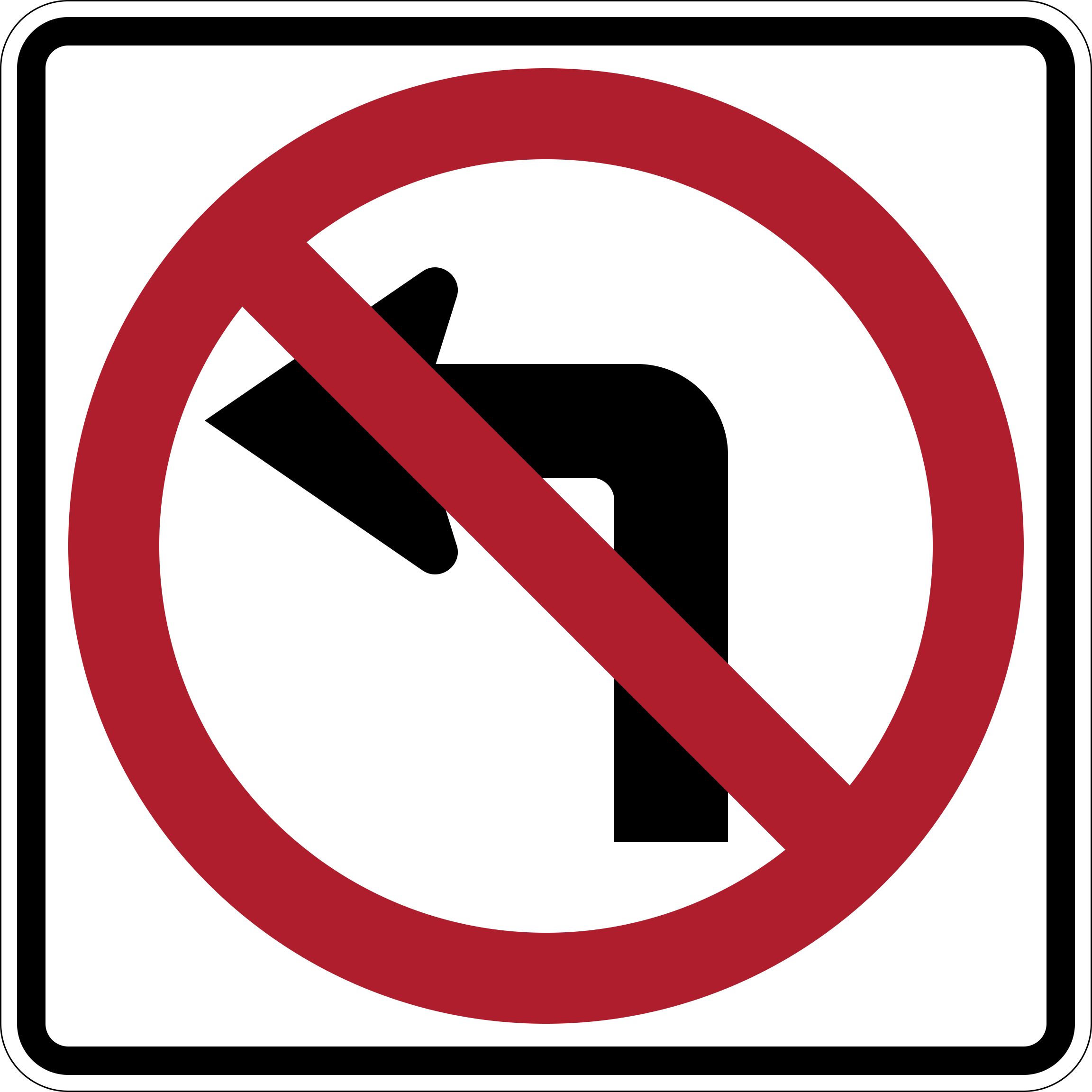
- A left turn
- Passing a slow vehicle in the left lane
- Going straight through an intersection
- A U-turn only at a railroad crossing
Show answer
A left turn. The crossed arrow depicts a left turn, so the restriction is aimed at that movement. A no-left-turn sign does not automatically prohibit U-turns, passing, or proceeding straight, although other signs or markings may control those actions elsewhere. The manual identifies no-left-turn and no-U-turn as examples of red-slash regulatory messages, which means the pictured symbol must be read precisely. When this sign appears, choose another permitted direction and check for lane arrows or signal indications before moving through the intersection.
Study this in the handbook: Road signs by shape and color
7. For a driver age 21 or older operating a noncommercial vehicle in Missouri, what is the lowest BAC covered by the general alcohol per se threshold?
- 0.02% or more
- 0.04% or more
- 0.08% or more
- 0.12% or more
Show answer
0.08% or more. Missouri identifies 0.08% BAC or more as illegal for an ordinary adult driver. The lower 0.04% threshold applies to commercial vehicle drivers, while 0.02% applies when the driver is under 21. The number is a legal limit, not a promise that lower alcohol levels are safe or acceptable for every person. Treat any drinking before driving as a reason to arrange another ride, rather than trying to estimate a personal margin.
Study this in the handbook: Alcohol limits and DWI penalties
8. What must a driver do when an ambulance approaches using a siren and flashing light?
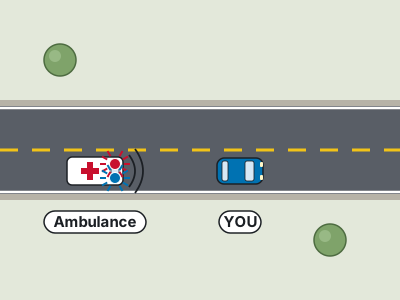
- Speed up so the ambulance cannot pass
- Yield and pull as near to the right as possible
- Move left and continue at the posted speed
- Stop in the intersection immediately
Show answer
Yield and pull as near to the right as possible. An ambulance using a siren or air horn and a red or blue flashing light is an emergency vehicle that receives priority. Missouri requires other drivers to yield, pull near the right edge, and remain stopped until it passes. If the driver is already in an intersection, clearing that space first is safer than stopping across the responder's path. Speeding up, moving left, or stopping in the intersection can delay the emergency response and create a collision risk.
Study this in the handbook: Right of way at intersections and roundabouts
9. What must a driver outside an organized funeral procession avoid doing while the procession is moving?
- Yielding at intersections
- Watching for emergency vehicles
- Waiting until the procession has passed
- Driving between vehicles in the procession
Show answer
Driving between vehicles in the procession. Vehicles outside an organized funeral procession must not drive between the procession vehicles while they are moving. The guide also says not to join a funeral procession to obtain the right of way and not to pass any vehicle in the procession except where a passing lane is specifically provided. An organized procession has the right of way at intersections regardless of traffic control devices, except for emergency vehicles or law enforcement direction. A line of vehicles using flashing emergency lights is the cue to wait.
Study this in the handbook: Pedestrians, cyclists, motorcycles and trucks
10. When renewing a Missouri vehicle registration, how recent must a required safety and/or emissions inspection certificate be?
- Within the last 30 days
- Within the last year
- Done within the last 60 days, if applicable
- No inspection is ever required for renewal
Show answer
Done within the last 60 days, if applicable. The renewal notice lists the documents needed to renew a Missouri vehicle registration. One of them is a current certificate of safety and/or emissions inspection done within the last 60 days, if an inspection applies to your vehicle. Thirty days is shorter than the guide's window, and a year old inspection is too old. Where an inspection is required, you cannot skip it. The other renewal items include the renewal notice or prior receipt, a paid personal property tax receipt, proof of insurance, and the registration fee.
11. If your accelerator becomes stuck, what should you do first?
- Shift to neutral and apply the brakes
- Pump the accelerator until it releases
- Turn off the ignition immediately while moving
- Pull the parking brake and close your eyes
Show answer
Shift to neutral and apply the brakes. A stuck accelerator requires the driver to reduce engine power while preserving steering control. Shift to neutral, apply the brakes, keep watching the road, and look for a safe way off the roadway. Turning off the ignition while still moving can lock the steering wheel in many vehicles, so the guide places that action after direction changes are no longer needed and the vehicle has stopped. Keep control, warn nearby drivers, and use the shoulder only when it is safe.
Study this in the handbook: Brake failure, blowouts and other emergencies
12. What does a steady red arrow mean for a driver waiting to turn left?
- Turn if the driver has already slowed down
- Turn after yielding to vehicles in the opposite direction
- Proceed straight through the intersection
- Stop at the stop line, crosswalk, or before the intersection
Show answer
Stop at the stop line, crosswalk, or before the intersection. A steady red arrow prohibits the indicated turn until the signal changes to green or a flashing yellow arrow. The vehicle must stop at the stop line, crosswalk, or before the intersection. It is not enough to yield, and slowing without stopping leaves the driver facing a red indication. The visual cue is the solid arrow pointing into the intended movement: hold position, monitor the signal, and move only when a permitted indication appears. Pedestrian movement still requires attention when the turn becomes available.
Study this in the handbook: Traffic lights, arrows and officers
13. How far before a designated stop do a Missouri school bus's amber warning lights begin flashing?
- 100 feet before the stop
- At the stop only
- 500 feet before the stop
- One mile before the stop
Show answer
500 feet before the stop. The Missouri guide says a school bus's amber warning lights will flash 500 feet before the bus comes to a designated stop, warning drivers of an impending stop. When the bus is stopped, the alternate flashing red lights and the stop signal arm are activated, and oncoming and following traffic must stop before reaching the bus. One hundred feet and one mile are not the stated distance, and the amber phase comes before the stop, not at it. When you see amber lights on a bus, slow down and prepare to stop.
Study this in the handbook: Right of way at intersections and roundabouts
14. Where does the Missouri guide say to find the recommended tire pressure?
- On the tire sidewall
- In the owner's manual or on the driver's side door jamb
- At any service station
- On the inspection sticker
Show answer
In the owner's manual or on the driver's side door jamb. Before entering the vehicle, check the tire pressure using the recommended PSI located in the vehicle owner's manual or on the driver's side door jamb, and measure it with a tire pressure gauge. If the reading is above the listed number, let air out; if it is below, add air. The guide does not point to the tire sidewall, a service station, or an inspection sticker as the source of the recommended pressure for your vehicle, so use the owner's manual or door jamb figure.
15. A Missouri driver reaches 8 points within 18 months for the first time. How long is the suspension?
- 60 days
- 90 days
- One year
- 30 days
Show answer
30 days. Eight or more points in 18 months suspends the privilege: 30 days for a first suspension, 60 days for a second, and 90 days for a third or later. So 60 and 90 days are later steps. One year is the revocation for 12 points in 12 months, 18 in 24 months, or 24 in 36 months. Reinstatement for a non-alcohol point suspension needs an SR-22 and a $20 fee.
Study this in the handbook: The point system and traffic penalties
16. What does a Missouri turn warning sign indicate when its recommended speed is 30 mph or less?

- A crossroad controlled by a four-way stop
- A normal curve with an advisory speed above the posted limit
- A school crossing where children may enter the roadway
- A sharp turn or turn requiring a maximum recommended speed of 30 mph or less
Show answer
A sharp turn or turn requiring a maximum recommended speed of 30 mph or less. A turn sign alerts the driver to a sharp bend or another turn whose recommended maximum speed is 30 mph or less. The number is an important warning about how much speed to shed before the turn, rather than a command to maintain the posted highway speed. A regular curve sign covers a less severe bend, and the school-crossing and four-way-stop choices describe separate traffic situations. Slow before the steering input, then follow the advisory plate if one is posted with the sign.
Study this in the handbook: Road signs by shape and color
17. After an administrative BAC suspension notice in Missouri, when does the suspension or revocation generally begin?
- After 15 days
- At the instant of the traffic stop
- After 30 days
- Only after a criminal trial
Show answer
After 15 days. The administrative notice tells the driver that the license will be suspended or revoked after 15 days. That notice may include a 15 day driving permit when the officer indicates it, and the driver may request a hearing or, if eligible, an immediate restricted privilege. The instant stop choice ignores the stated waiting period, while the criminal trial choice confuses an administrative action with a court case. Mark the number 15 as the transition from notice to the administrative license action.
Study this in the handbook: Alcohol limits and DWI penalties
18. A fluorescent orange sign beside a Missouri roadway indicates:
- A hospital or rest area is available ahead
- A destination and its distance from the driver
- A permanent rule about turns or parking
- Road work is being performed on or alongside the roadway
Show answer
Road work is being performed on or alongside the roadway. Fluorescent orange is reserved for work-zone information, including activity on the roadway or along its edge. Drivers should expect workers, narrowed lanes, changing traffic patterns, or other control devices and should respond with extra care. The service choice belongs to blue signs, destination guidance belongs to green or brown signs, and permanent traffic rules are commonly shown on white regulatory signs. The practical cue is color: orange means look for a work area, reduce distractions, watch for flaggers, and obey any temporary speed or lane instruction that follows.
Study this in the handbook: Road signs by shape and color
19. Under normal conditions, what is the minimum speed on a Missouri interstate highway?
- 25 mph
- 40 mph
- 55 mph
- There is no minimum
Show answer
40 mph. The Missouri guide says you may not drive slower than 40 mph on interstate highways under normal roadway conditions. The phrase normal roadway conditions matters, because the guide also treats the posted limit as the maximum only in ideal conditions and expects slower speeds when weather or traffic require it. Twenty five mph is the default limit in a city, town, or village unless posted otherwise, and 55 mph is not the stated minimum. The claim that interstates have no minimum is wrong, because the guide sets one at 40 mph.
Study this in the handbook: Speed limits and minimum speeds
20. What should a Missouri driver do after missing a highway exit?
- Stop and back up along the shoulder
- Make a U-turn across the highway
- Take the next exit and return to the missed exit
- Reverse through the exit gore
Show answer
Take the next exit and return to the missed exit. If an exit is missed, the safe response is to continue to the next exit and come back to the one that was missed. Stopping, backing up, or turning around on a highway creates a severe conflict with traffic traveling at high speed. The driver should accept the extra distance rather than recover the intended exit immediately. Watch signs early, but if the exit is gone, continue forward to the next safe route change.
Study this in the handbook: Highway driving, merging and breakdowns
QualitySpace is expanding to Missouri
We are a California-based independent insurance brokerage working on licensing in more states. We cannot help with Missouri insurance yet. Leave your email and we will let you know when we can.
Every question is written from the official Missouri Driver Guide. Need paper? Printable MO practice test with answer key.
Last verified 2026-10-05. How we check every question · Study all 201 as flashcards
Frequently asked questions
How many questions are on this Missouri practice test?
This fixed set has 20 questions. It is test 2 of 10 from the 201 question Missouri bank. The real MO exam asks 25 questions and you need 20 correct.
What is the passing score for the real Missouri test?
80% to pass That figure comes from the official Missouri source cited on the DMV facts page.
How does this fixed test relate to the full Missouri bank?
Each numbered test is a fixed set of questions in a fixed order, so you can retake the same test later and compare. Every test mixes road signs and the other topics in about the same proportion as the full bank. Tests 1 to 10 together cover 200 of the 201 questions in the Missouri bank, each once. The full practice page mixes the whole bank at random.
Last verified 2026-10-05. See the Missouri DMV facts page for sourced state details.
Return to the full Missouri practice test · Study road signs