
Test 1 of 10 · 20 questions · Free 2026
MO Permit Practice Test 1
Jump to the test ↓A fixed 20 question set from the Missouri bank with answers and plain English explanations. The real MO exam is 25 questions, 80 percent to pass; take the full length version on the main practice page.
Question 1 of 20 · 0 right so far
All 20 questions in test 1
Every question below comes from the Missouri question bank on this page. Open a question to see the correct answer and the explanation. Nothing here is hidden behind a signup.
1. Why does the Missouri guide say to stay especially alert after one deer crosses in front of you?
- Deer always cross back the same way
- One deer means the road is clear behind it
- Deer are attracted to headlights
- Deer seldom travel alone, so more are likely to follow
Show answer
Deer seldom travel alone, so more are likely to follow. Missouri's deer crash precautions include being especially alert in areas marked with deer crossing signs and remembering that deer seldom travel alone; if you see one deer crossing a road or notice a struck deer beside it, chances are others are nearby. The guide also names fields, streams, and gardens as places where deer gather, and the hours from sunset to midnight and around sunrise as the highest risk periods. If a crash is unavoidable, the guide says not to swerve off the road or into oncoming traffic.
Study this in the handbook: Speed limits and minimum speeds
2. What does a solid yellow line on a driver's side of the center line mean in Missouri?
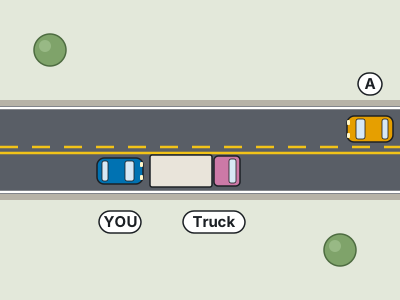
- The driver must not pass
- Passing is required before the line ends
- The lanes travel in the same direction
- The shoulder may be used for passing
Show answer
The driver must not pass. A solid yellow line on your side of the center line marks a no-passing condition. Yellow separates traffic moving in opposite directions, so crossing it to pass would place the vehicle in opposing traffic where sight distance or roadway design makes the maneuver hazardous. A same-direction white line has a different meaning, and the shoulder is not a legal passing lane. See solid yellow and wait for a permitted passing area.
Study this in the handbook: Pavement markings and lane use
3. On a two-lane road, when is passing unsafe even if no pavement marking prohibits it?
- When the road is straight and the driver can see far ahead
- When the passing vehicle signals before changing position
- When the vehicle being passed is traveling below the speed limit
- When the driver cannot see that the road is clear for the needed distance
Show answer
When the driver cannot see that the road is clear for the needed distance. Missouri forbids a pass on a two-lane road when the driver cannot see that the road is clear for the full distance needed to complete the maneuver. A straight view far ahead can support a safety assessment, but signaling alone cannot make an unseen roadway safe. The speed of the vehicle ahead is not the deciding condition either. Before moving left, confirm a long, unobstructed view, check for opposing traffic, and allow enough room to return to the lane. Visibility is the essential cue.
Study this in the handbook: Pavement markings and lane use
4. Which color and shape combination identifies school information in Missouri signs?
- Orange color and round shape
- Blue color and octagon shape
- Brown color and pennant shape
- Yellow green color and pentagon shape
Show answer
Yellow green color and pentagon shape. Missouri's sign key associates yellow green with school information and a pentagon with school signs. Together, those clues help a driver recognize a school zone or school crossing warning before reading every symbol. Orange is associated with construction, blue with motorist services, and brown with recreation or cultural interests. A driver seeing the fluorescent school color or five-sided outline should reduce attention to distractions and watch for children and crossing activity.
Study this in the handbook: Traffic lights, arrows and officers
5. A driver facing the red and white DO NOT ENTER sign should understand that:
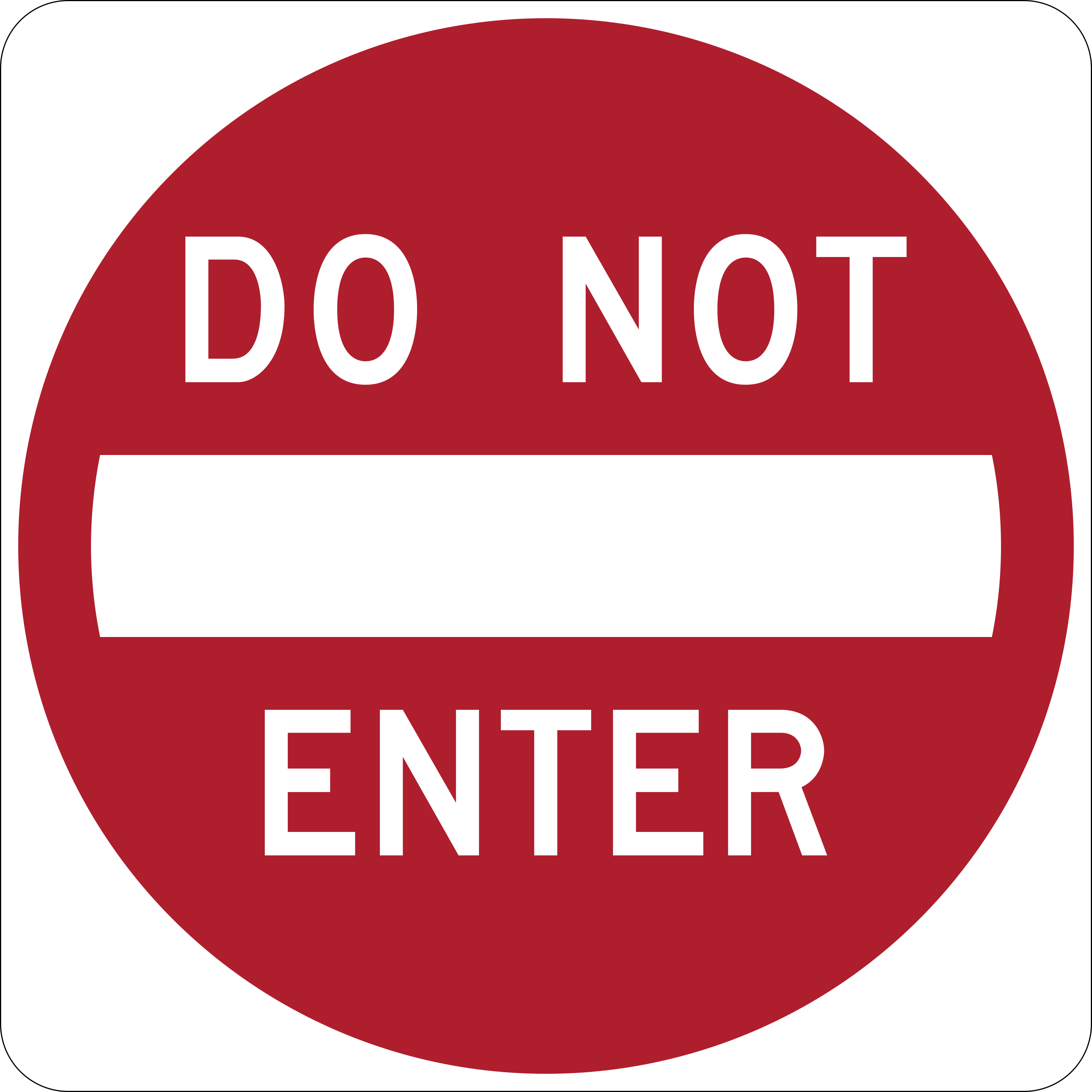
- The roadway opening must not be entered
- The road becomes two-way ahead
- Parking is prohibited only during business hours
- A railroad crossing is immediately ahead
Show answer
The roadway opening must not be entered. DO NOT ENTER is a regulatory sign. The Missouri guide says that when you see this sign at a roadway opening, you must not enter that road. It is not a parking message, a warning that the road becomes two way, or a railroad notice. The sign sits next to the ONE WAY and WRONG WAY signs in the guide because it guards roads and ramps where traffic is allowed in one direction only, so entering would put you against oncoming traffic. Read the words on the red sign as a direct instruction to stay out.
Study this in the handbook: Road signs by shape and color
6. When Missouri law permits passing on the right, what roadway area may not be used to complete the pass?
- The left travel lane
- A marked turn lane
- The paved shoulder
- The lane beside the vehicle being passed
Show answer
The paved shoulder. Missouri permits passing on the right only in listed situations, and the guide adds an absolute boundary: the maneuver must not be made by driving off the paved or main traveled portion of the roadway, including the shoulder. The shoulder choice is therefore prohibited even when it is paved. A driver should remain on the roadway and confirm that the specific passing condition exists. Legal permission to pass on the right is not permission to leave the travel surface.
Study this in the handbook: Passing, turning and signaling
7. After how many years without new points do a Missouri driver's points drop to zero?
- One year
- Two years
- Three years
- Five years
Show answer
Three years. Points come off gradually. After one year without new points, the remaining points drop by one-third; after two years, by one-half; and after three years they are reduced to zero. One and two years only reduce the total. Five years is not part of the schedule. Certain convictions stay listed on the record permanently even when the points are gone.
Study this in the handbook: The point system and traffic penalties
8. If a Missouri driver requests an administrative hearing after a BAC action, how long may legal driving continue after the decision is mailed?
- Until the arrest date
- For 5 days
- For 90 days automatically
- For 15 days
Show answer
For 15 days. When a hearing is granted, the guide says the driver may continue to drive legally until 15 days after the decision is mailed. The five day option shortens the stated period, and the 90 day option turns a possible restricted privilege into an automatic guarantee. The arrest date is not the endpoint for a granted hearing. Track the event that starts the clock: the Department's mailed decision, followed by fifteen days.
Study this in the handbook: Alcohol limits and DWI penalties
9. When approaching a stationary emergency vehicle on a Missouri road with at least four lanes, what lane change is required when safe?
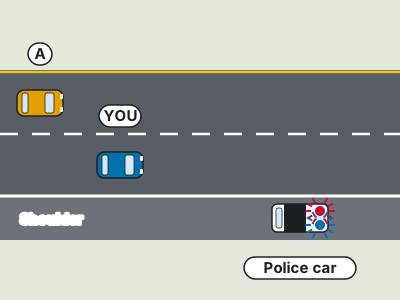
- Move toward the stationary vehicle's lane
- Move into a lane not adjacent to the stationary vehicle
- Change into the oncoming traffic lane
- Remain beside the vehicle at the same speed
Show answer
Move into a lane not adjacent to the stationary vehicle. On a roadway with at least four lanes and at least two lanes moving in the approaching driver's direction, the driver should make a lane change into a lane not adjacent to the stationary emergency vehicle when that can be done safely. Remaining beside it leaves no buffer, and moving toward it increases exposure. The oncoming lane is not a safe or lawful substitute. The condition matters: change away when possible, then use the reduced speed and caution rule when a lane change cannot be made safely.
Study this in the handbook: Emergency vehicles, Move Over and school buses
10. What roadway change is represented by the opposing arrows shown?
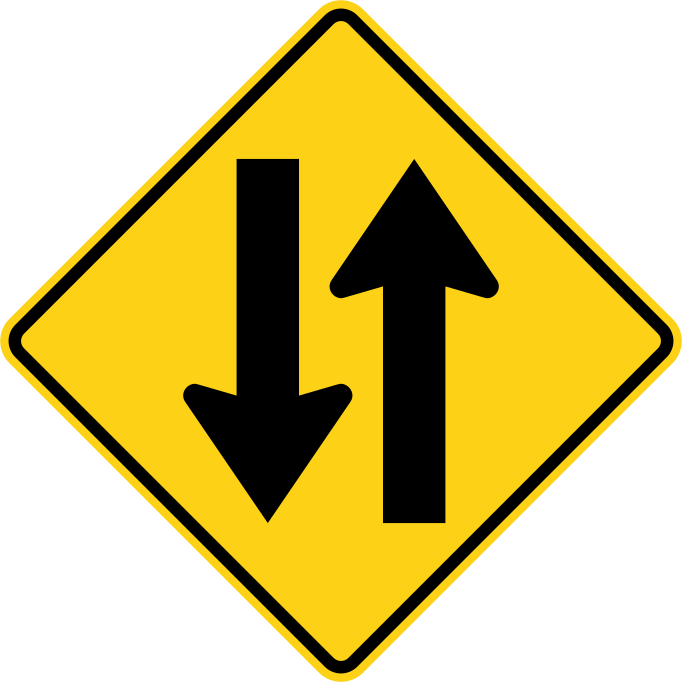
- Traffic will be separated permanently into two one-way roads
- Passing is permitted in both directions without checking traffic
- Two-way traffic will no longer be divided by a median or barrier
- A roundabout begins at the next intersection
Show answer
Two-way traffic will no longer be divided by a median or barrier. Opposing arrows warn that traffic flows in both directions, and this roadway condition marks the end of separation by a median or barrier. Drivers should expect oncoming traffic and keep the vehicle in its proper lane. The sign does not authorize passing in either direction, create two one-way roads, or announce a roundabout. Reduce speed if needed, scan for vehicles approaching from ahead, and pay close attention to lane markings as the divided section ends. The arrows are a reminder that opposing traffic can now share the roadway space.
Study this in the handbook: Road signs by shape and color
11. At the X-shaped railroad crossbuck, what rule applies to approaching trains?
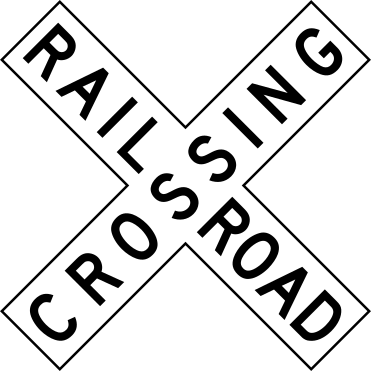
- Treat the tracks as a stop only when a gate is down
- Speed up to cross before a train reaches the roadway
- Yield to trains as you would at a yield sign
- Stop on the tracks to look for a second train
Show answer
Yield to trains as you would at a yield sign. A railroad crossbuck is located at the crossing and has the same meaning as a yield sign. The driver must yield to trains, never race a train, and avoid entering the tracks unless there is room on the other side. Waiting only for a lowered gate misses the crossbuck's standing rule, while speeding or stopping on the tracks creates extreme danger. Slow before the crossing, look and listen in both directions, and make sure the vehicle can clear every track before proceeding. A second train may be present where multiple tracks cross the road.
Study this in the handbook: Railroad crossings
12. Which blood alcohol level is listed among the offenses for which a Missouri court may suspend a driver under 21?
- A BAC of .08% or more
- A BAC of more than .02%
- Any BAC over .10%
- A BAC of .04% or more
Show answer
A BAC of more than .02%. Missouri applies a much lower standard to young drivers. For anyone older than 15 and under 21, the guide lists a blood alcohol content of more than .02% among the offenses for which a state court may suspend or revoke the driver license, alongside buying, possessing, or being visibly intoxicated. The .08% figure is the general adult limit and .04% applies to commercial vehicle drivers, so both are far too high for this rule. A .10% figure does not appear among the thresholds the guide lists.
Study this in the handbook: Underage drinking, Abuse and Lose, and getting your license back
13. How long must a Missouri instruction permit be held before the driver can graduate to an intermediate license?
- At least 120 days
- At least 90 days
- At least 182 days
- At least 365 days
Show answer
At least 182 days. The permit must be held for a minimum of six months, stated in the guide as 182 days beginning the day after issuance. The 90 day and 120 day choices shorten the learning period, while 365 days doubles it. This holding period is only one graduation condition, because the applicant also needs the required instruction hours and must satisfy the applicable record and testing rules. When counting, do not start with the issuance date itself. The guide specifically anchors the 182 day period to the following day.
Study this in the handbook: Permits and the Graduated Driver License
14. What is the maximum speed limit on Missouri interstate highways when a lower limit is not posted?
- 70 mph
- 65 mph
- 55 mph
- 75 mph
Show answer
70 mph. Missouri interstates have a maximum limit of 70 mph unless a posted lower limit applies. The 65 mph choice confuses a possible posted restriction with the statewide maximum described for these highways. Urban interchanges and frequent entering or exiting traffic may lead to lower signs, so a driver must read the roadside posting rather than assume the maximum is always available. A useful cue is to separate the road category from the actual sign: interstate maximum means 70 mph, while a safety based posting controls when it is lower.
Study this in the handbook: Speed limits and minimum speeds
15. At a four-way stop, when may the first-arriving driver proceed?
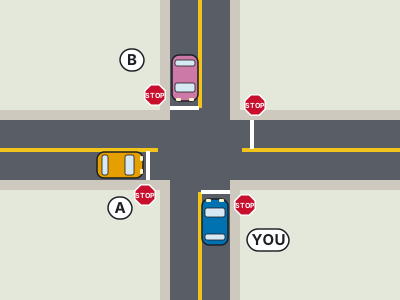
- After coming to a complete stop, before the other drivers
- Only after every other driver has turned
- Only when the vehicle is making a left turn
- Immediately upon reaching the sign
Show answer
After coming to a complete stop, before the other drivers. At a four-way stop, the driver who reaches the intersection first may proceed before the others, but only after making a complete stop. Reaching the sign does not permit a rolling entry, and the rule is not limited to left turns. Drivers who arrive later should remain stopped and watch for the first vehicle’s movement. The concrete cue is arrival order paired with a full stop, not speed or vehicle size.
Study this in the handbook: Right of way at intersections and roundabouts
16. At a Missouri intersection, what exception can override a funeral procession's right of way?
- A delivery vehicle
- An emergency vehicle
- A vehicle with hazard lights
- A driver running late for work
Show answer
An emergency vehicle. An organized funeral procession has priority at intersections regardless of the traffic control device, but the guide names an emergency vehicle as an exception. A delivery vehicle, hazard lights, or personal urgency does not create the same exception. Drivers outside the procession should not join it, pass through it, or enter its path merely because a signal changes. Watch for emergency response activity and otherwise allow the procession to proceed as an organized group.
Study this in the handbook: Right of way at intersections and roundabouts
17. At an intersection without a stop sign or traffic signal, which vehicle must yield when vehicles arrive together?
- The vehicle approaching from the left
- The vehicle with more passengers
- The vehicle approaching from the right
- Neither vehicle, because arrival is simultaneous
Show answer
The vehicle approaching from the left. At an uncontrolled intersection, Missouri directs the driver approaching from the left to yield to the vehicle coming from the right. This rule resolves the conflict when no sign or signal assigns movement order. Vehicle size, passenger count, and simultaneous arrival do not create an exception. Before entering, look both ways and be ready to let the right-side vehicle clear first. The right-side approach is the cue that determines who waits.
Study this in the handbook: Right of way at intersections and roundabouts
18. What center marking does Missouri use on a road with four lanes?
- A single broken white line
- A single solid white line
- Alternating yellow and white dashes
- Two solid yellow lines
Show answer
Two solid yellow lines. The Missouri guide says the center marking for roads with four lanes consists of two solid yellow lines. Those yellow lines tell you the traffic on the other side is moving in the opposite direction, and the guide says never to cross the two solid yellow lines to pass. White lines separate traffic moving in the same direction, and a solid white line marks the right edge of many roads, so neither white choice describes this center marking. Alternating yellow and white dashes are not the marking the guide describes. Read the color first, then the pattern.
Study this in the handbook: Pavement markings and lane use
19. Outside agricultural work-related activities, how many passengers under 19 who are not immediate family may ride with a Missouri intermediate license holder after the first six months?
- None
- No more than three
- No more than one
- No more than five
Show answer
No more than three. During the first six months, an intermediate license holder may carry no more than one passenger under 19 who is not immediate family. After six months, the limit rises to no more than three. So one is the early limit, not the later one, and none is stricter than the law. Five exceeds the cap. Immediate family includes parents, grandparents, brothers, sisters, stepbrothers, stepsisters, and adopted or foster children residing in the driver’s household.
Study this in the handbook: Permits and the Graduated Driver License
20. Green or brown square and rectangular guide signs with white lettering provide:
- A prohibition against a movement shown by a symbol
- Direction and distance to locations or special areas
- Advance notice of construction activity
- The location of motorist services such as hospitals
Show answer
Direction and distance to locations or special areas. Guide signs use green or brown backgrounds with white lettering to help drivers navigate. They can identify direction and distance to cities, airports, state lines, national parks, historical areas, and museums. A prohibition is conveyed by a regulatory sign with a red slash, construction is signaled by fluorescent orange, and service locations use blue signs. Use the guide sign to plan your path and confirm the destination before changing lanes or taking an exit. Its job is route information, not a command to stop or turn.
Study this in the handbook: Road signs by shape and color
QualitySpace is expanding to Missouri
We are a California-based independent insurance brokerage working on licensing in more states. We cannot help with Missouri insurance yet. Leave your email and we will let you know when we can.
Every question is written from the official Missouri Driver Guide. Need paper? Printable MO practice test with answer key.
Last verified 2026-10-05. How we check every question · Study all 201 as flashcards
Frequently asked questions
How many questions are on this Missouri practice test?
This fixed set has 20 questions. It is test 1 of 10 from the 201 question Missouri bank. The real MO exam asks 25 questions and you need 20 correct.
What is the passing score for the real Missouri test?
80% to pass That figure comes from the official Missouri source cited on the DMV facts page.
How does this fixed test relate to the full Missouri bank?
Each numbered test is a fixed set of questions in a fixed order, so you can retake the same test later and compare. Every test mixes road signs and the other topics in about the same proportion as the full bank. Tests 1 to 10 together cover 200 of the 201 questions in the Missouri bank, each once. The full practice page mixes the whole bank at random.
Last verified 2026-10-05. See the Missouri DMV facts page for sourced state details.
Return to the full Missouri practice test · Study road signs