
Test 6 of 10 · 20 questions · Free 2026
MO Permit Practice Test 6
Jump to the test ↓A fixed 20 question set from the Missouri bank with answers and plain English explanations. The real MO exam is 25 questions, 80 percent to pass; take the full length version on the main practice page.
Question 1 of 20 · 0 right so far
All 20 questions in test 6
Every question below comes from the Missouri question bank on this page. Open a question to see the correct answer and the explanation. Nothing here is hidden behind a signup.
1. What duty remains even when a Missouri driver technically has the right of way?
- Proceed without checking for hazards
- Use the shoulder to protect the right of way
- Stop and surrender the vehicle
- Do everything possible to avoid striking a pedestrian or vehicle
Show answer
Do everything possible to avoid striking a pedestrian or vehicle. Missouri's guide says the law identifies who must yield, but it does not give a driver permission to strike someone who is in the path. Every driver must do everything possible to prevent hitting a pedestrian or another vehicle, regardless of the circumstances. Proceeding without checking for hazards treats priority as protection from responsibility, and the shoulder choice invents a maneuver that may create another hazard. A good defensive cue is simple: right of way determines who should wait, while collision avoidance remains everyone's duty.
Study this in the handbook: Right of way at intersections and roundabouts
2. How many questions are on Missouri's Class F written test?
- 25 multiple-choice questions
- 15 multiple-choice questions
- 40 true-or-false questions
- 50 multiple-choice questions
Show answer
25 multiple-choice questions. An applicant for a Class F operator license takes a 25-question multiple-choice written test. The guide says the questions cover the laws and driving methods in the guide, while commercial-vehicle material in Chapter 15 is excluded from this standard test. That makes a 50-question format incorrect, and the test is not described as true or false. Prepare by reviewing the guide’s traffic rules and safe-driving methods.
Study this in the handbook: The written, sign, vision and driving tests
3. For a Missouri driver older than 15 and under 21, how does the guide treat consuming alcohol when a court weighs suspending or revoking the license?
- A driving test waiver
- Possession of alcohol
- A traffic signal violation
- No offense unless the person was driving
Show answer
Possession of alcohol. The guide lists the alcohol offenses that let a state court suspend or revoke the license of a person older than 15 and under 21. One of them is possessing any intoxicating liquor, and the guide adds that consumption constitutes possession. So drinking alone is enough to count as possession; the young person does not need to be driving or holding a container. It is not a test waiver or a traffic signal matter. Penalties in the guide start with a 30 day suspension for a first offense.
Study this in the handbook: Underage drinking, Abuse and Lose, and getting your license back
4. A Missouri driver is convicted of failing to have a required ignition interlock installed. What happens to the driving privilege?
- A $20 fee only
- It is revoked for one year
- A 30-day suspension
- Nothing if no alcohol was involved
Show answer
It is revoked for one year. A court conviction for failing to have an ignition interlock installed as required revokes the driving privilege for one year. A second offense takes the privilege away for five years. The $20 fee is for reinstating after a device lapse, not the penalty for this conviction. Thirty days understates the law, and the offense does not depend on drinking at the time.
Study this in the handbook: Alcohol limits and DWI penalties
5. When are Missouri drivers required to use headlights because of weather?
- Any time conditions require windshield wipers
- Only during snow when roads are closed
- Only after midnight on rural roads
- Only when following another vehicle
Show answer
Any time conditions require windshield wipers. Missouri ties headlight use to weather conditions that require windshield wipers. The rule is not limited to darkness, snow, or rural driving. Rain or another condition that makes the wipers necessary should also trigger the headlights. The useful driving cue is simple: if the wipers are operating for weather, turn on the headlights so the vehicle is easier for others to see. Waiting until midnight or until another vehicle appears leaves visibility lower than required.
Study this in the handbook: Night driving, rain, snow, fog and skids
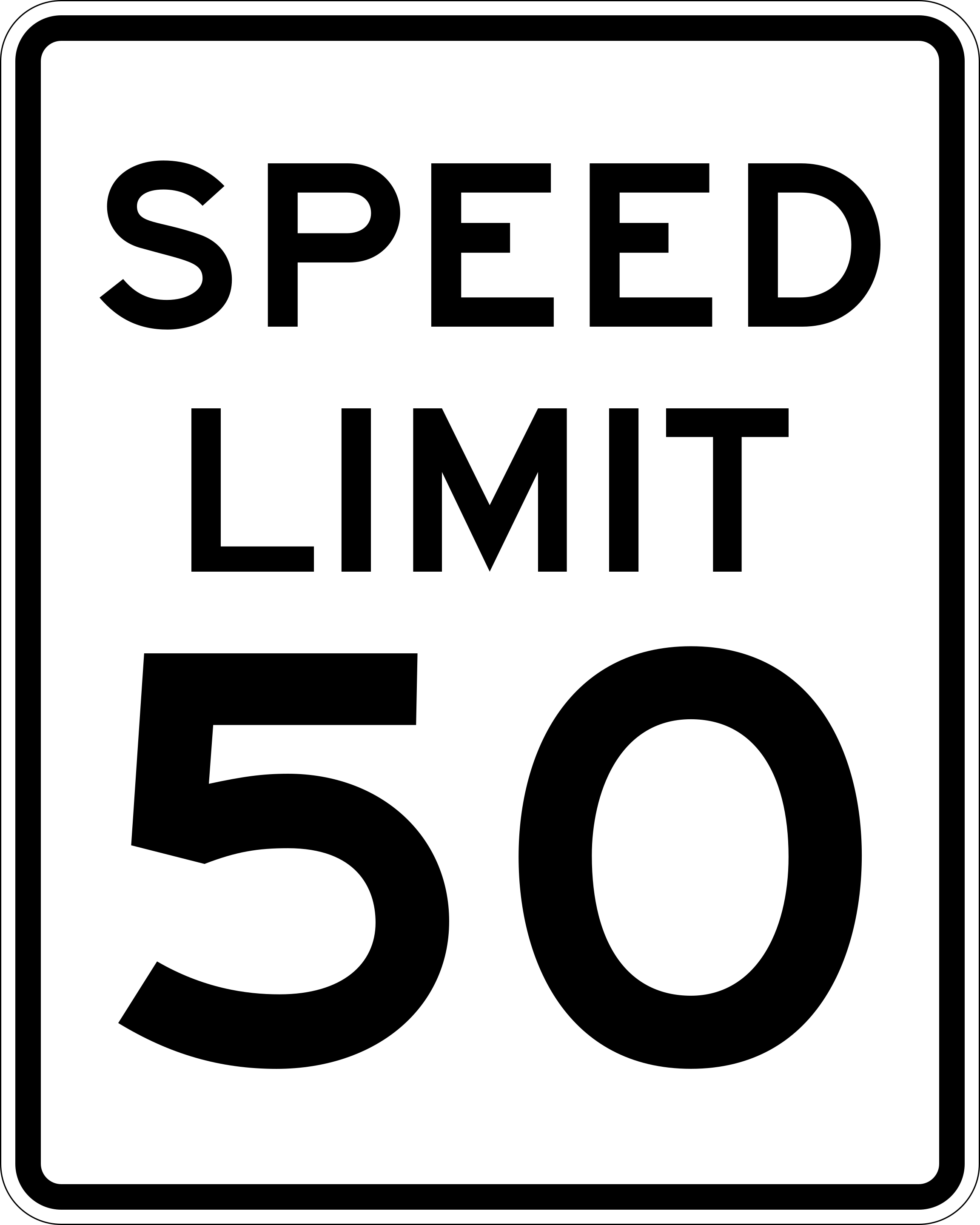
6. What does the SPEED LIMIT sign establish in Missouri?
- A speed that is always safe even on slippery pavement
- The maximum speed allowed by law, subject to conditions
- A recommended speed that may be exceeded when traffic is light
- The minimum speed for every road in the state
Show answer
The maximum speed allowed by law, subject to conditions. A speed limit is the legal maximum in ideal conditions, not a promise that the posted number is safe in every situation. Hills, curves, slippery roads, limited sight distance, pedestrians, bicyclists, and slow vehicles can require a lower speed. The sign does not create a general minimum for every road, and light traffic does not authorize exceeding it. Use the posted number as an upper boundary, then reduce speed whenever weather, visibility, or roadway conditions make that necessary. The white regulatory sign sets a limit, while the driver still has to judge conditions.
Study this in the handbook: Speed limits and minimum speeds
7. Who does Missouri law bar from reading, writing, or sending a text message while driving?
- Any person
- Only drivers under 21
- Only commercial drivers
- Only drivers with an instruction permit
Show answer
Any person. Because text messaging requires visual, manual and cognitive attention, the guide calls it by far the highest risk distraction, and it is against the law for any person to read, write or send a text message or electronic message while driving. The ban is not limited by age or license type. Other distractions the guide lists include navigation systems and MP3 players, which also pull attention from the road.
Study this in the handbook: Phones, distractions, fatigue and road rage
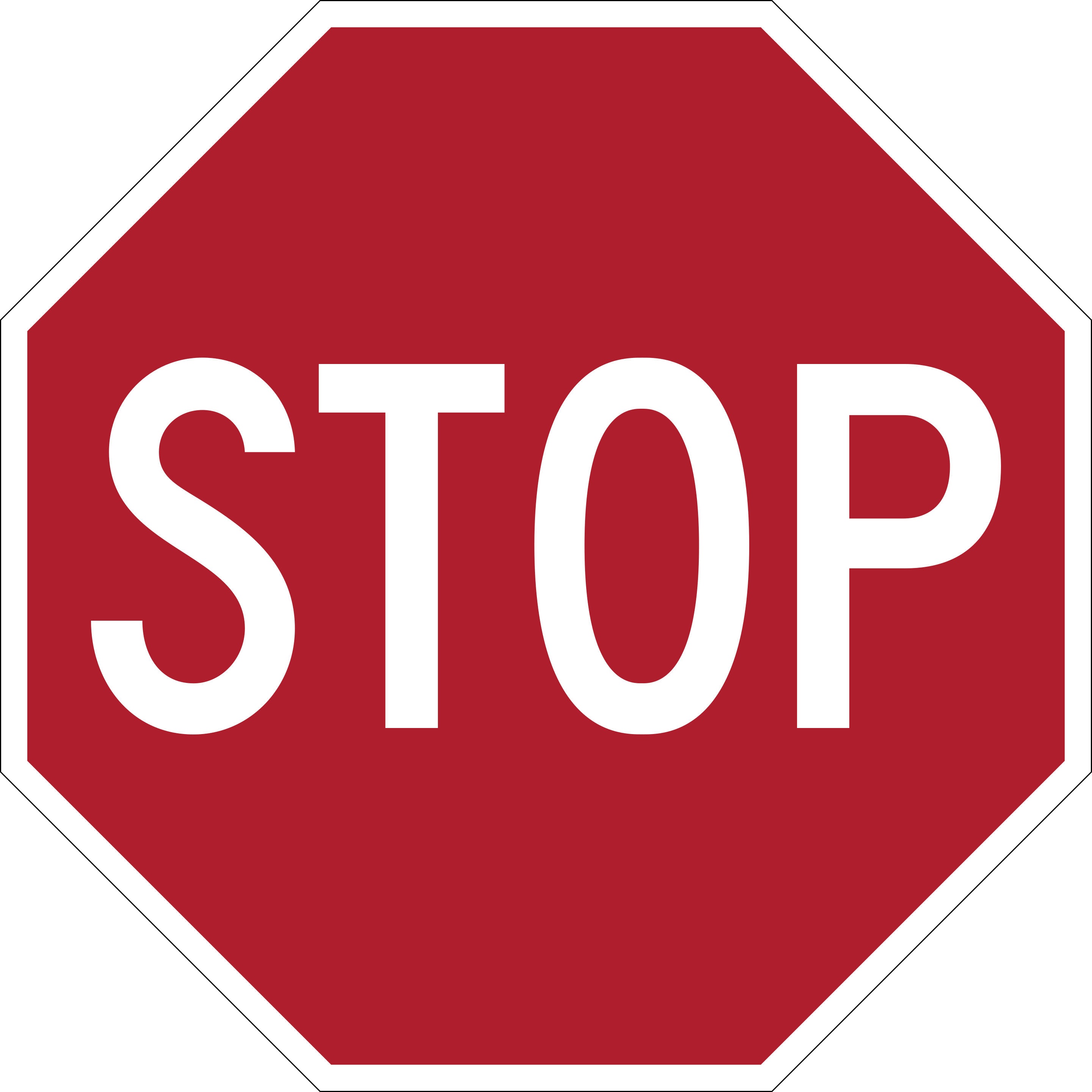
8. At the red octagonal sign shown, what action is required before entering the intersection?
- Slow down and continue if the lane appears clear
- Come to a full stop, check crossing traffic and pedestrians, then proceed when safe
- Stop only when another vehicle is approaching
- Yield without stopping if no pedestrian is visible
Show answer
Come to a full stop, check crossing traffic and pedestrians, then proceed when safe. A stop sign requires a full stop, not merely a reduction in speed. After stopping, the driver waits for crossing vehicles and pedestrians to clear and proceeds only when the movement is safe. The line, crosswalk, or edge of the intersection determines where the stop occurs. The distractors that allow a rolling approach or a stop only when traffic is visible remove the legal duty created by the sign. Use the octagon as an immediate visual cue, then scan both directions before moving through the intersection.
Study this in the handbook: Road signs by shape and color
9. Which restraint may be used for a Missouri child who is at least eight years old, at least 80 pounds, or taller than 4 feet 9 inches?
- No restraint because the child is beyond the law's coverage
- Only a rear-facing infant restraint
- A vehicle safety belt or booster seat appropriate for the child
- A child restraint system only, with no booster option
Show answer
A vehicle safety belt or booster seat appropriate for the child. Missouri places a child in the older-child classification when the child is at least eight years old, at least 80 pounds, or taller than 4 feet 9 inches. That classification calls for a vehicle safety belt or an appropriate booster seat. The rule does not eliminate restraint use, and it does not limit the child to an infant seat or to a child restraint system alone. The word or is important: meeting any one of the listed thresholds is enough for this category. Confirm that the belt fits properly and that a booster remains suitable for the individual child.
Study this in the handbook: Seat belts, child seats and following distance
10. When driving in Missouri, what must a driver carry as evidence of driving authority?
- Only the driver examination record
- A vehicle title instead of a license
- A signed note from an adult passenger
- The driver license or permit
Show answer
The driver license or permit. A driver must carry the driver license or permit while driving and present it when a law enforcement officer asks to see it. The examination record alone is not the same document and cannot replace the issued credential. A vehicle title proves an ownership matter, while an adult passenger's note has no licensing authority. A simple cue is document in hand: carry the issued license or permit, not merely proof that a test was completed or that the vehicle belongs to someone.
Study this in the handbook: Carrying, renewing and losing your license
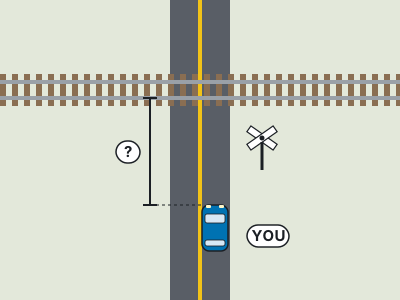
11. When a stop is required at a Missouri railroad crossing, how far before the tracks must you stop?
- Within 15 to 50 feet of the tracks
- At least 100 feet back
- Anywhere behind the crossbuck
- Within 5 feet of the tracks
Show answer
Within 15 to 50 feet of the tracks. Missouri fixes a stopping window for railroad crossings: when you must stop, stop within 15 to 50 feet before the tracks. The guide says you must stop if the red lights are flashing or the gate is down, and you must not try to go around the gate. Stopping within 5 feet is closer than the window allows, 100 feet is farther than it allows, and the crossbuck is not the measuring point. With two or more tracks, look for a second train before crossing.
Study this in the handbook: Road signs by shape and color
12. When a Missouri emergency vehicle approaches with its siren or air horn sounding and a red or blue flashing light, what should you do?
- Stop immediately in the intersection and leave the vehicle there
- Speed up so the emergency vehicle can pass on the shoulder
- Yield, move as far right as possible, stop, and remain stopped until it passes
- Turn left across traffic and follow the emergency vehicle
Show answer
Yield, move as far right as possible, stop, and remain stopped until it passes. Missouri requires drivers to yield to an approaching emergency vehicle, move to the right side of the roadway when possible, and stop until the vehicle has passed. The choice about speeding onto the shoulder is unsafe because it creates another moving obstacle and does not provide the required stopped position. Stopping in an intersection can block the emergency vehicle's path, while turning left across traffic adds a collision risk. When you hear the siren or air horn or see the flashing red or blue light, check traffic, clear the intersection if needed, pull right, and wait for the emergency vehicle to go by.
Study this in the handbook: Emergency vehicles, Move Over and school buses
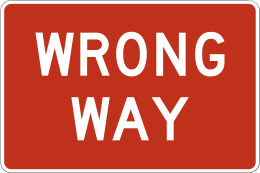
13. If the WRONG WAY sign faces you while driving, what is the safest immediate response?
- Continue slowly because the sign applies only to trucks
- Stop in the travel lane and wait for a green signal
- Pull off safely, turn around, and return from the correct direction
- Move left and pass the sign on the shoulder
Show answer
Pull off safely, turn around, and return from the correct direction. The WRONG WAY sign means the vehicle has entered a lane used by oncoming traffic after making a wrong turn. The driver should get off the road as quickly and safely as possible, turn around, and return in the proper direction. Continuing, even slowly, leaves the vehicle exposed to a head-on collision. Waiting in a travel lane or using the shoulder to pass the sign creates additional hazards and does not correct the direction of travel. Treat the sign as an urgent warning, but make the correction only after reaching a safe place to maneuver.
Study this in the handbook: Road signs by shape and color
14. What action is called for by a yellow warning sign near a sharp curve?
- Accelerate to finish the curve quickly
- Slow down and be prepared to stop if necessary
- Treat the sign as the posted legal speed limit
- Stop in the travel lane before the curve
Show answer
Slow down and be prepared to stop if necessary. Missouri warning signs identify a hazard ahead and tell drivers to adjust their approach. A curve sign may also show a recommended maximum speed, but that advisory number is guidance for the curve rather than a replacement for the legal speed limit. The wrong approach is accelerating or stopping in the lane without a reason. Ease off the accelerator, scan beyond the bend, and be ready to stop if traffic or another hazard appears. Yellow with black lettering is the cue to prepare, not to maintain normal speed automatically.
Study this in the handbook: Road signs by shape and color
15. After an emergency vehicle has passed, what should a driver do before moving again?
- Accelerate immediately and follow the emergency vehicle closely
- Move into the intersection and wait there for another signal
- Remain stopped until the way is clear, because other emergency vehicles may follow
- Turn off the vehicle's lights before checking traffic
Show answer
Remain stopped until the way is clear, because other emergency vehicles may follow. Missouri says emergency vehicles may follow each other, so a driver should proceed only when the way is clear. The safest habit is to remain stopped after the first vehicle passes, look and listen again, and then reenter when no additional emergency vehicle is approaching. Following closely can obstruct responders and exposes the driver to another sudden stop. Waiting in an intersection creates a separate conflict. Keep the vehicle positioned safely to the right, check all directions, and move only after the emergency path has fully cleared.
Study this in the handbook: Right of way at intersections and roundabouts
16. After failing to appear in court for a Missouri traffic ticket, how long does the court give the driver to pay before notifying the Driver License Bureau?
- 5 days
- 10 days
- 90 days
- 30 days
Show answer
30 days. The court notifies the driver of the failure to comply and allows 30 days to pay the fines. If the driver does not comply within 30 days, the court notifies the Driver License Bureau and the privilege is suspended immediately. Reinstatement requires proof the ticket is paid and a $20 fee. Five, ten and ninety days are not the stated period.
Study this in the handbook: The point system and traffic penalties
17. Which paperwork failure is listed among the reasons Missouri can take away a driver license?
- Failing to wash the license plates
- Failing to carry the owner's manual
- Failing to keep a paper map
- Failing to file an accident report when required
Show answer
Failing to file an accident report when required. The guide's list of reasons a driver can lose a license includes failing to file an accident report, giving false information when applying for a license, leaving the scene of a traffic accident, and refusing to let a police officer test for alcohol or drugs. The accident report item points readers to Chapter 13 of the guide for the details of when a report is required. Washing license plates, carrying the owner's manual, and keeping a paper map are not legal duties on that list.
Study this in the handbook: Carrying, renewing and losing your license
18. What should a driver do when nearing a curve while traveling at the maximum posted speed?
- Maintain the posted maximum through every curve
- Brake sharply after reaching the curve's midpoint
- Slow down before entering the curve
- Accelerate so the vehicle exits sooner
Show answer
Slow down before entering the curve. Missouri advises slowing when nearing a curve if the vehicle is already traveling at the maximum posted speed. The posted number is not a command to carry that speed through every bend, especially when visibility or traction changes. Braking sharply in the middle of the curve can upset control, while acceleration reduces time to respond to an unseen hazard. Reduce speed before the bend, look through it, and maintain a pace that leaves room to steer or stop.
Study this in the handbook: Night driving, rain, snow, fog and skids
19. What do the two solid yellow center lines on a Missouri four lane road tell you about passing?
- You may cross them to pass slower traffic when clear
- They mark the edge of the roadway
- They separate lanes moving in the same direction
- You should never cross them to pass
Show answer
You should never cross them to pass. The Missouri guide says the center marking for roads with four lanes consists of two solid yellow lines, and those yellow lines tell you the traffic on the other side is moving in the opposite direction. It then says you should never cross the two solid yellow lines to pass. A clear view does not create an exception. The guide notes that a solid white line marks the right edge of many roads, and white lines, not yellow, separate lanes moving in the same direction.
Study this in the handbook: Pavement markings and lane use
20. When may traffic traveling opposite a stopped school bus avoid stopping on a divided highway?
- When a median separates the opposite roadways
- Whenever the bus is more than 100 feet away
- Only when the bus driver waves traffic through
- Never, because every road requires both directions to stop
Show answer
When a median separates the opposite roadways. Opposite-direction traffic does not have to stop when a median divides the highway and places the two directions on totally separate roads. That exception depends on the physical separation, not distance from the bus or a wave from the driver. A roadway with four or more lanes can also have a separate exception described in the guide, but an ordinary undivided road does not. The key cue is a true median separating the roadways.
Study this in the handbook: Passing, turning and signaling
QualitySpace is expanding to Missouri
We are a California-based independent insurance brokerage working on licensing in more states. We cannot help with Missouri insurance yet. Leave your email and we will let you know when we can.
Every question is written from the official Missouri Driver Guide. Need paper? Printable MO practice test with answer key.
Last verified 2026-10-05. How we check every question · Study all 201 as flashcards
Frequently asked questions
How many questions are on this Missouri practice test?
This fixed set has 20 questions. It is test 6 of 10 from the 201 question Missouri bank. The real MO exam asks 25 questions and you need 20 correct.
What is the passing score for the real Missouri test?
80% to pass That figure comes from the official Missouri source cited on the DMV facts page.
How does this fixed test relate to the full Missouri bank?
Each numbered test is a fixed set of questions in a fixed order, so you can retake the same test later and compare. Every test mixes road signs and the other topics in about the same proportion as the full bank. Tests 1 to 10 together cover 200 of the 201 questions in the Missouri bank, each once. The full practice page mixes the whole bank at random.
Last verified 2026-10-05. See the Missouri DMV facts page for sourced state details.
Return to the full Missouri practice test · Study road signs