
Test 23 of 25 · 20 questions · Free 2026
MO Permit Practice Test 23
Jump to the test ↓A fixed 20 question set from the Missouri bank with answers and plain English explanations. The real MO exam is 25 questions, 80 percent to pass; take the full length version on the main practice page.
Question 1 of 20 · 0 right so far
All 20 questions in test 23
Every question below comes from the Missouri question bank on this page. Open a question to see the correct answer and the explanation. Nothing here is hidden behind a signup.
1. You are in a minor fender bender on a busy Missouri freeway, and no one is hurt. What does Missouri's Move It law expect?
- Leave the cars exactly where they are for police
- Move the vehicles onto the shoulder or off the road
- Stay in your car in the lane with flashers on
- Drive home and report it by phone later
Show answer
Move the vehicles onto the shoulder or off the road. Missouri's Move It law, promoted with the slogan Steer It and Clear It, requires vehicles in minor crashes with no injuries to move off the road onto the shoulder or another nearby location. Every minute a vehicle blocks a freeway lane backs up traffic for four minutes, and secondary crashes cause 18 percent of fatalities in Missouri. Moving the cars does not mean leaving the scene; stay until police say you may go.
2. Your young child in the back seat needs help while you are driving in Missouri. What should you do?
- Pull over to a safe place before helping
- Reach back quickly while keeping one hand on the wheel
- Turn around at a red light and help
- Tell the child to wait until you get home
Show answer
Pull over to a safe place before helping. Missouri's guide says children, friends, and pets can all be dangerous distractions. If you need to attend to your children, pull over to a safe place first rather than trying to handle them while driving. Reaching into the back seat takes your eyes and at least one hand off the job of driving. The guide also suggests teaching young children that driving is an important job that requires concentration.
Study this in the handbook: Phones, distractions, fatigue and road rage
3. When does the Missouri guide say you should set your mirrors, seat, radio, and climate controls?
- At the first stop light you reach
- Once you are cruising at highway speed
- Whenever traffic around you is light
- Before you begin to drive anywhere
Show answer
Before you begin to drive anywhere. Making destination entries, surfing the radio, or adjusting climate controls are distracting activities that can lead to a crash or near crash. Missouri suggests adjusting the vehicle's controls, including climate, mirrors, radio, and seat, before you begin to drive. Take advantage of normal stops for small changes, ask passengers to make adjustments for you, and check messages before you leave or after you arrive.
Study this in the handbook: Phones, distractions, fatigue and road rage
4. According to the Missouri guide, which drug is the most cited in car crashes after alcohol?
- Caffeine
- Cold medicine
- Marijuana
- Diet pills
Show answer
Marijuana. Missouri's guide states that marijuana is the second most cited drug in car crashes, behind alcohol. Marijuana can impair thinking, judgment of time and distance, and coordination, and research has shown increased lane weaving and poor reaction time in drivers who use it. Combining marijuana with alcohol made drivers even more impaired. Medical approval does not make it legal to drive under its influence.
5. You reach the end of a Missouri highway acceleration lane, but drivers on the highway have not made room for you. What must you do?
- Yield, even if it means stopping at the lane's end
- Force your way in, since they must let you merge
- Drive onto the shoulder and keep going until a gap opens
- Honk and merge, because the ramp has the right-of-way
Show answer
Yield, even if it means stopping at the lane's end. Drivers already on a Missouri highway should give entering vehicles room, but if they do not, you must not force your way on. The guide says you must yield the right-of-way to highway traffic, even if that means stopping at the end of the acceleration lane. Normally you should not stop there unless traffic is very heavy. Use the lane to build up speed, signal, and pull smoothly into a real opening.
Study this in the handbook: Highway driving, merging and breakdowns
6. When does the Missouri guide say it is especially important to check your speedometer?
- Mainly when you notice a police car parked up ahead
- After you leave a fast road for slower local streets
- When you first start the car and pull onto the street
- While climbing a long hill behind a slow truck
Show answer
After you leave a fast road for slower local streets. The best way to control speed, according to the Missouri guide, is to know how fast you are going by checking the speedometer often and watching posted limits. This matters most when you leave high-speed roads and start driving on much slower local roads. After a long stretch at highway speed, it is easy to carry too much speed onto local streets. A quick look at the gauge helps you match the new, lower limit.
Study this in the handbook: Highway driving, merging and breakdowns
7. A red circle with a red slash over a symbol on a regulatory sign means:
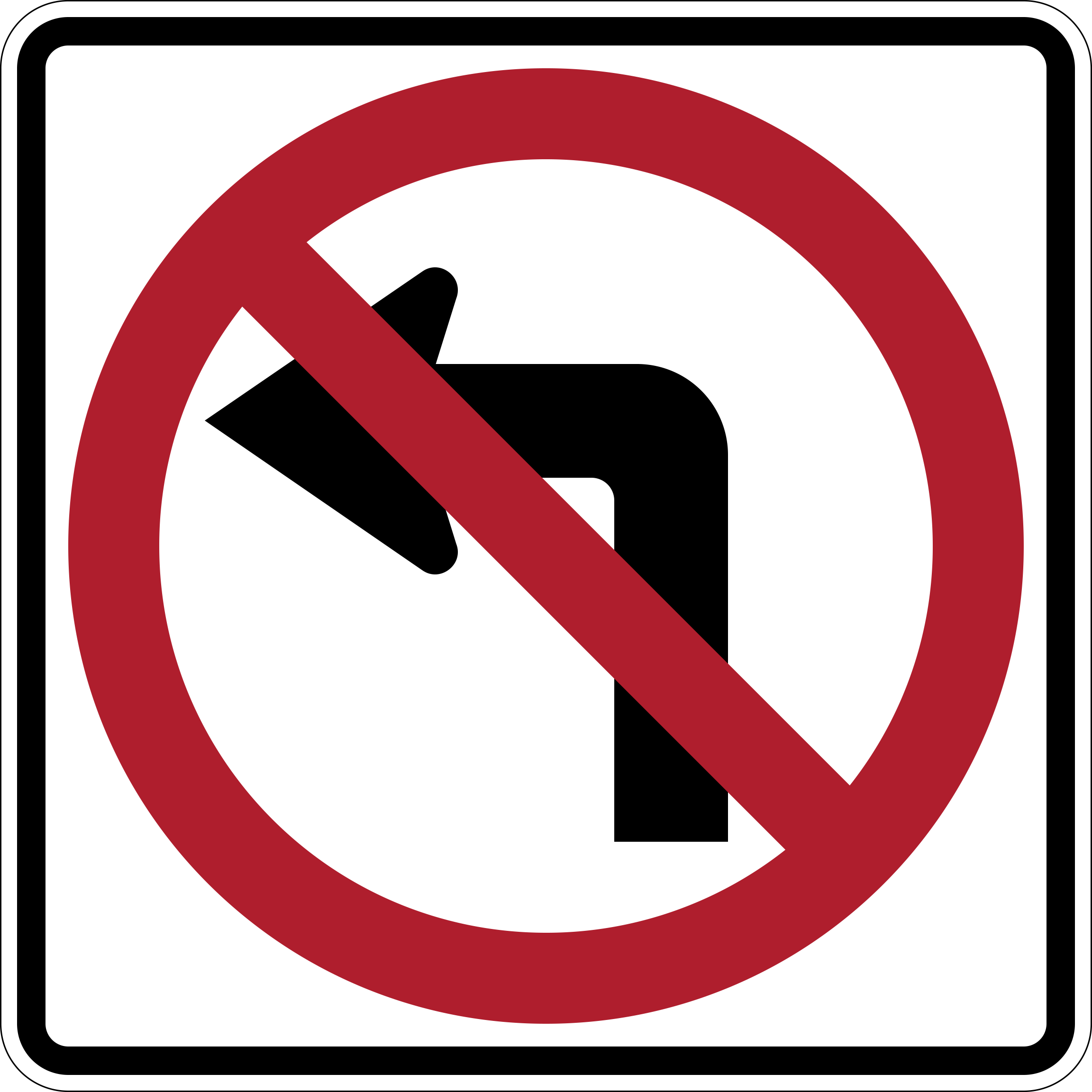
- The action shown is prohibited
- The action shown is permitted only for emergency vehicles
- The symbol identifies a service location nearby
- The action shown is recommended when traffic is light
Show answer
The action shown is prohibited. The red circle and slash are a visual ban on the movement or activity pictured. Missouri gives no-left-turn and no-U-turn signs as examples, so a driver must not perform the marked action at that location. A recommendation would not use this symbol, and emergency vehicles do not turn a prohibition into a general permission for ordinary drivers. Service information uses blue signs and words or symbols identifying facilities. The quick recognition cue is to read the picture first, then apply the slash as do not perform that action.
Study this in the handbook: Road signs by shape and color
8. It is 2 a.m., and the Missouri intersection ahead is empty in every direction. You face a red eight-sided sign. What must you do?
- Slow down and roll through if no one is coming
- Flash your lights and continue at low speed
- Treat it as a yield since the roads are empty
- Come to a full stop before going
Show answer
Come to a full stop before going. A Missouri stop sign requires a full stop every time, whatever the hour and however empty the roads look. Stop at the stop line, before the crosswalk, or near the edge of the intersection if neither is marked. Then look both ways and go only when crossing vehicles and pedestrians have cleared. Rolling through or treating the sign as a yield is not allowed just because no one seems to be coming.
Study this in the handbook: Road signs by shape and color
9. Late at night, a Missouri traffic signal is flashing red in your direction. What must you do?
- Slow down and continue with caution
- Wait for the light to turn green
- Come to a full stop, then proceed when safe
- Treat it as a yield and roll through
Show answer
Come to a full stop, then proceed when safe. Flashing traffic signals may be used at night, during low traffic periods, during emergencies, and at special events. In Missouri, a flashing red light means the same thing as a stop sign: come to a complete stop, yield to cross traffic and pedestrians, and proceed when it is safe. Slowing down and continuing describes a flashing yellow light. You do not need to wait for a green light.
Study this in the handbook: Traffic lights, arrows and officers
10. The rear of your car slides to the right on an icy Missouri curve. Which way should you gently steer?
- To the right
- To the left
- Hard to the left
- Keep the wheel straight
Show answer
To the right. Missouri says to handle a skid by taking your foot off the accelerator, not hitting the brakes, and gently turning the steering wheel in the direction your rear wheels are sliding. If the rear slides right, steer gently right until the car straightens out. Turning hard the other way or braking sharply will only make the skid worse. The method is the same for front-wheel and rear-wheel drive vehicles.
Study this in the handbook: Night driving, rain, snow, fog and skids
11. Your 11-year-old wants to ride in the front seat on a short trip in Missouri. What does the guide's air bag advice say?
- Front seat is fine for kids over ten
- Front seat is fine on trips under five miles
- Ride properly restrained in a rear seat
- Front seat is fine if the seat belt is worn
Show answer
Ride properly restrained in a rear seat. Missouri's air bag safety advice says children 12 and under should always ride properly restrained in a rear seat. An unrestrained or improperly restrained person can be seriously hurt or killed by a deploying air bag. An 11-year-old falls within that age group, so the back seat is the right place no matter how short the trip is. A seat belt is still needed in the back seat.
Study this in the handbook: Seat belts, child seats and following distance
12. You turn on your signal just 30 feet before a right turn in Missouri. What rule have you missed?
- Signal at least 500 feet before turning
- Signal at least 100 feet before turning
- Signal only if a car is behind you
- Signal after you begin the turn
Show answer
Signal at least 100 feet before turning. Missouri asks drivers to get into the proper lane and signal at least 100 feet before turning so other drivers can be ready. Signaling just 30 feet before the turn gives others little warning. Signal every time you change direction, even when you see no one around, because it is easy to miss someone who needs to know. Five hundred feet is not the rule.
Study this in the handbook: Passing, turning and signaling
13. Your car starts to skid on a slick Missouri road. What should you do with the pedals?
- Brake hard and hold the pedal down firmly
- Press the gas to pull the car straight
- Pump the brakes quickly until it stops
- Take your foot off the gas and do not hit the brakes
Show answer
Take your foot off the gas and do not hit the brakes. Missouri says handling a skid is the same whether your car has front-wheel or rear-wheel drive. Take your foot off the accelerator, but do not hit the brakes. Gently steer in the direction the rear wheels are sliding, and avoid braking or turning sharply, since hitting the brakes or jerking the wheel will only make the skid worse. The guide shows the front wheels turning the same way the rear wheels slide until the vehicle is straight again.
Study this in the handbook: Night driving, rain, snow, fog and skids
14. You park facing downhill next to the curb on a steep Missouri street. Which way should your front wheels point?
- Toward the curb, at the side of the road
- Out toward the middle of the street
- Straight ahead, with the brake set
- Toward the oncoming traffic lanes
Show answer
Toward the curb, at the side of the road. Missouri tells drivers parking on a hill to turn the wheels sharply toward the side of the road, so that if the vehicle starts to roll downhill, it rolls away from traffic. Facing downhill at a curb, that means turning the wheels toward the curb at the side of the road. Also leave the vehicle in the proper gear, set the parking brake, and remove the keys.
15. According to the Missouri guide, what two parts add up to your total stopping distance?
- Following distance plus lane width
- Reaction distance plus braking distance
- Braking distance plus the length of your car
- Reaction distance plus the speed limit
Show answer
Reaction distance plus braking distance. Missouri explains that your stopping distance equals your reaction distance plus your braking distance. Reaction distance is how far you travel after you see a danger and before you apply the brakes; braking distance is how far you travel after braking until you stop. Driving fast, being very tired, or having bad brakes means you will need more space to bring your vehicle to a stop.
Study this in the handbook: Seat belts, child seats and following distance
16. You want to go left at a Missouri roundabout. How do you enter it?
- Turn left into the circle, since that is the shortest path
- Turn slightly right and go counterclockwise around it
- Go clockwise around the island to reach the left exit
- Drive straight across the center island when it is clear
Show answer
Turn slightly right and go counterclockwise around it. Every Missouri roundabout works the same way: drivers make a slight right turn on entry and travel counterclockwise around the circular center island, then exit at the road they want. To go left, you simply continue around past the other exits. The guide states plainly that you must never make a left turn to enter a roundabout, and you always stay to the right of the center island. Yield to traffic already circling before you enter.
Study this in the handbook: Right of way at intersections and roundabouts
17. Turning left from a two-way street onto a one-way street with two lanes, which lane may a Missouri driver turn into?
- Only the left lane of the one-way street
- Only the right lane of the one-way street
- The lane that matches the speed you are going
- Either lane, whichever is free of traffic
Show answer
Either lane, whichever is free of traffic. Starting from a two-way street, Missouri tells drivers to begin a left turn with the left wheel as close as possible to the yellow dividing line. When the one-way street being entered has two lanes, the driver may turn into either its left lane or its right lane, choosing the one that is free of traffic. Neither lane is reserved for this turn, and your speed has nothing to do with the choice.
Study this in the handbook: Passing, turning and signaling
18. Your light turns green at a Missouri intersection, but a pedestrian is still crossing in front of you. What must you do?
- Go ahead, since the green light gives you the right-of-way
- Honk so the pedestrian hurries out of your lane
- Yield to the pedestrian until the crossing is clear
- Drive around the pedestrian if there is room
Show answer
Yield to the pedestrian until the crossing is clear. A green light lets you go through an intersection only after you yield. Missouri says that even when you face a green light, you must yield the right-of-way to all pedestrians in the intersection. Never assume you have the right-of-way, and do not assume pedestrians see you and will stop for you. Wait for the person to finish crossing before you move, and do not try to squeeze around them.
Study this in the handbook: Pedestrians, cyclists, motorcycles and trucks
19. According to the Missouri guide, about how fast is an average car going if it needs roughly 130 to 140 feet to stop?
- 25 mph
- 35 mph
- 75 mph
- 55 mph
Show answer
55 mph. Missouri's guide says the average passenger car traveling at 55 mph can stop in about 130 to 140 feet, almost half the length of a football field. A fully loaded tractor-trailer may need almost 400 feet to stop. The faster you go, the more distance you need, so leave enough space ahead and never cut in front of a large truck and then slow down.
Study this in the handbook: Pedestrians, cyclists, motorcycles and trucks
20. You pass a Bicycle Share the Road sign on a narrow Missouri road and come up behind a rider in your lane. What should you do?
- Squeeze past, since the rider must stay on the shoulder
- Honk until the rider moves off the road
- Slow down and pass only with a full lane of room
- Pass closely but quickly to save time
Show answer
Slow down and pass only with a full lane of room. The Bicycle Share the Road sign warns Missouri drivers to watch for bicycle riders traveling in the same lane as vehicle traffic. When passing a bicycle, give it a full lane width and do not squeeze past. If the lane is too narrow to share, slow down and wait for a clear stretch of road. Bicyclists have the same rights on the road as other vehicle operators.
Study this in the handbook: Road signs by shape and color
Every question is written from the official Missouri Driver Guide. Need paper? Printable MO practice test with answer key.
Last verified 2026-10-05. How we check every question · Study all 500 as flashcards
Frequently asked questions
How many questions are on this Missouri practice test?
This fixed set has 20 questions. It is test 23 of 25 from the 500 question Missouri bank. The real MO exam asks 25 questions and you need 20 correct.
What is the passing score for the real Missouri test?
80% to pass That figure comes from the official Missouri source cited on the DMV facts page.
How does this fixed test relate to the full Missouri bank?
Each numbered test is a fixed set of questions in a fixed order, so you can retake the same test later and compare. Every test mixes road signs and the other topics in about the same proportion as the full bank. Tests 1 to 25 together cover every question in the Missouri bank once. The full practice page mixes the whole bank at random.
Last verified 2026-10-05. See the Missouri DMV facts page for sourced state details.
Return to the full Missouri practice test · Study road signs