
Test 25 of 25 · 20 questions · Free 2026
MO Permit Practice Test 25
Jump to the test ↓A fixed 20 question set from the Missouri bank with answers and plain English explanations. The real MO exam is 25 questions, 80 percent to pass; take the full length version on the main practice page.
Question 1 of 20 · 0 right so far
All 20 questions in test 25
Every question below comes from the Missouri question bank on this page. Open a question to see the correct answer and the explanation. Nothing here is hidden behind a signup.
1. A car is coming toward you in your lane on a two-lane Missouri road. What does the guide tell you to do?
- Slow down, pull right, and sound your horn
- Swerve into the left lane to get around it
- Flash your high beams and hold your lane
- Speed up so you pass it before it reaches you
Show answer
Slow down, pull right, and sound your horn. When a vehicle is approaching head-on in your lane, Missouri says to slow down, pull over to the right, and sound your horn. Do not swing over into the left lane, because the other driver may pull back into that lane too and you would meet head-on there. Holding your lane or speeding up only shortens the time you both have to react.
Study this in the handbook: Brake failure, blowouts and other emergencies
2. You drive faster than the rest of the traffic on a Missouri two-lane road and keep passing cars. What risk does the guide point out?
- Every pass is another chance for a collision
- None, as long as you signal before each pass
- Only the risk of getting a speeding ticket
- The cars you pass are sure to stay in their lane
Show answer
Every pass is another chance for a collision. Vehicles moving in the same lane at the same speed cannot hit one another, and crashes often happen when drivers go faster or slower than other vehicles. If you are going faster than traffic, you have to keep passing others, and each time you pass someone there is a chance for a collision. The vehicle you pass may change lanes suddenly, or on a two-lane road an oncoming vehicle may appear. Speeding does not save more than a few minutes an hour.
Study this in the handbook: Passing, turning and signaling
3. Your light is green, and you want to turn left at a Missouri intersection while an oncoming car is going straight through. Who goes first?
- You, because you were waiting first
- You, because your light is green
- The oncoming car going straight
- Whichever driver is moving faster
Show answer
The oncoming car going straight. Missouri's intersection rules say that drivers turning left must yield to oncoming vehicles going straight. A green light lets you enter the intersection, but it does not give you priority over oncoming traffic. Wait for a safe gap, or for a green arrow if your signal has one, before you turn. Being first in line or having the green does not change who must yield.
Study this in the handbook: Right of way at intersections and roundabouts
4. You are pulling out of a side street onto a busy Missouri road that has a center two-way left-turn lane. May you turn into the center lane and wait there to merge?
- Yes, the center lane exists to help drivers merge in safely
- Yes, if you stay in it for less than 500 feet
- No, not when you are entering from a side street
- Yes, but only when traffic in both directions is heavy
Show answer
No, not when you are entering from a side street. A center lane marked as a two-way left-turn lane is for drivers on the main road who are preparing to slow or stop before turning left. Missouri says not to use it as a travel lane and not to use it when entering the roadway from a side street. The 500 foot figure limits how far a vehicle may travel in the lane; it does not create a merging area for drivers coming out of side streets.
Study this in the handbook: Right of way at intersections and roundabouts
5. You are in the inside lane of a two-lane Missouri roundabout. What does the guide say about moving to the outside lane while you circle?
- Lane changes inside the roundabout are not allowed
- Change lanes freely, since traffic flows one way
- Change lanes after signaling for three seconds
- Change lanes when you need to pass a slower truck
Show answer
Lane changes inside the roundabout are not allowed. For roundabouts with more than one lane, Missouri tells drivers to use roadside signs and pavement markings to pick the correct lane before entering. Once inside, do not change lanes, do not try to pass any vehicle, especially a large truck, and do not stop unless it is the only way to avoid a crash. Trucks may need more than one lane, which is one more reason to hold your lane and position steady until you exit.
Study this in the handbook: Right of way at intersections and roundabouts
6. To begin parallel parking in Missouri, you stop even with the vehicle ahead of the open space. About how far to the left of that vehicle should you be?
- About 1½ feet
- About 6 inches
- About 4 feet
- About 3 feet
Show answer
About 1½ feet. The Missouri guide begins parallel parking by having you stop even with the vehicle ahead of the open space, about 1½ feet to the left of it. From there, turn the wheels sharply to the right and back slowly into the space, then turn sharply left once you are clear of the front vehicle. Finish by turning sharply right and pulling forward toward the curb. The car should end up in the center of the space.
7. Under Missouri rules, who has the right-of-way when a pedestrian crosses in the middle of a block, away from any crosswalk?
- The pedestrian, as soon as one foot is in the road
- Traffic on the road; the pedestrian must yield
- Whoever is moving faster at that moment
- The pedestrian, but only during daylight hours
Show answer
Traffic on the road; the pedestrian must yield. Missouri allows pedestrians outside business districts to cross in the middle of a block, carefully, especially when stepping out between parked vehicles. When they do, they must yield the right-of-way to all traffic. Drivers still have a duty to drive carefully and avoid hitting anyone, whether a pedestrian is obeying the law or not. So the walker yields, and the driver stays alert and ready to stop.
Study this in the handbook: Pedestrians, cyclists, motorcycles and trucks
8. A highway department truck is stopped on the shoulder of a Missouri interstate with amber and white lights flashing. Does the Move Over law apply?
- No, it covers police cars, fire trucks, and ambulances alone
- Yes, change to a lane not next to it if safe, or slow down
- No, amber lights mean the truck is simply moving slowly
- Yes, but just when workers are standing outside the truck
Show answer
Yes, change to a lane not next to it if safe, or slow down. Missouri expanded its Move Over law in 2017. It now covers stationary vehicles showing amber or amber and white lights, not just emergency vehicles with red or red and blue lights. On a road with at least four lanes and two or more going your direction, move into a lane not adjacent to the stopped vehicle when it is safe. If a lane change would be unsafe or impossible, slow down to a safe speed and proceed with caution.
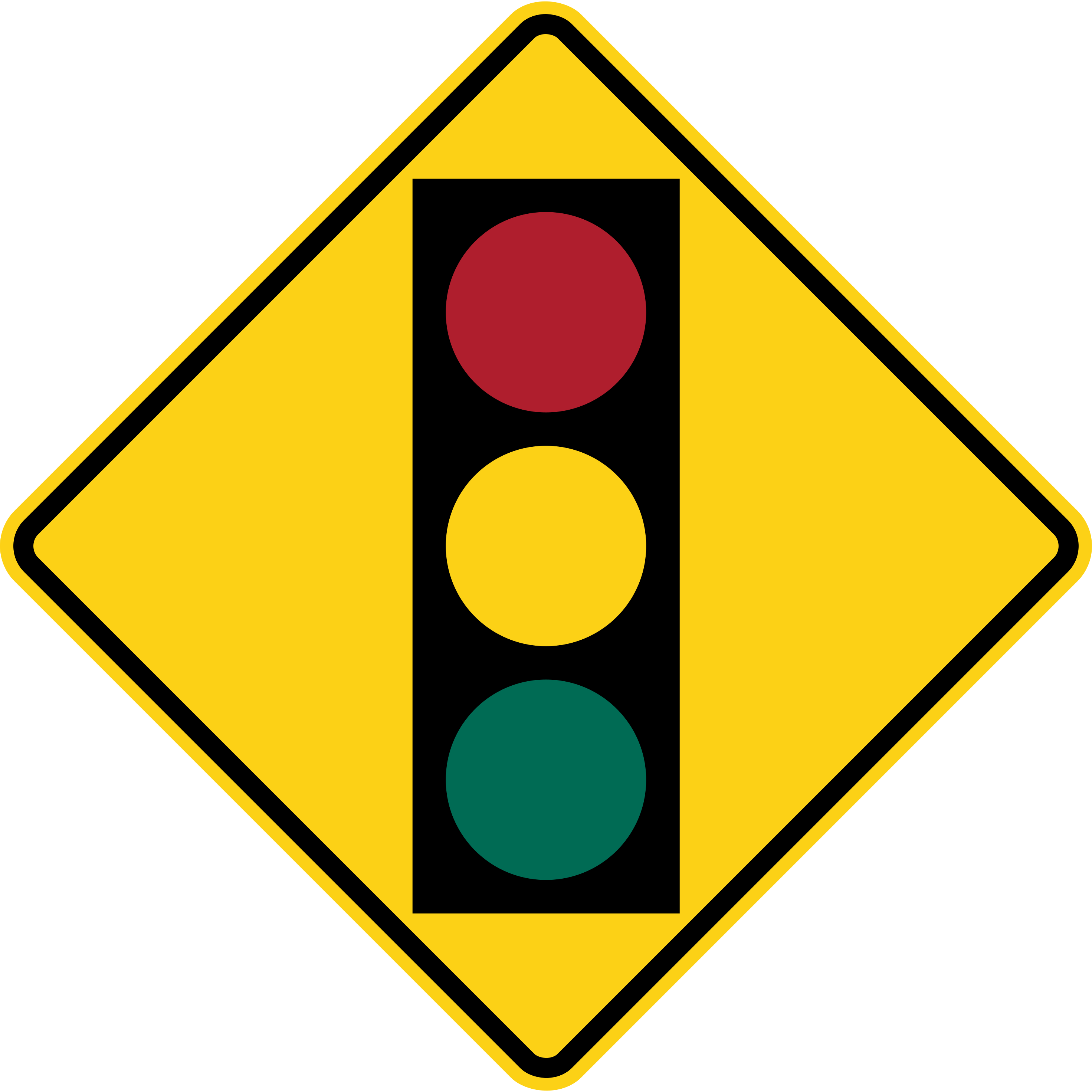
9. You come over a hill on a Missouri highway and see this sign. What should you be ready to do?
- Merge with traffic from a ramp
- Turn because the road ends
- Yield to trains at a crossing
- Stop at a traffic light ahead
Show answer
Stop at a traffic light ahead. This yellow warning sign tells Missouri drivers that there is a traffic signal ahead on the road they are on and to be prepared to stop. Coming over a hill or around a curve, you may not see the light itself until you are close. Ease off the gas so you can stop smoothly if the light is red or turning yellow. Merging traffic, road endings, and railroad crossings each have their own signs.
Study this in the handbook: Road signs by shape and color
10. On a two-lane Missouri road, you are behind a slow tractor when you see a yellow pennant-shaped sign. What should you do?
- Pass quickly before reaching the sign
- Pass only if the tractor is under 25 mph
- Pass, since farm vehicles may always be passed
- Do not start a pass here
Show answer
Do not start a pass here. In Missouri, the pennant shape is reserved for the No Passing Zone sign. No passing zones are on hills or curves where you cannot see far enough ahead to pass safely, and two-lane roads often mark them with a solid yellow line. A slow farm vehicle does not change the rule; wait until the zone ends and the road ahead is clearly visible before passing.
Study this in the handbook: Traffic lights, arrows and officers
11. Why should you never turn the ignition key to the lock position while your car is still moving?
- The headlights and dashboard lights will all go dark
- The steering wheel will lock and you will lose control
- The engine will be damaged and need to be replaced
- The air bags will deploy suddenly without warning
Show answer
The steering wheel will lock and you will lose control. Missouri warns never to turn your vehicle's ignition key to the lock position while the vehicle is still in motion. If you then try to turn the steering wheel, it will lock and you will lose control of the vehicle. The same caution appears in the emergency section: with power steering or a locking steering wheel, do not turn off the ignition until you have come to a full stop.
Study this in the handbook: Seat belts, child seats and following distance
12. You are very tired, and your brakes are worn as you drive on a Missouri highway. How does this change your stopping distance?
- It stays the same, since only speed changes it
- It gets shorter, because you drive more carefully
- Only braking distance changes; reaction distance stays fixed
- You will need more space to stop your vehicle
Show answer
You will need more space to stop your vehicle. Your stopping distance equals your reaction distance plus your braking distance. The guide says that if you are driving fast, are very tired, or your vehicle has bad brakes, you will need more space to stop. A tired driver is slower to react, and weak brakes take longer to slow the vehicle, so both problems stretch the distance you need. Leave extra room whenever any of these conditions applies to you.
Study this in the handbook: Seat belts, child seats and following distance
13. On a Missouri multi-lane road, why is passing on the right riskier than passing on the left?
- The driver may not see you and may move into your lane
- Passing on the right is always illegal in Missouri
- Cars in the right lane must drive under the limit
- The right lane is reserved for trucks and buses
Show answer
The driver may not see you and may move into your lane. On multi-lane roads, Missouri says the left-most lane is meant for passing slower vehicles. If you pass on the right, the other driver may have difficulty seeing you and might suddenly change lanes in front of you. Passing on the right is allowed only in limited situations, and never by driving on the shoulder. When you can, make your pass on the left.
Study this in the handbook: Pavement markings and lane use
14. What does an object marker sign tell Missouri drivers?
- A road worker is directing traffic ahead
- The road ahead will become a gravel surface
- Parking is allowed on the shoulder here
- An object is in the road or right beside it
Show answer
An object is in the road or right beside it. Missouri uses object markers to notify drivers of objects in the roadway or very close to its edge. The sign emphasizes the need to stay inside the marked travel lane rather than straying toward the object. A flagger, a change in road surface, and shoulder parking each have their own signs or rules. When you see an object marker, hold your lane steady and keep your speed under control.
Study this in the handbook: Road signs by shape and color
15. During a protected left-turn phase at a Missouri signal, what is oncoming traffic doing?
- Still moving, so you must wait for a safe gap
- Slowing down for a flashing yellow light ahead
- Stopped by a red light while you have a green arrow
- Going straight on a green light at the same time
Show answer
Stopped by a red light while you have a green arrow. A protected left turn in Missouri happens when you receive a green arrow while opposing vehicles are stopped by a red light. That is what makes it protected: no oncoming car should be crossing your path. In a permissive phase, by contrast, you see a circular green or a flashing yellow arrow and must judge the gap yourself. Even with a green arrow, the way must be clear of traffic and pedestrians.
Study this in the handbook: Traffic lights, arrows and officers
16. A deer runs across the Missouri road in front of you at dusk and disappears into the woods. What should you expect?
- The road is now clear of deer
- The deer will come back the same way
- Deer only cross in groups at noon
- More deer may follow it
Show answer
More deer may follow it. Missouri's guide says deer seldom travel alone, so if you see one deer crossing or notice a struck deer beside the road, others are likely nearby. Slow down and watch the roadside, especially around fields, streams, and gardens. Dusk falls within the highest-risk period, which runs from sunset to midnight and the hours around sunrise. After dark, use high beams when no opposing traffic is near.
Study this in the handbook: Speed limits and minimum speeds
17. Before moving into the left lane to pass on a Missouri four-lane highway, you check both mirrors. What else should you do?
- Honk to warn the car ahead
- Turn on your hazard lights
- Briefly look over your left shoulder
- Look over your right shoulder
Show answer
Briefly look over your left shoulder. On four-lane highways, Missouri says to check the left lane by using your left and inside rearview mirrors and briefly looking over your left shoulder. The shoulder check matters because it lets you see blind spots, the areas your mirrors cannot show. Then signal, pass quickly and smoothly without exceeding the limit, and return only when you see the passed vehicle in your rearview mirror.
Study this in the handbook: Highway driving, merging and breakdowns
18. Missouri sets an unposted speed limit of 25 mph for which kind of place?
- Any rural lettered road
- Any city, town, or village
- Highways near rest areas
- Urban freeways and expressways
Show answer
Any city, town, or village. Missouri's guide says the speed limit in any city, town, or village is 25 mph unless posted otherwise. Other roads have higher unposted maximums in the guide's table: lettered roads 55 mph, and interstates, freeways, or expressways within urbanized areas 60 mph. Cities and towns may post different limits by ordinance, and a posted sign always controls. Near schools and parks, children may dart into the road, so even 25 mph calls for care.
Study this in the handbook: Speed limits and minimum speeds
19. A friend had a couple of drinks with dinner and says he feels fine to drive home in Missouri. What does the guide say?
- He is fine until he feels dizzy or sleepy
- Even that amount could put him over the legal limit
- He is fine, because the limit applies after four drinks
- He is fine if he drinks coffee first
Show answer
Even that amount could put him over the legal limit. Missouri's guide says even one drink is likely to affect your ability to drive safely, and in many cases two drinks could place you over the legal blood alcohol limit. Feeling fine is not a safe test, because alcohol slows reflexes, affects vision, and limits the ability to make rational decisions. If you are going to drink, the guide says to let someone who has not been drinking do the driving.
Study this in the handbook: Alcohol limits and DWI penalties
20. A Missouri child is 6 years old, weighs 50 pounds, and is 4 feet 2 inches tall. What restraint does the law require?
- A regular seat belt only
- No restraint in the back seat
- A child restraint or booster seat
- A rear-facing infant seat
Show answer
A child restraint or booster seat. Missouri law says children at least four but less than eight years old, who weigh at least 40 but less than 80 pounds, and are less than 4 feet 9 inches tall, must be secured in a child passenger restraint system or booster seat appropriate for that child. This six-year-old fits all three conditions. A regular seat belt alone is for children who are at least eight, at least 80 pounds, or taller than 4 feet 9 inches.
Study this in the handbook: Seat belts, child seats and following distance
Every question is written from the official Missouri Driver Guide. Need paper? Printable MO practice test with answer key.
Last verified 2026-10-05. How we check every question · Study all 500 as flashcards
Frequently asked questions
How many questions are on this Missouri practice test?
This fixed set has 20 questions. It is test 25 of 25 from the 500 question Missouri bank. The real MO exam asks 25 questions and you need 20 correct.
What is the passing score for the real Missouri test?
80% to pass That figure comes from the official Missouri source cited on the DMV facts page.
How does this fixed test relate to the full Missouri bank?
Each numbered test is a fixed set of questions in a fixed order, so you can retake the same test later and compare. Every test mixes road signs and the other topics in about the same proportion as the full bank. Tests 1 to 25 together cover every question in the Missouri bank once. The full practice page mixes the whole bank at random.
Last verified 2026-10-05. See the Missouri DMV facts page for sourced state details.
Return to the full Missouri practice test · Study road signs