
Test 6 of 25 · 20 questions · Free 2026
CA Permit Practice Test 6
Jump to the test ↓A fixed 20 question set from the California bank with answers and plain English explanations. The real CA exam has 36 questions for applicants 18 and older and 46 for applicants under 18. A passing score is 80%. Take the full length version on the main practice page.
Parent of a new California driver? Adding a teen to the family policy changes the price. Get a free quote or call 714-666-6669. English and Vietnamese.
Question 1 of 20 · 0 right so far
All 20 questions in test 6
Every question below comes from the California question bank on this page. Open a question to see the correct answer and the explanation. Nothing here is hidden behind a signup.
1. How should you manage heavy sun glare while driving?
- Follow the next vehicle closely so its path guides you
- Turn on high beams to make your vehicle more visible
- Keep enough space and watch carefully for pedestrians
- Drive only by looking at the lane line beside your hood
Show answer
Keep enough space and watch carefully for pedestrians. Sun glare can hide pedestrians and brake lights, so keep extra space and scan carefully while using clean glass, sunglasses, and a working visor. The close-following choice is risky because glare also reduces your ability to judge when the vehicle ahead slows. The cue is low sun near sunrise or sunset; create more room and expect people or signals to be harder to see.
2. This round yellow sign warns of a railroad crossing ahead. If the crossing has several tracks, what should you expect?

- Trains only on the track nearest you
- Trains only during posted hours
- A train on any track, at any time, traveling in either direction
- No train once one has just passed
Show answer
A train on any track, at any time, traveling in either direction. The handbook tells drivers to expect a train on any track, at any time, traveling in either direction. Many crossings have multiple tracks, so look in both directions and cross only when it is safe, and never stop on the tracks. A train that has just passed can hide a second one coming the other way on another track. If gates stay down with no train visible, call the posted railroad emergency number or 911.
3. Your brake pedal sinks to the floor. What should you try first?
- Turn off the ignition before steering
- Quickly pump the brakes with gentle pressure
- Shift into park while moving
- Pull the parking brake with full force
Show answer
Quickly pump the brakes with gentle pressure. If the brake pedal sinks to the floor, the handbook says to quickly pump the brakes by gently applying and releasing pressure on the pedal. If pumping does not work, downshift into a lower or neutral gear to slow down, and then try using the emergency brake to stop. Turning off the ignition and shifting into park while moving are not listed steps, and the emergency brake comes after pumping and downshifting, not first. A cue is the pedal dropping farther than normal: keep steering and pump smoothly.
4. What is the usual speed limit within 500 feet of a school while children are outside or crossing?
- 15 mph at every school
- 35 mph
- 25 mph in the school zone condition
- 45 mph unless a guard is present
Show answer
25 mph in the school zone condition. The usual California school-zone limit is 25 mph within 500 feet while children are outside or crossing. Some zones can be posted as low as 15 mph, so 15 mph is not the universal answer unless signs or local conditions require it. The cue is children near the school. Reduce speed, watch for crossing guards and buses, and be ready to stop when children may enter the roadway.
5. While waiting to turn left, how should you hold your wheels before it is safe to turn?
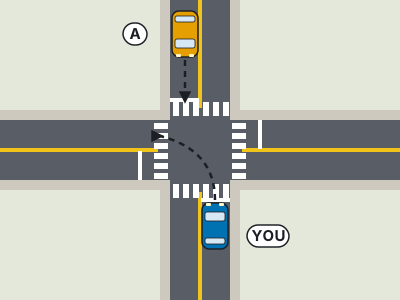
- Alternating left and right
- Turned left toward the oncoming lane
- Turned right toward the curb
- Pointed straight ahead
Show answer
Pointed straight ahead. When waiting to turn left, keep the wheels pointed straight ahead until it is safe to begin turning. Turning them left early is dangerous because a rear impact could push your vehicle into oncoming traffic. The cue is your waiting position in the intersection or turn lane. Hold the steering wheel steady, check pedestrians and approaching vehicles, then turn only when the gap is safe.
6. What steps must you take before changing lanes?
- Move first, then check mirrors
- Signal only after you are halfway over
- Rely on mirrors alone
- Signal, check mirrors and traffic, look over your shoulder, verify the lane is clear
Show answer
Signal, check mirrors and traffic, look over your shoulder, verify the lane is clear. Each lane-change step catches what the last one missed: the signal warns others, mirrors show the adjacent lanes, the shoulder check clears the blind spot mirrors hide, and the final look confirms the gap before you commit. Skipping the shoulder check is the classic lane-change crash, since motorcycles and small cars live in blind spots. On freeways, start signaling at least five seconds early.
7. A blind pedestrian pulls in their cane and steps away from the intersection. What does it mean?
- The pedestrian is asking for directions
- You must honk to acknowledge them
- The gesture usually means you may go
- You must exit and guide them across
Show answer
The gesture usually means you may go. Blind pedestrians communicate with cane signals: pulling the cane in and stepping back tells waiting drivers the crossing is off. The handbook pairs this with two cautions: never honk at a blind person, since the blast can startle them into traffic, and stay extra alert around quiet hybrid and electric cars they cannot hear. When in doubt, wait until their intent is unmistakable.
8. How close to a crosswalk with a curb extension may you park?
- Within 20 feet, the same as any crosswalk
- Within 15 feet where a curb extension is present
- Within 5 feet of the extension
- Parking is allowed up to the crosswalk edge
Show answer
Within 15 feet where a curb extension is present. Curb extensions narrow the roadway and push waiting pedestrians into better view of approaching drivers, so the no-parking buffer shrinks from the standard 20 feet down to 15. The general rule still bans parking within 20 feet of any unmarked or marked crosswalk everywhere else. Parking against the extension defeats its visibility purpose and hides crossing pedestrians, especially children, from drivers until the last moment.
9. BAC estimates are based on which factors?
- Number of drinks, gender, and body weight
- Height and eye color
- Time of day and weather
- Type of vehicle driven
Show answer
Number of drinks, gender, and body weight. Alcohol distributes through the body's water, so the same number of drinks produces a higher BAC in smaller people and, on average, in women than in men. Drink count sets the total alcohol load that must be absorbed. That is why the handbook's BAC tables are organized by drinks, sex, and weight together, and why food, drinking pace, and individual variation make personal BAC guesses dangerously unreliable.
10. What do double solid yellow centerlines require?
- Cross them freely when no traffic is near
- Stay right of them and never pass over them, with narrow exceptions
- Treat them as a single broken line
- Use them as a left-turn lane
Show answer
Stay right of them and never pass over them, with narrow exceptions. Double solid yellow centerlines mark roads where passing is too dangerous to allow, so crossing them is banned except for specific cases such as turning into a driveway, making a legal U-turn, or entering a signed HOV lane. Riding on or over the lines to squeeze past traffic is never permitted. Where passing is allowed, the centerline will be broken on your side instead.
11. Which headset or earplug use is illegal while driving in California?
- Wearing a headset or earplugs in both ears.
- Using a single hands-free earpiece.
- Listening through the vehicle's built-in speakers.
- Wearing hearing aids prescribed by a doctor.
Show answer
Wearing a headset or earplugs in both ears.. California says hearing helps drivers notice horns, sirens, motorcycles, and screeching tires, and it bars wearing a headset or earplugs in both ears while driving. The single-earpiece option changes the condition: the handbook's stated prohibition is both ears. A useful cue is whether outside warning sounds are blocked on both sides. If both ears are covered by plugs or a headset, do not drive that way.
12. Who may park at a blue curb?
- A disabled person or someone driving a disabled person with the proper placard or plate
- Any driver loading freight for a short time
- Only buses during posted commute hours
- Any driver who stays inside the vehicle
Show answer
A disabled person or someone driving a disabled person with the proper placard or plate. A blue curb is reserved for a disabled person or someone driving a disabled person when the vehicle has the special placard or license plate. Staying with the vehicle does not create permission, and freight loading is a yellow curb rule. The cue is blue paint paired with disability access. Before parking there, confirm that the required placard or special plate is displayed and that the trip actually involves eligible use.
13. What does a NO PARKING sign require of drivers?
- Park briefly with flashers on
- Never park or leave your vehicle there
- Park only at night
- Park only on weekends
Show answer
Never park or leave your vehicle there. A NO PARKING sign makes the curb an absolute no-stopping zone for parking purposes: the handbook lists posted locations first among illegal parking places. Flashers, darkness, weekends, and quick errands create no exception. Short passenger loading may be allowed only where separate signs or curb colors permit stopping; the NO PARKING face itself bans leaving the car. Officers can cite or tow a car left at a posted curb without further warning.
14. A California provisional driver on probation turns 18. What happens to the probation?
- It continues; turning 18 does not end existing restrictions or probation
- It ends automatically on the birthday
- It converts into a warning on the record
- It is cut in half
Show answer
It continues; turning 18 does not end existing restrictions or probation. California is explicit that reaching 18 does not erase or end restrictions, suspensions, or probation that are already in place. The birthday does not wipe the slate, so the automatic ending choice is wrong. Nothing in the handbook converts probation into a warning or shortens it by half. A teen who earned a six month suspension and a year of probation still serves both in full, and new at fault collisions or convictions during probation can lead to another suspension.
15. How far ahead should a hill or curve be before you begin passing on a California two lane road?
- At least 100 feet
- At least one third of a mile
- At least 500 feet
- Any distance, if you speed up
Show answer
At least one third of a mile. To pass safely, the hill or curve ahead should be at least one third of a mile away. A hill or curve can hide oncoming traffic, so you need that much clear road to finish the pass. One hundred feet is the no passing distance near intersections, bridges, tunnels, and railroad crossings, not the hill or curve distance. Five hundred feet is the high beam dimming distance. Speeding up does not replace the sight distance you need.
16. Which road surfaces freeze before the rest of the road?
- Tunnels, which trap cold air
- Parking garages, which lack sunlight
- Flat desert roads, which cool fastest
- Bridges and overpasses, which freeze before other pavement
Show answer
Bridges and overpasses, which freeze before other pavement. Bridges lose heat from above and below at once, so their decks drop below freezing while ordinary pavement still holds warmth from the ground. The handbook pairs this with a second frost trap: shaded spots under trees and buildings that freeze first and dry last. On cold wet days, ease off the gas before bridges and shaded curves rather than braking on them.
17. How should you drive through a road work zone?
- Maintain speed to clear the zone quickly
- Change lanes frequently to pass equipment
- Slow down and allow extra space between vehicles
- Stop and wait for a flagger escort
Show answer
Slow down and allow extra space between vehicles. Work zones squeeze lanes, shift alignments, and put people on foot beside open traffic, so the handbook's formula is slower speed plus extra following space. Speeding through to clear the zone faster endangers workers and invites doubled fines, while weaving past equipment multiplies conflict points. Full stops for escorts are only for directed situations, not the general rule. Also expect sudden slowdowns, watch for lane-changing drivers, avoid distractions, and let cones, drums, and flaggers guide you through instead of improvising your own path.
18. Which cannabis rule applies to vehicle passengers in California?
- Passengers may smoke but drivers may not
- Sealed cannabis may be used by passengers only
- Passengers may eat cannabis products at red lights
- It is illegal for passengers as well as drivers to smoke or eat a cannabis product in a vehicle
Show answer
It is illegal for passengers as well as drivers to smoke or eat a cannabis product in a vehicle. California treats cannabis in a moving vehicle like open alcohol: consumption is banned for everyone inside, not just the person steering. Passengers cannot smoke, vape, or eat cannabis products while riding, and stopping at a light changes nothing. Sealed containers may be transported only when properly stored, never opened and used en route. The rule keeps the cabin free of impairment and secondhand smoke and removes any dispute about who consumed what. Save all cannabis use for a private place after the trip ends.
19. Which collisions must you report to DMV within 10 days?
- Over $1,000 in property damage, or any injury or death
- Only damage above $10,000
- Only when police order it
- Only hit-and-run crashes
Show answer
Over $1,000 in property damage, or any injury or death. The ten-day DMV report duty turns on damage value and human harm, not on fault or police presence. Injuries and deaths always qualify, as does property damage past the thousand-dollar line. Each driver files separately through the SR 1 process, and missing the deadline can suspend the privilege. Fault and police presence never change the automatic ten-day reporting duty. Each involved driver must file a separate SR 1 report on time.
20. A firefighter gives you directions that conflict with a posted sign. What should you do?
- Follow the posted sign because it is permanent
- Proceed only if the traffic signal is green
- Wait until another driver chooses a direction
- Follow the firefighter's order
Show answer
Follow the firefighter's order. You must obey directions from a firefighter or law enforcement officer even when they conflict with signs, signals, or laws. The posted-sign choice is wrong because the manual gives the officer or firefighter's direction priority in that moment. The cue is a person officially directing traffic at a fire, collision, work zone, or emergency scene; follow the order calmly and watch for unexpected movement nearby.
New California driver? Insurance is the next step
Once the permit or license is in hand, the family policy changes. QualitySpace is an independent California broker (Kevin Vu, CDI #4037122): teen-driver additions, first-time policies, and multi-car bundles quoted across many carriers in one call.
Get a free quote or call 714-666-6669. English and Vietnamese.
Every question is written from the official California Driver's Handbook. Need paper? Printable CA practice test with answer key.
Last verified 2026-09-08. How we check every question · Study all 500 as flashcards
Frequently asked questions
How many questions are on this California practice test?
This fixed set has 20 questions. It is test 6 of 25 from the 500 question California bank. The real CA exam has 36 questions for applicants 18 and older and 46 for applicants under 18. A passing score is 80%.
What is the passing score for the real California test?
A passing score is 80%. That figure comes from the official California source cited on the DMV facts page.
How does this fixed test relate to the full California bank?
Each numbered test is a fixed set of 20 questions in a fixed order, so you can retake the same test later and compare. Every test mixes road signs and the other topics in about the same proportion as the full bank. Tests 1 to 25 together cover every question in the California bank once. The full practice page mixes the whole bank at random.
Last verified 2026-09-08. See the California DMV facts page for sourced state details.
Return to the full California practice test · Study road signs