
Test 8 of 25 · 20 questions · Free 2026
CA Permit Practice Test 8
Jump to the test ↓A fixed 20 question set from the California bank with answers and plain English explanations. The real CA exam has 36 questions for applicants 18 and older and 46 for applicants under 18. A passing score is 80%. Take the full length version on the main practice page.
Parent of a new California driver? Adding a teen to the family policy changes the price. Get a free quote or call 714-666-6669. English and Vietnamese.
Question 1 of 20 · 0 right so far
All 20 questions in test 8
Every question below comes from the California question bank on this page. Open a question to see the correct answer and the explanation. Nothing here is hidden behind a signup.
1. You sell your car to a private buyer in California. How soon must you notify DMV?
- Within 30 days
- Within 10 days
- Within 20 days
- Within five days
Show answer
Within five days. A seller must notify DMV within five days by completing a Notice of Transfer and Release of Liability, which can be done online. Filing it promptly protects you if the buyer gets a ticket or has a collision before the title changes hands. The 10 day period belongs to the buyer, who has 10 days to transfer ownership. Twenty days is how long a new resident has to register an out of state vehicle, and 30 days is not a deadline the handbook gives for a sale.
2. May you double park while waiting for someone?
- Never; double parking is on the illegal parking list
- Yes, for up to 5 minutes with flashers on
- Yes, if no other space is available
- Yes, on residential streets only
Show answer
Never; double parking is on the illegal parking list. A double-parked car blocks a full travel lane, forcing moving traffic into oncoming lanes and delaying fire trucks and ambulances that cannot squeeze past. That is why double parking appears on the handbook's Illegal Parking list with no exception for quick errands or waiting passengers. Hazard flashers, a shortage of open spaces, and the street being residential create no exemption, and officers can cite or tow the blocking vehicle.
3. What is the speed limit within 100 feet of an uncontrolled railroad crossing when you cannot see the tracks for 400 feet in both directions?
- 25 mph near schools, not this crossing
- 15 mph
- 35 mph
- 55 mph
Show answer
15 mph. California sets a 15 mph limit within 100 feet of a railroad crossing when you cannot see the tracks for 400 feet in both directions. The 25 mph figure is for many school zones, not this low-visibility rail setting. Your cue is poor sight distance near tracks. Slow early, scan both directions, and remember that gates, warning signals, or a flagman may permit a higher speed only when they control the crossing.
4. A 19-year-old in California wants to carry a sealed bottle of wine in the car. When is that allowed?
- Any time, as long as it stays sealed
- Never, under any circumstances
- Only on weekends
- Only when a person 21 or older is with them and the container is full, sealed, and unopened
Show answer
Only when a person 21 or older is with them and the container is full, sealed, and unopened. A driver under 21 may not carry any alcoholic beverage in a vehicle unless someone 21 or older is present, and the container must be full, sealed, and unopened. Being sealed alone is not enough without the adult. Never is too strong: the adult exception exists, and so does one for young people working for someone with an off site liquor sales license. Weekends have nothing to do with the rule. An opened container must go in the trunk or where passengers do not sit.
5. What does a yellow sign with two opposing arrows warn about?
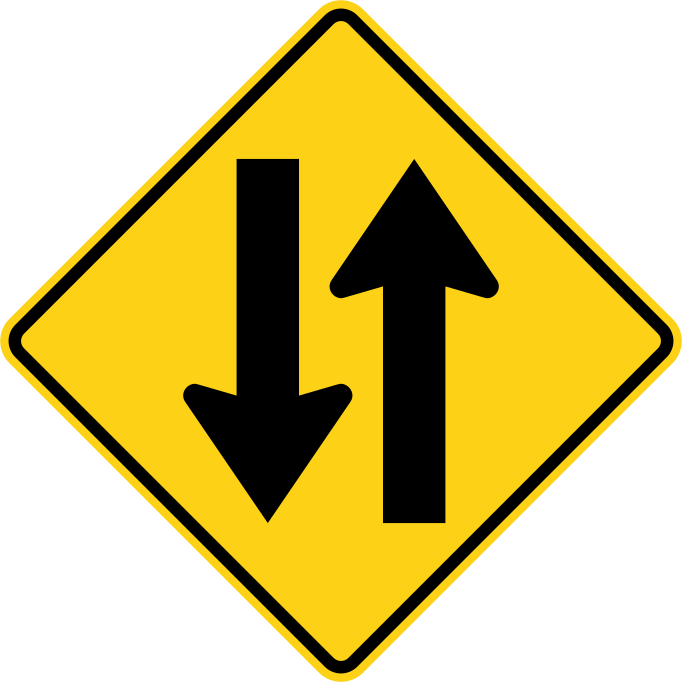
- A one-way street is beginning
- Only buses may use the next lane
- A divided highway starts at the sign
- Traffic will be moving in both directions
Show answer
Traffic will be moving in both directions. Two opposing arrows warn that traffic is or will be traveling both ways, so keep right and expect oncoming vehicles. The one-way choice reverses the message and could put you mentally in the wrong lane pattern. The cue is that the arrows point against each other; treat it as a warning to watch center lines, passing restrictions, and vehicles approaching from the opposite direction.
6. What do highway construction and maintenance signs warn drivers about?
- Only permanent lane-number changes
- Workers, slow-moving equipment, and closed lanes ahead
- Parking time limits near stores
- Railroad crossings without signals
Show answer
Workers, slow-moving equipment, and closed lanes ahead. Construction and maintenance warning signs tell drivers to expect workers, slow-moving equipment, and closed lanes. A permanent lane-number change is not the main meaning of these work-zone signs. The cue is the work-zone message board or warning sign ahead. Slow down, allow more room, expect sudden stops, and obey flaggers or special instructions as cones and barriers guide the path.
7. Besides turning the wheels correctly on a hill, what should you do before leaving the vehicle?
- Release the parking brake after checking mirrors
- Leave the transmission in neutral so the curb stops it
- Keep the engine running until the wheels touch the curb
- Set the parking brake and leave the vehicle in park or in gear
Show answer
Set the parking brake and leave the vehicle in park or in gear. Hill parking requires more than wheel direction. California says to set the parking brake and leave an automatic in park, or a manual transmission in gear. Neutral is wrong because it removes a layer of protection if the brake or curb hold fails. The cue is the slope itself. Once positioned, secure the drivetrain and brake before you exit so the vehicle cannot roll into traffic.
8. Which stopped roadside vehicle is covered by California's move over and slow down rule?
- Any parked passenger car with no lights on.
- A stopped road work vehicle displaying emergency flashing or amber warning lights.
- A food truck serving customers from a private lot.
- A moving delivery van using a turn signal.
Show answer
A stopped road work vehicle displaying emergency flashing or amber warning lights.. California's move over and slow down rule includes stopped road work vehicles displaying emergency flashing or amber warning lights, along with certain emergency vehicles and tow trucks. The parked-car option lacks the warning-light condition described by the handbook. This rule protects people working near traffic. The cue is a stopped work or emergency vehicle with flashing or amber lights: change lanes away from it when safe and reduce speed while passing.
9. A vehicle is stopped at a crosswalk in the lane next to you. What should you do?
- Pass only if you can stay under 10 mph
- Honk once, then continue if the driver does not move
- Stop or slow enough to yield because a pedestrian may be hidden
- Change lanes away from the vehicle and keep normal speed
Show answer
Stop or slow enough to yield because a pedestrian may be hidden. California warns not to pass a vehicle stopped at a crosswalk because that vehicle may be blocking your view of a pedestrian. The 10 mph choice borrows a rule for stopped buses or streetcars at safety zones, not crosswalks. The cue is a stopped vehicle at the crosswalk line; treat it as evidence that someone may be crossing and wait until the whole crosswalk is visible.
10. During a traffic stop, a state or local officer asks about your immigration status. What does California law allow?
- Only passengers are required to answer
- You must answer any question an officer asks
- You can decline to answer the question
- You must answer once you have shown your license
Show answer
You can decline to answer the question. California bars state and local officers from asking drivers or passengers about immigration status, and a driver who is asked may decline to answer. Showing your license does not change that, and the rule covers passengers just as it covers the driver. Questions about immigration status are reserved to federal officers. Declining is not the same as refusing to identify yourself, so provide your license, registration, and proof of insurance when asked, stay courteous, and if you believe your rights were disregarded, raise it later through a complaint rather than an argument at the roadside.
11. A limit line stands before a crosswalk where pedestrians are crossing. Where do you stop?
- Stop at the limit line and let pedestrians cross
- Stop past the line inside the crosswalk
- Slow down but keep rolling through
- Stop only if pedestrians wave at you
Show answer
Stop at the limit line and let pedestrians cross. The limit line holds cars back so the full crosswalk stays open and pedestrians remain visible to all lanes. Stopping on the line or inside the zebra stripes forces walkers around your bumper and hides them from adjacent traffic. Hold at the line until every pedestrian has cleared your half of the roadway, then proceed when the way is fully clear.
12. What is a bike route, and how is it marked?
- A freeway lane closed to bicycles
- A sidewalk shared with pedestrians
- A signed preferred route for bikes on streets shared with cars
- A racing course closed to traffic
Show answer
A signed preferred route for bikes on streets shared with cars. Bike routes steer cyclists onto calmer streets using route signs and shared-lane markings, but cars still use the same lanes, so drivers must expect bicycles and pass with care. The shared markings remind everyone that bikes may take the lane where needed. Never treat the bicycle symbols as decoration: they mark a corridor the city wants cyclists to use. Drivers who crowd route corridors force cyclists into the gutter or into parked-car doors.
13. To prevent skidding on slippery surfaces, what should you do before going down a steep hill?
- Shift to low gear before going down a steep hill
- Ride the brake pedal all the way down
- Shift into neutral to save fuel
- Pump the brakes rapidly while descending
Show answer
Shift to low gear before going down a steep hill. A low gear turns the engine into a brake that holds the vehicle back without heating the service brakes at all. Riding the brake pedal down a long grade overheats the pads and drums until they fade or fail completely, and shifting to neutral surrenders engine braking while letting speed build freely. Pumping the pedal is a technique for non-ABS emergency stops, not for controlled descents. Shifting down before the hill is the handbook's skid-prevention step for steep grades.
14. Within what distance of an intersection, bridge, tunnel, or railroad crossing does California say you must not pass?
- 50 feet
- 300 feet
- 100 feet
- 1,000 feet
Show answer
100 feet. California says not to pass within 100 feet of an intersection, bridge, tunnel, railroad crossing, or other hazardous area. Fifty feet is too short a buffer. Three hundred feet is the distance for following a vehicle with high beams and for staying behind emergency vehicles, not a passing rule. One thousand feet is the headlight visibility test. Passing is also barred at crossroads and driveways and whenever there is not enough room to return to your lane.
15. Which road surfaces tend to freeze before the rest of the road?
- Bridges and overpasses
- Freshly painted lane markings only
- Flat city blocks with heavy traffic
- Downhill shoulders after sunrise only
Show answer
Bridges and overpasses. Bridges and overpasses can freeze before other pavement, so slow before reaching them on cold wet days and expect hidden icy spots. The city-block choice overlooks the exposure of bridges and overpasses to cold air. The cue is elevated pavement, shade, or a structure crossing water or another road; ease off early and avoid abrupt steering or braking on the span.
16. What must each driver file with DMV after a reportable collision?
- A thank-you note to the other driver
- A Report of Traffic Accident (SR 1) filed with DMV
- A letter to the governor
- Nothing if damage looks minor
Show answer
A Report of Traffic Accident (SR 1) filed with DMV. The SR 1 form creates the official DMV record of qualifying crashes, separate from police reports and insurance claims. Every involved driver must file it after a reportable collision, and the handbook gives the online filing address. Failing to file can suspend the driving privilege even when the crash itself drew no citation. Missing the filing deadline can suspend your privilege even without any citation.
17. What BAC is illegal when you are driving a passenger for hire?
- 0.08% or higher
- 0.01% or higher
- 0.06% or higher
- 0.04% or higher
Show answer
0.04% or higher. Drivers carrying passengers for hire are held to the same stricter 0.04% standard as commercial-license holders, because they accept responsibility for other people's lives the moment they take a fare. The general 0.08% adult limit does not apply while driving for hire in any vehicle. Drivers under 21 face the 0.01% line regardless of hire status, which is stricter still.
18. Your brakes fail while driving. What sequence should you try?
- Turn off the engine immediately
- Pump the brakes, downshift, then try the emergency brake
- Open the door to slow down with your foot
- Honk continuously until you stop
Show answer
Pump the brakes, downshift, then try the emergency brake. Brake failure demands a fixed escalation: pumping may rebuild hydraulic pressure, a lower gear adds engine braking, and the separate cable-operated emergency brake remains as the final way to stop. Killing the engine robs power steering and can lock the wheel, while doors and horns do nothing to slow the car. Practice the sequence mentally so panic does not skip a step.
19. What is the left lane of a multilane road for?
- Cruise there permanently at any speed
- Enter and exit traffic from the curb
- Pass other vehicles or turn left
- Park during emergencies
Show answer
Pass other vehicles or turn left. The far-left lane sits closest to the center divider precisely so faster traffic can overtake without weaving through slower lanes. Camping there at cruising speed forces passes on the right and breeds road rage. The right lane handles entries, exits, and curb approaches, keeping each lane's purpose separate and predictable for everyone sharing the road. Trucks and towers must also keep right, leaving the left lane open for overtaking.
20. The pedestrian signal shows WALK or a walking person. What may you do?
- You may cross the street
- You may not cross the street
- You must run across quickly
- Only cyclists may cross
Show answer
You may cross the street. The WALK or walking-person display is the pedestrian's green light, but it still requires checking for turning cars whose drivers may not see you. Cross within the marked lines and keep watching while you walk. A steady raised hand or DON'T WALK means stay on the curb, and a flashing hand means do not start crossing. Keep small children by the hand and do not linger in the roadway once across.
New California driver? Insurance is the next step
Once the permit or license is in hand, the family policy changes. QualitySpace is an independent California broker (Kevin Vu, CDI #4037122): teen-driver additions, first-time policies, and multi-car bundles quoted across many carriers in one call.
Get a free quote or call 714-666-6669. English and Vietnamese.
Every question is written from the official California Driver's Handbook. Need paper? Printable CA practice test with answer key.
Last verified 2026-09-08. How we check every question · Study all 500 as flashcards
Frequently asked questions
How many questions are on this California practice test?
This fixed set has 20 questions. It is test 8 of 25 from the 500 question California bank. The real CA exam has 36 questions for applicants 18 and older and 46 for applicants under 18. A passing score is 80%.
What is the passing score for the real California test?
A passing score is 80%. That figure comes from the official California source cited on the DMV facts page.
How does this fixed test relate to the full California bank?
Each numbered test is a fixed set of 20 questions in a fixed order, so you can retake the same test later and compare. Every test mixes road signs and the other topics in about the same proportion as the full bank. Tests 1 to 25 together cover every question in the California bank once. The full practice page mixes the whole bank at random.
Last verified 2026-09-08. See the California DMV facts page for sourced state details.
Return to the full California practice test · Study road signs