
Test 20 of 25 · 20 questions · Free 2026
CA Permit Practice Test 20
Jump to the test ↓A fixed 20 question set from the California bank with answers and plain English explanations. The real CA exam has 36 questions for applicants 18 and older and 46 for applicants under 18. A passing score is 80%. Take the full length version on the main practice page.
Parent of a new California driver? Adding a teen to the family policy changes the price. Get a free quote or call 714-666-6669. English and Vietnamese.
Question 1 of 20 · 0 right so far
All 20 questions in test 20
Every question below comes from the California question bank on this page. Open a question to see the correct answer and the explanation. Nothing here is hidden behind a signup.
1. From a one-way street onto another one-way street, where should you start a left turn?
- From the far-left lane
- From the far-right lane
- From any open lane without signaling
- From the center lane only
Show answer
From the far-left lane. A left turn from one one-way street onto another starts from the far-left lane. The far-right lane is used for a right turn, so choosing it would swing across traffic. Your cue is the one-way to one-way setup. Move to the left lane in advance, signal, and check for pedestrians and bicyclists, who can legally use the left turn lane for their own left turns. If there are three or more lanes in your direction of travel, you may end the turn in any lane that is open.
2. If you are convicted of a DUI, how long will DMV suspend or revoke your driving privilege?
- 30 days
- One year
- 10 years
- Permanently
Show answer
One year. A DUI conviction costs the privilege itself for a full year, on top of the required DUI program, the SR-22 insurance filing, and any ignition interlock or fee orders. Separately, the conviction stays on the driving record for 10 years, so any repeat DUI in that window draws escalating penalties. Refusing a chemical test triggers its own suspension under implied consent, independent of the criminal case outcome.
3. You have finished parallel parking. What must you do before exiting?
- Leave the engine running for a quick return
- Set the brake but leave the car in neutral
- Lock the doors but leave the engine on
- Turn off the vehicle and set the parking brake
Show answer
Turn off the vehicle and set the parking brake. A parked car with a running engine can be stolen in seconds or roll if bumped, while one left in neutral rests entirely on the parking brake with no backup. The handbook's finish sequence is turn the engine off, set the parking brake, look carefully for passing vehicles and bicycles, then exit only when safe. Skipping the shutdown step leaves the car vulnerable and wastes fuel for no reason.
4. Can a California school zone have a speed limit lower than 25 mph?
- No, 25 mph is always the lowest school zone limit
- Only during summer school sessions
- Yes, some school zones may be posted as low as 15 mph
- Only when a crossing guard is in the street
Show answer
Yes, some school zones may be posted as low as 15 mph. The usual California school zone limit is 25 mph within 500 feet of a school while children are outside or crossing. The handbook adds that some school zones may have speed limits as low as 15 mph, so read the posted sign rather than assuming 25 is the floor. Lower limits are not limited to summer sessions or to moments when a crossing guard is out. Near schools, also watch for bicyclists, pedestrians, safety patrols and stopped school buses.
5. Besides aiming the wheels, what secures a car parked on a hill?
- Set the parking brake and leave it in park, or in gear for a manual
- Leave it in neutral with no brake
- Leave the engine running in drive
- Turn the wheels only and nothing else
Show answer
Set the parking brake and leave it in park, or in gear for a manual. Hills defeat any single safeguard, so the handbook layers three: wheels aimed to block street entry, the transmission holding in park or gear, and the parking brake as backup. Neutral with no brake lets gravity take the car immediately, and a running engine in gear drives it away. This triple lock applies on every grade, driveway slope, and curb or no-curb park.
6. Where does the handbook forbid U-turns?
- Only on freeways
- Only at night
- Only with a police escort
- Where a NO U-TURN sign is posted, at crossings, and across dividers
Show answer
Where a NO U-TURN sign is posted, at crossings, and across dividers. U-turn bans target the three deadliest reversal spots: signed intersections where engineers have ruled the move unsafe, railroad crossings where a slow reversal can strand you on the rails, and divided highways where crossing the barrier means driving into oncoming lanes. Legal U-turns still require clear sight lines, no interfering traffic, and compliance with every posted sign at the location.
7. In high winds, why should you reduce your speed?
- It gives you better control and more time to react to gusts
- It lets cruise control steer more accurately
- It prevents all debris from reaching your lane
- It allows you to drive with parking lights only
Show answer
It gives you better control and more time to react to gusts. California advises reducing speed in high winds because slower travel improves control and gives more reaction time if a gust hits. The cruise control choice conflicts with the same section, which tells drivers not to use cruise control in those conditions. The cue is an open bridge, gap between buildings, truck corridor, or blowing debris where a sudden side push could move the vehicle off line.
8. You are already inside a California intersection when an emergency vehicle with its lights on appears. What should you do?
- Stop immediately in the intersection.
- Back up to the limit line.
- Turn left to clear the middle faster.
- Continue through, then drive right and stop as soon as safe.
Show answer
Continue through, then drive right and stop as soon as safe.. If you are already in an intersection when an emergency vehicle appears, California says to continue through the intersection, then drive to the right and stop as soon as it is safe. Stopping in the middle can block the emergency route and cross traffic. The backing-up option creates another conflict because drivers behind you may not expect it. The cue is your vehicle's position: inside the intersection means clear it first, then yield from the right edge.
9. A pedestrian is crossing at an unmarked crosswalk. What must you remember?
- Drivers may proceed if no white lines are painted
- Pedestrians have the right-of-way there
- Only school crosswalks create right-of-way
- Pedestrians must yield to turning vehicles
Show answer
Pedestrians have the right-of-way there. California treats both marked and unmarked crosswalks as places where pedestrians have the right-of-way. The no-white-lines option is wrong because not all crosswalks are painted. At intersections, the crosswalk may exist even when there are no visible lines. The cue is a person crossing where pedestrians are legally expected, especially at an intersection. Slow, stop if needed, and allow enough time for the person to finish crossing safely.
10. When may you turn right at a solid red light in California?
- After slowing, if the cross street is clear.
- Only from a one-way street onto another one-way street.
- After stopping, unless a NO TURN ON RED sign is posted, and yielding as required.
- Only when a green arrow is also displayed.
Show answer
After stopping, unless a NO TURN ON RED sign is posted, and yielding as required.. A solid red light requires a stop, but California allows a right turn after the stop when no NO TURN ON RED sign forbids it. You still have to stop at the proper line and yield to pedestrians and traffic before turning. The slow-and-go option skips the complete stop, which changes the rule. Use the posted sign and stop line as cues: no prohibiting sign plus a full stop can make the right turn legal.
11. What is the maximum speed for a passenger vehicle towing a trailer on a California highway, even when the general posted limit is higher?
- 55 mph.
- 60 mph.
- 65 mph.
- 70 mph when traffic is light.
Show answer
55 mph.. The handbook sets 55 mph as the limit for vehicles towing trailers, the same figure used on a two-lane undivided highway, while most other highways allow 65 mph. A higher general posted limit does not raise this towing maximum. Obey a lower posted limit and slow further when conditions require. A passenger vehicle pulling a trailer must follow this vehicle-specific cap rather than the higher speed allowed for ordinary cars on the same road. Leave additional room to slow and stop with the trailer.
12. When turning right, what must you always check for?
- Only traffic behind you
- Only the traffic signal
- Only parked cars
- Pedestrians crossing plus motorcycles and bicycles beside you
Show answer
Pedestrians crossing plus motorcycles and bicycles beside you. Right turns sweep across the crosswalk and the bike lane at once, which is why the handbook names three separate checks in one rule. Pedestrians step off the curb as your light turns green, while motorcycles and bicycles ride in your blind spot or the adjacent lane. Mirror, signal, blind-spot glance, then turn: skipping any check risks a collision the handbook explicitly warns against.
13. Where may you legally make a U-turn on green?
- Never, under any circumstance
- Only on one-way streets
- Only with a police escort
- At an intersection on green, unless a NO U-TURN sign is posted
Show answer
At an intersection on green, unless a NO U-TURN sign is posted. Green-ball and green-arrow intersections offer the protected gap U-turns need, since cross traffic holds red while you swing. The NO U-TURN sign overrules the permission wherever engineers have judged the move unsafe. Even where legal, U-turns demand clear sight lines and zero interference with other road users. Sight lines must stay clear and no other road user may be interfered with.
14. What penalty faces assaulting a highway worker?
- A warning letter
- Only a small fine
- Fines up to $2,000 and up to a year in jail
- Community service only
Show answer
Fines up to $2,000 and up to a year in jail. Highway workers stand unprotected beside traffic, so the law punishes attacks on them as serious crimes rather than simple batteries. The $2,000 fine and year of custody reflect the vulnerability of flaggers and crews. Threats and thrown objects count alongside physical strikes. Thrown objects and threats count alongside physical strikes against workers. Flaggers and road crews stand unprotected beside fast-moving traffic.
15. At dusk you switch on your parking lights instead of the headlights. Is that acceptable?
- Yes, as long as the street is lit
- Yes, until it becomes fully dark
- No, driving on parking lights alone is illegal
- Yes, on roads posted below 35 mph
Show answer
No, driving on parking lights alone is illegal. California makes driving on parking lights alone illegal, so switching them on in place of headlights is not a lawful halfway step at dusk. Street lighting and a lower speed limit change nothing, and dusk is precisely when the rule bites. Headlights are required once it is too dark to see 1,000 feet ahead, from thirty minutes after sunset until thirty minutes before sunrise, and in bad weather. A useful habit: if the wipers are running because of fog, rain, or snow, the low beams belong on too, since the same conditions that obscure the road also hide your vehicle from everyone else.
16. For a California driver age 21 or older operating a noncommercial vehicle, what is the lowest general per-se DUI BAC threshold?
- 0.04% or higher only when not towing
- 0.08% or higher
- 0.10% or higher after midnight
- Any reading only if a crash occurs
Show answer
0.08% or higher. For a noncommercial driver over 21, California sets the illegal BAC threshold at 0.08% or higher. The 0.04% figure belongs to commercial driver license vehicles and passenger for hire driving, so using it for every over-21 driver changes who the rule covers. A useful cue is the ordinary adult limit: eight hundredths is the number tied to drivers over 21, while lower numbers apply to probation, underage, or commercial situations.
17. You see this WRONG WAY sign facing you. What should you do when safe?
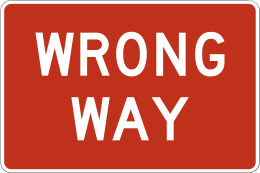
- Continue slowly until the next exit
- Back out or turn around
- Move to the left lane and keep going
- Stop in the lane and wait for a tow
Show answer
Back out or turn around. A WRONG WAY sign means you have entered a roadway against traffic. When it is safe, back out or turn around to leave the wrong-direction path. Continuing slowly is not acceptable because it keeps you exposed to head-on traffic. A night cue is red road reflectors shining in your headlights. If you see the sign or red reflectors, stop compounding the error and get out of that direction safely.
18. How often may a California driver use traffic violator school to keep a one-point citation from being reported to the insurance company?
- Once in any 18-month period
- Once every 6 months
- Once per year
- Once in a lifetime
Show answer
Once in any 18-month period. When you are given a one-point traffic violation, the judge may offer the choice to attend a traffic violator school so the citation is not reported to your insurance company, although it stays on your driver record. You can do this once in any 18-month period. The school reports completion to the court and you receive a completion receipt. Six months and one year are shorter than the window, and it is not a one-time option.
19. If a tire blows out, what should you do with the accelerator?
- Press it hard to keep the vehicle straight
- Abruptly remove your foot from it
- Gradually release it while keeping control
- Alternate quickly between accelerator and brake
Show answer
Gradually release it while keeping control. During a tire blowout, hold the wheel, keep control, and gradually release the accelerator after the vehicle stabilizes enough to slow safely. Abruptly lifting off is a trap because the handbook warns that sudden braking or sudden accelerator release can cause loss of control. The cue is a bang, pull, or vibration from a tire; resist panic inputs and steer where you want the vehicle to go.
20. What minimum liability insurance must California drivers carry for property damage?
- $5,000 for property damage
- $15,000 for property damage
- $10,000 for property damage
- $30,000 for property damage
Show answer
$15,000 for property damage. California minimum liability coverage includes at least $15,000 for property damage. The $30,000 figure is used for a single death or injury, so it is the wrong number for property damage. Keep the categories separate: bodily injury limits are listed by people injured, while property damage covers damage to vehicles or other property. A cue is the smallest dollar amount in the handbook's three insurance bullets.
New California driver? Insurance is the next step
Once the permit or license is in hand, the family policy changes. QualitySpace is an independent California broker (Kevin Vu, CDI #4037122): teen-driver additions, first-time policies, and multi-car bundles quoted across many carriers in one call.
Get a free quote or call 714-666-6669. English and Vietnamese.
Every question is written from the official California Driver's Handbook. Need paper? Printable CA practice test with answer key.
Last verified 2026-09-08. How we check every question · Study all 500 as flashcards
Frequently asked questions
How many questions are on this California practice test?
This fixed set has 20 questions. It is test 20 of 25 from the 500 question California bank. The real CA exam has 36 questions for applicants 18 and older and 46 for applicants under 18. A passing score is 80%.
What is the passing score for the real California test?
A passing score is 80%. That figure comes from the official California source cited on the DMV facts page.
How does this fixed test relate to the full California bank?
Each numbered test is a fixed set of 20 questions in a fixed order, so you can retake the same test later and compare. Every test mixes road signs and the other topics in about the same proportion as the full bank. Tests 1 to 25 together cover every question in the California bank once. The full practice page mixes the whole bank at random.
Last verified 2026-09-08. See the California DMV facts page for sourced state details.
Return to the full California practice test · Study road signs