
Test 24 of 25 · 20 questions · Free 2026
CA Permit Practice Test 24
Jump to the test ↓A fixed 20 question set from the California bank with answers and plain English explanations. The real CA exam has 36 questions for applicants 18 and older and 46 for applicants under 18. A passing score is 80%. Take the full length version on the main practice page.
Parent of a new California driver? Adding a teen to the family policy changes the price. Get a free quote or call 714-666-6669. English and Vietnamese.
Question 1 of 20 · 0 right so far
All 20 questions in test 24
Every question below comes from the California question bank on this page. Open a question to see the correct answer and the explanation. Nothing here is hidden behind a signup.
1. A California lane is signed for public transit buses only. When may a car cross it?
- To make a right turn
- Never, for any reason
- Whenever no bus is in sight
- To pass slow traffic
Show answer
To make a right turn. It is illegal to drive, stop, park or leave a vehicle in an area designated for public transit buses, and signs are posted to show which lanes are bus only. The one exception the handbook gives is that you may cross a bus lane to make a right turn. An empty lane is still a bus lane, and it is never a passing lane. Check for buses before crossing, then complete the turn without traveling along the lane.
2. At night, red road reflectors shining in your headlights usually warn that you are:
- Approaching a carpool lane entrance
- Driving the wrong way
- Near a railroad crossing
- Entering a construction detour
Show answer
Driving the wrong way. Red reflectors shining back at night are California's warning that you have entered a roadway against traffic. The railroad crossing choice confuses reflector color with sign shape, since crossings are warned by circular or X-shaped signs and active lights. The cue is seeing red reflected from pavement markers in your headlights where you expected lane guidance, which should make you stop safely and correct direction without continuing forward.
3. What is the maximum fine listed for dumping or abandoning an animal on a California highway?
- Exactly $100 with no jail exposure
- Up to $250
- Up to $1,000
- Only payment for animal shelter costs
Show answer
Up to $1,000. The handbook says dumping or abandoning animals on a highway can bring a fine up to $1,000, six months in jail, or both. The shelter costs choice misses that California treats the conduct as a crime with stated penalties. The cue is any attempt to leave an animal beside or on a highway instead of transferring it safely to a person, shelter, or other lawful care.
4. Your vehicle becomes disabled on a California freeway and you have a cell phone. What assistance step does the handbook give?
- Walk to the nearest exit for help
- Flag down passing trucks
- Wait in the traffic lane with flashers on
- Dial 511 or locate a call box for assistance
Show answer
Dial 511 or locate a call box for assistance. A disabled vehicle on a freeway shoulder still sits feet from high-speed traffic, so the handbook's priority is getting professional help while you stay protected inside the car. Dialing 511 connects you to traveler assistance, and freeway call boxes exist exactly for drivers without a working phone. Walking along the freeway or standing in a lane trades a car problem for a pedestrian fatality risk, and flagging down strangers is unreliable and unsafe. Pull fully onto the shoulder, stay belted inside, use flashers at your discretion, and let trained help come to you.
5. When may you park in a tunnel or on a bridge in California?
- Whenever traffic is light
- Only where signs permit it
- For up to 15 minutes with flashers on
- Only commercial vehicles may do so
Show answer
Only where signs permit it. Tunnels and bridges leave no shoulder to escape to, so a parked vehicle becomes a fixed obstacle in a narrow, low-visibility corridor. California therefore bans the practice outright unless signs at that specific spot permit it. Light traffic does not change the geometry, flashers do not protect a car with nowhere to go, and commercial plates grant no exemption. If signs allow parking, follow their limits exactly; otherwise keep moving until you reach ground with a real shoulder.
6. You are driving on an icy California road. What speed does the handbook say to keep?
- About 25 mph
- Half your normal speed
- 5 to 10 mph below the limit
- No more than 5 mph
Show answer
No more than 5 mph. Ice is the most slippery surface the handbook lists, so its speed guidance is the strictest: reduce your speed to no more than 5 mph. Half your normal speed is the rule for packed snow, and taking 5 to 10 mph off the limit is the rule for a merely wet road. A fixed 25 mph is far too fast when tires have almost no grip. Remember that shaded spots, bridges and overpasses freeze first, so ice can appear even when the rest of the road looks dry.
7. A California minor fails the behind the wheel drive test. How long is the wait before the next attempt?
- 14 days, not counting the day of the failure
- Seven days
- Six months
- No wait if a parent signs a new form
Show answer
14 days, not counting the day of the failure. For a minor, a failed behind the wheel drive test means a 14 day wait before retesting, and the day of the failure is not counted. Seven days is the waiting period after a failed knowledge test, so it is the wrong test. Six months is how long a minor must hold the instruction permit before the first drive test, not a retest delay. A parent's signature does not waive the waiting period. A sample Driving Performance Evaluation score sheet at dmv.ca.gov/teendriver shows what the drive test covers.
8. What BAC is illegal for a California driver who is under 21?
- 0.08% or higher
- 0.05% or higher
- 0.01% or higher
- 0.04% or higher
Show answer
0.01% or higher. California makes it illegal for a driver under 21 to drive with a BAC of 0.01% or higher. The 0.08% figure is the adult limit for drivers over 21. The 0.05% figure is the preliminary screening level that can lead an officer to require a breath or blood test from an underage driver, not the legal limit itself. The 0.04% figure applies to commercial vehicles and to drivers carrying passengers for hire. The same 0.01% limit applies at any age to drivers on DUI probation.
9. A rider on a motorcycle uses a carpool lane alone. Unless a sign says otherwise, is that allowed?
- Only if the motorcycle displays a clean air decal
- No, the rider needs a second person on the motorcycle
- No, motorcycles are barred from carpool lanes entirely
- Yes, motorcycles may use the lane unless posted otherwise
Show answer
Yes, motorcycles may use the lane unless posted otherwise. California lists motorcycles among the vehicles permitted in a high occupancy lane, and a rider alone still qualifies unless signs at that location say otherwise. The occupancy requirement posted for cars does not transfer to a motorcycle, and the decal rule applies to low emission and zero emission vehicles rather than to riders. Read the signs at the on ramp anyway, because a few corridors post their own restrictions. Enter and exit only at the marked openings, since the solid lines bordering the lane still apply to motorcycles.
10. Can a single alcoholic drink affect your ability to drive safely?
- No, one drink never affects driving
- Only if mixed with medication
- Yes, even one drink can affect safe driving
- Only for drivers under 21
Show answer
Yes, even one drink can affect safe driving. Impairment begins with the very first drink, well before any legal limit comes into play: judgment, reaction time, and coordination all degrade early while confidence stays deceptively high. The handbook's warning exists because drivers routinely overestimate their own sobriety after just one drink. Legally under the limit never means actually safe, and the only reliably safe choice is not to drive after drinking anything.
11. How close may you follow an emergency vehicle with its siren or flashing lights on?
- No closer than 100 feet
- No closer than 300 feet
- No closer than 500 feet
- Any distance if you are not using the same lane
Show answer
No closer than 300 feet. Do not follow within 300 feet of any fire engine, law enforcement vehicle, ambulance, or other emergency vehicle when its siren or flashing lights are on. The 500-foot choice may sound safer, but the handbook's figure is 300 feet, and 100 feet is too close. Using a different lane does not change the rule. The cue is an active emergency vehicle ahead: drop back instead of using its path through traffic, and when one approaches with siren and red lights, drive to the right edge of the road and stop until it has passed.
12. How should you enter or exit an HOV lane bordered by double solid lines?
- Cross the lines whenever traffic is moving below the speed limit
- Cross only if your vehicle has the required number of occupants
- Use the double solid lines as a passing area for slower traffic
- Wait for a designated entrance or exit instead of crossing the double solid lines
Show answer
Wait for a designated entrance or exit instead of crossing the double solid lines. Double solid lines next to an HOV lane are a barrier, so enter and leave only at designated openings. The occupancy choice is incomplete because having enough people lets you use the lane, but it does not let you cross the double solid lines. The cue is continuous paired white lines; keep your lane until the marking changes to an allowed entrance or exit.
13. Cargo extends more than 4 feet beyond the rear bumper during the day. What marker is required?
- Two amber reflectors on the cargo end.
- One white light visible from 300 feet.
- A 12-inch red or fluorescent orange square flag.
- A blue warning flag at least 6 inches wide.
Show answer
A 12-inch red or fluorescent orange square flag.. California requires a 12-inch red or fluorescent orange square flag when cargo projects more than 4 feet behind the rear bumper. The white-light option borrows lighting language from other visibility rules and does not describe daytime rear cargo marking. At night, the handbook calls for two red lights instead. The cue is the overhang length: once the load extends beyond 4 feet from the back, mark its far end conspicuously.
14. Before driving down a steep hill on a slippery road, what should you do?
- Shift to low gear before going down.
- Coast in neutral to reduce tire spin.
- Keep high gear and brake hard as needed.
- Turn off traction control before descending.
Show answer
Shift to low gear before going down.. For slippery-surface skid prevention, California tells drivers to shift to low gear before going down a steep hill. Low gear helps control speed without relying on abrupt braking. The neutral option removes engine braking and can make speed harder to manage. The cue is the combination of downgrade and poor traction: prepare before the hill begins, slow early, and avoid quick stops or fast turns that can start a skid.
15. Where must you not park on a two-way street?
- Within a marked legal space beside the right curb
- On a level street after setting the parking brake
- In a time-limited green curb space during posted hours
- On the wrong side of the street
Show answer
On the wrong side of the street. Parking on the wrong side of the street is prohibited, so on a two-way street you park with traffic on the right side unless a lawful exception applies. The green-curb choice can be legal if you obey the posted time limit. The cue is facing against approaching traffic after parking; if your vehicle would point the wrong way for that side, choose a legal space with the flow instead.
16. How close to the tracks must you stop when warned a train is coming?
- 5 feet from the nearest rail
- 30 feet from the crossing sign
- At least 15 feet from the nearest track
- On the tracks if the line is long
Show answer
At least 15 feet from the nearest track. Fifteen feet keeps the car clear of the train's overhang and the gate's sweep while leaving room to see down the tracks. Beyond the stop line, never shift gears on the crossing, never stop on the rails for any queue, and never drive under or around gates. If the car stalls on the tracks, exit immediately and move diagonally away.
17. How many practice driving hours must a California minor complete before the drive test, and how many at night?
- At least 50 hours, with 10 at night
- At least 40 hours, with none required at night
- At least 100 hours, with 20 at night
- At least 30 hours, with 5 at night
Show answer
At least 50 hours, with 10 at night. Applicants under 18 must practice driving for at least 50 hours with a California-licensed driver who is at least 25 years old, and ten of those hours must be at night. The practice comes on top of driver education and driver training and the six month permit holding period. Forty, 100, and 30 hour totals do not appear in the California handbook, and none of them carries the right night count. The Parent Teen Driving Contract and full requirements are on the DMV teen driver page.
18. A California bicyclist is riding slower than traffic. When may the rider move away from the right curb?
- When passing, preparing to turn left, or avoiding a hazard or road condition
- Never, the rider must stay at the curb
- Only when riding in a group
- Only on roads posted under 25 mph
Show answer
When passing, preparing to turn left, or avoiding a hazard or road condition. Bicyclists traveling slower than the flow of traffic must ride as close as possible to the right curb or edge of the road, unless they are passing a vehicle or another bicycle in the same direction, preparing to make a left turn, avoiding a hazard or road condition, or the lane is too narrow to share. Drivers should expect a bicycle to move left for those reasons and leave three feet when passing. Group riding and low speed limits are not exceptions.
19. Besides darkness and bad weather, where does the California handbook say headlights must be on even on a sunny day?
- On all freeways
- On mountain roads and in tunnels
- In parking structures
- Within 500 feet of a school
Show answer
On mountain roads and in tunnels. The headlight rules go beyond nighttime. You must turn on your headlights when conditions such as clouds, dust, smoke or fog prevent you from seeing other vehicles, on mountain roads and tunnels even on sunny days, when a road sign states that headlights must be on, and to help other drivers see your vehicle when the sun is low. Freeways, parking structures and school zones carry no such blanket rule.
20. This red-slash sign with a left-turn arrow tells you:
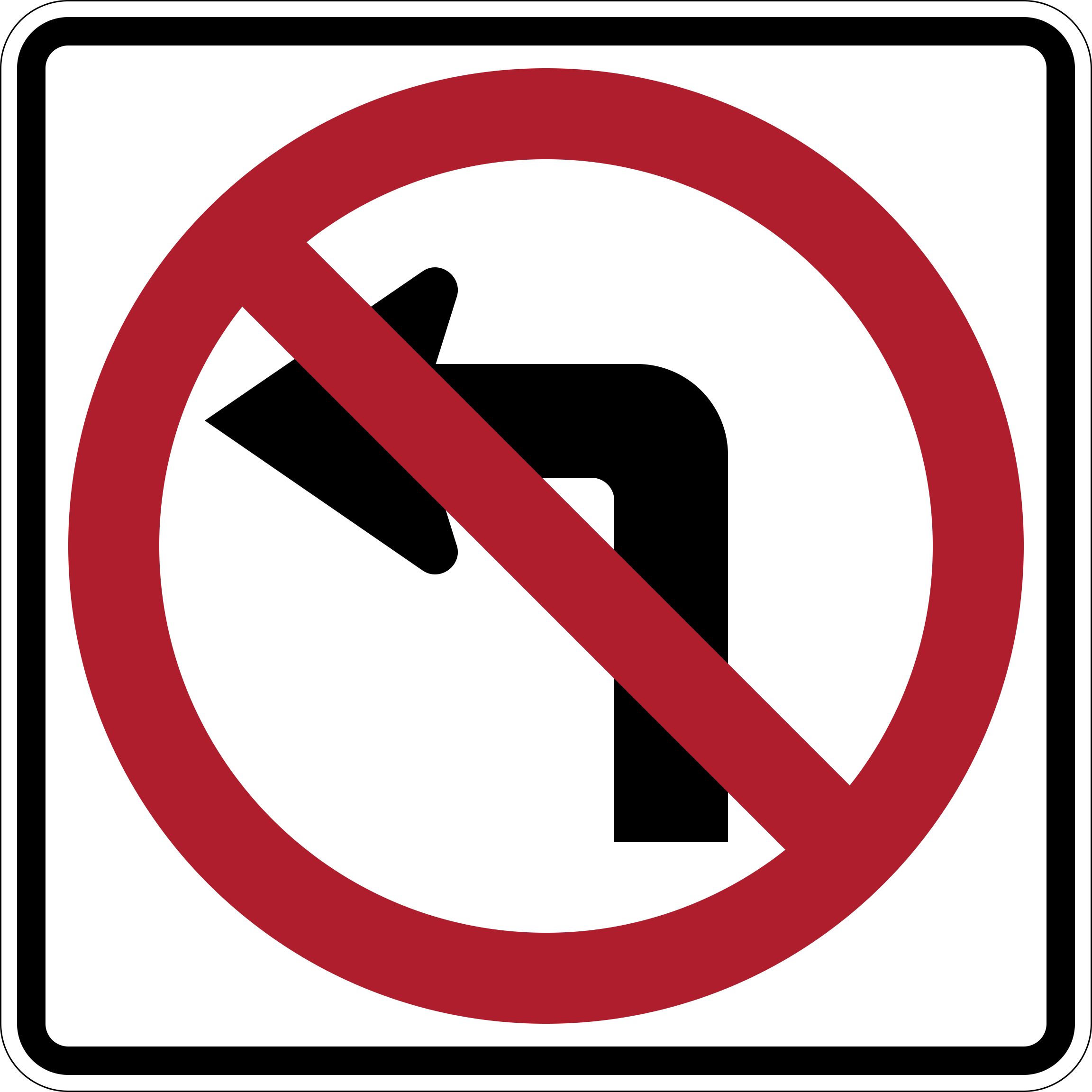
- Left turns are protected only on green
- Left turns are not allowed here
- Only buses may turn left here
- You must make a U-turn instead
Show answer
Left turns are not allowed here. The sign prohibits the movement shown inside the red circle. Because the image shows a left-turn arrow crossed by a red slash, you may not turn left at that location. The protected-green option confuses a prohibition sign with a traffic signal rule. A cue is the slash, not the arrow alone: the arrow names the movement, while the red circle and slash say that movement is forbidden.
New California driver? Insurance is the next step
Once the permit or license is in hand, the family policy changes. QualitySpace is an independent California broker (Kevin Vu, CDI #4037122): teen-driver additions, first-time policies, and multi-car bundles quoted across many carriers in one call.
Get a free quote or call 714-666-6669. English and Vietnamese.
Every question is written from the official California Driver's Handbook. Need paper? Printable CA practice test with answer key.
Last verified 2026-09-08. How we check every question · Study all 500 as flashcards
Frequently asked questions
How many questions are on this California practice test?
This fixed set has 20 questions. It is test 24 of 25 from the 500 question California bank. The real CA exam has 36 questions for applicants 18 and older and 46 for applicants under 18. A passing score is 80%.
What is the passing score for the real California test?
A passing score is 80%. That figure comes from the official California source cited on the DMV facts page.
How does this fixed test relate to the full California bank?
Each numbered test is a fixed set of 20 questions in a fixed order, so you can retake the same test later and compare. Every test mixes road signs and the other topics in about the same proportion as the full bank. Tests 1 to 25 together cover every question in the California bank once. The full practice page mixes the whole bank at random.
Last verified 2026-09-08. See the California DMV facts page for sourced state details.
Return to the full California practice test · Study road signs