
Test 9 of 25 · 20 questions · Free 2026
CA Permit Practice Test 9
Jump to the test ↓A fixed 20 question set from the California bank with answers and plain English explanations. The real CA exam has 36 questions for applicants 18 and older and 46 for applicants under 18. A passing score is 80%. Take the full length version on the main practice page.
Parent of a new California driver? Adding a teen to the family policy changes the price. Get a free quote or call 714-666-6669. English and Vietnamese.
Question 1 of 20 · 0 right so far
All 20 questions in test 9
Every question below comes from the California question bank on this page. Open a question to see the correct answer and the explanation. Nothing here is hidden behind a signup.
1. After driving through floodwater, what should you check?
- Whether the tires gained extra traction
- Whether the horn can be heard from 200 feet
- Whether the brakes work correctly
- Whether the parking brake will hold at highway speed
Show answer
Whether the brakes work correctly. After crossing a flooded road, test your brakes to confirm they work correctly because water can reduce braking performance. The horn-distance choice is a drive-test equipment requirement, not the post-flood safety check. The cue is any water deep enough to reach the wheels; once clear of it, slow down in a safe place and verify braking response before returning to normal speed.
2. Before turning across light rail tracks, what should you do?
- Stop on the tracks until the train operator waves you through
- Turn as soon as your vehicle has a green light, without checking the tracks
- Check for approaching light rail vehicles and turn only when the signal allows it
- Drive beside the train and turn ahead of it if you are faster
Show answer
Check for approaching light rail vehicles and turn only when the signal allows it. California tells drivers to look for light rail vehicles before turning across tracks and to finish the turn only when the traffic light permits it. The green light without checking choice is unsafe because light rail can interrupt signals and may be approaching through a blind spot. A useful cue is seeing rails embedded in the street near an intersection, which should trigger an extra track scan before you steer across.
3. You are turning left on a flashing yellow arrow. What must you do about oncoming traffic?
- Yield to oncoming traffic, then turn with caution
- Turn immediately because the arrow protects you
- Stop and wait for a green arrow
- Turn only if no pedestrians are anywhere nearby
Show answer
Yield to oncoming traffic, then turn with caution. A flashing yellow arrow permits the turn but leaves you unprotected, so oncoming traffic keeps the right-of-way until you find a genuine gap. Creep forward, judge the speed of approaching cars, and complete the turn without forcing anyone to brake. The maneuver mirrors turning left on a solid green ball: legal, but entirely your responsibility to make safely. Oncoming drivers may speed up to beat the yellow, so demand a larger gap than usual.
4. What does a red circle with a red line through it mean?
- The pictured action is recommended
- The circle marks a scenic route
- The sign is decorative only
- The picture shows something you cannot do
Show answer
The picture shows something you cannot do. The red ring-and-slash is the universal prohibition mark, turning any symbol inside into a ban: no U-turn, no trucks, no bicycles, and dozens more. Words may accompany the picture, but the slash alone carries the legal force. Memorizing every variant is unnecessary once you know the grammar: circle plus slash always means the depicted action is forbidden here. Treat every new ring-and-slash sign as a ban first and check the details only once stopped.
5. What are two sets of solid double yellow lines spaced two or more feet apart?
- A passing lane for faster traffic
- A barrier you must not drive over except at designated openings
- A center left turn lane for 200 feet
- A shoulder marking for disabled vehicles
Show answer
A barrier you must not drive over except at designated openings. Two sets of solid double yellow lines spaced at least two feet apart are treated as a barrier. They are not a center left turn lane, which has a broken inner line and a solid outer line on both sides. The cue is two separate double-yellow pairs with space between them. Do not drive on or across that area, and do not make a left turn or U-turn across it except at a marked opening.
6. What does California's Basic Speed Law require?
- Drive faster than traffic when passing is legal
- Always drive exactly at the posted speed limit
- Use the same speed in clear weather and fog
- Never drive faster than is safe for current road conditions
Show answer
Never drive faster than is safe for current road conditions. The Basic Speed Law means the posted limit is not permission to drive too fast for conditions. You may need to slow for weather, road surface, congestion, pedestrians, or bicyclists. Driving exactly at the sign speed can still be unlawful if fog, rain, or crowding makes that speed unsafe. The cue is changing conditions around you. Match speed to what you can see, stop for, and control.
7. Where is parking prohibited near a marked or unmarked crosswalk?
- Within 30 feet, but only at school crossings
- Within 5 feet, unless the vehicle faces traffic
- Within 20 feet, or within 15 feet when a curb extension is present
- Within 100 feet whenever the road has two lanes
Show answer
Within 20 feet, or within 15 feet when a curb extension is present. California prohibits parking close to crosswalks because a parked vehicle can hide pedestrians from approaching drivers. The ordinary distance is within 20 feet of a marked or unmarked crosswalk, reduced to within 15 feet when a curb extension is present. The 30-foot school-only option invents a different condition. A useful cue is any corner crossing area: leave the approach clear so drivers can see people entering the roadway.
8. May you overtake and pass a light rail vehicle or streetcar on its left side in California?
- Yes, whenever it is standing still
- No, whether it is moving or standing, except in a few listed cases
- Yes, if you can complete the pass at 10 mph
- Only when its doors are open
Show answer
No, whether it is moving or standing, except in a few listed cases. The handbook prohibits overtaking and passing a light rail vehicle or streetcar on the left side, whether it is moving or standing. The listed exceptions are narrow: the tracks are so close to the right side that a passenger vehicle cannot pass on the right, you are on a one-way street, or a traffic officer directs you to pass on the left. Standing still and open doors do not create an exception, and the 10 mph figure belongs to passing a bus, streetcar, or trolley stopped at a safety zone or traffic light.
9. An officer has stopped you and has not told you to get out. What should you do?
- Get out so the officer can see you clearly
- Step out and walk back to meet the patrol car
- Leave the vehicle only if it is daylight
- Stay inside the vehicle until the officer directs otherwise
Show answer
Stay inside the vehicle until the officer directs otherwise. California tells drivers to remain inside the vehicle during a law enforcement stop unless the officer directs them to get out. An officer can legally require the driver and all passengers to exit or to stay inside, and if you are told either one, you must do so. Getting out on your own, walking back to the patrol car, or deciding based on daylight are not what the handbook describes. Turn on your right signal, stop in a well lit area when possible, roll down the window, and keep your hands in clear view.
10. What is a limit line?
- A decorative border around crosswalks
- The line where parking must begin
- A wide white line showing where to stop before an intersection or crosswalk
- A lane divider for turning traffic
Show answer
A wide white line showing where to stop before an intersection or crosswalk. The limit line sets the legal stop position so waiting cars leave the crosswalk clear for pedestrians and keep the intersection approach open. Stop behind it; only when no limit line exists do you fall back to stopping before the crosswalk, or before the intersection itself. Creeping past the line blocks pedestrians and can draw a citation even if you stopped.
11. How far from the steering wheel air bag cover should a California driver sit?
- At least 4 inches
- At least 10 inches, while keeping full control of the vehicle
- At least 24 inches, even if pedals are hard to reach
- As close as possible so the bag inflates quickly
Show answer
At least 10 inches, while keeping full control of the vehicle. An air bag inflates with great force, so the handbook says to ride at least 10 inches from the air bag cover, as long as you can still fully control the vehicle. Measure from the center of the steering wheel to your breastbone. If you cannot sit that far back safely, the handbook suggests asking the dealer or manufacturer for advice. Four inches is dangerously close, sitting as close as possible invites injury, and moving so far back that you cannot reach the pedals gives up control.
12. A California driver under 21 is caught with alcohol in the vehicle. How long can law enforcement impound the vehicle?
- Up to 30 days
- Up to 7 days
- Up to 6 months
- It cannot be impounded
Show answer
Up to 30 days. When a driver under 21 is caught with alcohol in the vehicle, law enforcement can impound the vehicle for up to 30 days. Seven days understates the limit and six months overstates it. Saying the vehicle cannot be impounded ignores the rule. The court may also fine the driver and suspend the license for one year, and if the young person has no license yet, the court may ask DMV to delay the first license for up to one year.
13. After a California DUI conviction, which three requirements does the handbook list together?
- Complete a DUI program, file an SR 22/SR 1P certificate, and pay reissue or restriction fees
- Attend traffic school, retake the written test, and replace your license
- Install an interlock, sell the vehicle, and reapply as a new driver
- Pay the fine, wait 30 days, and request a new license by mail
Show answer
Complete a DUI program, file an SR 22/SR 1P certificate, and pay reissue or restriction fees. A DUI conviction triggers a package of consequences that go well beyond the court fine: education through a licensed DUI program, proof of future financial responsibility through the SR 22 or SR 1P certificate, and DMV fees to reissue or restrict the license. Traffic school cannot substitute for the DUI program, and nothing about the process is automatic by mail after 30 days. Interlock devices and vehicle sales apply in specific cases but are not the standard trio. Completing every item matters because the license stays invalid until each requirement clears.
14. At what age can a California resident get a no-fee Senior ID card?
- 55 or older
- 62 or older
- 65 or older
- 70 or older
Show answer
62 or older. California offers a no-fee Senior ID card to anyone 62 years old or older. People of any age who can no longer drive safely because of a physical or mental condition may also be able to trade their license for a no-fee ID card. Fifty five is the age for the Mature Driver Improvement Program, 70 is the age at which renewals must be done in person with a vision test, and 65 is a common guess that the handbook does not use.
15. Parking on the wrong side of the street or on a freeway is allowed only:
- At night when traffic is light
- For vehicles with hazard lights on
- When no legal space exists nearby
- In an emergency, when an officer requires a stop, or where a stop is specifically permitted
Show answer
In an emergency, when an officer requires a stop, or where a stop is specifically permitted. Wrong-side parking forces a driver to cross into oncoming lanes both arriving and leaving, while a freeway stop puts a stationary car beside 65 mph traffic, so California bans both except in three narrow cases. Genuine emergencies, direct orders from law enforcement, and spots where signs specifically permit stopping are the only exceptions. Darkness, flashers, and a shortage of legal spaces never legalize the maneuver. Plan ahead for legal parking, and if an emergency forces you onto a freeway shoulder, get fully off the lanes and call for help.
16. To pass safely near a hill or curve, how far ahead should it be?
- 100 feet ahead
- 500 feet ahead
- One mile ahead
- At least one-third of a mile ahead
Show answer
At least one-third of a mile ahead. A hill or curve hides oncoming traffic until the last moment, so the handbook demands generous sight distance before you commit to the opposing lane. One-third of a mile gives time to see, decide, pass, and return even if another car appears. If the crest or bend is closer than that, stay behind and wait for a straight, clear stretch.
17. During a traffic stop, what should the driver do after stopping and before the officer reaches the vehicle?
- Roll down the window and keep hands visible
- Get out and meet the officer beside the vehicle
- Reach for documents immediately in the glove box
- Keep the radio on so the stop is recorded
Show answer
Roll down the window and keep hands visible. During a law enforcement stop, California says to roll down your window after stopping and before the officer makes contact, and the driver and all passengers should place their hands in clear view before that contact. Stay inside unless the officer directs you to get out, and turn off the radio. Reaching into the glove box before contact takes your hands out of view, and getting out on your own conflicts with the handbook. A cue is the moment after you stop: make the vehicle calm, quiet, and visibly controlled.
18. At this stop sign there is no limit line and no crosswalk. Where must a California driver stop?
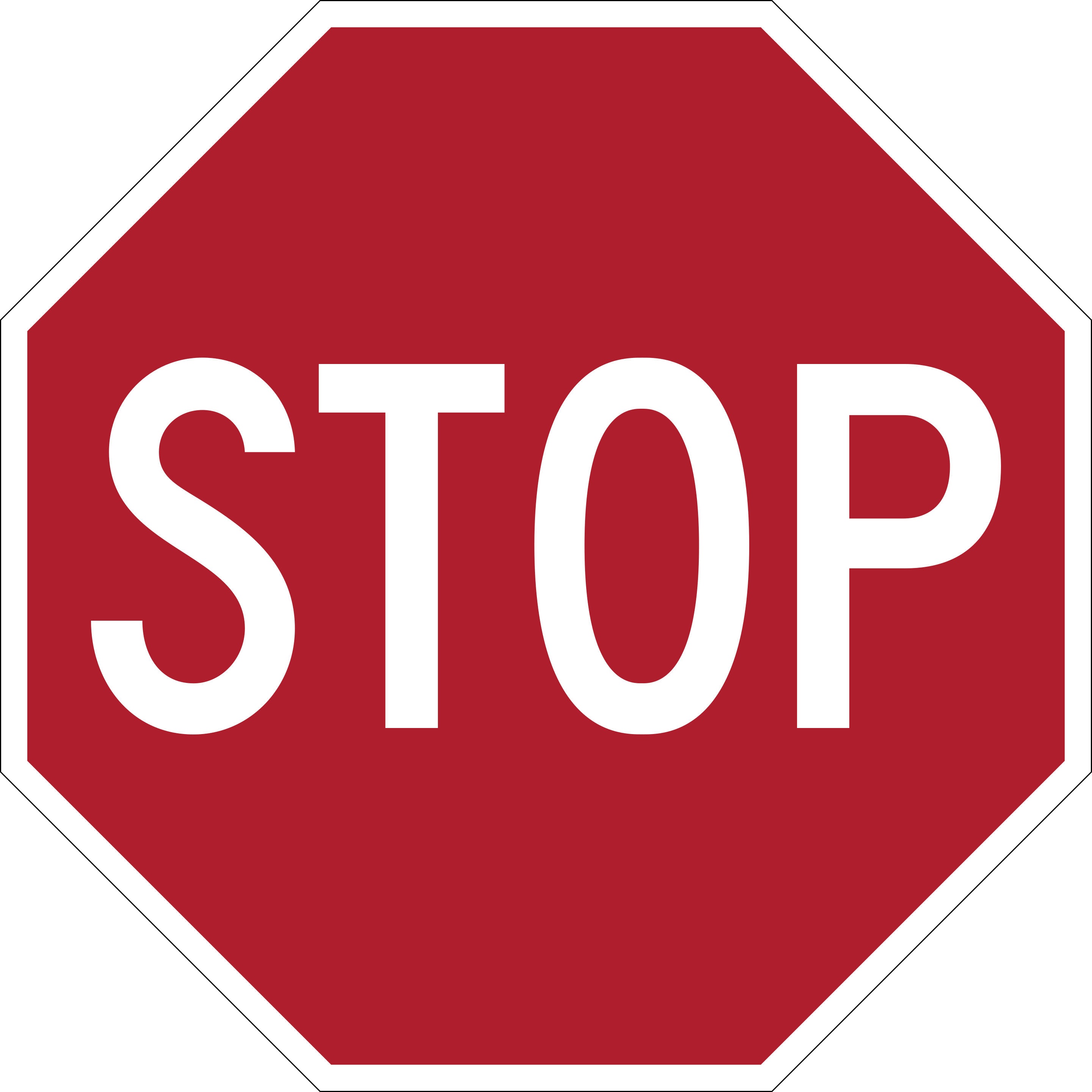
- At the sign post
- Before entering the intersection
- With the front wheels in the intersection for a better view
- Ten feet past the sign
Show answer
Before entering the intersection. A limit line is a wide white line that shows drivers where to stop before an intersection or crosswalk. If there is no limit line, stop before you enter the crosswalk, and if there is no crosswalk either, stop before you enter the intersection. The sign post is not the reference point, and nosing into the intersection puts the vehicle into cross traffic. After stopping, look left, right and left again and go only when it is safe.
19. When may a child graduate to a regular safety belt?
- They must use a rear-facing seat
- They must sit in the front seat
- They may use a properly secured safety belt meeting federal standards
- They need no restraint at all
Show answer
They may use a properly secured safety belt meeting federal standards. Eight years or 4-foot-9 marks the graduation from child restraints to adult belts, provided the belt fits properly across the hips and shoulder. Until then, most children must ride in federally approved child seats in the back. Fit matters more than pride: a poorly fitting belt can injure in a crash. Belt fit across hips and shoulder matters more than the child's pride.
20. You must stop on a freeway. What should you do?
- Park fully off the pavement and stay inside with doors locked until help arrives
- Stop in the travel lane with flashers on
- Walk along the freeway for help
- Leave the car unlocked and hitchhike
Show answer
Park fully off the pavement and stay inside with doors locked until help arrives. A freeway shoulder stop is for genuine emergencies only, and full clearance from the pavement plus locked doors protects against both traffic and strangers. Flashers, dome light at night, and a 511 or call-box call summon proper help. Walking the freeway or flagging rides trades a car problem for a pedestrian fatality risk. Dome lights at night and flashers always help rescuers find you faster.
New California driver? Insurance is the next step
Once the permit or license is in hand, the family policy changes. QualitySpace is an independent California broker (Kevin Vu, CDI #4037122): teen-driver additions, first-time policies, and multi-car bundles quoted across many carriers in one call.
Get a free quote or call 714-666-6669. English and Vietnamese.
Every question is written from the official California Driver's Handbook. Need paper? Printable CA practice test with answer key.
Last verified 2026-09-08. How we check every question · Study all 500 as flashcards
Frequently asked questions
How many questions are on this California practice test?
This fixed set has 20 questions. It is test 9 of 25 from the 500 question California bank. The real CA exam has 36 questions for applicants 18 and older and 46 for applicants under 18. A passing score is 80%.
What is the passing score for the real California test?
A passing score is 80%. That figure comes from the official California source cited on the DMV facts page.
How does this fixed test relate to the full California bank?
Each numbered test is a fixed set of 20 questions in a fixed order, so you can retake the same test later and compare. Every test mixes road signs and the other topics in about the same proportion as the full bank. Tests 1 to 25 together cover every question in the California bank once. The full practice page mixes the whole bank at random.
Last verified 2026-09-08. See the California DMV facts page for sourced state details.
Return to the full California practice test · Study road signs