
Test 21 of 25 · 20 questions · Free 2026
CA Permit Practice Test 21
Jump to the test ↓A fixed 20 question set from the California bank with answers and plain English explanations. The real CA exam has 36 questions for applicants 18 and older and 46 for applicants under 18. A passing score is 80%. Take the full length version on the main practice page.
Parent of a new California driver? Adding a teen to the family policy changes the price. Get a free quote or call 714-666-6669. English and Vietnamese.
Question 1 of 20 · 0 right so far
All 20 questions in test 21
Every question below comes from the California question bank on this page. Open a question to see the correct answer and the explanation. Nothing here is hidden behind a signup.
1. A pedestrian using a white cane is at a crossing. What right-of-way rule applies?
- They have the right-of-way only inside a marked crosswalk
- They may be warned forward with a horn tap
- They must wait for all vehicles to clear first
- They have the right-of-way at all times
Show answer
They have the right-of-way at all times. Pedestrians using white canes or guide dogs have the right-of-way at all times. Be especially careful when turning or backing because they may rely on sound to judge nearby vehicles. The marked-crosswalk choice is too narrow; the handbook gives this rule broadly. A cue is the white cane or guide dog. Do not honk, and do not stop in the middle of the crosswalk where you could force the person into traffic.
2. What is the purpose of a center left-turn lane?
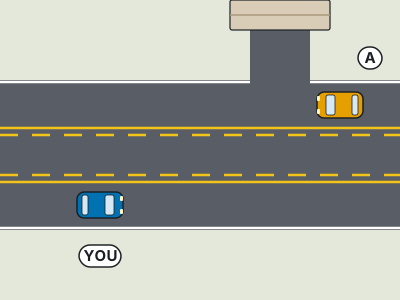
- To begin or finish a left turn or permitted U-turn
- To wait before entering a freeway ramp
- To pass slow traffic before a driveway
- To travel continuously when both through lanes are crowded
Show answer
To begin or finish a left turn or permitted U-turn. A center left-turn lane sits in the middle of a two-way street, and drivers use it to prepare for and make a left turn or a U-turn. It is not a passing lane or a way to bypass congestion. The continuous-travel choice is especially risky because opposing drivers may enter the same lane for their own left turns. Look for the broken inner line and solid outer line on both sides, drive no more than 200 feet in it, and use it only for the turn.
3. You are approaching a hill or curve on a two lane road and cannot see whether other traffic is coming. What does the California handbook say about passing?
- Do not pass, because you cannot see whether traffic is approaching
- Pass quickly so you are back in your lane before the crest or curve
- Pass if you sound your horn before pulling out
- Pass if the vehicle ahead is going below the speed limit
Show answer
Do not pass, because you cannot see whether traffic is approaching. California says not to pass if you are approaching a hill or curve and cannot see whether other traffic is approaching, and it calls this very dangerous on one and two lane roads. To pass safely, the hill or curve should be at least one third of a mile ahead. Speeding up, sounding the horn, or a slow vehicle ahead does not change what you cannot see. Passing is also barred within 100 feet of an intersection, bridge, tunnel, railroad crossing, or other hazardous area.
4. If your vehicle stops working on the freeway, what should you do after pulling onto the right shoulder?
- Stand behind the vehicle to warn traffic
- Walk along the freeway shoulder to find help
- Turn off all lights so traffic will not follow you
- Return to the vehicle and stay belted inside until help arrives
Show answer
Return to the vehicle and stay belted inside until help arrives. After a freeway breakdown, pull to the right shoulder if possible, call for help, and stay inside with your seat belt on until help arrives. Standing behind the vehicle puts you near fast traffic and gives little protection. The cue is a disabled vehicle on a freeway shoulder; use emergency flashers when helpful, enter from the right side if you got out, and avoid walking beside traffic.
5. When driving near bicycles, what does a shared roadway bicycle marking tell drivers?
- Bicycles must leave the roadway at the next corner
- Bicyclists can occupy the lane
- Drivers may pass bicycles in the same lane without changing position
- The lane is reserved only for public transit and bicycles
Show answer
Bicyclists can occupy the lane. A shared roadway bicycle marking warns that a bicyclist may use the travel lane and helps position the rider away from hazards. The same lane passing choice is risky because California tells drivers to leave space and, when needed, change lanes to pass safely. On the road, treat the marking as a cue to scan farther ahead, expect a bicycle near the middle of the lane, and wait until there is enough room before passing.
6. What should you carry if you drive in snowy areas?
- A bag of sand but no chains
- Snow chains of the correct number and type for your vehicle
- Spare windshield wipers only
- A second spare tire
Show answer
Snow chains of the correct number and type for your vehicle. Chains give tires the extra bite that snow and ice take away, and California chain-control areas can require them with no exceptions for unprepared drivers. The handbook stresses carrying the correct number and type for your specific vehicle, because the wrong chains fit poorly and can damage the car or fail when needed. Sand helps with traction in a pinch but does not satisfy chain requirements, while wipers and a second spare solve different problems. Before a mountain trip, confirm the chains fit, practice installing them once in daylight, and check whether chain controls are in effect.
7. What happens to fines in a highway construction or maintenance zone when workers are present?
- Fines are waived for first offenses
- Fines stay the same as elsewhere
- Only the driver, not the owner, is fined
- Fines are doubled when workers are present
Show answer
Fines are doubled when workers are present. Doubled fines reflect the deadly record of work-zone crashes, where laborers on foot have no protection whatsoever from passing traffic. The same doubling applies in designated Safety Enhanced-Double Fine Zones because of their history of collision injuries and deaths. Through any cone zone, slow down early, move over where possible, obey flaggers and posted limits, and give workers the widest berth the lane allows.
8. Where may a bicyclist ride on a one-way street?
- Near the left curb or edge of the street
- In the exact center of the road
- Against traffic on the right side
- On the sidewalk only
Show answer
Near the left curb or edge of the street. One-way streets free cyclists from the keep-right default since no oncoming traffic threatens the left side. Riding the left edge keeps clear of right-side parking maneuvers and turning cars. The choice belongs to the cyclist based on safety: either edge is legal, but the center of a shared lane invites dangerous same-lane passing. Either edge is legal, so cyclists should pick whichever side looks safest.
9. How far and how close to the curb should you back in a straight line?
- One car length, hugging the curb exactly
- Ten car lengths at highway speed
- Any distance without looking back
- Three vehicle lengths, staying within three feet of the curb
Show answer
Three vehicle lengths, staying within three feet of the curb. The test-standard maneuver keeps the car tracking straight and tight to the curb so it never wanders into traffic. Before rolling, run the full setup: traffic check with blind spots, signal on before pulling to the curb, mirror plus over-shoulder check, then back smoothly while watching behind. Stay aware of everything behind you the whole way, since backing has the worst visibility of any maneuver.
10. If another vehicle merges too closely in front of you, what should you do?
- Flash high beams until the driver speeds up
- Tap the bumper to warn the other driver
- Move onto the shoulder and pass immediately
- Ease off the accelerator to create space
Show answer
Ease off the accelerator to create space. When a vehicle cuts into your following space, California recommends taking your foot off the accelerator to rebuild the gap ahead. Flashing high beams or passing on the shoulder adds conflict and does not create a safe cushion. The cue is a car merging so close that your three second distance disappears; respond by smoothly reducing speed rather than braking sharply or challenging the other driver.
11. What does a yellow and black circular or X-shaped sign warn you about?
- A hospital driveway ahead
- A lane reserved for carpools
- An approaching railroad crossing
- A mandatory detour around a work zone
Show answer
An approaching railroad crossing. California uses yellow and black circular or X-shaped signs to warn that you are approaching a railroad crossing. The carpool lane choice describes HOV signs and diamond pavement markings, not this rail warning. The cue is the round advance sign or crossbuck style X near tracks; begin looking and listening, reduce speed, and be ready to stop before the crossing if a train or warning device appears.
12. What is the striped crosshatched area next to a disabled parking space for?
- It must be kept clear; parking there is prohibited
- It is extra parking for compact cars
- Motorcycles may park there
- It marks a loading zone
Show answer
It must be kept clear; parking there is prohibited. The diagonal-striped access aisle gives wheelchair users and lift-equipped vans the side room to deploy ramps and transfer safely. Parking in it, even partially or on a motorcycle, seals off the adjacent accessible stall and strands someone who cannot simply squeeze through. It is never overflow parking for small vehicles and never a loading zone. Keep the entire striped area empty, leave the accessible stall itself for placard holders, and report violators rather than squeezing your own vehicle into leftover striped inches.
13. In California, when may a driver turn left against a red light?
- From any street onto a one-way street after stopping.
- From a two-way street onto a divided highway.
- From a one-way street onto a one-way street, after stopping and yielding, if no sign prohibits it.
- From a left turn lane whenever cross traffic has stopped.
Show answer
From a one-way street onto a one-way street, after stopping and yielding, if no sign prohibits it.. California's left on red permission is narrow. It applies only when you turn from a one-way street onto a one-way street and no sign prohibits the turn. A red light still means stop first, then yield to other vehicles, pedestrians, or bicyclists who have a green light, look both ways, and turn when it is safe. Turning from a two-way street, or onto a divided highway, goes beyond what the handbook allows. If either street is not one-way, or a sign says not to turn, wait for a green signal.
14. May you drive a car so overloaded you cannot control it or see around you?
- Only if the load falls off
- Never, if you cannot control the car or see ahead and to the sides
- Only on freeways
- Only at night
Show answer
Never, if you cannot control the car or see ahead and to the sides. An overloaded car steers, brakes, and sees worse in every direction, turning the driver into a hazard for everyone nearby. The handbook bans driving in this state outright rather than waiting for the load to shift or spill. Redistribute weight, remove excess cargo, or make two trips before entering traffic. Make two trips or shed weight before entering traffic with an unsafe load.
15. How must a motorized bicycle rider treat other bicyclists?
- Use caution around bicyclists and travel at a reasonable, safe speed
- Ride as fast as the engine allows
- Weave between bicycles closely
- Ignore bicyclists entirely
Show answer
Use caution around bicyclists and travel at a reasonable, safe speed. Motorized bicycles split the difference between bikes and motorcycles, sharing lanes with pedal cyclists who cannot match their pace. Reasonable speed and a wide berth keep the speed mismatch from becoming sideswipes. Endangering other bicyclists with aggressive moped riding violates the same rule that protects the rider. Wide berths and moderate speed keep the pace mismatch from causing sideswipes. Aggressive moped riding around cyclists violates the protective rule itself.
16. A driver is convicted of DUI for the first time, with nobody injured. Which set of consequences does the handbook describe?
- A fine only, with no possibility of jail
- A written warning for a first offense
- Up to six months in jail, a fine, and possible impound of the vehicle
- License suspension with no other penalty
Show answer
Up to six months in jail, a fine, and possible impound of the vehicle. California lists several penalties that can follow a DUI conviction: a jail sentence of up to six months, a fine, and impound of the vehicle by law enforcement with a storage fee to pay. A conviction is not treated as a warning, and jail is possible even without an injury. Causing serious injury or death while impaired also opens the driver to civil lawsuits. On top of that, DMV suspends or revokes the driving privilege for one year, and the driver must complete a DUI program, file an SR 22 or SR 1P, and may need an ignition interlock device.
17. You are in a collision and do not have proper insurance coverage. What happens to your driving privilege?
- Nothing, provided the other driver caused the collision
- It can be suspended for up to four years, whoever was at fault
- It is suspended only if you are found at fault
- It is suspended for thirty days and then restored
Show answer
It can be suspended for up to four years, whoever was at fault. California suspends the driving privilege for up to four years when a driver is in a collision without proper insurance coverage, and the handbook is explicit that fault does not matter. Being the blameless party is no protection, and a short thirty day suspension is not the rule. There is a route back: during the last three years of the suspension you can get your license back by providing a California Insurance Proof Certificate, the SR 22 or SR 1P, and maintaining it during that period. Carry proof of financial responsibility whenever you drive.
18. What movement does this sign prohibit?
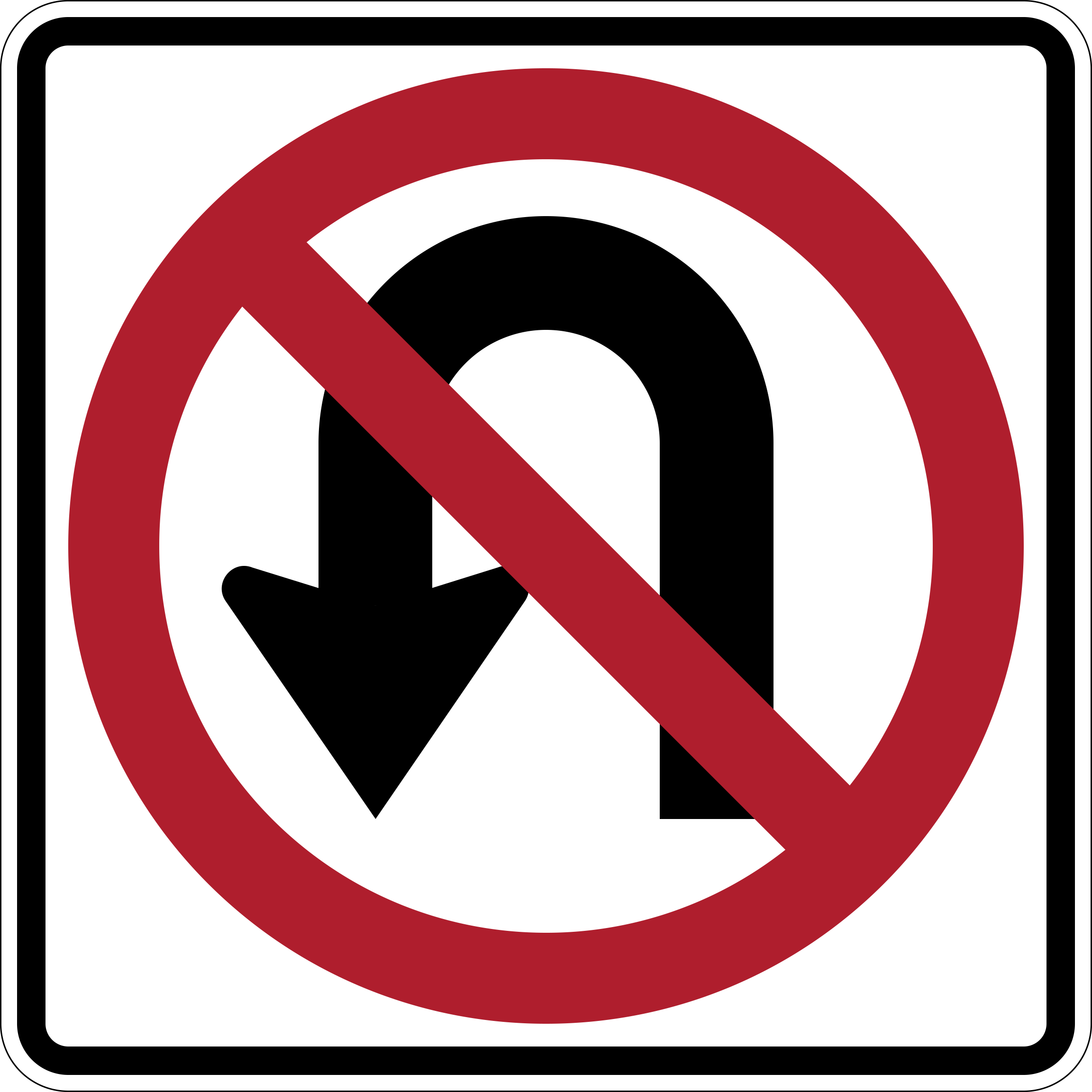
- A left turn only
- A right turn only
- A U-turn
- A lane change
Show answer
A U-turn. A red circle with a red slash means the pictured movement is not allowed. On this sign, the U-shaped arrow is crossed out, so a U-turn is prohibited at that location. The left-turn choice is wrong because the symbol is not a simple left arrow. A cue is the exact picture inside the circle: identify the movement shown, then understand that the red slash cancels that movement.
19. After moving, how soon must you notify DMV of your new California address?
- Within five days
- Within ten days
- Within 20 days
- When your license next expires
Show answer
Within ten days. A California driver who moves must notify DMV of the new address within ten days. Waiting until renewal is too late because DMV needs a current mailing address on record for notices and licensing matters. The five-day choice may sound familiar from vehicle sale reporting, but address changes use ten days. A cue is any move, even within California: submit the change online or by mail promptly.
20. Where must an open alcohol container be kept in an ordinary passenger vehicle?
- On the rear floor as long as the cap is attached
- In the glove box if the driver is sober
- In the trunk or another area where passengers do not sit
- Anywhere outside the driver's reach
Show answer
In the trunk or another area where passengers do not sit. An opened alcohol container cannot be kept in the passenger area of an ordinary vehicle. It must go in the trunk or another place where passengers do not sit. The glove-box choice is specifically wrong because the handbook says an open alcohol container may not be kept there. A clear cue is the broken seal: once the container is open, move it out of the seating area before driving.
New California driver? Insurance is the next step
Once the permit or license is in hand, the family policy changes. QualitySpace is an independent California broker (Kevin Vu, CDI #4037122): teen-driver additions, first-time policies, and multi-car bundles quoted across many carriers in one call.
Get a free quote or call 714-666-6669. English and Vietnamese.
Every question is written from the official California Driver's Handbook. Need paper? Printable CA practice test with answer key.
Last verified 2026-09-08. How we check every question · Study all 500 as flashcards
Frequently asked questions
How many questions are on this California practice test?
This fixed set has 20 questions. It is test 21 of 25 from the 500 question California bank. The real CA exam has 36 questions for applicants 18 and older and 46 for applicants under 18. A passing score is 80%.
What is the passing score for the real California test?
A passing score is 80%. That figure comes from the official California source cited on the DMV facts page.
How does this fixed test relate to the full California bank?
Each numbered test is a fixed set of 20 questions in a fixed order, so you can retake the same test later and compare. Every test mixes road signs and the other topics in about the same proportion as the full bank. Tests 1 to 25 together cover every question in the California bank once. The full practice page mixes the whole bank at random.
Last verified 2026-09-08. See the California DMV facts page for sourced state details.
Return to the full California practice test · Study road signs