
Test 25 of 25 · 20 questions · Free 2026
CA Permit Practice Test 25
Jump to the test ↓A fixed 20 question set from the California bank with answers and plain English explanations. The real CA exam has 36 questions for applicants 18 and older and 46 for applicants under 18. A passing score is 80%. Take the full length version on the main practice page.
Parent of a new California driver? Adding a teen to the family policy changes the price. Get a free quote or call 714-666-6669. English and Vietnamese.
Question 1 of 20 · 0 right so far
All 20 questions in test 25
Every question below comes from the California question bank on this page. Open a question to see the correct answer and the explanation. Nothing here is hidden behind a signup.
1. When is stopping or parking on a freeway allowed?
- For a phone call if you keep your hazard lights on
- In an emergency or when a law enforcement officer requires it
- Any time the shoulder is wider than your vehicle
- Only during daylight outside commute periods
Show answer
In an emergency or when a law enforcement officer requires it. Freeway stopping or parking is generally illegal, with exceptions such as an emergency, a law enforcement requirement, or a specifically permitted stop. The phone-call choice is not an emergency and leaves you exposed to freeway-speed traffic. The cue is the freeway setting itself; unless a real emergency or official direction exists, continue to an exit or another lawful stopping place.
2. You see a collision or hazard ahead on a California road. How does the handbook say to warn drivers behind you?
- Turn on the emergency flashers or lightly tap the brake pedal three or four times
- Sound the horn repeatedly
- Swerve slightly to draw attention
- Turn on the high beams
Show answer
Turn on the emergency flashers or lightly tap the brake pedal three or four times. When you can see a collision or hazard ahead, the handbook lists three ways to warn drivers behind you: turn on your emergency flashers, lightly tap your brake pedal three or four times, or use a hand signal when slowing and stopping. Each of these is aimed at the traffic behind you. Sounding the horn, swerving, and switching on high beams are not on the list. If you must stop because of vehicle trouble, turn on the flashers, and if the vehicle has none, use your turn signals instead.
3. What does California law say about throwing a lit cigarette from a vehicle?
- It is allowed if the road has no dry brush nearby.
- It is allowed from a stopped vehicle only.
- It is illegal to throw a flaming or glowing substance from the vehicle.
- It is illegal only inside city limits.
Show answer
It is illegal to throw a flaming or glowing substance from the vehicle.. California prohibits throwing a cigarette, cigar, or any other flaming or glowing material from a vehicle. That rule is not limited to dry rural areas, so the brush-related option narrows the law incorrectly. Treat anything lit as a fire hazard before it leaves the vehicle. A practical cue is simple: if the object is burning, glowing, or could ignite debris after landing, keep it inside until you can dispose of it safely.
4. At a pedestrian signal, what does a steady raised hand mean?
- You may cross after checking for turning vehicles
- You may not cross the street
- You should hurry because the light will change soon
- You may cross only in a marked crosswalk
Show answer
You may not cross the street. A steady raised hand is the pedestrian signal telling you not to cross the street. The hurry choice belongs more closely to a flashing hand for pedestrians already in the roadway, but a steady hand means do not begin. A practical cue is the solid hand icon at the far side of the intersection; wait at the curb until the walk or walking person signal appears.
5. A 17-year-old in California fails the knowledge test on a Monday. How long must they wait before retaking it?
- They may retest the same day
- 24 hours
- 30 days
- Seven days, not counting the day of the failure
Show answer
Seven days, not counting the day of the failure. California makes a minor who fails the knowledge test wait seven days before trying again, and the day of the failure does not count toward that week. A same day retest and a 24 hour wait are both too short for an applicant under 18. Thirty days is not a knowledge test waiting period the handbook gives. Keep this separate from the drive test: a minor who fails the behind the wheel test waits 14 days instead. Applicants get three attempts at the knowledge test before they must reapply.
6. Why must you never start your vehicle inside the garage with the door closed?
- The engine will overheat within seconds
- Exhaust fumes will stain the garage walls
- The noise can damage your hearing permanently
- Carbon monoxide from the exhaust is a deadly odorless gas
Show answer
Carbon monoxide from the exhaust is a deadly odorless gas. Every gas-powered vehicle produces carbon monoxide, which you cannot see or smell, so a closed garage gives no warning before the gas reaches dangerous levels. Poisoning symptoms such as tiredness, dizziness, and nausea can look like ordinary fatigue, which makes the danger easy to miss until it is too late. Overheating, stains, and noise are minor or imaginary concerns next to a gas that can kill in minutes. Always open the garage door fully before starting the engine, and never leave a vehicle running in an enclosed space.
7. Rain has made a California road wet. How much should you reduce your speed?
- By 5 to 10 mph
- By half
- To no more than 5 mph
- No change is needed below the limit
Show answer
By 5 to 10 mph. For a wet road, the California handbook says to reduce your speed by 5 to 10 mph and to allow more space behind the vehicle ahead. Cutting speed by half is the guidance for packed snow, and slowing to no more than 5 mph is the guidance for ice, so those choices match harsher surfaces. Staying at the posted limit ignores the longer stopping distance on wet pavement; the limit is set for good conditions, not rain.
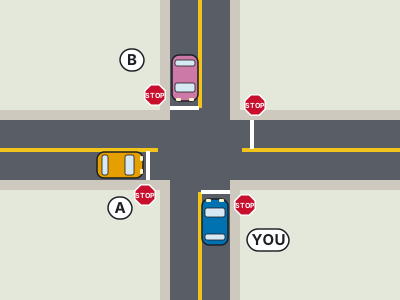
8. At a four-way stop, who has the right-of-way when vehicles arrive at different times?
- The vehicle with the brightest headlights
- The vehicle on the widest road
- The driver making a right turn
- The vehicle that arrives first
Show answer
The vehicle that arrives first. California's right-of-way rule begins with arrival order: the vehicle that arrives at the intersection first has the right-of-way. When there is a stop sign on all four corners, the handbook says to stop first and then proceed by that same rule, and if two road users arrive at the same time, yield to the one on your right. Headlights, road width, and turn direction do not decide who goes first. Still yield to pedestrians, who always have the right-of-way at intersections.
9. What is the first listed action if your vehicle starts to skid?
- Brake hard until the wheels lock
- Slowly remove your foot from the accelerator
- Turn sharply away from the skid
- Shift immediately into park
Show answer
Slowly remove your foot from the accelerator. When a skid starts on a slippery surface, California's first listed step is to slowly remove your foot from the accelerator. The next steps are not to use the brakes, to turn the steering wheel in the direction of the skid, and to try to get a wheel on dry pavement. Braking hard and turning sharply away from the skid go against those steps, and shifting into park is not on the list. To prevent skids, slow down before intersections and curves and avoid fast turns and quick stops.
10. May a passenger drink beer in a car traveling on a California road?
- Yes, passengers may not drink alcohol in a moving car
- Yes, but only beer is allowed
- No, passengers may drink freely
- No, unless the driver is also drinking
Show answer
Yes, passengers may not drink alcohol in a moving car. The open-container law binds everyone inside the car, not just the person steering. A passenger sipping beer violates the same sentence that bans the driver from drinking, and officers can cite any occupant. The narrow exemptions cover passengers in buses, taxis, campers, and motorhomes, never in ordinary cars, trucks, or SUVs on the road. Officers may cite drivers and passengers alike for open containers found in the car.
11. Double solid white lines separate your lane from the carpool lane beside it. What do those lines tell you?
- You may cross whenever traffic in your lane slows down
- They are a barrier you may not cross to change lanes
- You may cross only during posted carpool hours
- They mark the edge of the roadway shoulder
Show answer
They are a barrier you may not cross to change lanes. Two solid white lines mark a barrier between a regular lane and a preferential lane, and drivers may not change lanes across them. Congestion in your own lane does not create an exception, and the posted hours govern who may occupy the carpool lane, not where you may enter it. These lines also appear near freeway on and off ramps for the same reason. Enter and leave a carpool lane only at the designated openings, where the solid lines give way to a dashed segment or a gap in the striping.
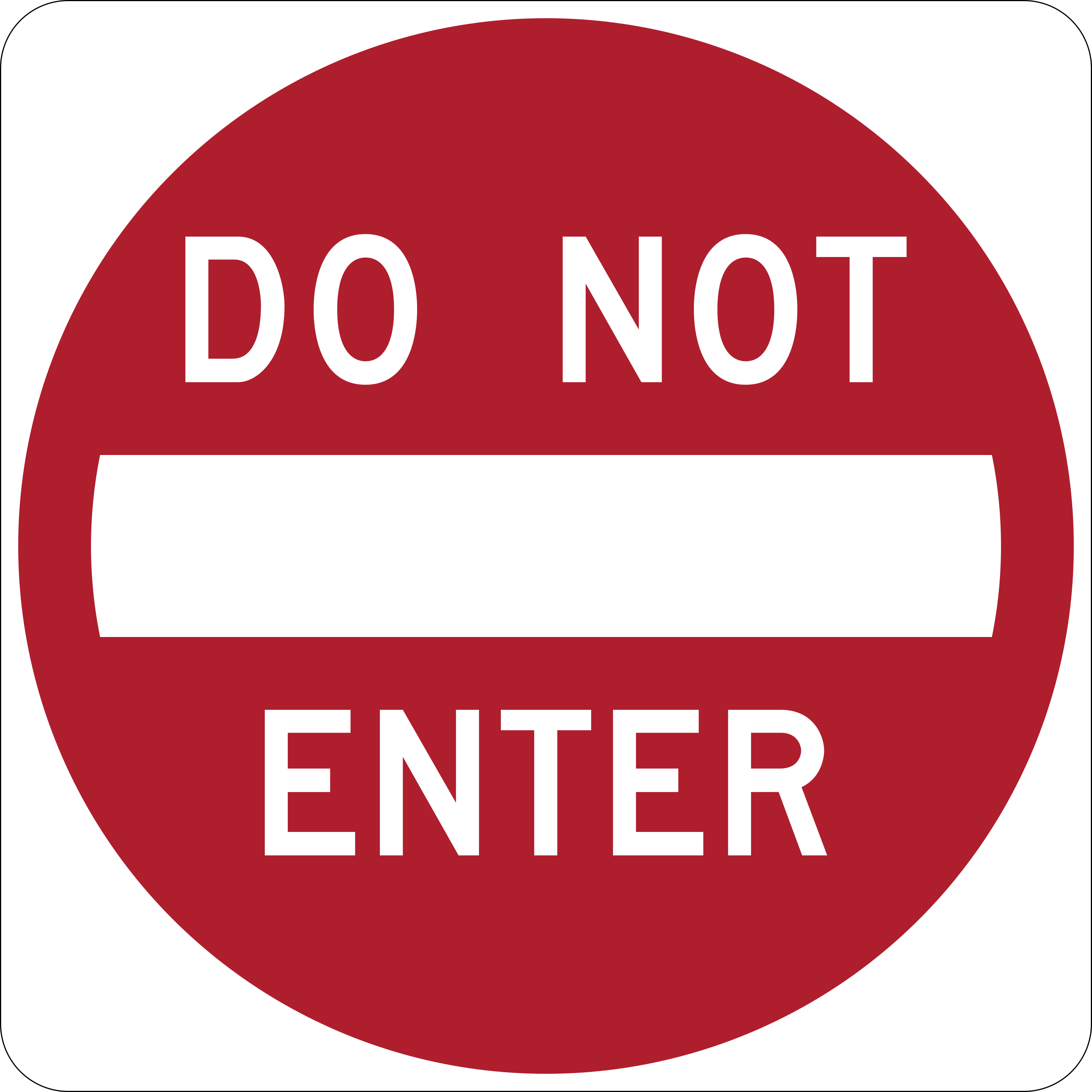
12. What does this DO NOT ENTER sign tell you?
- The road may be entered after stopping
- Only trucks are barred from the ramp
- Do not enter the road or ramp where it is posted
- The lane is closed only during rush hour
Show answer
Do not enter the road or ramp where it is posted. A DO NOT ENTER sign is a regulatory sign that bars entry to the road or ramp where it stands. Stopping first does not make entry legal. The trucks-only choice adds a limitation the sign does not contain. A cue is the red-and-white sign facing you at a ramp or roadway entrance. Treat it as a hard prohibition and choose another legal route before reaching opposing traffic.
13. If the Freeway Service Patrol cannot start your car, where will it be towed?
- To your home, free of charge
- To a CHP-approved location, free of charge
- To any shop you name
- Nowhere; FSP never tows
Show answer
To a CHP-approved location, free of charge. When roadside repair fails, FSP's free tow moves the car only as far as the nearest CHP-approved drop, where CHP then contacts your auto club or a tow company for the rest of the journey. Home delivery and shop-of-choice tows remain private business. The program's mission is clearing the freeway fast, not replacing commercial towing. Your auto club or a private tow company handles the rest of the journey from there.
14. With a California instruction permit, who must practice driving with you before your license test?
- Any licensed driver who has held a license for 6 months.
- A parent or guardian only.
- A California-licensed driver who is at least 18, or 25 for minors.
- A licensed passenger of any age if the route avoids freeways.
Show answer
A California-licensed driver who is at least 18, or 25 for minors.. To get a license after an instruction permit, the handbook says to practice with a California-licensed driver at least 18 years old, with the supervising age rising to 25 for minors. The parent-only choice is too narrow; a qualified licensed adult can supervise, and for minors that adult must meet the higher age requirement. The cue is the permit holder's age. Adults use the 18-year threshold, while minors need the 25-year supervising driver.
15. When you are arrested for DUI, what does the officer do with your driver license?
- Take your license and give you a 30-day temporary license
- Let you keep your license until trial
- Issue a warning and release you
- Suspend your registration instead
Show answer
Take your license and give you a 30-day temporary license. Under Administrative Per Se, the license action starts at the moment of arrest rather than waiting for a conviction: the officer confiscates the plastic card and hands back a temporary license good for 30 days. That temporary window is when the driver must request the 10-day DMV hearing to contest the coming suspension. No warning option exists at a DUI arrest, and refusal brings separate penalties.
16. How close may you park to a fire station driveway in California?
- Within 5 feet is allowed
- Within 10 feet is allowed
- You must stay at least 15 feet away
- Within 25 feet is allowed
Show answer
You must stay at least 15 feet away. Fire crews need a clear swing path to roll engines out of the station driveway at any hour, so California keeps parked cars 15 feet back on either side. The same 15-foot rule protects fire hydrants, and both exist because seconds lost to a blocked exit can cost lives. Five or ten feet still traps a turning fire engine, while 25 feet overstates the rule and wastes legal parking. When in doubt near any emergency access point, leave more room than the minimum and never block the driveway itself.
17. Why must you give turning trucks extra room?
- They turn tighter than cars
- They never need extra room
- They always stay in one lane
- They must often swing wide, so watch their signals and give room
Show answer
They must often swing wide, so watch their signals and give room. Long wheelbases drag the trailer across adjacent lanes and curbs through tight turns, forcing drivers to swing wide before committing. Cars that squeeze alongside or pass on the turning side get crushed in the gap. Hang back, read the truck's signals rather than its position, and never block the swing zone. Never block the swing zone or pass on the truck's turning side.
18. After a collision in which someone is hurt, a driver leaves without stopping. What is that called and how seriously is it treated?
- A minor infraction if the damage looks small
- A reportable incident with no criminal exposure
- A civil insurance matter only
- A hit-and-run, which carries severe punishment on conviction
Show answer
A hit-and-run, which carries severe punishment on conviction. Failing to stop or leaving the scene of an accident is called a hit-and-run, and the handbook says the punishment is severe if you are convicted. It is not a minor infraction, a simple report, or only an insurance question, and small looking damage does not change that. Stopping is the first duty in any collision because someone could be injured and need your help. Call 911 right away if anyone is hurt, and show your license, registration, insurance information, and current address to the others involved.
19. A judge offers traffic violator school for your one-point ticket. What does it do?
- Pay double the fine instead
- Lose the license automatically
- Attend traffic violator school to keep it off the insurance record
- Ignore the ticket safely
Show answer
Attend traffic violator school to keep it off the insurance record. Judges may offer school for eligible one-point violations, letting drivers trade classroom hours for insurance protection. The conviction stays on the DMV record and counts toward negligent-operator totals, but insurers never see it. The offer comes roughly once per 18 months, so spend it on the costliest ticket. Spend the roughly once-in-18-months offer on the costliest eligible ticket. The DMV record keeps the point toward negligent-operator totals regardless.
20. A pedestrian using a wheelchair is crossing. How should a driver treat that person?
- As a pedestrian or vulnerable road user
- As a slow vehicle that must yield
- As a bicyclist only in a marked lane
- As traffic only when using a motor
Show answer
As a pedestrian or vulnerable road user. California includes a person with a disability using a wheelchair for transportation among pedestrians or vulnerable road users. Calling the wheelchair a slow vehicle is wrong because pedestrian right-of-way and crossing duties still apply. The cue is the person crossing the roadway, not whether the chair is manual or electric. Reduce speed or stop as needed so the person can finish crossing safely.
New California driver? Insurance is the next step
Once the permit or license is in hand, the family policy changes. QualitySpace is an independent California broker (Kevin Vu, CDI #4037122): teen-driver additions, first-time policies, and multi-car bundles quoted across many carriers in one call.
Get a free quote or call 714-666-6669. English and Vietnamese.
Every question is written from the official California Driver's Handbook. Need paper? Printable CA practice test with answer key.
Last verified 2026-09-08. How we check every question · Study all 500 as flashcards
Frequently asked questions
How many questions are on this California practice test?
This fixed set has 20 questions. It is test 25 of 25 from the 500 question California bank. The real CA exam has 36 questions for applicants 18 and older and 46 for applicants under 18. A passing score is 80%.
What is the passing score for the real California test?
A passing score is 80%. That figure comes from the official California source cited on the DMV facts page.
How does this fixed test relate to the full California bank?
Each numbered test is a fixed set of 20 questions in a fixed order, so you can retake the same test later and compare. Every test mixes road signs and the other topics in about the same proportion as the full bank. Tests 1 to 25 together cover every question in the California bank once. The full practice page mixes the whole bank at random.
Last verified 2026-09-08. See the California DMV facts page for sourced state details.
Return to the full California practice test · Study road signs