
Test 23 of 25 · 20 questions · Free 2026
CA Permit Practice Test 23
Jump to the test ↓A fixed 20 question set from the California bank with answers and plain English explanations. The real CA exam has 36 questions for applicants 18 and older and 46 for applicants under 18. A passing score is 80%. Take the full length version on the main practice page.
Parent of a new California driver? Adding a teen to the family policy changes the price. Get a free quote or call 714-666-6669. English and Vietnamese.
Question 1 of 20 · 0 right so far
All 20 questions in test 23
Every question below comes from the California question bank on this page. Open a question to see the correct answer and the explanation. Nothing here is hidden behind a signup.
1. A collision blocks the road ahead and you are not involved. What should you do?
- Stop to watch and take photos
- Slow down to stare at the scene
- Follow the ambulance closely
- Avoid the area so help reaches victims faster
Show answer
Avoid the area so help reaches victims faster. Gawking queues block lanes that fire trucks and ambulances need, and staring drivers rear-end the car ahead. The handbook's advice is blunt: stay away when possible so other vehicles do not choke the scene. If you must pass, keep moving, watch the road, and never stop in the travel lanes. Keep moving past the scene and watch the road, never the wreckage.
2. You signed a citation promising to appear in traffic court, then missed the date. What can DMV do?
- Nothing, because court attendance is not a DMV matter
- Cancel the citation after a waiting period
- Convert the charge into a written warning
- Suspend your driving privilege until you appear
Show answer
Suspend your driving privilege until you appear. Signing a ticket is a promise to appear, and breaking it lets DMV suspend your driving privilege until you do appear. The failure to appear also goes onto your driver record, so ignoring the date makes the situation worse rather than letting it lapse. The charge is not downgraded to a warning, and the citation does not expire on its own. The suspension follows from the missed promise, not the original violation, and any conviction that follows is also reported by the court to DMV.
3. How far before a turn should you begin signaling on a street?
- Only after entering the intersection
- At least 100 feet before turning
- At least 25 feet before turning
- Exactly one block before every turn
Show answer
At least 100 feet before turning. California tells drivers to start the turn signal at least 100 feet before the turn. Waiting until the intersection gives drivers, pedestrians, and bicyclists too little time to understand your movement. The one-block option can be too early or too vague depending on the street. Use the distance cue: begin signaling early enough that nearby traffic can see your plan before you brake or move toward the curb.
4. What following distance rule does California recommend to avoid tailgating?
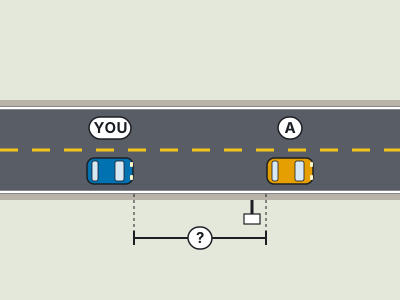
- Use a three-second gap behind the vehicle ahead
- Stay one car length back at any speed
- Keep two seconds only on freeways
- Follow closely so others cannot merge
Show answer
Use a three-second gap behind the vehicle ahead. California recommends the three-second rule as the basic following distance for normal driving. One car length at any speed is unreliable because stopping distance grows as speed rises. A close following position also blocks your view and removes reaction time if the driver ahead brakes hard. Pick a roadside marker, count after the vehicle ahead passes it, and adjust until at least three seconds separate your vehicles.
5. A driver uses their car to run from officers who are performing their duties. How does California classify that?
- A misdemeanor punishable by up to one year in county jail
- An infraction carrying a fine only
- A civil penalty assessed by DMV
- No offense unless a collision results
Show answer
A misdemeanor punishable by up to one year in county jail. Using a motor vehicle to flee or to try to evade law enforcement on duty is a misdemeanor, punishable by imprisonment in a county jail for a year or less. It is a criminal matter, not a fine or an administrative penalty handled by DMV, and no collision is needed for the offense to be complete. The exposure grows sharply if the pursuit hurts someone: up to seven years in state prison for serious bodily injury. If an officer signals you to stop, turn on your right turn signal, move to the right shoulder, and stop.
6. A flashing raised hand appears while you are waiting at a crosswalk. What should you do?
- Begin crossing if the countdown shows enough seconds
- Do not start crossing
- Cross diagonally only
- Step into the street and wait on the centerline
Show answer
Do not start crossing. A flashing raised hand means pedestrians should not start across because the traffic signal is about to change. The countdown choice is wrong for someone still waiting, since the number tells how much crossing time remains for people already using the crosswalk. The cue is the hand symbol flashing before you leave the curb: stay out of the roadway and wait for the next walk indication.
7. Scooters, neighborhood electric vehicles, and golf carts share your road. What must you do?
- Honk until they pull over
- Pass them on the shoulder
- Adjust your speed to share the road with them
- Follow closely to push them faster
Show answer
Adjust your speed to share the road with them. Scooters, NEVs, and golf carts are legal slow traffic on their designated public roads, not obstacles to bully aside. Their small size and low speed demand patience: slow early, pass only where legal with full clearance, and expect sudden stops. Crowding or honking at these vulnerable road users causes exactly the panicked swerves that end in crashes. Never pressure them with tailgating or honking; their limits are legal and mechanical.
8. Your vehicle stalls on railroad tracks. No train is coming and the warning lights are not flashing. After exiting, what should you do?
- Stay inside with your seatbelt fastened
- Try to restart the engine until it moves
- Push the vehicle off the tracks alone
- Exit, then dial the number on the crossing posts or control box
Show answer
Exit, then dial the number on the crossing posts or control box. With no train coming and no lights flashing, there is time to call the railroad's emergency number posted at the crossing so trains can be stopped. Staying belted inside a vehicle on live tracks gambles everything on restarting in time. If a train does appear, the rule changes: abandon the vehicle and run diagonally away from the tracks in the direction the train is coming from.
9. What does California law say about drinking alcohol while riding as a passenger in a vehicle?
- It is illegal while riding as a passenger.
- It is allowed if the driver is sober.
- It is allowed in the front seat only.
- It is illegal only for passengers under 21.
Show answer
It is illegal while riding as a passenger.. California bars drinking alcohol, and smoking or eating cannabis products, while driving or riding as a passenger in a vehicle. The sober-driver option is wrong because the passenger conduct is prohibited separately. The handbook lists narrow exceptions for passengers in a bus, taxi, camper, or motorhome, but not for an ordinary moving car. The cue is an open container or active use inside the passenger area: keep alcohol and cannabis sealed and unopened during the ride.
10. After a collision, what information must you show to the other driver and others involved?
- Only your license plate number and phone number.
- Driver's license and a written estimate of damage.
- Only proof that the vehicle passed smog inspection.
- Driver's license, registration, insurance information, and current address.
Show answer
Driver's license, registration, insurance information, and current address.. California requires drivers in a collision to show their driver's license, vehicle registration card, insurance information, and current address to the other driver, law enforcement, and anyone else involved. The license-plate option leaves out required documents and your current address. These exchanges help identify drivers, vehicles, and financial responsibility. The cue is any collision scene where you are involved: stop and be ready to provide the listed records before leaving.
11. What must you do at lowering or lowered crossing gates?
- Drive around them if no train is visible
- Never go under or around them
- Lift them manually to pass
- Honk and proceed slowly
Show answer
Never go under or around them. Gates descend for trains the driver cannot yet see or hear, including second trains on parallel tracks and quiet-zone movements. Ducking under or weaving around them gambles against hundreds of tons at full speed. Lowered gates mean stop and wait no matter how long the delay or how clear the tracks look. Second trains on parallel tracks kill drivers who dodge around lowered gates.
12. You parked uphill with wheels away from the curb. What final step secures the car?
- Drive forward until the tires hit the curb hard
- Let the car roll back a few inches until a wheel gently touches the curb
- Leave the car in neutral so it can settle
- Turn the wheels back to straight
Show answer
Let the car roll back a few inches until a wheel gently touches the curb. Uphill wheels point away so that any roll sends the car off the road, not into traffic, and the gentle curb contact wedges the tire as a physical backup to brake and gear. Rolling back just inches keeps the movement controlled; slamming the curb hard can damage tires and steering. Combined with park and the parking brake, the wedge completes the triple lock.
13. How can you identify vehicles that are part of a funeral procession?
- They drive only in the far-left lane
- They all flash red emergency lights
- They have windshield markers and headlights on
- They are marked by orange slow vehicle triangles
Show answer
They have windshield markers and headlights on. California describes a funeral procession as led by a traffic officer, with participating vehicles identified by windshield markers and headlights. The red emergency lights choice confuses processions with emergency vehicles; funeral traffic has the right-of-way but is not using ambulance or fire signals. The cue is a continuous line of vehicles with lights on and visible markers, especially behind an escort, which you should not interrupt.
14. May you use a fire station driveway to turn around?
- Yes, driveways are public turnarounds
- Never use a fire station driveway to turn around
- Yes, when no fire trucks are present
- Only at night when the station is quiet
Show answer
Never use a fire station driveway to turn around. Fire station driveways must stay clear for emergency rollouts at any hour, and a turning civilian car can delay a crew by critical seconds. The ban runs around the clock regardless of visible activity. Use the next intersection or legal opening instead of emergency aprons. Emergency crews roll without warning, so the ban never sleeps or pauses. Use the nearest legal intersection or opening instead of emergency aprons.
15. What should you avoid doing when strong fog makes driving unsafe?
- Continuing with only parking or fog lights
- Using low-beam headlights
- Increasing your following distance
- Listening for traffic you cannot see
Show answer
Continuing with only parking or fog lights. In heavy fog or smoke, California says to use low beams and never drive using only parking or fog lights. Increasing following distance and listening for unseen traffic are both recommended, so they are not the unsafe action. The cue is fog reflecting light back toward you; low beams reduce glare, while parking lights alone do not give enough forward visibility or make your vehicle clear to others.
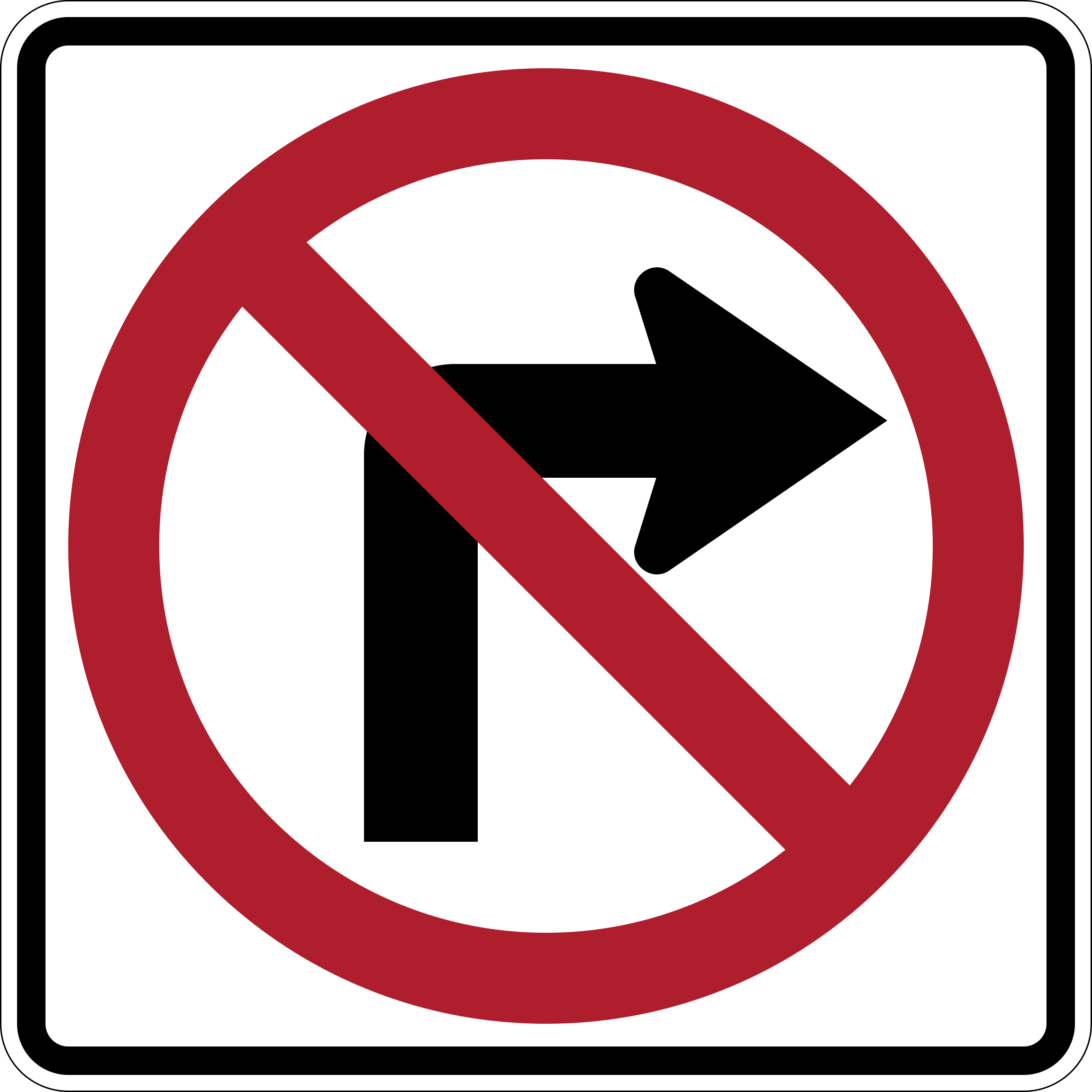
16. This red-slash sign with a right-turn arrow means:
- Right turns are allowed only from the bus lane
- Right turns are allowed after a complete stop
- Right turns are prohibited at this location
- Right turns must be made from the left lane
Show answer
Right turns are prohibited at this location. A regulatory sign with a red circle and slash forbids the movement pictured. Here the pictured movement is a right turn, so a driver must not turn right where the sign applies. The after-stop choice confuses this with a red traffic light rule; a no-right-turn sign remains a prohibition even if you stop. A cue is the arrow under the slash: it names the turn you may not make.
17. After a DUI arrest, within how long may you request a DMV administrative hearing?
- 30 days
- One year
- 60 days
- 10 days
Show answer
10 days. The 10-day clock starts running on the date of the arrest itself, and missing the deadline forfeits the hearing where you could challenge the Administrative Per Se suspension. At arrest the officer takes the license and issues a temporary one good for 30 days, so the hearing request and the temporary license run on different clocks that are easy to confuse. Act immediately after release to protect your rights.
18. You reach a flooded stretch of road and cannot tell how deep the water is. What is the handbook's first advice?
- Find another route
- Drive through quickly in a low gear
- Follow the vehicle ahead closely through the water
- Stop in the middle and check the depth on foot
Show answer
Find another route. Floodwater hides its depth along with washed-out pavement, debris, and live electrical hazards, so guessing wrong can float or stall a vehicle in seconds. The handbook puts avoidance first: take another route rather than gambling on an unknown crossing. Driving through slowly is only the fallback when no other option exists, and even then it stays risky. Speeding through can hydroplane the car or flood the engine, following another vehicle closely doubles the danger, and wading out on foot exposes you to currents and hidden drop-offs. Turn around whenever a detour exists.
19. How many attempts does a California applicant get to pass the knowledge test for an original license before having to reapply?
- One
- Two
- Three
- Unlimited attempts within one year
Show answer
Three. California allows three attempts at the knowledge test on an application for an original driver license. After the third failure, the applicant must start a new application. One or two attempts understates the allowance, and there is no unlimited window. Testing aids such as the handbook or a cell phone are not allowed in the test, so every attempt is closed book. Minors also face a seven day wait between knowledge test attempts, which means three tries can take a few weeks for a teen applicant.
20. How close to a sidewalk ramp for disabled persons may you park in California?
- Right up to its edge
- No closer than 15 feet
- No closer than three feet
- No closer than 20 feet
Show answer
No closer than three feet. California bars parking within three feet of a sidewalk ramp for disabled persons, and parking in front of or on a curb that provides wheelchair access is also forbidden. Parking right up to the ramp would block it. Fifteen feet is the fire hydrant distance, and 20 feet is the crosswalk distance, so both belong to other rules. The crosshatched area next to a disabled parking space is also off limits, whatever the gap.
New California driver? Insurance is the next step
Once the permit or license is in hand, the family policy changes. QualitySpace is an independent California broker (Kevin Vu, CDI #4037122): teen-driver additions, first-time policies, and multi-car bundles quoted across many carriers in one call.
Get a free quote or call 714-666-6669. English and Vietnamese.
Every question is written from the official California Driver's Handbook. Need paper? Printable CA practice test with answer key.
Last verified 2026-09-08. How we check every question · Study all 500 as flashcards
Frequently asked questions
How many questions are on this California practice test?
This fixed set has 20 questions. It is test 23 of 25 from the 500 question California bank. The real CA exam has 36 questions for applicants 18 and older and 46 for applicants under 18. A passing score is 80%.
What is the passing score for the real California test?
A passing score is 80%. That figure comes from the official California source cited on the DMV facts page.
How does this fixed test relate to the full California bank?
Each numbered test is a fixed set of 20 questions in a fixed order, so you can retake the same test later and compare. Every test mixes road signs and the other topics in about the same proportion as the full bank. Tests 1 to 25 together cover every question in the California bank once. The full practice page mixes the whole bank at random.
Last verified 2026-09-08. See the California DMV facts page for sourced state details.
Return to the full California practice test · Study road signs