
Key points
A passenger vehicle at 55 mph can stop within 300 feet, but a large vehicle can take up to 400 feet.
Source: Handbook p. 42
“The average passenger vehicle traveling at 55 mph can stop within 300 feet. A large vehicle traveling at the same speed can take up to 400 feet to stop.”
California Driver's Handbook, Handbook p. 42Always pass a large vehicle on the left side.
Source: Handbook p. 43
“Always pass a large vehicle on the left side.”
California Driver's Handbook, Handbook p. 43Never drive through a safety zone, under any condition.
Source: Handbook p. 43
“Do not drive through a safety zone under any condition.”
California Driver's Handbook, Handbook p. 43Do not pass a light rail vehicle or streetcar on the left, moving or standing, except in the few cases the handbook lists.
Source: Handbook p. 44
“Do not overtake and pass a light rail vehicle or streetcar on the left side, whether it is moving or standing, unless:”
California Driver's Handbook, Handbook p. 44For an emergency vehicle using a siren and red lights, drive to the right edge of the road and stop until it passes.
Source: Handbook p. 45
“Drive to the right edge of the road and stop until the emergency vehicle(s) have passed.”
California Driver's Handbook, Handbook p. 45It is illegal to follow within 300 feet of an emergency vehicle with its siren or flashing lights on.
Source: Handbook p. 45
“It is against the law to follow within 300 feet of any fire engine, law enforcement vehicle, ambulance, or other emergency vehicle when their siren or flashing lights are on.”
California Driver's Handbook, Handbook p. 45Some slow-moving vehicles, such as road maintenance vehicles, have an orange and red triangle on the back and usually travel at 25 mph or less.
Source: Handbook p. 45
“Some slow-moving vehicles have an orange and red triangle on their back, such as road maintenance vehicles, which usually travel at 25 mph or less.”
California Driver's Handbook, Handbook p. 45Allow at least three feet between your vehicle and a bicyclist you pass. If you cannot give three feet, do not pass until you can.
Source: Handbook p. 48
“allow at least three feet between your vehicle and the bicyclist. If you cannot give three feet of space, do not pass the cyclist until three feet of clearance can be given.”
California Driver's Handbook, Handbook p. 48Work zone fines can be $1,000 or more, and assaulting a highway worker can bring up to $2,000 and one year in jail.
Source: Handbook p. 49
“Fines for traffic violations in a work zone can be $1,000 or more. Anyone convicted of assaulting a highway worker faces fines of up to $2,000 and imprisonment for up to one year.”
California Driver's Handbook, Handbook p. 49Vehicles with hazardous load signs must stop before crossing railroad tracks.
Source: Handbook p. 50
“Vehicles with these signs must stop before crossing railroad tracks.”
California Driver's Handbook, Handbook p. 50
Numbers to know
| Number | What it means | Manual |
|---|---|---|
| 55 mph | speed used for the stopping distance comparison | Handbook p. 42 |
| 300 feet | stopping distance of a car at 55 mph | Handbook p. 42 |
| 400 feet | stopping distance of a large vehicle at 55 mph | Handbook p. 42 |
| 300 feet | minimum following distance behind an emergency vehicle | Handbook p. 45 |
| 25 mph | usual top speed of slow-moving vehicles such as road maintenance vehicles | Handbook p. 45 |
| 3 feet | minimum passing clearance for a bicyclist | Handbook p. 48 |
| $1,000 | work zone fines can reach this or more | Handbook p. 49 |
| $2,000 | maximum fine for assaulting a highway worker | Handbook p. 49 |
Recognize these signs

Slow moving vehicle 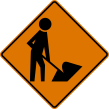
Workers present 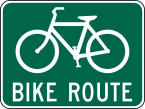
Bike route
3 questions from the California practice test
1. A safety zone is marked in the roadway for people waiting for a streetcar. May you drive through it?
- Yes, if the streetcar has already left
- Yes, when no pedestrians are standing in it
- Yes, at 10 mph or less
- No, never, under any condition
Show answer
No, never, under any condition. Safety zones are spaces set aside for pedestrians waiting for buses, streetcars, and trolleys, and they are marked by raised buttons or markers on the road. The handbook says not to drive through a safety zone under any condition, so an empty zone or a departed streetcar does not open it to traffic. The 10 mph figure is the limit for passing a bus or streetcar stopped at a safety zone, not permission to enter the zone itself. Treat the raised markers as a curb you cannot cross.
2. May you overtake and pass a light rail vehicle or streetcar on its left side in California?
- Yes, whenever it is standing still
- No, whether it is moving or standing, except in a few listed cases
- Yes, if you can complete the pass at 10 mph
- Only when its doors are open
Show answer
No, whether it is moving or standing, except in a few listed cases. The handbook prohibits overtaking and passing a light rail vehicle or streetcar on the left side, whether it is moving or standing. The listed exceptions are narrow: the tracks are so close to the right side that a passenger vehicle cannot pass on the right, you are on a one-way street, or a traffic officer directs you to pass on the left. Standing still and open doors do not create an exception, and the 10 mph figure belongs to passing a bus, streetcar, or trolley stopped at a safety zone or traffic light.
3. Which stopped roadside vehicle is covered by California's move over and slow down rule?
- Any parked passenger car with no lights on.
- A stopped road work vehicle displaying emergency flashing or amber warning lights.
- A food truck serving customers from a private lot.
- A moving delivery van using a turn signal.
Show answer
A stopped road work vehicle displaying emergency flashing or amber warning lights.. California's move over and slow down rule includes stopped road work vehicles displaying emergency flashing or amber warning lights, along with certain emergency vehicles and tow trucks. The parked-car option lacks the warning-light condition described by the handbook. This rule protects people working near traffic. The cue is a stopped work or emergency vehicle with flashing or amber lights: change lanes away from it when safe and reduce speed while passing.
Practice this topic
Lock it in with right of way questions from the free California practice test. Every answer comes with a plain English explanation.
Source: the California Driver's Handbook, Section 7: Laws and Rules of the Road. This lesson is a plain English summary, not the law itself; where it differs, the manual and the statute govern. Last checked 2026-09-27.