
Test 7 of 25 · 20 questions · Free 2026
CA Permit Practice Test 7
Jump to the test ↓A fixed 20 question set from the California bank with answers and plain English explanations. The real CA exam has 36 questions for applicants 18 and older and 46 for applicants under 18. A passing score is 80%. Take the full length version on the main practice page.
Parent of a new California driver? Adding a teen to the family policy changes the price. Get a free quote or call 714-666-6669. English and Vietnamese.
Question 1 of 20 · 0 right so far
All 20 questions in test 7
Every question below comes from the California question bank on this page. Open a question to see the correct answer and the explanation. Nothing here is hidden behind a signup.
1. At night, what does it mean to avoid overdriving your headlights?
- Use only parking lights when streetlights are present
- Drive slowly enough to stop within the distance your headlights illuminate
- Keep high beams on whenever another vehicle follows you
- Look away from the roadway whenever headlights reflect
Show answer
Drive slowly enough to stop within the distance your headlights illuminate. At night, your speed must let you stop within the distance lit by your headlights, because hazards outside that light are not visible soon enough. The parking-lights choice is illegal and reduces what you can see. The cue is your stopping distance: if your headlights reveal only a short stretch, reduce speed until you could stop before reaching the end of that visible area.
2. To merge or enter traffic on a California city street, about how much space do you need?
- Half a block, about 150 feet
- One car length
- A full block, about 300 feet
- About 50 feet
Show answer
Half a block, about 150 feet. On city streets, merging, entering, or exiting traffic takes a gap of about half a block, roughly 150 feet. A full block, about 300 feet, is the space the handbook calls for on the highway, where speeds are higher. One car length or 50 feet is far too little room to reach traffic speed safely. When entering from a full stop, signal and leave a big enough space to get up to the speed of traffic.
3. A preliminary alcohol screening shows a 20-year-old California driver at 0.05% BAC. What may the officer do?
- Nothing, because 0.05% is under the adult limit
- Require a breath or blood test
- Issue a parking citation
- Only call the driver's parents
Show answer
Require a breath or blood test. If a preliminary alcohol screening shows 0.05% or higher for a driver under 21, the officer may require a breath or blood test. If that later test also shows 0.05% or more, the young driver may be arrested for DUI and the privilege may be suspended. Being under the adult 0.08% limit protects no one under 21, whose legal limit is 0.01%. A parking citation is unrelated, and calling parents is not the listed step.
4. Your vehicle is disabled and you cannot get completely off the road. Where must you NOT stop?
- On a straight stretch where others can pass
- As far onto the shoulder as possible
- Just over a hill or just around a curve
- Where your flashers are visible from behind
Show answer
Just over a hill or just around a curve. A stopped vehicle is only safe if approaching drivers can see it in time to react. Over a hill crest or around a curve, sight distance collapses and a driver topping the hill has no room to stop or swerve. If you cannot get completely off the road, the handbook says to stop where people can see you and your vehicle from behind.
5. When may you turn left against a red light?
- Never, left on red is always illegal
- Only when a green arrow is also lit
- From any street when no traffic is coming
- From a one-way street onto a one-way street, with no prohibiting sign
Show answer
From a one-way street onto a one-way street, with no prohibiting sign. The one-way to one-way left mirrors the right-on-red maneuver: you turn into the nearest lane without crossing opposing traffic. The handbook still demands a full stop first, obedience to any sign banning the turn, and yielding to everyone holding the green, including pedestrians and bicyclists. Look both ways even on a one-way street, since wrong-way drivers and emergency vehicles can appear.
6. How must you park on a sloping driveway?
- Leave the wheels straight and the car in neutral
- Point the wheels toward the street for a quick exit
- Leave the engine running with flashers on
- Turn the wheels to block street roll, leave it in park, set the brake
Show answer
Turn the wheels to block street roll, leave it in park, set the brake. A sloped driveway can roll an unsecured car straight into traffic if the brakes alone fail, so the handbook demands three independent layers of protection: wheels aimed to prevent street entry, the transmission in park or in gear for a manual, and the parking brake firmly set. Straight wheels in neutral offer no backup at all. Build the same wheels-plus-park-plus-brake habit for every hill park, with or without a curb.
7. Which warning signs must you obey?
- Only signs with red borders
- Every warning sign, whatever its shape or color
- Only signs you have seen before
- Only signs on highways
Show answer
Every warning sign, whatever its shape or color. Warning signs come as diamonds, rectangles, yellow, orange, and fluorescent green, precisely because different hazards need different designs. The handbook's blanket rule removes any excuse to ignore an unfamiliar shape: if it warns, obey it. Regulatory signs such as speed limits and stop signs carry their own must-obey force, but warnings demand the same respect for your own safety. Ignoring a warning you dislike is how drivers meet the exact hazard the sign described.
8. Where must you pull over for a law enforcement stop?
- Stop in the carpool lane where you are
- Pull onto the left shoulder
- Move fully onto the right shoulder, even from the carpool lane
- Drive to the nearest parking lot
Show answer
Move fully onto the right shoulder, even from the carpool lane. The right shoulder removes both cars from traffic flow and gives the officer a safe working space on the passenger side. The handbook stresses leaving the carpool lane because stopping there blocks buses and carpools at full speed. Pick a well-lit stretch when possible, stop fully clear of the lane, and remain belted inside until the officer reaches you. Turn off the radio and stay belted inside until the officer reaches your window.
9. What rights do light rail vehicles have on public roads?
- They must yield to all cars at all times
- They have the same rights and responsibilities as other vehicles
- They may ignore traffic signals
- They always have the right-of-way over cars
Show answer
They have the same rights and responsibilities as other vehicles. Light rail vehicles are traffic, not pedestrians on rails: they follow the same signals, lanes, and right-of-way rules as cars wherever they run in streets. Drivers must share carefully because trains cannot swerve and need long distances to stop, while buildings and trees hide them at crossings. Never overtake one on the left except where the handbook's narrow exceptions apply.
10. You believe an officer treated you improperly during a stop. What is the course the handbook points to?
- Comply at the roadside, then file a complaint with the agency
- Refuse to cooperate until a supervisor arrives
- Withhold your license until the officer justifies the stop
- Drive away and report the matter later
Show answer
Comply at the roadside, then file a complaint with the agency. Anyone may file a complaint against a law enforcement agency, and retaliation by a government employee for filing one is itself against the law. The handbook says that even if you believe your rights were violated, you should not physically resist; you can voice your objection at the scene, and your safety and the officer's safety could be jeopardized if the situation escalates. The driver must still produce a license, proof of insurance, and registration. File the complaint with the agency that employs the officer, which must investigate it.
11. What do the chevron markings in a buffered bike lane provide?
- Greater separation from traffic and parked cars
- A lane where cars may park briefly
- A lane reserved for motorcycles
- A pedestrian walkway
Show answer
Greater separation from traffic and parked cars. Buffered bike lanes add a painted cushion, striped with chevrons or diagonals, between cyclists and the twin hazards of moving cars and opening doors. Drivers must respect both the bike lane and its buffer instead of treating the extra paint as spare road. Never drive, stop, or park in the buffer zone any more than in the bike lane itself.
12. After parallel parking, how close must your vehicle be to the curb?
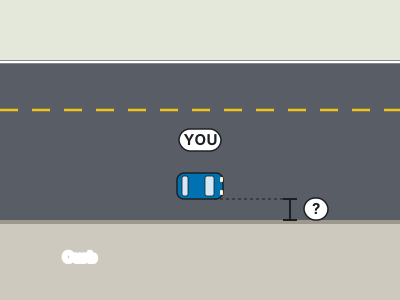
- Within 6 inches of the curb
- Within 3 feet of the curb
- Within 18 inches of the curb
- No set distance if the wheels are straight
Show answer
Within 18 inches of the curb. After parallel parking, the vehicle should be parallel and within 18 inches of the curb. Three feet appears in the straight-line backing practice, but it is not the final parallel parking curb distance. The cue is the last alignment step: straighten the car, pull forward or back if needed, and check that the vehicle sits close enough to the curb before turning it off and setting the parking brake.
13. What does a yellow and black circular or X-shaped railroad sign mean?

- You must stop only if gates are lowered
- A divided highway begins after the tracks
- A train has already cleared every track
- A railroad crossing is ahead, so look, listen, slow down, and prepare to stop
Show answer
A railroad crossing is ahead, so look, listen, slow down, and prepare to stop. A yellow and black circular or X-shaped sign warns that a railroad crossing is ahead. Gates lowered is only one possible active warning; the sign itself calls for looking, listening, slowing, and preparing to stop before any train appears. The cue is the round yellow advance sign or X marking. Reduce speed, scan both directions, and let any trains pass before crossing the tracks.
14. When preparing for a right turn across a bicycle lane, when may you enter the bike lane?
- Never, even when making the turn
- At any point in the block if traffic is heavy
- Only after stopping in the crosswalk
- Within 200 feet of the intersection after checking for bicyclists
Show answer
Within 200 feet of the intersection after checking for bicyclists. A driver may enter a bicycle lane for a turn within 200 feet of an intersection, but only after checking blind spots and watching for bicyclists. The never-enter option ignores California's turning exception. The cue is the dashed or ending bike-lane area near the corner. Merge safely behind any cyclist, signal about 100 feet before turning, and avoid cutting across the bicyclist's path.
15. Before entering a bike lane to make a right turn, what should a driver check?
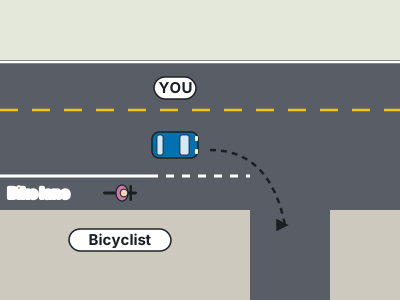
- Only the rearview mirror after starting the turn
- Whether the nearest parked car has expired tags
- Blind spots for bicyclists
- The left shoulder, because bicycles may not be on the right
Show answer
Blind spots for bicyclists. California allows a driver to enter a bike lane near a turn, but the driver must check for bicyclists in blind spots before doing so. The rearview mirror only choice is incomplete because a bicycle can be alongside the vehicle where mirrors miss it. The cue is the last 200 feet before a right turn, when the bike lane line changes or the curb lane opens and a shoulder check becomes essential.
16. A California minor racks up three at fault collisions or traffic convictions in the first year of licensing. What follows?
- A 30 day restriction to driving with an adult
- A warning letter
- Loss of the license until age 21
- A six month suspension followed by one year of probation
Show answer
A six month suspension followed by one year of probation. Three at fault collisions, three convictions, or any combination of three leads DMV to suspend the minor's driving privilege for six months and then place the driver on probation for one year. More collisions or convictions during probation bring another suspension. The 30 day adult supervised restriction is the step for two incidents, not three. A warning letter understates the penalty, and the handbook does not hold the license until 21. Turning 18 does not end the suspension or the probation.
17. How should you adjust for a wet road?
- Drive at the posted limit but flash your lights
- Drive more slowly than on a dry road and allow more space ahead
- Brake firmly every few seconds to test grip
- Follow the vehicle ahead more closely for guidance
Show answer
Drive more slowly than on a dry road and allow more space ahead. Water lifts tires off the pavement and stretches stopping distances, so the handbook prescribes two linked changes: lower speed plus a bigger gap to the vehicle ahead. The posted limit assumes dry pavement and full traction, which a wet road no longer offers. Flashing lights warns nobody of your reduced grip, rhythmic hard braking invites skids, and tailgating removes the margin a longer stop needs. Add extra caution for the first minutes of rain, when oil and water mix into the slickest surface of the storm.
18. After certain DUI offenses, what device may California require on your vehicle?
- A GPS tracker reporting to the court
- A breathalyzer built into the radio
- An ignition interlock device (IID)
- A dashboard camera
Show answer
An ignition interlock device (IID). An ignition interlock wires a breath test into the starter: the engine will not start until the driver provides a passing sample, and rolling retests keep monitoring during the trip. Courts and the DMV order it after repeat or serious DUI offenses to physically prevent impaired driving rather than merely punishing it afterward. GPS trackers, radio gadgets, and cameras record behavior but cannot stop an impaired start. Installation must use a certified provider, and tampering with the device brings its own penalties on top of the underlying offense.
19. What space rule limits every passing maneuver?
- Pass only with enough space to return to your lane
- Pass whenever the car ahead is slow
- Pass even if you must run off the road
- Pass on any hill or curve
Show answer
Pass only with enough space to return to your lane. Every pass ends with a merge back, and without a guaranteed gap the maneuver strands you head-on against oncoming traffic. The handbook lists this space rule alongside bans on passing at hills, curves, intersections, crossroads, and driveways. Judge the gap before leaving your lane, not while committed to the wrong side of the road. Patience here prevents the head-on crashes that make passing the deadliest maneuver.
20. You move to California or take a job here. How soon must you register your car?
- Within 20 days of becoming a resident or getting a job
- Within one year
- Only when the old registration expires
- Newcomers never need California registration
Show answer
Within 20 days of becoming a resident or getting a job. California starts the clock fast for newcomers: twenty days after residency or employment begins, the car must carry California plates and registration. Out-of-state registration does not transfer by itself, and driving past the deadline risks citation and back fees. Military members follow separate nonresident rules. Out-of-state plates past the deadline risk citation plus back fees and penalties. Military members follow separate nonresident registration rules.
New California driver? Insurance is the next step
Once the permit or license is in hand, the family policy changes. QualitySpace is an independent California broker (Kevin Vu, CDI #4037122): teen-driver additions, first-time policies, and multi-car bundles quoted across many carriers in one call.
Get a free quote or call 714-666-6669. English and Vietnamese.
Every question is written from the official California Driver's Handbook. Need paper? Printable CA practice test with answer key.
Last verified 2026-09-08. How we check every question · Study all 500 as flashcards
Frequently asked questions
How many questions are on this California practice test?
This fixed set has 20 questions. It is test 7 of 25 from the 500 question California bank. The real CA exam has 36 questions for applicants 18 and older and 46 for applicants under 18. A passing score is 80%.
What is the passing score for the real California test?
A passing score is 80%. That figure comes from the official California source cited on the DMV facts page.
How does this fixed test relate to the full California bank?
Each numbered test is a fixed set of 20 questions in a fixed order, so you can retake the same test later and compare. Every test mixes road signs and the other topics in about the same proportion as the full bank. Tests 1 to 25 together cover every question in the California bank once. The full practice page mixes the whole bank at random.
Last verified 2026-09-08. See the California DMV facts page for sourced state details.
Return to the full California practice test · Study road signs