
Test 1 of 25 · 20 questions · Free 2026
CA Permit Practice Test 1
Jump to the test ↓A fixed 20 question set from the California bank with answers and plain English explanations. The real CA exam has 36 questions for applicants 18 and older and 46 for applicants under 18. A passing score is 80%. Take the full length version on the main practice page.
Parent of a new California driver? Adding a teen to the family policy changes the price. Get a free quote or call 714-666-6669. English and Vietnamese.
Question 1 of 20 · 0 right so far
All 20 questions in test 1
Every question below comes from the California question bank on this page. Open a question to see the correct answer and the explanation. Nothing here is hidden behind a signup.
1. What does a red painted curb mean?
- Limited-time parking during posted hours
- Passenger loading for three minutes
- Disabled parking with a placard
- No stopping, standing, or parking
Show answer
No stopping, standing, or parking. A red curb is the strictest colored curb rule: no stopping, standing, or parking. Passenger loading belongs to a white curb, and disabled parking is marked by blue. The exception is a bus stopping in a red zone marked only for buses. Your cue is the red paint itself. Treat it like a prohibition zone and do not pause there for errands, pickups, or waiting.
2. In fog, which lighting choice does the handbook forbid?
- Low-beam headlights
- Only parking or fog lights
- Windshield wipers and defroster
- Hazard flashers while moving slowly
Show answer
Only parking or fog lights. Parking lights and fog lights alone do not project enough light to drive by, and they make your vehicle harder for others to judge in murky air. The handbook pairs this ban with the positive rule to use low-beam headlights, because high beams reflect off the water droplets and cause glare instead of helping. Windshield wipers and the defroster are recommended alongside proper headlights to keep the glass clear while you crawl through the fog.
3. What does a flashing yellow arrow mean for a left turn?
- You may turn, but the turn is not protected; yield to oncoming traffic and proceed with caution
- Stop and wait for a green arrow
- Turn only if no pedestrian signal is present
- The turn is protected; oncoming traffic must stop
Show answer
You may turn, but the turn is not protected; yield to oncoming traffic and proceed with caution. A flashing yellow arrow opens the turn to your judgment instead of reserving the intersection for you: oncoming lanes keep their green, so you must pick a safe gap, yield to every approaching vehicle, and finish carefully. Treating it as a stop wastes legal turns and confuses drivers behind you, while treating it as protected invites a head-on collision with traffic that has no red. Pedestrians matter at every turn but are not what the flashing arrow is about. Watch the oncoming flow, then commit decisively once a true gap appears.
4. After a DUI, what insurance proof must you file with the DMV?
- A standard insurance card for one year
- A letter from any licensed agent
- A California Insurance Proof Certificate (SR 22/SR 1P)
- Nothing until your policy renews
Show answer
A California Insurance Proof Certificate (SR 22/SR 1P). The SR 22 (or SR 1P) certificate is the DMV's proof that a high-risk driver carries the required liability coverage, and the insurer must notify the DMV directly if the policy lapses. A regular insurance card or agent letter does not create that reporting duty, and waiting for renewal leaves the filing missing. The certificate typically must stay on file for several years, and any gap restarts the clock and can re-suspend driving privileges. Arrange the filing through an insurer authorized to issue it before expecting license restoration.
5. A yellow divided-highway sign with arrows separating around a median means what?

- Opposing traffic will be separated by a divider ahead
- A lane ends and traffic must merge left immediately
- You may cross the median to make a U-turn anywhere
- The road changes to one lane for both directions
Show answer
Opposing traffic will be separated by a divider ahead. The divided-highway warning means a physical or marked divider separates opposing directions ahead, so stay to the right of the median and follow lane markings. The U-turn choice is wrong because a divider is not permission to cross wherever you like. The cue is the pair of arrows splitting around a central shape, which shows traffic streams separating rather than merging into one lane.
6. A yellow right-angle turn arrow is warning you to expect what?

- A sharp change in road direction ahead
- A lane added for passing slow traffic
- A crossroad controlled by four stop signs
- A one-way street beginning after the sign
Show answer
A sharp change in road direction ahead. A right-angle arrow warns of a sharper turn than a gentle curve, so slow before the turn and stay well inside your lane. The added-lane choice is unrelated because it describes extra pavement, not a change in direction. The cue is the abrupt bend in the arrow; prepare for a tighter steering path and watch for advisory speed signs or hidden traffic around the corner.
7. What should you expect at crossings with several tracks?
- Only one track is ever active
- Trains run on a fixed schedule you can time
- A train on any track, at any time, in either direction
- Tracks beyond the first are always abandoned
Show answer
A train on any track, at any time, in either direction. Multiple tracks hide a second train behind the first, and quiet zones or curves can mask its approach until the last second. Looking both ways before and while crossing, never stopping on the rails, and expecting movement on every track in either direction are the handbook's layered defenses. If the signals activate while you cross, keep moving clear without stopping.
8. What does a green arrow mean at a traffic signal?
- Go in the direction of the arrow for a protected turn.
- Proceed straight only after yielding to all traffic.
- Turn only after stopping at the limit line.
- The protected turn has ended and the light will change.
Show answer
Go in the direction of the arrow for a protected turn.. A green arrow means go in the direction the arrow points, and California describes that movement as a protected turn because oncoming vehicles are stopped by a red signal. The protected-turn-ended option describes a yellow arrow, not a green one. Even with the arrow, stay alert for pedestrians or hazards. The cue is arrow color: green grants the indicated protected movement, while yellow warns that the protected time is ending.
9. Who is exempt from the open-container passenger rule?
- Passengers in any private car
- The driver when parked
- Passengers in a bus, taxi, camper, or motorhome
- Passengers on a motorcycle
Show answer
Passengers in a bus, taxi, camper, or motorhome. The exemption recognizes vehicles built for living and hired transport, where passengers ride far from the controls and the driver remains fully bound by every DUI and open-container rule. Ordinary cars, pickups, and SUVs never qualify no matter how the passengers behave. Drivers of exempt vehicles face the same zero-tolerance treatment as every other driver. The driver of an exempt vehicle remains fully bound by all DUI laws.
10. What is the proper way to check your own blind spots?
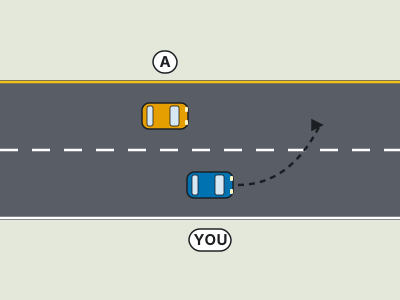
- Turn your whole body and steering wheel together.
- Rely only on adjusted mirrors.
- Look over your shoulders out the side windows.
- Wait for another driver to honk.
Show answer
Look over your shoulders out the side windows.. Mirrors do not show every area around the vehicle. California says to check blind spots by looking over the right and left shoulders out the side windows, turning only your head. The mirror-only choice misses the areas slightly behind and beside most vehicles. The whole-body option is also unsafe because it can move the steering wheel. The cue is any lane change, merge, backing movement, parking exit, or door opening: add a shoulder check before moving.
11. During a traffic stop, what documents must a California driver produce?
- A driver license, proof of insurance, and vehicle registration.
- Only a driver license and current address.
- A passport, registration, and smog certificate.
- Insurance information only after a citation is issued.
Show answer
A driver license, proof of insurance, and vehicle registration.. During a law enforcement stop, the driver must produce a driver's license, proof of insurance, and vehicle registration. The current-address-only option leaves out registration and insurance, which the handbook specifically includes. Officers may conduct a limited search for those documents if the driver does not produce them. The cue is a stopped vehicle contact with law enforcement: have the three required records available and provide them when requested.
12. When may a person ride in the back of a pickup or other truck?
- Whenever the trip is under one mile
- Only when the truck stays below 25 mph
- If the person is at least 18 years old
- If the vehicle has secure seats and safety belts
Show answer
If the vehicle has secure seats and safety belts. A person may not ride in a pickup or other truck bed unless secure seating and seat belts are provided. The adult-passenger choice is wrong because age alone does not create an exception. The cue is whether the rider has an actual seat and belt, not whether they can sit against the cab, hold the side rail, or take a short low-speed trip.
13. What is the Mature Driver Improvement Program?
- A 30-minute online quiz
- An eight-hour course for drivers 55 and older
- A racing clinic for seniors
- A vision test only
Show answer
An eight-hour course for drivers 55 and older. The mature-driver course refreshes rules, updates seniors on new laws, and teaches compensation for slower reflexes and vision changes. Graduates often earn insurance discounts alongside safer habits. Eight classroom hours is a small price for confidence behind the wheel at any age past 55. Many graduates also earn insurance discounts along with refreshed driving habits. Rule refreshers and new-law updates target age-related driving changes.
14. Someone is injured in your California collision. How soon must a report go to law enforcement?
- Within 10 days
- Within 24 hours
- Within 30 days
- Only if police came to the scene
Show answer
Within 24 hours. When anyone is injured or killed, the collision must be reported to law enforcement within 24 hours. Your insurance agent, broker, or legal representative can file it for you. Ten days is the deadline for the separate SR 1 report to DMV, so the two deadlines are easy to swap. Thirty days is too late for either report. The duty does not depend on officers coming to the scene, and law enforcement will not file the DMV report on your behalf.
15. You are towing a trailer on a California highway. Which lane must you use?
- Any lane, since trailers follow the car
- The far-left lane to stay clear of merging traffic
- The far-right lane or a lane marked for slower vehicles
- The center lanes to avoid all merging traffic
Show answer
The far-right lane or a lane marked for slower vehicles. Towing combinations accelerate, climb hills, and stop far more slowly than solo cars, so the handbook keeps them with other slow traffic on the right where faster vehicles can pass safely. The same lane rule covers trucks with three or more axles. On unmarked roads with four or more lanes in your direction, these heavier vehicles may use only the two lanes nearest the right edge of the road.
16. A California driver is convicted of manslaughter from evading police during a pursuit. What prison term applies?
- Up to one year in county jail
- A minimum of 4 to 10 years in state prison
- Up to seven years in state prison
- Probation only
Show answer
A minimum of 4 to 10 years in state prison. Manslaughter resulting from evading law enforcement during a pursuit carries a state prison term with a minimum of 4 to 10 years. Up to one year in county jail is the penalty for the basic misdemeanor of fleeing officers. Up to seven years in state prison applies when the pursuit causes serious bodily injury, not death. Probation alone is not a listed outcome. The penalties climb with the harm the pursuit causes.
17. A car is left standing on a California freeway. After how long may it be removed?
- After one hour
- After more than four hours
- After 24 hours
- After 72 hours
Show answer
After more than four hours. A vehicle stopped, parked, or left standing on a freeway for more than four hours may be removed. One hour is too short. The 24 and 72 hour figures are not the freeway rule in the handbook. If you must stop on a freeway, park completely off the pavement and stay in the vehicle with the doors locked until help arrives. Stopping on a freeway is allowed only in an emergency, when an officer requires it, or where a stop is specifically permitted.
18. At a California T intersection with no STOP or YIELD signs, who has the right-of-way?
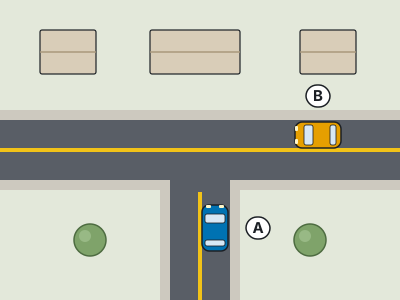
- The vehicle on the right in every case
- Whoever reaches the intersection first
- The driver turning from the dead-end street
- Vehicles, bicyclists, and pedestrians on the through road
Show answer
Vehicles, bicyclists, and pedestrians on the through road. At a T intersection without STOP or YIELD signs, the handbook gives the right-of-way to vehicles, bicyclists, and pedestrians on the through road, meaning the road that continues straight. A driver coming from the road that ends must wait for a safe gap. Arrival order and the vehicle-on-the-right rule apply at ordinary four-way uncontrolled intersections, not here. Look for the shape of the junction: if your road ends at the cross street, you yield to everything already moving along it.
19. What does a flashing yellow traffic signal light mean?
- Turn only if a police officer gives a hand signal
- Stop and remain stopped until a green light appears
- Treat the intersection as closed in all directions
- Slow down, stay alert, and proceed with caution
Show answer
Slow down, stay alert, and proceed with caution. A flashing yellow signal is a caution warning. California says to slow down, remain alert, and continue carefully without making a required full stop. The remain stopped choice describes a red arrow or other stop condition, not a flashing yellow light. The cue is the yellow light blinking rather than steady, which should make you scan cross traffic, pedestrians, and turning vehicles while keeping enough speed control to stop if conditions change.
20. How may an adult driver use a cell phone while driving?
- Only in hands-free mode when necessary
- By holding it for a brief call at a red light
- By reading texts if traffic is stopped
- Only with both hands on the steering wheel and speaker off
Show answer
Only in hands-free mode when necessary. Adult drivers should use a cell phone only in hands-free mode when necessary, with the phone mounted and operated by a single swipe or touch if used. The red-light handheld choice still involves holding the phone while driving. The cue is whether the device is in your hand; if a call cannot wait, pull safely off the road instead of handling the phone in traffic.
New California driver? Insurance is the next step
Once the permit or license is in hand, the family policy changes. QualitySpace is an independent California broker (Kevin Vu, CDI #4037122): teen-driver additions, first-time policies, and multi-car bundles quoted across many carriers in one call.
Get a free quote or call 714-666-6669. English and Vietnamese.
Every question is written from the official California Driver's Handbook. Need paper? Printable CA practice test with answer key.
Last verified 2026-09-08. How we check every question · Study all 500 as flashcards
Frequently asked questions
How many questions are on this California practice test?
This fixed set has 20 questions. It is test 1 of 25 from the 500 question California bank. The real CA exam has 36 questions for applicants 18 and older and 46 for applicants under 18. A passing score is 80%.
What is the passing score for the real California test?
A passing score is 80%. That figure comes from the official California source cited on the DMV facts page.
How does this fixed test relate to the full California bank?
Each numbered test is a fixed set of 20 questions in a fixed order, so you can retake the same test later and compare. Every test mixes road signs and the other topics in about the same proportion as the full bank. Tests 1 to 25 together cover every question in the California bank once. The full practice page mixes the whole bank at random.
Last verified 2026-09-08. See the California DMV facts page for sourced state details.
Return to the full California practice test · Study road signs