
Test 11 of 25 · 20 questions · Free 2026
CA Permit Practice Test 11
Jump to the test ↓A fixed 20 question set from the California bank with answers and plain English explanations. The real CA exam has 36 questions for applicants 18 and older and 46 for applicants under 18. A passing score is 80%. Take the full length version on the main practice page.
Parent of a new California driver? Adding a teen to the family policy changes the price. Get a free quote or call 714-666-6669. English and Vietnamese.
Question 1 of 20 · 0 right so far
All 20 questions in test 11
Every question below comes from the California question bank on this page. Open a question to see the correct answer and the explanation. Nothing here is hidden behind a signup.
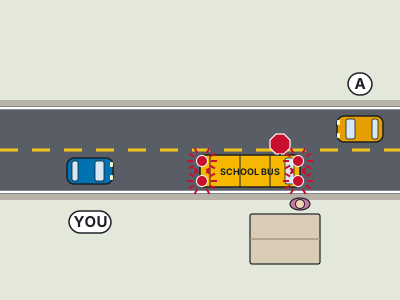
1. A school bus on an undivided road is flashing red lights. What must drivers do?
- Stop only if traveling behind the bus
- Slow to 15 mph and pass with extra room
- Stop from either direction until the lights stop flashing
- Proceed once children have left your lane
Show answer
Stop from either direction until the lights stop flashing. When a school bus flashes red lights on an undivided road, traffic from both directions must stop and remain stopped until the flashing ends and children are safely across. Slowing to 15 mph is not enough; the manual requires a stop. The divided or multilane highway exception applies only when the bus is across a divided highway or a road with at least two lanes in each direction. Watch the top front and rear red lights as your cue.
2. An officer arrests a California driver for DUI and takes the license. What does the driver receive, and for how long?
- Nothing; driving must stop immediately
- A 90 day restricted license
- A permit to drive only to work for one year
- A temporary driver's license good for 30 days
Show answer
A temporary driver's license good for 30 days. Under California's Administrative Per Se law, the arresting officer may take the license and issue a temporary driver's license for 30 days. That window lets the driver request a DMV administrative hearing, which must be done within 10 days of the arrest. The handbook does not describe an immediate end to driving, a 90 day restricted license, or a one year work permit at the arrest stage. DMV is still required to suspend the privilege under the per se law.
3. DMV mails you notice of a proposed action against your California driving privilege. How long do you have to request a hearing?
- 30 days from the date of the notice
- 10 days after being served, or 14 days from the date the notice is mailed
- Until your license expires
- 48 hours
Show answer
10 days after being served, or 14 days from the date the notice is mailed. An administrative hearing must be requested within 10 days of being served, or within 14 days of the date the notice was mailed. Miss the deadline and the right to a hearing is lost. Thirty days is too long, and waiting until the license expires would forfeit the hearing entirely. Forty eight hours is not a deadline the handbook gives. The hearing lets you be heard before DMV acts, and it is separate from any court appearance on the same matter.
4. What front light must a bicycle have at night?
- No light is required
- A candle in a jar
- A red light facing forward
- A white front lamp visible from 300 feet
Show answer
A white front lamp visible from 300 feet. Night cycling without a headlamp makes the rider invisible to cross traffic and turning cars until the last instant. The white lamp must throw light 300 feet ahead so others can see and be seen by. Rear red reflectors or lights plus pedal and wheel reflectors complete the required night package. Rear red gear plus wheel and pedal reflectors complete the night package.
5. How should you enter a center left-turn lane?
- Merge fully into the center lane so you do not block traffic
- Stop in the through lane to wait
- Use it as a passing lane
- Enter it a mile early
Show answer
Merge fully into the center lane so you do not block traffic. The shared center lane works only when turning drivers clear the through lanes completely before waiting for a gap. Stopping half-in blocks the lane you came from and invites rear-end crashes. Enter near your turn, never travel long distances in it, and never use it to pass or as a merge lane. Opposing turners share the lane, so long travel inside it courts head-on crashes.
6. An officer signals you to pull over. How should you first acknowledge?
- Turn on your right turn signal to show you see the officer
- Speed up to the next exit
- Flash your high beams
- Stop in the travel lane immediately
Show answer
Turn on your right turn signal to show you see the officer. The right signal tells the officer you have seen the lights and are complying, which keeps the stop calm from the first second. After acknowledging, move completely onto the right shoulder even from the carpool lane, choose a well-lit spot, turn off the radio, and stay inside unless told to get out. Fleeing, dazzling, or blocking the lane turns a routine stop dangerous.
7. Your vehicle kills or injures an animal on the road. What must you do?
- Move the animal off the road yourself
- Leave the scene without reporting
- Keep the animal as a pet
- Call the humane society or law enforcement, and do not move an injured animal
Show answer
Call the humane society or law enforcement, and do not move an injured animal. An injured animal can bite or thrash from pain, and moving it may worsen internal injuries, so professionals must handle the rescue. The humane society or law enforcement will dispatch trained responders and document the incident. Leaving without calling abandons a suffering animal and skips the collision report the handbook requires for property and animal strikes alike. Keep your own car clear of the animal while you wait for responders to arrive.
8. Where must an opened alcohol container be kept in the car?
- In the trunk or where passengers do not sit
- In the glove box
- On the passenger seat
- In the driver's cup holder
Show answer
In the trunk or where passengers do not sit. Once a seal breaks, the container must leave everyone's reach so nobody can sip during the trip. Trunks, locked cargo boxes, and truck beds behind the cab all qualify, while glove boxes, seats, consoles, and cup holders all fail because passengers sit there. The glove box is expressly named as an illegal spot for open containers. Locked cargo areas and truck beds behind the cab also satisfy the storage rule.
9. How should you enter a roundabout?
- Enter heading left to save time
- Enter heading right when a big enough gap lets you merge safely
- Stop inside the circle to check traffic
- Enter at full speed without looking
Show answer
Enter heading right when a big enough gap lets you merge safely. Roundabouts replace stop-and-go with slow-and-merge: approach slowly, yield to everyone already circling, then slip right into the first safe gap. Traffic orbits one way around the central island, so entering left would mean head-on conflict. Once inside, keep moving with the flow, signal your exit, and watch for pedestrians at the crosswalks. Yield lines of white triangles often mark the exact spot where entering cars must give way.
10. At a STOP sign, where must you make a full stop?
- Past the crosswalk where cross traffic is visible
- Before the crosswalk or at the limit line
- Only after the front wheels enter the intersection
- Beside the sign post, regardless of pavement markings
Show answer
Before the crosswalk or at the limit line. A STOP sign requires a full stop before entering the crosswalk or at the limit line. Rolling forward past the crosswalk before stopping can place the vehicle where pedestrians may be crossing. If there is no limit line or crosswalk, stop before entering the intersection. The cue is the first legal stopping point: limit line first, then crosswalk, then the edge of the intersection.
11. What is the speed limit at a blind intersection when your view is blocked?
- 10 mph until you see both directions
- 25 mph because it is still an intersection
- 15 mph unless posted otherwise
- 35 mph if no stop signs are posted
Show answer
15 mph unless posted otherwise. A blind intersection with blocked sight lines has a 15 mph limit. The lower speed gives you time to edge forward, find cross traffic and pedestrians, and stop if needed. The 25 mph option confuses this situation with the broader business or residential default. Use the cue from the handbook: if the corner has no stop signs and buildings, bushes, or parked vehicles block your view, move slowly and obey 15 mph.
12. How far ahead must you signal a freeway lane change?
- No signal is needed on freeways
- Signal only after starting to move
- One second before moving
- At least five seconds before changing lanes
Show answer
At least five seconds before changing lanes. Freeway speeds compress time and distance, so five seconds of flashing signal gives nearby drivers a real chance to adjust before you move. Signal first, then check mirrors, blind spots, and traffic beside you, and only then glide over when the gap is safe. The same signal-before-moving discipline applies to every lane change, curb pull-out, and turn. Cancel the signal once established so others do not misread your next move.
13. Where may a California driver attach a sticker no larger than a 7-inch square?
- In the center of the windshield behind the rearview mirror
- The lower corner of the passenger's side windshield
- Anywhere along the top edge of the windshield
- The lower corner of the driver's side of the windshield
Show answer
The lower corner of the passenger's side windshield. California limits what you may stick on your glass so that your view stays clear. A 7-inch square is allowed on the lower corner of the passenger's side windshield or the lower corner of the rear window. A 5-inch square may go on the lower corner of the driver's side window, and a 5-inch square in the top center is reserved for an electronic toll device. Objects behind the mirror or across the driver's line of sight are not on the list, and nothing may hang from the mirror.
14. In the evening, from what point does California require your headlights to be on?
- Beginning 30 minutes after sunset
- Beginning one hour after sunset
- Only once streetlights switch on
- Exactly at sunset, not before
Show answer
Beginning 30 minutes after sunset. California sets a clock rule for headlights: they must be on beginning 30 minutes after sunset and until 30 minutes before sunrise. The same list also requires them whenever it is too dark to see from 1,000 feet away, so a cloudy dusk can call for them even earlier. Waiting a full hour leaves you hard to see during twilight. Streetlights are not the trigger, and the handbook does not tie the rule to the exact moment of sunset.
15. You are looking for a parallel parking space in California. How long should the space be?
- Exactly the length of your vehicle
- At least one foot longer than your vehicle
- At least three feet longer than your vehicle
- At least two full car lengths
Show answer
At least three feet longer than your vehicle. The first step of the handbook's parallel parking method is to find a space at least three feet longer than your vehicle, then signal to show you plan to park. That extra room lets you back in at an angle and straighten out without touching the cars in front and behind. A space that only matches your car's length, or is just a foot longer, leaves no margin for the maneuver. Two full car lengths is far more than the handbook asks for.
16. How should you treat motorcycles that are lane splitting in California?
- Move to reduce room because sharing lanes is illegal
- Open your door only after the motorcycle passes your mirror
- Follow within one second so other cars cannot enter the gap
- Give room and do not try to pass one in the same lane
Show answer
Give room and do not try to pass one in the same lane. California recognizes lane splitting, so drivers should leave room, check mirrors, and avoid blocking a motorcycle moving between lanes. The choice saying sharing lanes is illegal reverses the handbook and could lead to a dangerous squeeze. The cue is a motorcycle approaching between slow or stopped lanes; hold your position, avoid sudden lateral moves, and check before opening a door next to traffic.
17. The pedestrian signal shows a steady raised hand. What must you do?
- Start crossing if you hurry
- Cross only in the crosswalk lines
- Do not cross; wait for the next WALK
- Cross halfway and wait on the median
Show answer
Do not cross; wait for the next WALK. A steady raised hand or DON'T WALK is a hard stop for pedestrians, matching what a red ball means for drivers. Starting late strands you in moving traffic when the light changes, which is exactly why the flashing hand warns crossers not to begin. Wait on the sidewalk for the next WALK display, then cross with a fresh green. Drivers must still yield to pedestrians caught out when the display changes.
18. A yellow sign showing a small STOP sign ahead tells you to do what?

- Start slowing and prepare to make a full stop soon
- Maintain speed because it only marks a future parking rule
- Turn right at the next intersection without stopping
- Stop immediately at the warning sign itself
Show answer
Start slowing and prepare to make a full stop soon. A stop-ahead warning means the actual stop sign is coming soon, so start reducing speed and get ready for a complete stop at the proper line or crosswalk. Stopping immediately at the warning sign is the likely trap; the warning sign is advance notice, not the legal stop location. The cue is the miniature stop symbol on a yellow background, which gives you time to react before the red octagon appears.
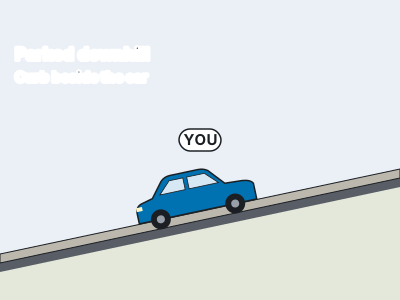
19. You park facing downhill against a curb. Which way should the front wheels point, and why?
- Straight ahead, so the steering stays centered
- Away from the curb, so the tires clear the gutter
- Toward the curb, so the car cannot roll into the street
- Toward the curb only if the parking brake fails
Show answer
Toward the curb, so the car cannot roll into the street. The point of turning the wheels on a slope is to give a rolling vehicle something to stop it if the brakes let go. Facing downhill, gravity pulls the car forward, so pointing the front wheels into the curb lets the tire catch instead of rolling toward traffic. Turning them away sends the car into the street, which is the outcome the rule exists to prevent. Centered wheels offer no protection at all. Set the parking brake and leave the transmission in park, or in gear with a manual, as a second line of defense.
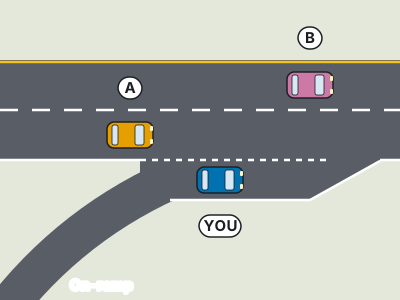
20. When entering a highway, what speed should you aim for on the on-ramp?
- 15 mph below the slowest vehicle
- At or near the speed of highway traffic
- A complete stop before every merge
- The posted alley speed until fully merged
Show answer
At or near the speed of highway traffic. When merging onto a highway, California advises being at or near the speed of traffic before entering. A complete stop is only for situations where it is absolutely necessary, because stopping on the ramp can make the gap harder to use. The cue is the flow of highway traffic beside you. Use the ramp to match speed, check mirrors and blind spots, signal, and merge into a large enough space.
New California driver? Insurance is the next step
Once the permit or license is in hand, the family policy changes. QualitySpace is an independent California broker (Kevin Vu, CDI #4037122): teen-driver additions, first-time policies, and multi-car bundles quoted across many carriers in one call.
Get a free quote or call 714-666-6669. English and Vietnamese.
Every question is written from the official California Driver's Handbook. Need paper? Printable CA practice test with answer key.
Last verified 2026-09-08. How we check every question · Study all 500 as flashcards
Frequently asked questions
How many questions are on this California practice test?
This fixed set has 20 questions. It is test 11 of 25 from the 500 question California bank. The real CA exam has 36 questions for applicants 18 and older and 46 for applicants under 18. A passing score is 80%.
What is the passing score for the real California test?
A passing score is 80%. That figure comes from the official California source cited on the DMV facts page.
How does this fixed test relate to the full California bank?
Each numbered test is a fixed set of 20 questions in a fixed order, so you can retake the same test later and compare. Every test mixes road signs and the other topics in about the same proportion as the full bank. Tests 1 to 25 together cover every question in the California bank once. The full practice page mixes the whole bank at random.
Last verified 2026-09-08. See the California DMV facts page for sourced state details.
Return to the full California practice test · Study road signs