
Test 12 of 13 · 20 questions · Free 2026
CA Permit Practice Test 12
Jump to the test ↓A fixed 20 question set from the California bank with answers and plain English explanations. The real CA exam has 36 questions for applicants 18 and older and 46 for applicants under 18. A passing score is 80%. Take the full length version on the main practice page.
Parent of a new California driver? Adding a teen to the family policy changes the price. Get a free quote or call 714-666-6669. English and Vietnamese.
Question 1 of 20 · 0 right so far
All 20 questions in test 12
Every question below comes from the California question bank on this page. Open a question to see the correct answer and the explanation. Nothing here is hidden behind a signup.
1. Which adult point total may lead DMV to suspend a California driver license?
- 2 points in 12 months.
- 4 points in 12 months.
- 5 points in 24 months.
- 7 points in 36 months.
Show answer
4 points in 12 months.. For adults, California lists possible suspension when the record shows 4 points in 12 months, 6 in 24 months, or 8 in 36 months. The 7-in-36 choice is one point short of the handbook's 36-month total. These numbers matter because convictions and certain collisions remain on the driving record. The cue is the time window: match the point count to 12, 24, or 36 months before deciding whether the negligent-operator threshold is reached.
2. Your vehicle stalls on train tracks and a train is approaching. Which direction should you run?
- Straight down the tracks away from the train
- Toward the nearest crossing gate
- Diagonally away from the tracks toward the direction the train is coming from
- Behind your vehicle so it shields you from debris
Show answer
Diagonally away from the tracks toward the direction the train is coming from. Leave the vehicle immediately and run diagonally away from the tracks in the direction the train is coming from. That path helps avoid debris pushed forward from the collision area. Running straight down the tracks keeps you in the danger path, and standing behind the vehicle is also unsafe. The cue is an approaching train with warning lights: get out first, move diagonally away, then call 911.
3. Cargo extends more than 4 feet beyond the rear bumper during the day. What marker is required?
- Two amber reflectors on the cargo end.
- One white light visible from 300 feet.
- A 12-inch red or fluorescent orange square flag.
- A blue warning flag at least 6 inches wide.
Show answer
A 12-inch red or fluorescent orange square flag.. California requires a 12-inch red or fluorescent orange square flag when cargo projects more than 4 feet behind the rear bumper. The white-light option borrows lighting language from other visibility rules and does not describe daytime rear cargo marking. At night, the handbook calls for two red lights instead. The cue is the overhang length: once the load extends beyond 4 feet from the back, mark its far end conspicuously.
4. How long must a California minor hold an instruction permit before scheduling the behind-the-wheel drive test?
- At least 30 days
- At least 1 year
- At least 3 months
- At least 6 months, or until turning 18
Show answer
At least 6 months, or until turning 18. An applicant under 18 must have an instruction permit from California or another state for at least 6 months, or turn 18, before scheduling the behind-the-wheel drive test. During that time the minor must complete driver education and driver training and practice for at least 50 hours with a California-licensed driver who is at least 25, ten of those hours at night. Thirty days, three months, and a full year are not the handbook's figure.
5. Where must most children under 8 years old ride when using a child passenger restraint system?
- In the front seat if an adult is driving.
- In the front passenger seat with the air bag on.
- In any seat if the trip is under 10 miles.
- In a rear seat.
Show answer
In a rear seat.. California requires children under 8, or shorter than 4 feet 9 inches, to be secured in a child passenger restraint system in a rear seat unless a listed exception applies. The front-seat option is too broad; the handbook allows front-seat placement only in limited cases such as no rear seat or medical reasons. The cue is the child's age or height: under 8 or below 4 feet 9 inches points you first to a proper restraint in the back.
6. Traffic is moving faster than the posted speed limit. What should you remember?
- The posted limit does not apply during rush hour.
- You must match the fastest traffic to avoid blocking lanes.
- You may be cited for driving faster or slower than the speed limit.
- You may exceed the limit when staying in the right lane.
Show answer
You may be cited for driving faster or slower than the speed limit.. California warns that driving faster or slower than the speed limit can lead to a citation, even when traffic pressure makes another speed tempting. The match-fastest-traffic option is wrong because surrounding drivers do not erase the posted limit or the Basic Speed Law. Conditions may require slowing, but speeding remains risky and illegal. The cue is the speedometer compared with the posted sign: keep a lawful, reasonable speed and move to the right when a driver close behind you wants to go faster.
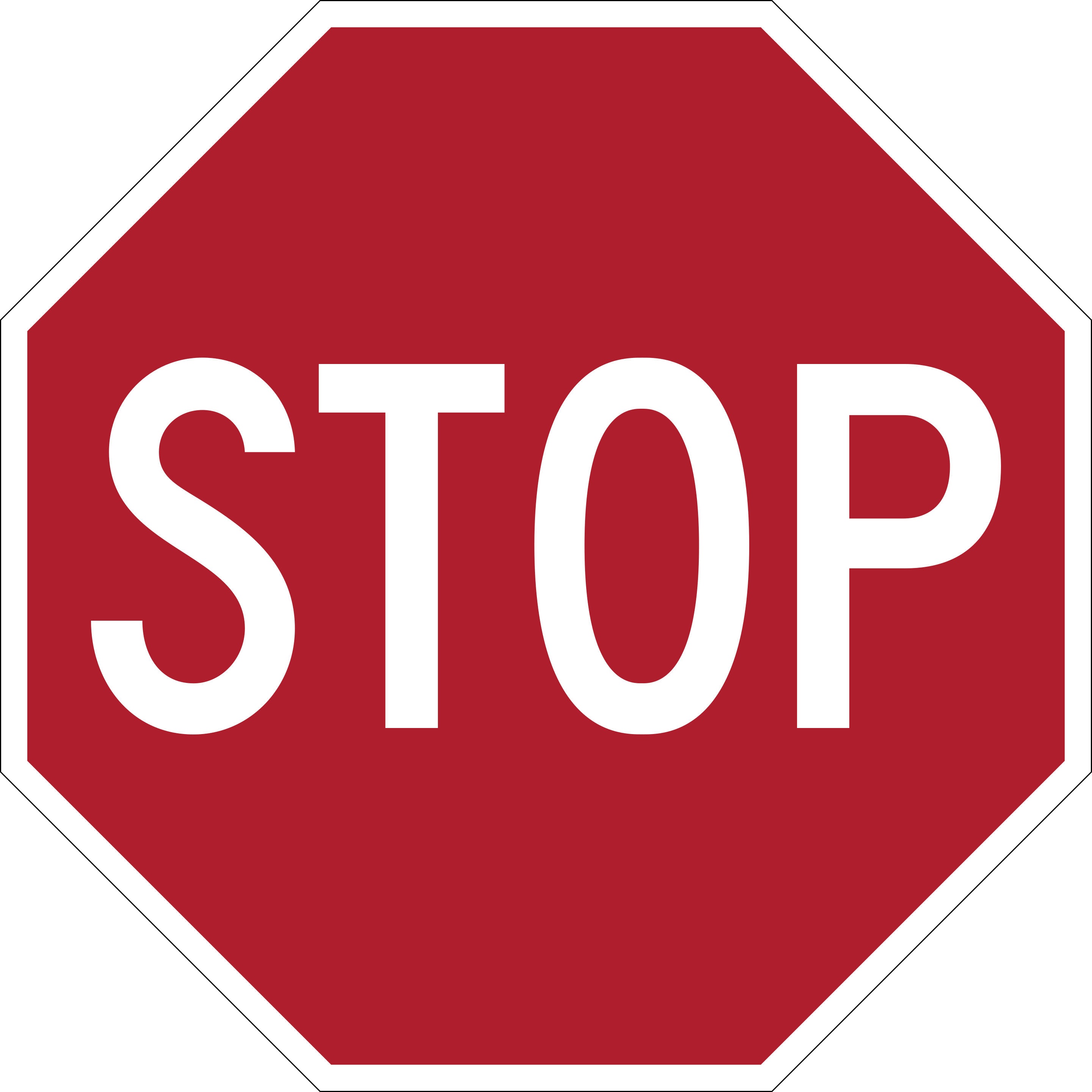
7. At this stop sign there is no limit line and no crosswalk. Where must a California driver stop?
- At the sign post
- Before entering the intersection
- With the front wheels in the intersection for a better view
- Ten feet past the sign
Show answer
Before entering the intersection. A limit line is a wide white line that shows drivers where to stop before an intersection or crosswalk. If there is no limit line, stop before you enter the crosswalk, and if there is no crosswalk either, stop before you enter the intersection. The sign post is not the reference point, and nosing into the intersection puts the vehicle into cross traffic. After stopping, look left, right and left again and go only when it is safe.
8. What does California law say about drinking alcohol while riding as a passenger in a vehicle?
- It is illegal while riding as a passenger.
- It is allowed if the driver is sober.
- It is allowed in the front seat only.
- It is illegal only for passengers under 21.
Show answer
It is illegal while riding as a passenger.. California bars drinking alcohol, and smoking or eating cannabis products, while driving or riding as a passenger in a vehicle. The sober-driver option is wrong because the passenger conduct is prohibited separately. The handbook lists narrow exceptions for passengers in a bus, taxi, camper, or motorhome, but not for an ordinary moving car. The cue is an open container or active use inside the passenger area: keep alcohol and cannabis sealed and unopened during the ride.
9. When a pedestrian is crossing the roadway outside a marked crosswalk, what should you do?
- Use caution, reduce speed, or stop so the pedestrian can finish crossing
- Continue at speed because only marked crosswalks count
- Pass in front of the pedestrian if your lane is open
- Stop only if the pedestrian makes eye contact
Show answer
Use caution, reduce speed, or stop so the pedestrian can finish crossing. California requires caution for a pedestrian crossing with or without a crosswalk, including reducing speed or stopping so the person can finish safely. The marked crosswalks only choice is wrong because unmarked crossings and pedestrians outside marked lines still require care. The cue is any person already in the roadway ahead; cover the brake, watch both sides, and leave enough time for a safe crossing.
10. If you cannot see a truck's side mirrors, what should you assume?
- You are safely outside every blind spot
- The truck is about to stop
- The truck driver cannot see you
- The truck must change lanes first
Show answer
The truck driver cannot see you. Large trucks have No Zones where a smaller vehicle can disappear from the driver's view. If you cannot see the truck's side mirrors, assume the truck driver cannot see you either. The about-to-stop choice invents a signal the mirror rule does not provide. The cue is mirror visibility: stay out of those blind areas, avoid lingering alongside, and pass on the left when you can do so safely.
11. A California minor fails the behind the wheel drive test. How long is the wait before the next attempt?
- 14 days, not counting the day of the failure
- Seven days
- Six months
- No wait if a parent signs a new form
Show answer
14 days, not counting the day of the failure. For a minor, a failed behind the wheel drive test means a 14 day wait before retesting, and the day of the failure is not counted. Seven days is the waiting period after a failed knowledge test, so it is the wrong test. Six months is how long a minor must hold the instruction permit before the first drive test, not a retest delay. A parent's signature does not waive the waiting period. A sample Driving Performance Evaluation score sheet at dmv.ca.gov/teendriver shows what the drive test covers.
12. A California provisional driver has a medical need to drive during restricted hours and no other reasonable way to travel. Whose signed note is required?
- A parent or guardian
- A school principal
- A physician, stating the condition and expected recovery date
- A DMV examiner
Show answer
A physician, stating the condition and expected recovery date. For the medical exception, the note must come from the minor's physician and must state the medical condition and the date the minor is expected to recover. A parent or guardian's note covers a different exception, driving an immediate family member. A principal, dean, or designee signs for school activities, not medical needs. DMV examiners do not write these exception notes. The exception also applies only when the minor cannot reasonably find another way to travel.
13. At a STOP sign, where must you make a full stop?
- Past the crosswalk where cross traffic is visible
- Before the crosswalk or at the limit line
- Only after the front wheels enter the intersection
- Beside the sign post, regardless of pavement markings
Show answer
Before the crosswalk or at the limit line. A STOP sign requires a full stop before entering the crosswalk or at the limit line. Rolling forward past the crosswalk before stopping can place the vehicle where pedestrians may be crossing. If there is no limit line or crosswalk, stop before entering the intersection. The cue is the first legal stopping point: limit line first, then crosswalk, then the edge of the intersection.
14. You face a steady red right arrow. When may you turn right?
- After a complete stop if no pedestrians are present
- When cross traffic has a yellow signal
- After yielding, unless a sign says no turn on red
- Only after the signal changes to green or a green arrow
Show answer
Only after the signal changes to green or a green arrow. A steady red arrow does not allow the same turn as a circular red signal. Stay stopped until a green light or green arrow appears for your movement. The choice about stopping and yielding sounds like the right-turn-on-red rule, but that rule applies to a red light, not a red arrow. Use the arrow shape as the cue: it controls the direction shown and keeps that turn stopped.
15. Which road surfaces tend to freeze before the rest of the road?
- Bridges and overpasses
- Freshly painted lane markings only
- Flat city blocks with heavy traffic
- Downhill shoulders after sunrise only
Show answer
Bridges and overpasses. Bridges and overpasses can freeze before other pavement, so slow before reaching them on cold wet days and expect hidden icy spots. The city-block choice overlooks the exposure of bridges and overpasses to cold air. The cue is elevated pavement, shade, or a structure crossing water or another road; ease off early and avoid abrupt steering or braking on the span.
16. What should you do when a traffic light is not working?
- Proceed because the larger road has priority
- Treat the intersection as if all directions have STOP signs
- Stop only if another vehicle reaches the intersection first
- Use the pedestrian signal as the only control
Show answer
Treat the intersection as if all directions have STOP signs. A nonworking traffic light is handled like an all-way stop: stop first, then proceed cautiously when it is safe. The larger-road choice is unsafe because the handbook does not give automatic priority to the wider or busier road in this situation. The cue is a dark or failed signal head; make a complete stop, communicate with other road users, and apply normal stop-sign right-of-way order.
17. In high winds, why should you reduce your speed?
- It gives you better control and more time to react to gusts
- It lets cruise control steer more accurately
- It prevents all debris from reaching your lane
- It allows you to drive with parking lights only
Show answer
It gives you better control and more time to react to gusts. California advises reducing speed in high winds because slower travel improves control and gives more reaction time if a gust hits. The cruise control choice conflicts with the same section, which tells drivers not to use cruise control in those conditions. The cue is an open bridge, gap between buildings, truck corridor, or blowing debris where a sudden side push could move the vehicle off line.
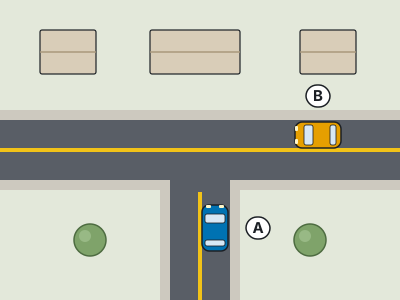
18. At a California T intersection with no STOP or YIELD signs, who has the right-of-way?
- The vehicle on the right in every case
- Whoever reaches the intersection first
- The driver turning from the dead-end street
- Vehicles, bicyclists, and pedestrians on the through road
Show answer
Vehicles, bicyclists, and pedestrians on the through road. At a T intersection without STOP or YIELD signs, the handbook gives the right-of-way to vehicles, bicyclists, and pedestrians on the through road, meaning the road that continues straight. A driver coming from the road that ends must wait for a safe gap. Arrival order and the vehicle-on-the-right rule apply at ordinary four-way uncontrolled intersections, not here. Look for the shape of the junction: if your road ends at the cross street, you yield to everything already moving along it.
19. A car is left standing on a California freeway. After how long may it be removed?
- After one hour
- After more than four hours
- After 24 hours
- After 72 hours
Show answer
After more than four hours. A vehicle stopped, parked, or left standing on a freeway for more than four hours may be removed. One hour is too short. The 24 and 72 hour figures are not the freeway rule in the handbook. If you must stop on a freeway, park completely off the pavement and stay in the vehicle with the doors locked until help arrives. Stopping on a freeway is allowed only in an emergency, when an officer requires it, or where a stop is specifically permitted.
20. An average passenger vehicle at 55 mph can stop within about 300 feet. How far can a large truck take at the same speed?
- About 150 feet
- The same 300 feet
- About 200 feet
- Up to 400 feet
Show answer
Up to 400 feet. California's handbook compares the two directly: at 55 mph an average passenger vehicle can stop within 300 feet, while a large vehicle can take up to 400 feet. Heavier, faster vehicles need more room, so the truck cannot stop in the same distance and certainly not in less. That is why cutting in front of a truck and then slowing is so dangerous. A loaded truck needs even more distance than an empty one.
New California driver? Insurance is the next step
Once the permit or license is in hand, the family policy changes. QualitySpace is an independent California broker (Kevin Vu, CDI #4037122): teen-driver additions, first-time policies, and multi-car bundles quoted across many carriers in one call.
Get a free quote or call 714-666-6669. English and Vietnamese.
Every question is written from the official California Driver's Handbook. Need paper? Printable CA practice test with answer key.
Last verified 2026-09-08. How we check every question · Study all 275 as flashcards
Frequently asked questions
How many questions are on this California practice test?
This fixed set has 20 questions. It is test 12 of 13 from the 275 question California bank. The real CA exam has 36 questions for applicants 18 and older and 46 for applicants under 18. A passing score is 80%.
What is the passing score for the real California test?
A passing score is 80%. That figure comes from the official California source cited on the DMV facts page.
How does this fixed test relate to the full California bank?
Each numbered test is a fixed set of 20 questions in a fixed order, so you can retake the same test later and compare. Every test mixes road signs and the other topics in about the same proportion as the full bank. Tests 1 to 13 together cover 260 of the 275 questions in the California bank, each once. The full practice page mixes the whole bank at random.
Last verified 2026-09-08. See the California DMV facts page for sourced state details.
Return to the full California practice test · Study road signs