
Test 16 of 25 · 20 questions · Free 2026
CA Permit Practice Test 16
Jump to the test ↓A fixed 20 question set from the California bank with answers and plain English explanations. The real CA exam has 36 questions for applicants 18 and older and 46 for applicants under 18. A passing score is 80%. Take the full length version on the main practice page.
Parent of a new California driver? Adding a teen to the family policy changes the price. Get a free quote or call 714-666-6669. English and Vietnamese.
Question 1 of 20 · 0 right so far
All 20 questions in test 16
Every question below comes from the California question bank on this page. Open a question to see the correct answer and the explanation. Nothing here is hidden behind a signup.
1. A flashing yellow left-turn arrow appears. What does it mean?
- Your left turn is protected from oncoming traffic
- You must stop and wait for a green arrow
- You may turn after yielding to oncoming traffic
- Oncoming vehicles must stop before you turn
Show answer
You may turn after yielding to oncoming traffic. A flashing yellow arrow allows the turn, but it is not protected. You must yield to oncoming traffic and proceed cautiously when the gap is safe. The protected-turn choice confuses this signal with a green arrow, where oncoming vehicles are stopped by red. A cue is the flashing yellow color: it gives permission to turn with caution, not ownership of the intersection.
2. You hit a parked vehicle and cannot find the owner. What must you do?
- Leave a note with your contact information and report it to law enforcement
- Drive away if the damage appears minor
- Wait exactly ten minutes, then notify your insurer only
- Leave your license plate number only on the windshield
Show answer
Leave a note with your contact information and report it to law enforcement. If you hit a parked vehicle or other property and cannot locate the owner, leave a secure note with your name, phone number, and address, then report the collision to law enforcement. Notifying only an insurer is incomplete because the handbook calls for the note and law enforcement report. A cue is the absent owner: once you cannot exchange information directly, create a written record at the scene.
3. In extreme heat, which step does the handbook list for overheating conditions?
- Drive faster so air cools the engine
- Open the radiator cap immediately
- Watch the temperature gauge and turn off the air conditioner
- Idle the engine in park for ten minutes
Show answer
Watch the temperature gauge and turn off the air conditioner. Extreme heat pushes cooling systems toward their limits, so the handbook advises watching the temperature gauge for early warning and switching off the air conditioner to cut engine load. Speeding up adds heat faster than airflow removes it, and idling in park keeps the engine working with almost no cooling airflow. Opening a hot radiator cap is outright dangerous because pressurized coolant can erupt and scald. If the gauge climbs into the red, pull over safely, shut the engine off, and let it cool before checking anything under the hood.
4. You agreed to a PAS or breath test. Can officers still demand blood or urine?
- No, passing PAS ends all testing
- Yes, blood or urine can still be required to detect drugs
- Only if you are under 21
- Only on weekends
Show answer
Yes, blood or urine can still be required to detect drugs. Alcohol screening and drug detection are separate jobs: PAS and breath tests measure alcohol, while blood or urine reveal drugs the breath tests cannot see. Agreeing to the first never waives the second, and refusing the drug test triggers the same DMV suspension or revocation as refusing alcohol testing. Prescription and over-the-counter drugs count fully under this rule. A refusal counts the same whether the suspected substance is alcohol or drugs.
5. Before changing lanes on a freeway, how long should you signal?
- At least two seconds.
- At least 100 feet, the same as every turn.
- Only while the vehicle is crossing the lane line.
- At least five seconds.
Show answer
At least five seconds.. For freeway lane changes, California says to signal at least five seconds before moving over. The 100-foot figure is used for turns, but freeway speeds make time a better cue than distance for lane changes. Signaling only while crossing the lane line gives nearby drivers too little warning. Watch for the freeway setting: before moving laterally at highway speed, start the signal early enough for others to see your plan and react.
6. How does the BAC table account for drinking time?
- Add 0.02% per hour
- BAC never changes over time
- Food raises the estimate
- Subtract 0.01% for each 40 minutes between drinks
Show answer
Subtract 0.01% for each 40 minutes between drinks. The liver clears alcohol at a roughly steady rate, so the BAC table discounts the total for elapsed drinking time. Spacing drinks lets the body keep pace, while chugging stacks every drink at once. Time is the only real reducer: coffee, cold air, food, and exercise do not speed the liver's fixed hourly rate. Coffee, food, and fresh air never speed the liver's fixed elimination rate.
7. Why should you allow extra time for seniors, people with small children, and people with disabilities at crossings?
- They may need extra time to cross safely.
- They may cross only at yellow crosswalk lines.
- They have right-of-way only when signals are flashing.
- They must wait until all vehicles have passed.
Show answer
They may need extra time to cross safely.. California reminds drivers that some pedestrians, including seniors, people with small children, and people with disabilities, may require extra time to cross safely. The flashing-signal option is wrong because pedestrians have right-of-way in marked or unmarked crosswalks, and drivers must be prepared to yield. The cue is a pedestrian who may move slowly or need assistance. Reduce speed early and wait long enough for the person to fully clear your path.
8. What is the right lane of a multilane road for?
- Pass all slower traffic
- Race to red lights
- Cruise in the blind spots of trucks
- Enter or exit traffic, or enter the road from a curb or shoulder
Show answer
Enter or exit traffic, or enter the road from a curb or shoulder. The right lane is the road's on-ramp and off-ramp: merging, exiting, and curb departures all happen there so through traffic flows undisturbed on the left. Slower drivers belong there too, keeping the left lanes free for passing. Drifting along in truck blind spots or sprinting between signals in the right lane misuses its access purpose. Trucks with three or more axles face the same keep-right lane restrictions.
9. What do flashing yellow lights on a school bus warn you to do?
- Stop only if children are already in the street
- Pass quickly before red lights appear
- Slow down and prepare to stop
- Continue at speed unless the stop arm is out
Show answer
Slow down and prepare to stop. Flashing yellow lights on a school bus warn that the bus is preparing to stop and you should slow down and get ready to stop. Passing quickly is the dangerous choice because yellow usually comes before children unload and red lights require a full stop. The cue is the color change on the bus. Ease off the accelerator, cover the brake, and watch for children near the curb.
10. During the first 12 months of a California provisional license, which hours are off limits for driving unless a qualifying adult rides along or an exception applies?
- Between 9 p.m. and 6 a.m.
- Between 11 p.m. and 5 a.m.
- Between midnight and 4 a.m.
- Between 10 p.m. and 6 a.m.
Show answer
Between 11 p.m. and 5 a.m.. For the first 12 months, a California provisional driver may not drive between 11 p.m. and 5 a.m. unless a parent, guardian, or other California-licensed driver at least 25 rides along, or a documented exception applies and the required signed note is carried. The other windows shift the start or end time and are not the handbook's figures. The cue is the word provisional and the first year after licensing. The passenger limit on riders under 20 is a separate restriction that applies at all hours during that year.
11. At this railroad crossbuck, what should you do before crossing?
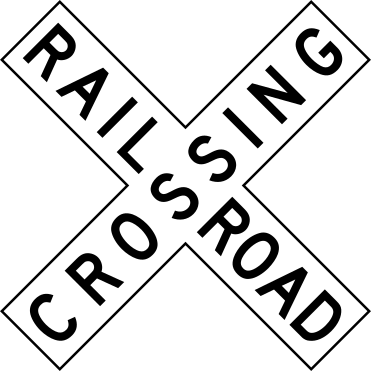
- Cross immediately after the first train passes
- Stop only when a gate is present
- Maintain speed because trains must sound a horn
- Look, listen, slow down, and be ready to stop
Show answer
Look, listen, slow down, and be ready to stop. A railroad crossbuck marks a crossing where you must watch and listen for trains, slow down, and prepare to stop. Gates or flashing lights are not the only warning that matters. The gate-only choice is dangerous because many crossings require careful checking even without gates. A cue is the X-shaped railroad sign: look both ways, listen for bells or horns, and cross only when the tracks are clear.
12. If you cannot see a truck's side mirrors, what should you assume?
- You are safely outside every blind spot
- The truck is about to stop
- The truck driver cannot see you
- The truck must change lanes first
Show answer
The truck driver cannot see you. Large trucks have No Zones where a smaller vehicle can disappear from the driver's view. If you cannot see the truck's side mirrors, assume the truck driver cannot see you either. The about-to-stop choice invents a signal the mirror rule does not provide. The cue is mirror visibility: stay out of those blind areas, avoid lingering alongside, and pass on the left when you can do so safely.
13. What insurance proof must you have when you drive and during a drive test?
- A dealership sales contract
- Proof of financial responsibility
- A DMV knowledge test receipt
- A maintenance log for the vehicle
Show answer
Proof of financial responsibility. California requires proof of financial responsibility, commonly insurance, when you drive and for a drive test. A sales contract or maintenance record does not show liability coverage. The cue is any time you operate the vehicle or arrive for the behind-the-wheel test: be ready to show valid insurance proof. After a collision, the same proof must be shown to other involved drivers.
14. At an uncontrolled intersection, you and another vehicle arrive at the same time. Who should yield?
- The vehicle going straight must stop first
- The larger vehicle must always yield
- Yield to the vehicle on your left
- Yield to the vehicle on your right
Show answer
Yield to the vehicle on your right. At an uncontrolled intersection, simultaneous arrivals require you to give way to the vehicle, pedestrian, or bicyclist on your right. The left-side option reverses the California rule. Vehicle size does not decide priority, and going straight does not cancel the right-side rule. Your cue is arrival timing: first to the intersection goes first, but a tie is resolved by yielding to the road user on your right.
15. When rain or snow makes you use windshield wipers, what else must you do?
- Drive with parking lights only
- Switch to high beams
- Turn on low-beam headlights
- Turn off all exterior lights
Show answer
Turn on low-beam headlights. California requires low-beam headlights when wipers are needed because of fog, rain, or snow. High beams can reflect glare in bad weather, and parking lights alone are illegal for driving. The cue is simple: if the windshield needs wipers to keep visibility, the car needs low beams so others can see it. Do this even in daytime storms or light snow.
16. Before opening a parked car door next to traffic, what should you check for?
- Motorcyclists near the traffic side of the vehicle.
- Only vehicles directly in front of you.
- Whether the curb is painted green.
- Whether your parking brake is released.
Show answer
Motorcyclists near the traffic side of the vehicle.. California specifically tells drivers to check for motorcyclists before opening a door next to traffic. The same habit also protects bicyclists and passing vehicles, but the handbook names motorcyclists in the motorcycle-sharing section. The front-only option is wrong because the danger comes from beside and behind the parked vehicle. Use the cue of any door opening into a lane: look back along the traffic side before the door moves.
17. Must you signal when no other vehicles are around?
- Signal anyway, even with no vehicles in sight
- Skip the signal when alone
- Signal only at night when alone
- Honk instead of signaling
Show answer
Signal anyway, even with no vehicles in sight. Empty-looking roads hide motorcycles behind pillars, cyclists in shadows, and pedestrians about to step out, all of whom read your signal before you ever see them. Signaling always also builds the reflex that protects you when traffic suddenly appears. The cost is one finger flick; the payoff is never surprising someone you missed. Hidden motorcycles and pedestrians read your blinker before you ever see them.
18. What conditions do pedestrian, bicycle, and school warning signs cover?
- Only highway construction zones
- Pedestrians, bicycles, schools, playgrounds, and buses
- Only railroad crossings
- Only parking restrictions
Show answer
Pedestrians, bicycles, schools, playgrounds, and buses. This warning family guards the most vulnerable road users: children around schools and playgrounds, cyclists in the lane, and riders boarding buses. Their fluorescent yellow-green faces stand out from ordinary yellow warnings precisely so drivers slow down early. Treat every sign in this group as a cue to cover the brake and scan the sidewalks, not just the pavement. Slow early for this family of signs, since children and cyclists move unpredictably near them.
19. What hidden dangers can flooded roads hold?
- They improve your tire traction
- They create flood hazards including electrocution from fallen lines
- They make the water shallower
- They mark the safe route across
Show answer
They create flood hazards including electrocution from fallen lines. Floodwater hides almost every danger it carries: debris that can puncture or trap the car, pavement that may have washed away, stalled engines in deep spots, and live current from toppled power lines spreading through the water. Depth cannot be judged by looking, which is why the handbook's first advice is finding another route and its fallback is driving through slowly only when no option exists.
20. May you leave children or animals in a hot parked vehicle?
- Never; it is dangerous and illegal even with a window cracked
- Yes, if the window is slightly open
- Yes, for under five minutes
- Yes, if the car is in the shade
Show answer
Never; it is dangerous and illegal even with a window cracked. A parked car's interior turns into an oven within minutes in the sun, and a cracked window barely slows the rise. Heat stroke kills children, pets, and the elderly quickly because their bodies cannot shed heat fast enough. California makes hot-car abandonment a crime precisely because good intentions do not change the physics; take everyone with you or stay with the car.
New California driver? Insurance is the next step
Once the permit or license is in hand, the family policy changes. QualitySpace is an independent California broker (Kevin Vu, CDI #4037122): teen-driver additions, first-time policies, and multi-car bundles quoted across many carriers in one call.
Get a free quote or call 714-666-6669. English and Vietnamese.
Every question is written from the official California Driver's Handbook. Need paper? Printable CA practice test with answer key.
Last verified 2026-09-08. How we check every question · Study all 500 as flashcards
Frequently asked questions
How many questions are on this California practice test?
This fixed set has 20 questions. It is test 16 of 25 from the 500 question California bank. The real CA exam has 36 questions for applicants 18 and older and 46 for applicants under 18. A passing score is 80%.
What is the passing score for the real California test?
A passing score is 80%. That figure comes from the official California source cited on the DMV facts page.
How does this fixed test relate to the full California bank?
Each numbered test is a fixed set of 20 questions in a fixed order, so you can retake the same test later and compare. Every test mixes road signs and the other topics in about the same proportion as the full bank. Tests 1 to 25 together cover every question in the California bank once. The full practice page mixes the whole bank at random.
Last verified 2026-09-08. See the California DMV facts page for sourced state details.
Return to the full California practice test · Study road signs