
Test 18 of 25 · 20 questions · Free 2026
CA Permit Practice Test 18
Jump to the test ↓A fixed 20 question set from the California bank with answers and plain English explanations. The real CA exam has 36 questions for applicants 18 and older and 46 for applicants under 18. A passing score is 80%. Take the full length version on the main practice page.
Parent of a new California driver? Adding a teen to the family policy changes the price. Get a free quote or call 714-666-6669. English and Vietnamese.
Question 1 of 20 · 0 right so far
All 20 questions in test 18
Every question below comes from the California question bank on this page. Open a question to see the correct answer and the explanation. Nothing here is hidden behind a signup.
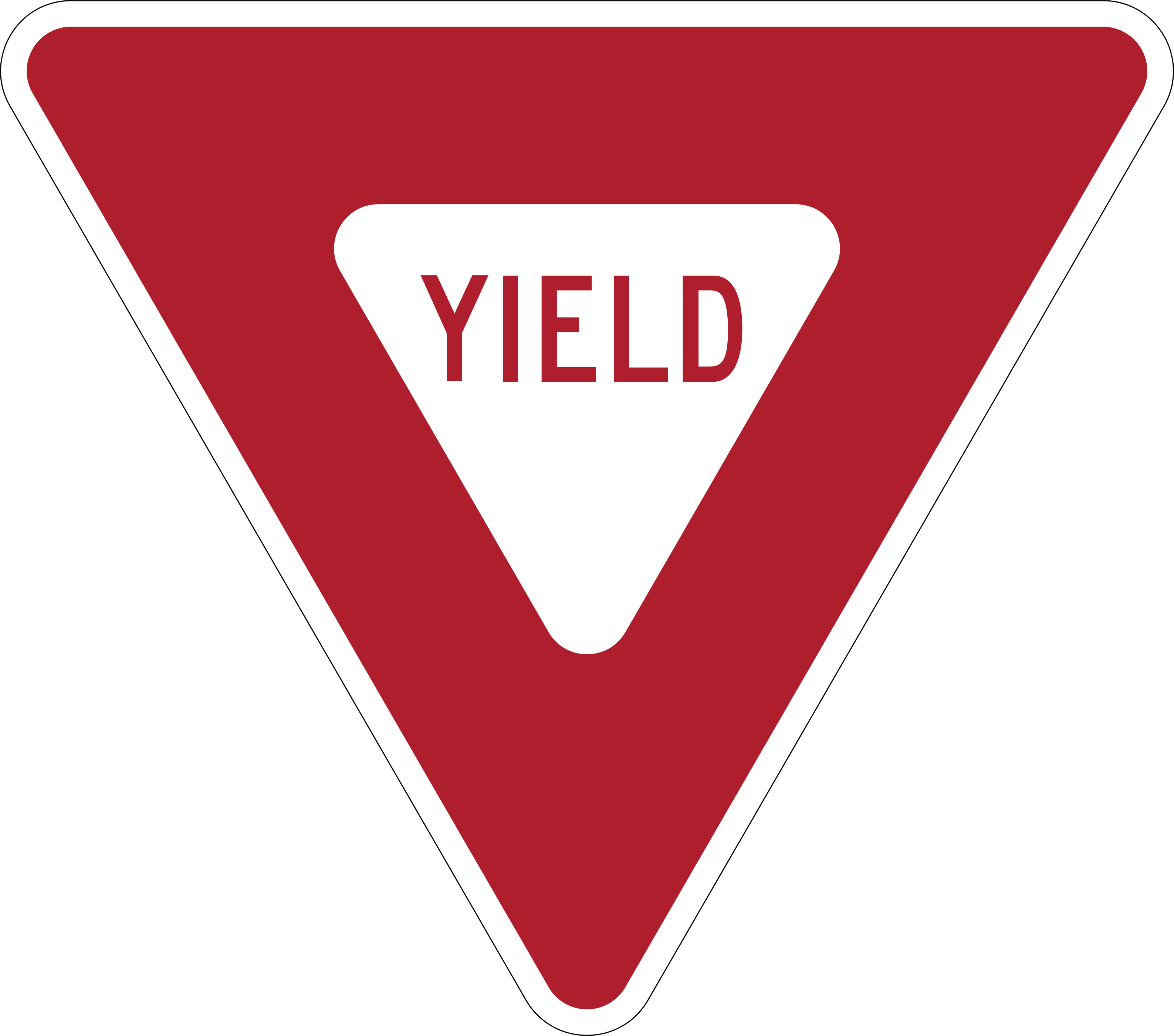
1. At this yield sign, what must you be ready to do?
- Speed up to match traffic before entering
- Stop if needed to let vehicles, bicyclists, or pedestrians pass
- Stop only if another driver honks
- Proceed first because cross traffic has the sign
Show answer
Stop if needed to let vehicles, bicyclists, or pedestrians pass. A yield sign tells you to slow down and be prepared to stop so other traffic or pedestrians with priority can pass. It does not always require a full stop, but it does require one when needed. The speed-up choice is unsafe because yielding begins with slowing and checking. A cue is the red inverted triangle: approach expecting to give way, then enter only after the conflict area is clear.
2. A child is under 2 years old, under 40 pounds, and under 3 feet 4 inches tall. How must the child ride?
- In a rear-facing child passenger restraint system
- In a booster seat in the front seat
- With only a lap belt in any rear seat
- In a forward-facing seat if an adult is beside them
Show answer
In a rear-facing child passenger restraint system. For a child under 2 who is also under 40 pounds and under 3 feet 4 inches tall, California requires a rear-facing child passenger restraint system. A booster or regular belt is for older or larger children, so those choices ignore the age, weight, and height combination. The cue is all three measurements together. If the child fits those limits, use rear facing and keep the restraint out of an airbag-equipped front seat.
3. May you smoke in a car carrying someone under 18?
- Never smoke with a minor in the car; you can be fined
- Smoking is allowed with teens 16 and up
- Only the driver is banned from smoking
- Smoking bans apply only on freeways
Show answer
Never smoke with a minor in the car; you can be fined. Secondhand smoke concentrates fast in a car's small cabin, and children cannot consent to the exposure. The law bans smoking whenever any minor rides along, regardless of windows or road type. Fines punish violations, and the rule covers cigarettes, cigars, pipes, and vaping devices. The rule covers cigarettes, cigars, pipes, and vaping devices alike. Open windows never excuse smoking with a young passenger aboard.
4. Where can you U-turn in a business district?
- U-turns are banned everywhere downtown
- Any driveway works for U-turns
- Only at intersections, or on divided highways with a provided opening
- U-turn freely between intersections
Show answer
Only at intersections, or on divided highways with a provided opening. Business districts pack driveways, pedestrians, and parked cars too tightly for mid-block reversals, so the handbook limits U-turns to intersections and engineered highway openings. The definition covers any office-and-shop area, not just downtown cores. Look for the next signal rather than swinging across busy commercial frontage. Office-and-shop areas everywhere count, not just downtown city cores. The next signalized intersection is always the safer reversal choice.
5. What does the handbook say about parking on a sidewalk?
- Allowed if you leave room for pedestrians
- Never; not on a sidewalk, partially blocking one, or in front of a driveway
- Allowed for motorcycles only
- Allowed for up to 15 minutes
Show answer
Never; not on a sidewalk, partially blocking one, or in front of a driveway. Sidewalks are pedestrian space, and even partial blockage forces walkers, wheelchair users, and parents with strollers out into the street with moving traffic. The same handbook bullet also bans parking in front of a driveway, which traps residents' cars and blocks emergency access to the property. Leaving a narrow gap, riding a motorcycle, or promising to return in a few minutes creates no exception to either ban.
6. Your preliminary screening (PAS) shows 0.05% BAC or higher. What can the officer require?
- Let you go with a warning
- Confiscate your car immediately
- Suspend you on the spot without more testing
- Require a breath or blood test
Show answer
Require a breath or blood test. The roadside PAS is only a screening tool, so a 0.05% or higher reading triggers the evidentiary test that actually decides the case. Breath or blood results carry the legal weight the handheld screen lacks. Refusing the follow-up test invokes implied-consent suspension on top of whatever the DUI investigation already supports. You may still face license action even if criminal charges are later reduced.
7. Within what distance of an intersection, bridge, tunnel, or railroad crossing must you NOT pass?
- Within 50 feet
- Within 75 feet
- At any distance if the way is clear
- Within 100 feet
Show answer
Within 100 feet. Intersections, bridges, tunnels, and crossings all hide cross traffic, narrow the road, or remove escape room, which is why passing is banned near them. The same list bans passing on hills and curves with blind sight lines, at crossroads and driveways, and whenever you cannot return to your lane safely. Wait until you are past the hazard zone with clear sight distance.
8. When turning left, who must you give the right-of-way to?
- Any pedestrian or approaching vehicle close enough to be dangerous
- Only vehicles already honking
- Only pedestrians in marked crosswalks
- Nobody, turning traffic goes first
Show answer
Any pedestrian or approaching vehicle close enough to be dangerous. Left turns cross opposing lanes and pedestrian paths at once, so the handbook makes the turning driver the one who waits. Scan the crosswalk first, then judge the speed and distance of oncoming cars rather than assuming they will slow for you. The same yield covers bicyclists and motorcyclists, who are easy to miss against a line of larger vehicles.
9. What must you do before driving on any medication?
- Assume all medications are safe for driving
- Ask passengers whether you seem impaired
- Drive first and judge the effects later
- Read labels and know the effects of every drug you take
Show answer
Read labels and know the effects of every drug you take. Many prescriptions and over-the-counter remedies warn against driving precisely because drowsiness, dizziness, and slowed reactions sneak up on users. Reading the label before the first dose reveals those warnings while there is still time to arrange another ride. Officers judge the driving they observe, not the pharmacy bottle, so ignorance of side effects never defends an impairment stop. Drowsiness warnings apply equally to prescription, over-the-counter, and herbal products.
10. What do large broken lines usually mean on a freeway or street lane?
- Traffic in the lane must stop immediately
- The lane is only for bicycles
- Drivers may ignore all merge signs
- The lane is ending or becoming an exit lane
Show answer
The lane is ending or becoming an exit lane. Large broken lines tell drivers that a freeway or street lane is usually ending or marked for an exit. The bicycle lane choice confuses this marking with a bike lane, which is typically marked by a solid white line and signs. The cue is seeing noticeably longer broken lane lines ahead; begin checking signs, mirrors, and gaps so you can exit or merge without a last second movement.
11. When may you pass another vehicle on the right?
- Whenever the shoulder is wide enough for your vehicle
- When an open highway has two or more lanes in your direction
- Only when the road is wet and left passing is risky
- Never, because California allows passing only on the left
Show answer
When an open highway has two or more lanes in your direction. Passing on the right is allowed on an open highway with two or more lanes going your direction, and in other listed situations, but not by leaving the paved or main-traveled road. The shoulder choice is the dangerous trap because the handbook expressly bars driving off the main roadway to pass. The cue is whether there is a lawful traffic lane to your right, not merely extra pavement.
12. How should you control the car while backing up?
- Back as fast as possible
- Back at a smooth, safe speed and adjust steering as needed
- Back with your eyes closed
- Back without ever stopping
Show answer
Back at a smooth, safe speed and adjust steering as needed. Backing offers the worst visibility and the least precise steering of any maneuver, so slow smooth rolling with constant correction is the only safe technique. Jerky speed or fixed steering lets the rear wander toward cars, poles, and pedestrians you cannot see well. Practice until the car tracks straight, stop the moment anything approaches behind, and pull forward to restart rather than forcing it.
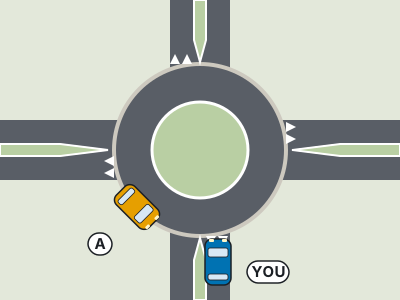
13. When entering a roundabout, who must you yield to?
- Only vehicles entering from your right
- Only large trucks already in the circle
- All traffic already in the roundabout
- Pedestrians only after you enter
Show answer
All traffic already in the roundabout. Before entering a roundabout, slow down and yield to traffic that is already circulating. Enter to the right only when there is a safe gap. The vehicles-from-your-right choice confuses roundabouts with some other intersection rules; traffic inside the circle has priority regardless of which entry you are using. Use the cue of the central island: watch the circulating lane, wait for a gap, then travel counterclockwise.
14. Within the first 12 months of a California minor's license, the teen has two at fault collisions. What can DMV do?
- Nothing until a third incident
- Bar the teen from driving for 30 days unless a licensed adult at least 25 rides along
- Revoke the license permanently
- Require only a letter of apology
Show answer
Bar the teen from driving for 30 days unless a licensed adult at least 25 rides along. California escalates action against a minor's license by the number of at fault collisions or traffic convictions. Two of them, or one of each, mean the teen cannot drive for 30 days unless a licensed adult at least 25 years old is in the vehicle. DMV does not wait for a third incident; the third step is a six month suspension with a year of probation. Permanent revocation is not the listed consequence, and an apology letter is not part of the process.
15. Which medication-related situation can make driving illegal?
- Only taking medication bought without a prescription
- Taking medicine only after sunset
- Taking any drug that affects your ability to drive safely
- Carrying prescription medicine in the vehicle
Show answer
Taking any drug that affects your ability to drive safely. California treats impairment from drugs seriously, whether the drug is illegal, prescribed, or bought over the counter. If it affects your ability to drive safely, driving can be illegal. The prescription-medicine choice misses the point because possession is not the issue; impairment is. A cue is the warning label or side effect, such as drowsiness, slowed reaction, or poor attention. Read labels before deciding to drive.
16. You are on a narrow mountain road where you cannot see at least 200 feet ahead. What does the handbook say you may do with your horn?
- Sound it to alert oncoming traffic you cannot yet see
- Save it strictly for emergencies once a collision is unavoidable
- Sound it only after an oncoming vehicle appears
- Leave it alone, because horns are prohibited on mountain roads
Show answer
Sound it to alert oncoming traffic you cannot yet see. Mountain curves hide oncoming traffic until the last moment, so California lists this as one of the situations where a horn genuinely helps: a short sound warns a driver you cannot see that someone is coming around the bend. Waiting until the other vehicle appears defeats the purpose, since by then you both need braking distance you may not have. Horns are not banned on these roads either. Keep it brief and stay right of the center line, because the horn warns other people but does nothing to widen the lane or slow your own vehicle.
17. How must you treat a red and white regulatory sign?
- Treat it as a suggestion
- Obey it only in daylight
- Follow the instruction it gives, such as DO NOT ENTER
- Obey it only when workers are present
Show answer
Follow the instruction it gives, such as DO NOT ENTER. Red and white is the color of direct orders: stop, yield, do not enter, and wrong way all speak in commands, not advice. The handbook's example makes the grammar explicit, since entering a ramp against traffic causes head-on freeway crashes. Obey these signs at all hours and in all conditions; unlike warning signs, they never depend on your judgment of the situation.
18. How should you use signals when pulling to the curb to back up?
- Leave it blinking after parking
- Never signal when backing
- Signal before pulling to the curb, then cancel when done
- Signal only once parked
Show answer
Signal before pulling to the curb, then cancel when done. The signal tells followers your slowdown means parking rather than turning or stalling, and canceling afterward keeps the next driver from misreading a stale blinker. This on-then-off discipline applies to every maneuver: signal intent before moving, complete the move, then cancel. Modern self-canceling stalks help, but shallow turns often leave them on. Stale blinkers after shallow turns fool drivers into expecting another move.
19. What free help does the Freeway Service Patrol (FSP) provide?
- Gas, jump starts, radiator water, flat-tire changes, and collision reports
- Free engine rebuilds and body work
- Rides home for stranded drivers
- Payment of your towing bill anywhere
Show answer
Gas, jump starts, radiator water, flat-tire changes, and collision reports. The Freeway Service Patrol is a free roaming motorist-aid program that fixes small problems on the spot so disabled cars clear the freeway quickly. A gallon of gas, a jump start, radiator water with taped hoses, a flat-tire swap, or a collision report to CHP covers most strandings. Major repairs, passenger transport, and private tow bills fall outside the program's roadside mission.
20. Your vehicle starts skidding sideways. What should you do?
- Keep braking hard through the skid
- Turn away from the skid sharply
- Accelerate to power out of it
- Stop braking and steer into the direction of the skid
Show answer
Stop braking and steer into the direction of the skid. A skid means the tires have lost grip, and braking harder only extends the slide. Releasing the brakes lets the wheels roll and grip again, while steering into the skid points the tires along the slide so they can recover traction. Once grip returns, straighten the wheel smoothly; jerking it the other way starts a second skid in the opposite direction.
New California driver? Insurance is the next step
Once the permit or license is in hand, the family policy changes. QualitySpace is an independent California broker (Kevin Vu, CDI #4037122): teen-driver additions, first-time policies, and multi-car bundles quoted across many carriers in one call.
Get a free quote or call 714-666-6669. English and Vietnamese.
Every question is written from the official California Driver's Handbook. Need paper? Printable CA practice test with answer key.
Last verified 2026-09-08. How we check every question · Study all 500 as flashcards
Frequently asked questions
How many questions are on this California practice test?
This fixed set has 20 questions. It is test 18 of 25 from the 500 question California bank. The real CA exam has 36 questions for applicants 18 and older and 46 for applicants under 18. A passing score is 80%.
What is the passing score for the real California test?
A passing score is 80%. That figure comes from the official California source cited on the DMV facts page.
How does this fixed test relate to the full California bank?
Each numbered test is a fixed set of 20 questions in a fixed order, so you can retake the same test later and compare. Every test mixes road signs and the other topics in about the same proportion as the full bank. Tests 1 to 25 together cover every question in the California bank once. The full practice page mixes the whole bank at random.
Last verified 2026-09-08. See the California DMV facts page for sourced state details.
Return to the full California practice test · Study road signs