
Test 17 of 25 · 20 questions · Free 2026
CA Permit Practice Test 17
Jump to the test ↓A fixed 20 question set from the California bank with answers and plain English explanations. The real CA exam has 36 questions for applicants 18 and older and 46 for applicants under 18. A passing score is 80%. Take the full length version on the main practice page.
Parent of a new California driver? Adding a teen to the family policy changes the price. Get a free quote or call 714-666-6669. English and Vietnamese.
Question 1 of 20 · 0 right so far
All 20 questions in test 17
Every question below comes from the California question bank on this page. Open a question to see the correct answer and the explanation. Nothing here is hidden behind a signup.
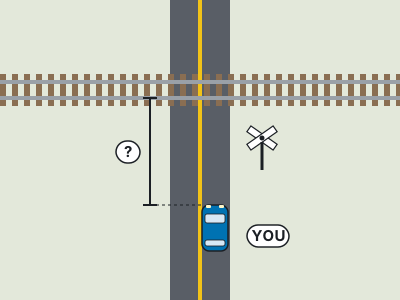
1. When a crossing device warns that a train is coming, how far from the nearest track must you stop?
- Only behind the vehicle ahead
- At least 5 feet away
- Exactly 100 feet away
- At least 15 feet away
Show answer
At least 15 feet away. When warning devices or a person indicate a train is coming, stop at least 15 feet from the nearest track. Stopping five feet away places the vehicle too close to the rail area, and 100 feet is a speed-limit visibility condition, not the stopping distance. The cue is an active warning: flashing red railroad lights, gates, bells, or a flagger mean stop well before the track and wait.
2. You face a steady red right arrow. When may you turn right?
- After a complete stop if no pedestrians are present
- When cross traffic has a yellow signal
- After yielding, unless a sign says no turn on red
- Only after the signal changes to green or a green arrow
Show answer
Only after the signal changes to green or a green arrow. A steady red arrow does not allow the same turn as a circular red signal. Stay stopped until a green light or green arrow appears for your movement. The choice about stopping and yielding sounds like the right-turn-on-red rule, but that rule applies to a red light, not a red arrow. Use the arrow shape as the cue: it controls the direction shown and keeps that turn stopped.
3. Before opening your driver-side door next to traffic, what should you check for?
- Passing vehicles, bicycles, and motorcycles
- Only whether the parking brake is set
- Whether the curb is painted green
- Only vehicles coming from the front
Show answer
Passing vehicles, bicycles, and motorcycles. Before exiting a parked vehicle, look carefully for traffic that could strike the door, including bicycles and motorcycles. Checking only the parking brake does not protect someone riding beside the parked cars. A cue is any door opening toward a travel lane or bike lane: use mirrors and a shoulder glance, wait for a safe gap, then open the door only as much as needed.
4. You want to turn right at a red light. Which sign would forbid the turn?
- A YIELD sign on the cross street
- A speed limit sign
- A ONE WAY sign
- A NO TURN ON RED sign
Show answer
A NO TURN ON RED sign. Right on red is a privilege with conditions: full stop first, no prohibiting sign, yield to pedestrians and cross traffic. The NO TURN ON RED sign removes the privilege entirely at intersections where turning sight lines are blind or pedestrian flows are heavy. One-way, yield, and speed signs govern other maneuvers and never authorize or ban the red-light turn by themselves.
5. Where can icy spots hide on cold, wet days?
- In shade from trees or buildings, which freezes first and dries last
- Only on north-facing mountain passes
- Only above 5,000 feet elevation
- Only on dirt roads
Show answer
In shade from trees or buildings, which freezes first and dries last. Sunlight is the road's natural de-icer, so pavement denied direct sun stays frozen long after open stretches dry out. A shaded curve can hide black ice between two dry sunny straights, which is exactly where drivers get surprised. Treat every shadow across the road on a cold wet day as a potential ice patch and slow before reaching it. Bridge decks and shaded curves deserve extra caution on every cold morning commute.
6. You are in a collision. What is your first duty, and why?
- Move your vehicle before anyone arrives
- Leave to find a telephone
- Stop, because someone could be injured and need your help
- Wait in your vehicle for police to arrive
Show answer
Stop, because someone could be injured and need your help. Stopping is the first and non-negotiable duty after any collision, because injuries are often hidden at first and your help or your emergency call may be what gets aid started. Leaving the scene for any reason is hit-and-run, which the handbook warns is punished severely upon conviction. Only after stopping do the remaining duties apply: moving a drivable vehicle out of traffic, warning others, exchanging information, and reporting the crash as required.
7. What is the penalty for dumping or abandoning animals on a California highway?
- A warning for a first offense
- Community service only
- A fine of up to $1,000, six months in jail, or both
- License suspension for 30 days
Show answer
A fine of up to $1,000, six months in jail, or both. California treats dumping animals on a highway as a real crime, not a minor infraction, because abandoned animals cause collisions and suffer cruelly. The punishment reaches a $1,000 fine, six months in county jail, or both, matching the seriousness of reckless roadway behavior. Warnings, community service alone, and short license suspensions all understate what the law allows. Beyond the penalty, an animal darting into traffic can kill its rescuers too, so surrender unwanted animals to a shelter instead of abandoning them.
8. Who may stop at a red zone in California?
- Anyone stopping briefly to load passengers
- No one, except buses at a red zone marked for buses only
- Taxis picking up fares
- Delivery trucks for five minutes
Show answer
No one, except buses at a red zone marked for buses only. Red means no stopping, standing, or parking for anyone, because these zones protect fire access, sight lines, and traffic flow at the most sensitive curbs. The single exception is a bus serving a red zone explicitly marked for buses only, where the stop is part of scheduled transit service. Passenger loading, taxis, and quick deliveries all belong at white or yellow zones instead. Even a brief stop in a red zone risks a ticket and can block emergency equipment, so keep moving until you find a legal curb.
9. During the first 12 months of a California provisional license, who may supervise the holder when carrying passengers under 20, apart from authorized exceptions?
- A licensed parent or guardian, a licensed driver at least 25, or a licensed or certified driving instructor
- Any licensed driver who is at least 18
- Any passenger who is 20 or older, licensed or not
- An older sibling who holds an instruction permit
Show answer
A licensed parent or guardian, a licensed driver at least 25, or a licensed or certified driving instructor. During the first 12 months of a provisional license, the holder may not transport passengers under 20 unless accompanied and supervised by a licensed parent or guardian, a licensed driver who is 25 or older, or a licensed or certified driving instructor. A licensed 18 year old does not meet the age requirement, an unlicensed passenger cannot supervise however old they are, and a permit holder is not a licensed driver. Separate exceptions exist for documented needs such as medical, school, or work necessity, each backed by a signed statement.
10. What happens to fines on a California road marked as a Safety Enhanced-Double Fine Zone?
- Fines are waived for first offenses
- Fines apply only to trucks
- Fines are doubled
- Fines are reduced if no crash occurred
Show answer
Fines are doubled. Certain roads are chosen as Safety Enhanced-Double Fine Zones because of increased collision-related injuries and fatalities, and fines are doubled in these zones. Fines are also doubled in highway construction or maintenance zones when workers are present. Work zone fines can be $1,000 or more, and assaulting a highway worker brings fines up to $2,000 and up to a year in jail. The doubling applies to every driver, not only trucks, and does not depend on a crash.
11. What lane space should you give a motorcycle when possible?
- Only the left half of the lane.
- The full lane.
- Enough room to share the lane side by side.
- A shoulder path if traffic is slow.
Show answer
The full lane.. California advises drivers to give motorcycles the full lane whenever possible. Motorcycles are smaller and can be harder to see, but they are still entitled to the lane space needed for safety. The side-by-side choice is wrong because the handbook separately warns never to pass a motorcycle in the same lane. Use the cue of a motorcycle ahead or beside you: leave a normal lane cushion instead of trying to squeeze past.
12. What follows a DUI conviction at 0.01% BAC or higher?
- Only a warning letter
- A fine with no other action
- One-year revocation plus a licensed DUI program
- A 30-day restriction only
Show answer
One-year revocation plus a licensed DUI program. Under-21 drivers convicted at the 0.01% zero-tolerance line lose the privilege for a full year and must complete state-licensed DUI education before returning. The program requirement applies on top of fines, fees, and any court punishment. Refusing the chemical test that would prove the violation triggers its own separate suspension. Fines, fees, and court costs pile on top of the revocation and program.
13. May bicyclists ride on California freeways?
- Never, under any circumstance
- On certain sections with no alternate route, where not forbidden by law
- On all freeways at all times
- Only during daylight hours
Show answer
On certain sections with no alternate route, where not forbidden by law. Freeway cycling is the rare exception the handbook tolerates only where cyclists have no other path and no law closes that stretch. Expect these riders on rural connectors and bridge approaches, give them a full lane, and pass with care. Where alternate routes exist, bicycles belong off the freeway entirely. Rural connectors and bridge approaches are where freeway cyclists usually appear.
14. What does California ban regarding alcohol and cannabis in a moving vehicle?
- Only drinking hard liquor while driving
- Only smoking cannabis as a passenger
- Drinking any alcohol, or smoking or eating cannabis, as a driver or passenger
- Only eating cannabis edibles while parked
Show answer
Drinking any alcohol, or smoking or eating cannabis, as a driver or passenger. The handbook's ban covers both substances and both seats: drivers and passengers alike may not drink alcohol or use cannabis in any form while the car is on the road. Smoking, vaping, eating edibles, and sipping all violate the same rule. Sealed, unopened containers may be transported under strict storage rules, but nothing open may be consumed by anyone in the vehicle.
15. In which situations does California allow passing on the right?
- Whenever you are in a hurry and the shoulder is wide
- Only on a multi-lane highway or when the ahead driver is turning left
- Whenever the vehicle ahead is going below the limit
- Only when directed by a police officer
Show answer
Only on a multi-lane highway or when the ahead driver is turning left. Passing on the right is the exception rather than the rule, allowed only where extra lanes or a left-turning vehicle ahead make the maneuver safe. The shoulder is never a passing lane no matter how wide or tempting it looks, and merely slow traffic ahead never justifies a right-side pass on a two-lane road. For the mirror case, never pass on the left of a driver who is signaling a left turn.
16. You cannot see 200 feet in each direction. May you U-turn?
- Never make a U-turn there
- U-turns are always allowed
- Only motorcycles may U-turn
- Honk first, then U-turn
Show answer
Never make a U-turn there. The 200-foot sight rule guarantees approaching drivers time to see and react to a slow-turning car blocking lanes. Hills, curves, and parked cars that cut sight lines below that distance make the maneuver illegal on the spot. Find an intersection or driveway with full visibility instead of gambling blind. Hills and parked cars that cut visibility make the maneuver illegal immediately.
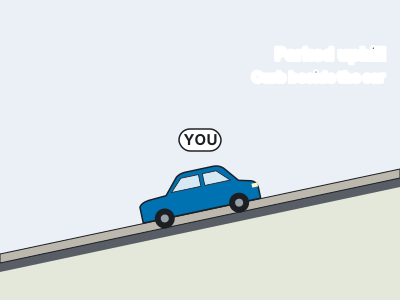
17. When parking uphill next to a curb, which way should you turn the front wheels?
- Toward the curb before setting the brake
- Away from the curb, then let the vehicle roll back slightly
- Straight ahead with the transmission in neutral
- Toward the center only if the curb is red
Show answer
Away from the curb, then let the vehicle roll back slightly. Uphill parking with a curb calls for turning the front wheels away from the curb and letting the vehicle roll back a few inches until the wheel rests gently against the curb. Turning toward the curb is the downhill rule. The cue is the hill direction: uphill plus curb means wheels left, then parking brake and park or gear. This positions the curb to stop the vehicle if equipment fails.
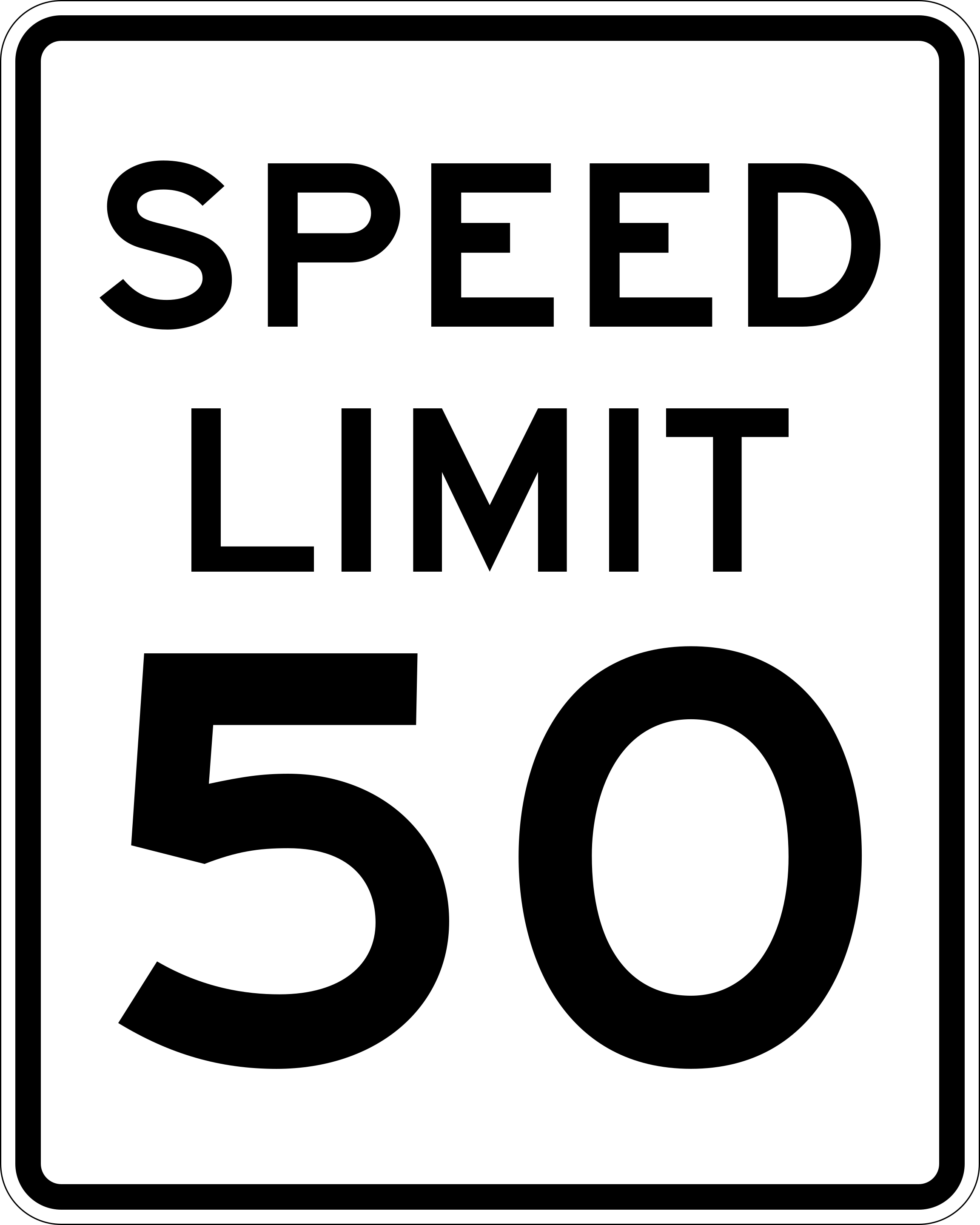
18. A white SPEED LIMIT sign with black lettering is what type of sign?
- A regulatory sign you must obey
- A guide sign for destinations
- A warning sign for changing road conditions
- A temporary construction advisory
Show answer
A regulatory sign you must obey. White rectangular signs communicate rules drivers must obey, and a speed limit sign is one of those regulatory signs. It is not merely a warning about a possible condition ahead. The guide-sign choice is also wrong because guide signs point to routes, places, or services instead of setting legal duties. A cue is the white rectangle with black text: read it as a rule, then adjust speed before passing the sign.
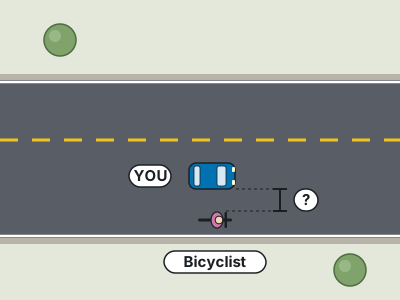
19. When you cannot change lanes to pass a bicyclist, how much clearance must you allow?
- At least two feet if traffic is light
- As much room as your lane allows, with no minimum
- One full car length
- At least three feet
Show answer
At least three feet. If you cannot move into another lane to pass a bicyclist, leave at least three feet between your vehicle and the bicycle. If three feet is not available, wait until it is. The no-minimum choice is wrong because the handbook gives a specific clearance requirement. A cue is a narrow lane with a bicyclist ahead: slow, hold position, and pass only when the three-foot space can be maintained.
20. What do broken white lane lines mean on a road with traffic moving in the same direction?
- Traffic on your side is about to become two-way
- Lane changes are prohibited until the next intersection
- The lane is reserved for emergency vehicles
- Changing lanes is allowed when it is safe
Show answer
Changing lanes is allowed when it is safe. Broken white lines separate lanes traveling in the same direction and allow lane changes when safe. You still need mirrors, a shoulder check, a signal, and enough space. The prohibited-lane-change choice describes a solid line or signed restriction, not the broken white marking. A cue is the color and pattern together: white means same direction, and the breaks show a permitted crossing when conditions allow.
New California driver? Insurance is the next step
Once the permit or license is in hand, the family policy changes. QualitySpace is an independent California broker (Kevin Vu, CDI #4037122): teen-driver additions, first-time policies, and multi-car bundles quoted across many carriers in one call.
Get a free quote or call 714-666-6669. English and Vietnamese.
Every question is written from the official California Driver's Handbook. Need paper? Printable CA practice test with answer key.
Last verified 2026-09-08. How we check every question · Study all 500 as flashcards
Frequently asked questions
How many questions are on this California practice test?
This fixed set has 20 questions. It is test 17 of 25 from the 500 question California bank. The real CA exam has 36 questions for applicants 18 and older and 46 for applicants under 18. A passing score is 80%.
What is the passing score for the real California test?
A passing score is 80%. That figure comes from the official California source cited on the DMV facts page.
How does this fixed test relate to the full California bank?
Each numbered test is a fixed set of 20 questions in a fixed order, so you can retake the same test later and compare. Every test mixes road signs and the other topics in about the same proportion as the full bank. Tests 1 to 25 together cover every question in the California bank once. The full practice page mixes the whole bank at random.
Last verified 2026-09-08. See the California DMV facts page for sourced state details.
Return to the full California practice test · Study road signs