
Test 3 of 25 · 20 questions · Free 2026
CA Permit Practice Test 3
Jump to the test ↓A fixed 20 question set from the California bank with answers and plain English explanations. The real CA exam has 36 questions for applicants 18 and older and 46 for applicants under 18. A passing score is 80%. Take the full length version on the main practice page.
Parent of a new California driver? Adding a teen to the family policy changes the price. Get a free quote or call 714-666-6669. English and Vietnamese.
Question 1 of 20 · 0 right so far
All 20 questions in test 3
Every question below comes from the California question bank on this page. Open a question to see the correct answer and the explanation. Nothing here is hidden behind a signup.
1. Unless otherwise posted, what is the ideal maximum speed on most California highways?
- 55 mph
- 65 mph
- 70 mph
- 60 mph
Show answer
65 mph. Most California highways post 65 mph as the standard maximum where conditions allow, balancing travel speed against stopping distances and traffic mix. Fifty-five applies to two-lane undivided highways and to vehicles towing trailers, not to multilane freeways generally. Seventy appears only where specifically posted on select segments, and 60 is not a standard California maximum. Remember that any posted limit is a ceiling for good conditions: rain, fog, heavy traffic, and work zones all demand slower speeds under the Basic Speed Law.
2. Which adult point total may lead DMV to suspend a California driver license?
- 2 points in 12 months.
- 4 points in 12 months.
- 5 points in 24 months.
- 7 points in 36 months.
Show answer
4 points in 12 months.. For adults, California lists possible suspension when the record shows 4 points in 12 months, 6 in 24 months, or 8 in 36 months. The 7-in-36 choice is one point short of the handbook's 36-month total. These numbers matter because convictions and certain collisions remain on the driving record. The cue is the time window: match the point count to 12, 24, or 36 months before deciding whether the negligent-operator threshold is reached.
3. Why must you never move in front of a large truck and suddenly slow down or stop?
- The truck cannot stop fast enough to avoid crashing into you
- The truck driver cannot see your brake lights
- Trucks are exempt from following-distance rules
- The truck will automatically change lanes
Show answer
The truck cannot stop fast enough to avoid crashing into you. A loaded truck needs far more stopping distance than a car, and that gap shrinks to nothing when a smaller vehicle cuts in and brakes without warning. The truck's momentum makes a rear-end crash unavoidable no matter how alert or skilled its driver is, and the car always loses that exchange. The handbook's rule protects both vehicles by keeping a full cushion ahead of large trucks: never move in front of one and suddenly slow down or stop.
4. Who leads a funeral procession, and what priority does it have?
- The hearse leads and other drivers may pass freely
- A family car leads with no special priority
- A traffic officer leads it and the procession has the right-of-way
- A motorcycle escort leads but must obey all signals
Show answer
A traffic officer leads it and the procession has the right-of-way. A funeral procession moves as a single unit under a traffic officer's lead, and California grants that unit the right-of-way so mourners are not split across intersections by red lights. Participating vehicles mark themselves with windshield identifiers and headlights on, signaling other drivers to hold back. Cutting into or through the procession can draw a ticket for interfering with it. When you meet one, yield, avoid passing through the line, and resume normal driving only after the last marked vehicle clears.
5. A pedestrian signal shows a flashing raised hand. What should you do as a pedestrian?
- Run across quickly before it changes
- Cross only in the second half of the street
- Do not start crossing the street
- Cross if no vehicles are moving
Show answer
Do not start crossing the street. The flashing hand is the clearance interval: traffic is about to get the green, so anyone still on the curb must wait for the next walk cycle. Starting now strands you mid-crossing against moving cars, and running does not fix the timing because drivers are already preparing to go. Half-street crossings and reading gaps in traffic both gamble against signal timing designed to protect you. If you are already crossing when it starts flashing, keep walking steadily to finish; the command applies to starting, not to freezing mid-street.
6. When passing a stopped bus, streetcar, or trolley at a safety zone, what speed limit applies?
- No more than 15 mph
- No more than 10 mph
- No more than 25 mph
- Normal posted speed if the lane is clear
Show answer
No more than 10 mph. When a bus, streetcar, or trolley is stopped at a safety zone or traffic light, you may pass at no more than 10 mph. The 25 mph choice confuses this rule with school and business or residential speed limits. The cue is a stopped transit vehicle beside a safety zone marked for pedestrians; slow to a crawl and watch for people entering or leaving the vehicle.
7. No pedestrian signal faces your crosswalk. Which signal should you obey?
- Cross whenever you like
- Obey the vehicle traffic signals
- Wait for another pedestrian to lead
- Cross only on flashing red
Show answer
Obey the vehicle traffic signals. Where no pedestrian head exists, the vehicle signal governs everyone: cross with the green facing your direction of travel and never start on yellow or red. The same crosswalk right-of-way rules protect you once you step off the curb legally. Look for turning cars even on your green, since drivers often watch gaps instead of crosswalks. Turning drivers still must yield to walkers crossing legally on the green.
8. Before backing up, what visual check does the handbook require?
- Check mirrors and look over your shoulder for traffic and pedestrians
- Use only the backup camera if the image is clear
- Look only through the left side window
- Trust a passenger outside the vehicle to guide you
Show answer
Check mirrors and look over your shoulder for traffic and pedestrians. Before backing, check mirrors and look over your shoulder so you can see vehicles and pedestrians that mirrors or cameras may miss. The backup-camera-only choice is inadequate because technology assists but does not replace an actual visual check. The cue is any reverse movement from a curb, driveway, or parking space; pause first, look behind and to the sides, then back at a smooth safe speed.
9. Which point totals can suspend an adult license?
- 1 point in 6 months
- 2 points ever
- 10 points in a year
- 4 in 12 months, 6 in 24, or 8 in 36
Show answer
4 in 12 months, 6 in 24, or 8 in 36. The negligent-operator ladder counts violations and at-fault crashes over rolling windows, suspending adults whose records hit any rung. Points stay for years and stack across tickets, so a few moving violations can trigger suspension without any crash. Traffic school can hide one point from insurers but the DMV record keeps its own count. Violations and at-fault crashes both feed the rolling negligent-operator count.
10. How long do DUI convictions remain on a California driver record?
- 10 years
- 18 months
- 3 years
- Only until all fines are paid
Show answer
10 years. California keeps every DUI conviction on a driver record for 10 years. The three year choice may sound familiar because some traffic convictions and collisions remain for 36 months or longer, but DUI has a specific 10 year record period. The cue is any conviction for driving under the influence, since later DUI penalties can depend on whether another DUI occurred within that decade.
11. Can you be cited for driving slower than the posted speed limit?
- Yes, driving faster or slower than the limit can both draw a citation
- No, only exceeding the limit is citable
- No, slow driving is only a warning offense
- Yes, but only on freeways
Show answer
Yes, driving faster or slower than the limit can both draw a citation. The limit works in both directions: excessive speed causes crashes, while unreasonably slow driving disrupts traffic flow and provokes risky passing from frustrated drivers behind you. The handbook pairs this two-sided rule with lane courtesy, directing slower drivers to keep right and to yield the lane when faster traffic approaches from behind. If traffic or weather forces everyone slower, match the safe flow rather than camping at an unyielding pace.
12. You have one lane in your direction and a solid yellow line on your side. May you pass the car ahead?
- Yes, whenever the way ahead looks clear
- Yes, but only if you ride a motorcycle
- Yes, but only during daylight hours
- No, passing is banned with one lane and solid yellow on your side
Show answer
No, passing is banned with one lane and solid yellow on your side. One solid yellow line down the middle means traffic flows in opposite directions on either side, and with only a single lane serving you there is no safe place to pass. The ban holds regardless of visibility, vehicle type, or time of day. Passing requires a broken line on your side of the center. Same-direction lanes are divided by white lines instead, and bike lanes use solid white edge lines.
13. When may an animal be transported in the back of a pickup or other truck?
- Whenever the trip stays below 35 mph.
- Only when the animal is properly secured.
- If the tailgate is closed and traffic is light.
- Only on rural roads outside business districts.
Show answer
Only when the animal is properly secured.. California says not to transport animals in the back of a pickup or other truck unless the animal is properly secured. The closed-tailgate option is incomplete because the handbook focuses on preventing the animal from falling, jumping, or being thrown from the vehicle. Speed and road type do not replace secure restraint. The cue is an animal riding in an open truck bed: before moving, confirm it is secured against escape or ejection.
14. Who can be ticketed if a passenger under 16 is not wearing a seat belt?
- Only the unbelted passenger
- Only the passenger's parent or guardian
- The driver
- The vehicle owner, even if not present
Show answer
The driver. The driver can receive a ticket when a passenger under 16 is not buckled. The passenger-only choice is wrong for this age group because the handbook puts responsibility on the driver as well. The cue is the passenger's age: if the rider is younger than 16, confirm the seat belt is fastened before moving, just as you would check mirrors or doors.
15. You have parked and shut off the car. What must you do before getting out?
- Open the door immediately
- Exit on the traffic side always
- Leave the engine running
- Check for passing vehicles, bicycles, and motorcycles, then exit when safe
Show answer
Check for passing vehicles, bicycles, and motorcycles, then exit when safe. Dooring a cyclist or stepping into a passing car turns a finished park into a crash, so the exit check is a mandatory final step. After shutting off and braking, scan the mirror and over your shoulder for anything approaching on your side. Only open the door into a confirmed clear gap, and keep children on the curb side until the street side is safe.
16. What does a yellow winding-road sign tell you?

- A single sharp turn is immediately followed by a stop sign
- A road crew is directing alternating one-way traffic
- A high-wind area begins and trailers are prohibited
- Several curves are ahead and speed should be controlled early
Show answer
Several curves are ahead and speed should be controlled early. A winding-road sign warns that more than one curve is ahead, so choose a speed you can hold through the sequence instead of reacting curve by curve. The high-wind choice is tempting because of the word winding, but the sign describes road alignment, not weather. The cue is the snaking arrow; look farther ahead for each bend and leave extra space before entering the first one.
17. Your vehicle stalls on train tracks and a train is approaching. Which direction should you run?
- Straight down the tracks away from the train
- Toward the nearest crossing gate
- Diagonally away from the tracks toward the direction the train is coming from
- Behind your vehicle so it shields you from debris
Show answer
Diagonally away from the tracks toward the direction the train is coming from. Leave the vehicle immediately and run diagonally away from the tracks in the direction the train is coming from. That path helps avoid debris pushed forward from the collision area. Running straight down the tracks keeps you in the danger path, and standing behind the vehicle is also unsafe. The cue is an approaching train with warning lights: get out first, move diagonally away, then call 911.
18. This sign is posted at the curb. What does it require?
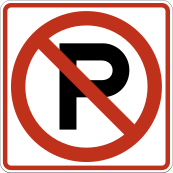
- Park briefly with flashers on
- Park only at night
- Load passengers for an hour
- Never park or leave your vehicle there
Show answer
Never park or leave your vehicle there. The NO PARKING face bans leaving the car at that curb around the clock unless the sign posts limited hours. Flashers, darkness, quick errands, and passenger loading create no exception. Find legal parking nearby: posted zones are enforced by citation and tow, especially near intersections, hydrants, and driveways. Posted zones near intersections and hydrants are enforced by tow as well.
19. A 16-year-old without a license is convicted of riding a bicycle under the influence in California. How can this affect future driving?
- It cannot, because a bicycle is not a motor vehicle
- The teen must wait until age 25 to apply
- The driving privilege may be suspended or delayed for one year once eligible
- Only a $10 fine applies
Show answer
The driving privilege may be suspended or delayed for one year once eligible. California reaches young cyclists too: anyone 13 to 20 years old convicted of operating a bicycle under the influence of alcohol or drugs may have the driving privilege suspended or delayed for one year once eligible to drive. The fact that a bicycle is not a motor vehicle does not protect the teen. Age 25 has nothing to do with this rule, and the handbook sets no $10 fine. The one year period is the same length as the minor alcohol penalties elsewhere in the handbook.
20. A California provisional driver needs to drive to a job during the restricted late night hours. What must they carry?
- A note signed by their employer confirming the employment
- Nothing, because work trips are automatically exempt
- A copy of their most recent paycheck
- A letter from a police department
Show answer
A note signed by their employer confirming the employment. Driving for work is one of the recognized exceptions to the provisional restrictions, but the minor must carry a note signed by the employer that confirms the employment. Work trips are not exempt without that note. A paycheck is not the document the handbook names, and law enforcement does not issue these permissions. The other exceptions follow the same pattern: a physician's note for a medical need, a note from the principal, dean, or designee for school activities, and a parent's note for driving an immediate family member.
New California driver? Insurance is the next step
Once the permit or license is in hand, the family policy changes. QualitySpace is an independent California broker (Kevin Vu, CDI #4037122): teen-driver additions, first-time policies, and multi-car bundles quoted across many carriers in one call.
Get a free quote or call 714-666-6669. English and Vietnamese.
Every question is written from the official California Driver's Handbook. Need paper? Printable CA practice test with answer key.
Last verified 2026-09-08. How we check every question · Study all 500 as flashcards
Frequently asked questions
How many questions are on this California practice test?
This fixed set has 20 questions. It is test 3 of 25 from the 500 question California bank. The real CA exam has 36 questions for applicants 18 and older and 46 for applicants under 18. A passing score is 80%.
What is the passing score for the real California test?
A passing score is 80%. That figure comes from the official California source cited on the DMV facts page.
How does this fixed test relate to the full California bank?
Each numbered test is a fixed set of 20 questions in a fixed order, so you can retake the same test later and compare. Every test mixes road signs and the other topics in about the same proportion as the full bank. Tests 1 to 25 together cover every question in the California bank once. The full practice page mixes the whole bank at random.
Last verified 2026-09-08. See the California DMV facts page for sourced state details.
Return to the full California practice test · Study road signs