
Test 19 of 25 · 20 questions · Free 2026
CA Permit Practice Test 19
Jump to the test ↓A fixed 20 question set from the California bank with answers and plain English explanations. The real CA exam has 36 questions for applicants 18 and older and 46 for applicants under 18. A passing score is 80%. Take the full length version on the main practice page.
Parent of a new California driver? Adding a teen to the family policy changes the price. Get a free quote or call 714-666-6669. English and Vietnamese.
Question 1 of 20 · 0 right so far
All 20 questions in test 19
Every question below comes from the California question bank on this page. Open a question to see the correct answer and the explanation. Nothing here is hidden behind a signup.
1. Fog becomes too thick for safe driving. What should you consider doing?
- Pull off the road, turn on emergency flashers, and wait.
- Use high beams and continue at the posted speed.
- Drive using only fog lights.
- Cross lanes to find a clearer path.
Show answer
Pull off the road, turn on emergency flashers, and wait.. In heavy fog or smoke, California first recommends avoiding the drive if possible. If fog becomes too thick while you are already driving, consider pulling off the road, activating emergency flashers, and waiting for conditions to improve. The high-beam option is wrong because high beams reflect back and cause glare. Your cue is limited sight distance that prevents a safe stop within what you can see: leave the lane instead of pressing on.
2. Your license was suspended after an uninsured collision. How can you get it back early?
- Nothing can restore it early
- Only a governor's pardon works
- Move to another state instead
- File an SR 22/SR 1P certificate and maintain it for three years
Show answer
File an SR 22/SR 1P certificate and maintain it for three years. Uninsured at-fault drivers lose the privilege for up to four years, but proof of future financial responsibility can cut the wait. The SR 22 or SR 1P certificate filed by an insurer guarantees coverage, and maintaining it unbroken for three years proves the lesson stuck. Dropping coverage restarts the suspension. Dropping the required coverage at any point restarts the full suspension.
3. A later test after your PAS shows 0.05% BAC or higher. What can happen?
- You may be arrested for DUI and your privilege may be suspended
- Nothing further can happen
- You only pay a small fine
- You must retake the drive test
Show answer
You may be arrested for DUI and your privilege may be suspended. The follow-up test confirms what the screen suggested, and 0.05% or higher gives the officer probable cause to arrest and DMV grounds to suspend. Each step of the sequence raises the stakes: screen, evidentiary test, arrest, and administrative action. The same ladder applies to drug impairment discovered through the blood or urine testing the handbook describes. Separate DMV and court cases mean two fights from the same arrest.
4. When does darkness require your headlights?
- Only after midnight
- When it is too dark to see 1,000 feet away
- Only in tunnels
- Only when it rains
Show answer
When it is too dark to see 1,000 feet away. The thousand-foot visibility test sets an objective trigger: if darkness hides things that far out, headlights go on whether or not the sun has set. Storms, smoke, and dusk all trip the rule before true nightfall. California pairs it with the wipers-on rule so rain driving always runs lit. Storms and smoke trip the headlight rule well before true nightfall arrives.
5. How large a space do you need to parallel park?
- Any gap bigger than the car
- Exactly the car's length
- At least three feet longer than your vehicle
- Twice the car's length
Show answer
At least three feet longer than your vehicle. Three spare feet give room to swing in at 45 degrees and straighten without tapping either bumper. Smaller gaps force multi-point shuffles that block the lane and risk contact. Once committed to a big-enough space, signal your intent, pull alongside the car ahead, check over your shoulder, and back in smoothly. If the gap is too tight, drive on and find a larger space ahead.
6. What jail time can a DUI conviction bring?
- Up to six months in jail, plus fines and impound
- A warning for the first offense
- Only a small fine with no jail
- Community service instead of any penalty
Show answer
Up to six months in jail, plus fines and impound. California stacks DUI consequences so every conviction hurts several ways: custody time up to half a year, criminal fines, vehicle impound with daily storage fees, license action, DUI school, and insurance filings. The jail exposure exists even for first offenses without injury, and repeat or aggravated cases multiply it. These criminal penalties run separately from the DMV administrative suspension. Prior convictions and injuries raise every part of the punishment ladder higher.
7. How may a minor use a cell phone while driving?
- For hands-free calls during daylight
- Only to make an emergency assistance call
- For texting when traffic is stopped
- Any time the phone is mounted
Show answer
Only to make an emergency assistance call. A minor may use a cell phone while driving only for emergency assistance. The mounted-phone and single-swipe rules are adult hands-free rules, not permission for minors to talk or text. Stopped traffic is still driving for this restriction. The cue is the driver's age: if the driver is under 18, calls, answering, sending, and responding are off limits unless the call is for an emergency.
8. When can pavement be especially slippery during rain?
- After the road has completely dried
- Only after a full hour of heavy rain
- Only when the temperature is below freezing
- When rain first starts after dry, hot weather
Show answer
When rain first starts after dry, hot weather. Pavement can be very slippery when rain first begins, especially after a dry, hot spell has left oil and dust on the surface. Waiting for heavy rain to last an hour is the risky choice because the first drizzle may create the slickest coating. The cue is the first sign of rain, drizzle, or snow. Ease off the speed early and add following distance before traction disappears.
9. Two vehicles meet on a steep narrow road where neither can pass. Which driver should back up?
- The uphill-facing driver because gravity helps them stop
- The downhill-facing driver until the uphill vehicle can pass
- The driver closest to the centerline
- The larger vehicle, regardless of direction
Show answer
The downhill-facing driver until the uphill vehicle can pass. On a steep narrow road where only one vehicle can pass, the vehicle facing uphill has the right-of-way. The vehicle facing downhill should back up because it has more control backing uphill. The larger-vehicle choice ignores the direction rule. A cue is the grade: if your vehicle is facing downhill and there is no passing room, back carefully until the uphill vehicle can get through.
10. Your light is green and pedestrians are still crossing. Who has the right-of-way?
- Go, but cautiously, since pedestrians keep the right-of-way
- Go without looking because green means you own it
- Stop and wait for the next green
- Turn only, never go straight
Show answer
Go, but cautiously, since pedestrians keep the right-of-way. Green invites movement but never cancels the duty to yield to pedestrians lawfully in the road. Turning drivers especially must scan crosswalks before rolling, since walkers may be finishing legally on a stale WALK. The handbook repeats this caution for green arrows too: protection from cars is not protection from responsibility to people. Green-arrow turns demand the same pedestrian scan as ordinary green lights.
11. When may you drive in a bicycle lane?
- Whenever traffic is heavy
- Only when no cyclists are present
- Never, under any circumstance
- Only to park where permitted, enter or leave the road, or turn within 200 feet of an intersection
Show answer
Only to park where permitted, enter or leave the road, or turn within 200 feet of an intersection. Bike lanes are travel lanes for bicycles, and the handbook's three exceptions all involve brief crossings rather than travel: reaching a legal parking spot, entering or leaving the roadway, and merging across for a turn within 200 feet of the intersection. Cruising down the bike lane to beat traffic is never allowed. Always check mirrors and blind spots before crossing the solid white line.
12. This ONE WAY sign means traffic on that road moves:
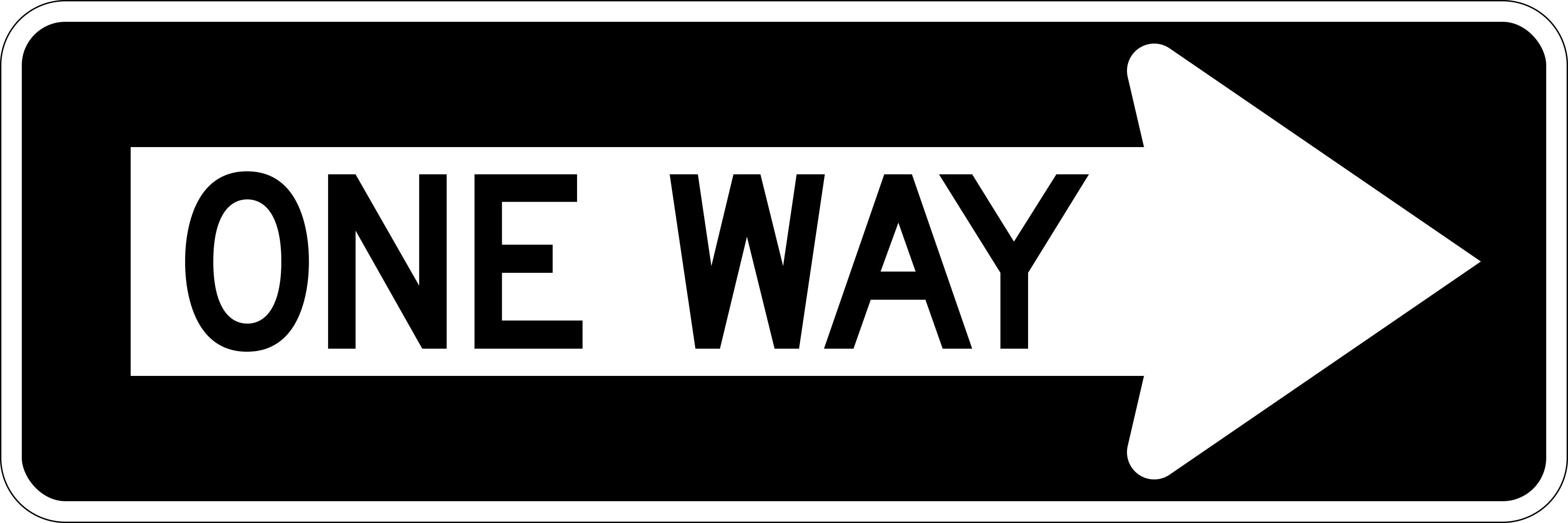
- Only in the direction shown by the arrow
- Both directions, but right turns have priority
- One direction for trucks and both directions for cars
- The arrow direction only during commute hours
Show answer
Only in the direction shown by the arrow. A ONE WAY sign is a white regulatory sign that controls the direction of travel. Drivers must travel only in the direction shown by the arrow on that roadway. The commute-hours choice invents a time limit; if a time restriction applies, another sign would say so. A cue is the black arrow and words: before turning onto the street, match your turn with the arrow direction and avoid entering against traffic.
13. Under California's Basic Speed Law, what should your speed depend on?
- Only the posted speed limit
- Only the speed of the fastest nearby vehicle
- Traffic, other vehicles' speed, road surface, and similar conditions
- Only the time of day
Show answer
Traffic, other vehicles' speed, road surface, and similar conditions. The Basic Speed Law makes the posted limit a ceiling, never a guarantee: you may never drive faster than conditions allow. Traffic density, the speed of surrounding vehicles, road surface, pedestrians, and weather can each demand a speed well under the sign. A driver at the posted limit in fog or heavy rain can still violate the Basic Speed Law.
14. Cargo on a California passenger vehicle sticks out past the right side fenders. What is the most it may extend?
- 6 inches
- 12 inches
- 4 feet
- It may not extend at all
Show answer
6 inches. On a passenger vehicle, cargo may not extend beyond the fenders on the left side at all, and no more than 6 inches beyond the fenders on the right side. Twelve inches doubles the right side limit. Four feet is the rear overhang that triggers a 12 inch red or orange flag, not a side limit. The no extension rule is for the left side so it is the wrong answer for the right side.
15. If you choose to drive slower than other traffic, which lane should you use?
- Any lane as long as hazard lights are on
- The far-left passing lane
- The right lane
- The lane beside the center divider
Show answer
The right lane. Slower traffic should use the right lane so faster traffic can pass without weaving or tailgating. The far-left lane choice conflicts with the handbook's lane guidance because that lane is generally for passing or left turns. The cue is a line of vehicles closing from behind while you are traveling below the flow; move right when safe and let them pass.
16. What should you do when a traffic light is not working?
- Proceed because the larger road has priority
- Treat the intersection as if all directions have STOP signs
- Stop only if another vehicle reaches the intersection first
- Use the pedestrian signal as the only control
Show answer
Treat the intersection as if all directions have STOP signs. A nonworking traffic light is handled like an all-way stop: stop first, then proceed cautiously when it is safe. The larger-road choice is unsafe because the handbook does not give automatic priority to the wider or busier road in this situation. The cue is a dark or failed signal head; make a complete stop, communicate with other road users, and apply normal stop-sign right-of-way order.
17. If your vehicle becomes disabled on a freeway and you can pull over safely, where should you go first?
- Into the left lane nearest the divider
- Safely onto the right shoulder
- To a stop in the current travel lane
- Across all lanes to the nearest median opening
Show answer
Safely onto the right shoulder. For a disabled vehicle on the freeway, California's first listed step is to safely pull over to the right shoulder. Stopping in the current travel lane leaves you exposed to fast traffic unless there is no workable alternative. The cue is losing power, a flat tire, or warning lights while on a freeway; signal, steer smoothly right when there is a gap, and get as far from moving traffic as practical.
18. You park on a grade where there is no curb. What must you do with the wheels?
- Turn them toward the center of the road
- Leave them straight and rely on the parking brake
- Turn them so the vehicle will not roll into the street, leave it in park, and set the parking brake
- Turn them sharply left regardless of direction
Show answer
Turn them so the vehicle will not roll into the street, leave it in park, and set the parking brake. Without a curb to catch a rolling tire, the wheels themselves must aim any roll away from traffic, so the handbook tells you to angle them so the vehicle cannot roll into the street. Park gear and the parking brake back that up as a triple lock against gravity. Straight wheels let the car roll wherever slope pulls it, and a fixed left turn only helps on one slope direction. On any grade, with or without a curb, always combine aimed wheels, park, and the brake before walking away.
19. What does a diamond-shaped sign on a truck tell you?
- The truck is over the weight limit
- The truck is making a wide turn
- The truck carries perishable food
- The truck's load may be dangerous, such as gas or explosives
Show answer
The truck's load may be dangerous, such as gas or explosives. Diamond placards on commercial trucks are hazardous-load warnings, alerting everyone nearby that the cargo may be flammable, explosive, or otherwise dangerous. Weight, turning, and refrigeration each have their own signs and contexts, but the diamond shape specifically flags hazmat. Give these trucks extra following distance, never cut in front of one, and note that they must stop before railroad crossings. In a collision involving a placarded truck, stay back and let emergency crews handle materials you cannot identify.
20. After driving through deep water, your brakes feel weak. How does the handbook say to dry them?
- Pump the brake pedal hard repeatedly
- Keep driving normally until they recover on their own
- Lightly press the accelerator and brake pedals at the same time until the brakes dry
- Shift into neutral and coast until they grip again
Show answer
Lightly press the accelerator and brake pedals at the same time until the brakes dry. Water on the brake drums or pads lowers friction, so the pedal can feel soft and stopping distances grow. The handbook's fix is to dry the brakes while rolling: press the accelerator and the brake pedal lightly together, just until braking feels normal again. Pumping hard is the response to a sinking pedal from a hydraulic problem, not wet brakes, and coasting in neutral gives up engine braking without drying anything. Test the brakes gently afterward and keep extra following distance until full stopping power returns.
New California driver? Insurance is the next step
Once the permit or license is in hand, the family policy changes. QualitySpace is an independent California broker (Kevin Vu, CDI #4037122): teen-driver additions, first-time policies, and multi-car bundles quoted across many carriers in one call.
Get a free quote or call 714-666-6669. English and Vietnamese.
Every question is written from the official California Driver's Handbook. Need paper? Printable CA practice test with answer key.
Last verified 2026-09-08. How we check every question · Study all 500 as flashcards
Frequently asked questions
How many questions are on this California practice test?
This fixed set has 20 questions. It is test 19 of 25 from the 500 question California bank. The real CA exam has 36 questions for applicants 18 and older and 46 for applicants under 18. A passing score is 80%.
What is the passing score for the real California test?
A passing score is 80%. That figure comes from the official California source cited on the DMV facts page.
How does this fixed test relate to the full California bank?
Each numbered test is a fixed set of 20 questions in a fixed order, so you can retake the same test later and compare. Every test mixes road signs and the other topics in about the same proportion as the full bank. Tests 1 to 25 together cover every question in the California bank once. The full practice page mixes the whole bank at random.
Last verified 2026-09-08. See the California DMV facts page for sourced state details.
Return to the full California practice test · Study road signs