
Test 2 of 25 · 20 questions · Free 2026
CA Permit Practice Test 2
Jump to the test ↓A fixed 20 question set from the California bank with answers and plain English explanations. The real CA exam has 36 questions for applicants 18 and older and 46 for applicants under 18. A passing score is 80%. Take the full length version on the main practice page.
Parent of a new California driver? Adding a teen to the family policy changes the price. Get a free quote or call 714-666-6669. English and Vietnamese.
Question 1 of 20 · 0 right so far
All 20 questions in test 2
Every question below comes from the California question bank on this page. Open a question to see the correct answer and the explanation. Nothing here is hidden behind a signup.
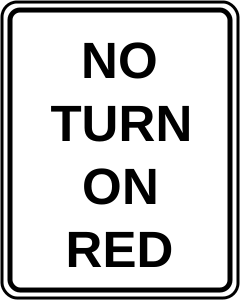
1. This sign faces you at a red light and you want to turn right. What must you do?
- Turn right without stopping
- Turn right after yielding only
- Do not turn right; wait for green
- Turn left instead
Show answer
Do not turn right; wait for green. The NO TURN ON RED sign removes the usual right-on-red privilege at intersections where sight lines are blind or pedestrian flows run heavy. Come to a full stop, hold behind the limit line, and wait for the green before turning. Disobeying the sign draws the same red-light citation as running it straight through. Running the signed ban draws the same citation as running the red light straight.
2. If you must get out on the freeway, which side should you use?
- On the left, near traffic
- Through the sunroof
- On the right side, away from traffic
- It does not matter which side
Show answer
On the right side, away from traffic. The right side faces the shoulder and the barrier instead of 65-mph traffic, so every entry and exit should use it. Children, elderly passengers, and pets especially must go right-side only. Once out, move behind the barrier if one exists and never stand between the car and the travel lanes. Never stand between the disabled car and the live travel lanes.
3. For normal push-pull steering, where should your hands start?
- At 10 and 2 o'clock
- At 12 and 6 o'clock
- One hand at 12 o'clock for all turns
- At 9 and 3 o'clock or 8 and 4 o'clock
Show answer
At 9 and 3 o'clock or 8 and 4 o'clock. California describes starting push-pull steering with hands at 9 and 3 or 8 and 4, keeping them there through turns. The 10 and 2 choice is not a position this handbook gives for push-pull steering. The cue is ordinary steering, not backing or operating a control; keep both hands on the wheel and never cross them over the middle of the wheel while turning.
4. Another driver is close behind you and wishes to drive faster. What should you do?
- Speed up to match the other driver
- Move to the right and let the faster driver pass
- Tap your brakes to signal the driver to back off
- Stay in your lane to teach the driver patience
Show answer
Move to the right and let the faster driver pass. Blocking a faster driver invites tailgating and risky passing attempts that endanger everyone nearby, including you. The handbook's courtesy rule is simple and unconditional: move right for faster traffic, and if you habitually drive slower than the surrounding flow, stay in the right lane as your default. Never brake-check a tailgater, since that turns mere annoyance into a rear-end collision that investigators will trace back to your brake lights.
5. A strong gust of wind hits your vehicle on an exposed road. What hand position does the handbook advise?
- Maintain a firm hand position on the steering wheel
- Grip the wheel loosely so it can self-correct
- Steer with one hand and brace the other on the door
- Let go briefly so the gust passes without resistance
Show answer
Maintain a firm hand position on the steering wheel. Gusts are unpredictable and can shove a tall vehicle sideways with little warning, especially on bridges and open stretches. A firm two-handed grip lets you correct instantly instead of being surprised by the wheel jerking in your hands. A loose grip or one-handed steering slows your correction and invites overcorrection, which can send the vehicle into the next lane. Letting go surrenders all control. Slow down as well, since lower speed gives gusts less leverage and gives you more time to react.
6. What colors can crosswalk markings use?
- Only white lines are ever used
- School crossings may use yellow lines, and unmarked crossings still count
- Crosswalk color has no meaning
- Yellow means no crossing allowed
Show answer
School crossings may use yellow lines, and unmarked crossings still count. Most crosswalks wear white stripes, but schools get yellow paint for extra visibility around children. Paint or no paint, every intersection leg is a legal crosswalk where pedestrians hold the right-of-way. Flashing-light crossings demand the same stop-or-yield respect whether the beacons are lit or dark. Unmarked intersection legs still grant pedestrians full legal right-of-way protection. Drivers must stop for pedestrians in any crosswalk, whatever its paint.
7. How must drivers treat school safety patrols and crossing guards?
- Wave them aside to keep traffic moving
- Honk to hurry them along
- Proceed around them carefully
- Obey their directions at all times
Show answer
Obey their directions at all times. Safety patrols and crossing guards stand in the road as the school's traffic authority, with legal power to stop cars for children. Their raised hand or stop paddle carries the force of a traffic signal. Patient obedience protects small pedestrians who cannot judge gaps themselves and keeps drivers clear of school-zone penalties. A guard's stop paddle carries the same force as a red traffic signal.
8. What must you do at a red arrow?
- Stop, then turn when clear like a stop sign
- Stop and remain stopped until a green signal or green arrow appears
- Slow down and turn with caution
- Stop only if pedestrians are present
Show answer
Stop and remain stopped until a green signal or green arrow appears. Unlike a solid red light, which allows a careful right turn after stopping in most cases, a red arrow commands a full stop with no turn until the arrow itself changes. The arrow exists where turning traffic would conflict with protected movements, so proceeding early drives straight into vehicles that have the green. Slowing without stopping ignores a stop command, and pedestrian presence is irrelevant to what the arrow requires. Wait for the green arrow or green signal, then turn with normal caution for cross traffic and pedestrians.
9. What does California say about driving very slowly?
- It is always the safest choice
- It is allowed in any lane at any speed
- Slow drivers must use hazard lights
- You should not block normal and reasonable traffic flow by driving too slowly
Show answer
You should not block normal and reasonable traffic flow by driving too slowly. Traffic safety depends on predictable, similar speeds, so a car crawling far below the flow creates dangerous closing-speed differences and provokes risky passes. California therefore tells slow drivers not to block normal and reasonable movement, and to keep right so faster traffic can pass. Extreme slowness is not automatically virtuous, hazard lights are for true hazards rather than a chosen pace, and no lane welcomes a rolling roadblock. If you must go slowly for conditions or a struggling vehicle, stay right, and leave the road entirely if you cannot keep a reasonable pace.
10. You see a blind pedestrian waiting to cross. What does the handbook say about your horn?
- Do not honk your horn at a blind person
- Honk lightly to signal it is safe
- Honk twice to announce your presence
- Honk only after stopping fully
Show answer
Do not honk your horn at a blind person. Blind pedestrians navigate by listening to traffic sounds, so a horn blast near them destroys the very information they need instead of helping. A honk can startle them into stepping the wrong way or freeze them in a dangerous spot. There is no coded honk pattern that communicates safety, and stopping first does not make honking useful. The correct response is to yield the right-of-way quietly, stop well short, and wait patiently until they finish crossing, keeping the soundscape clean for their judgment.
11. What pedal reflectors must a bicycle have for night riding?
- No pedal reflectors are needed
- Only the left pedal needs one
- White or yellow reflectors on pedals, shoes, or ankles, visible from 200 feet
- Any color reflector works
Show answer
White or yellow reflectors on pedals, shoes, or ankles, visible from 200 feet. Pedaling feet move up and down in drivers' headlights, and reflectors on that motion catch the eye from 200 feet away. Shoes or ankle bands with reflective material satisfy the rule as well as pedal reflectors. Colors are restricted to white or yellow so the signal stays consistent for drivers. Reflective shoes or ankle bands satisfy the rule as well as pedal reflectors.
12. May you drive with an unsecured load?
- Never drive with an unsecured load that is a safety hazard
- Unsecured loads are fine on short trips
- Only tie down loads on freeways
- Ropes are optional for heavy items
Show answer
Never drive with an unsecured load that is a safety hazard. Flying mattresses, ladders, and furniture kill motorists every year when tie-downs fail or were never used. The handbook bans driving with any unsecured load amounting to a hazard, whatever the road or distance. Net, rope, or strap every item, tug-test the work, and recheck after the first miles. Recheck every tie-down after the first few miles of any loaded trip.
13. Why should you create more space ahead when another vehicle is tailgating you?
- So you can brake harder and force the tailgater back.
- So you have more time to react and can let the tailgater pass when safe.
- So the tailgater can draft behind your vehicle.
- So you can speed up without changing lanes.
Show answer
So you have more time to react and can let the tailgater pass when safe.. A tailgater behind you reduces your margin if traffic changes suddenly, so California advises creating more space in front while maintaining course and speed, then moving right when safe to let the driver pass. The brake-harder choice increases rear-end risk and contradicts the handbook's calm response. The cue is a vehicle riding too close behind you: avoid sudden moves, open space ahead, and give that driver a chance to go around.
14. A yellow crossroad sign tells you to watch for what?

- A no-turn area controlled by red regulatory signs
- A hospital zone where sirens have priority
- Traffic entering or crossing from another road ahead
- A railroad crossing with gates and flashing red lights
Show answer
Traffic entering or crossing from another road ahead. A crossroad warning points to an intersection ahead where vehicles, bicycles, or pedestrians may cross your path. The railroad choice describes a different family of signs and warning devices, so it would aim your attention at tracks instead of side traffic. The cue is the plus-shaped symbol on yellow; ease off the accelerator and search both side approaches before you reach the conflict point.
15. A California provisional driver has a medical need to drive during restricted hours and no other reasonable way to travel. Whose signed note is required?
- A parent or guardian
- A school principal
- A physician, stating the condition and expected recovery date
- A DMV examiner
Show answer
A physician, stating the condition and expected recovery date. For the medical exception, the note must come from the minor's physician and must state the medical condition and the date the minor is expected to recover. A parent or guardian's note covers a different exception, driving an immediate family member. A principal, dean, or designee signs for school activities, not medical needs. DMV examiners do not write these exception notes. The exception also applies only when the minor cannot reasonably find another way to travel.
16. After a California DUI arrest, how long does the driver have to request a DMV administrative hearing?
- 10 days from the date of the arrest
- 30 days from the date of the arrest
- Until the criminal trial ends
- One year
Show answer
10 days from the date of the arrest. The deadline to request a DMV administrative hearing after a DUI arrest is 10 days from the date of the arrest. Thirty days is the life of the temporary license, not the hearing deadline, so waiting that long loses the hearing. The DMV action runs separately from the criminal case, so the end of a trial is not the clock. One year is the length of a DUI conviction suspension, not a filing window. If the window passes, the chance for that hearing is gone.
17. When must a collision be reported to DMV within 10 days?
- When property damage is more than $1,000 or anyone is injured or killed
- Only when a driver is cited at the scene
- Only when damage is more than $5,000
- When police decide not to write a report
Show answer
When property damage is more than $1,000 or anyone is injured or killed. A DMV collision report is required within 10 days when property damage exceeds $1,000 or when anyone is injured or killed, even for minor injuries. Waiting for a citation is wrong because fault or enforcement action is not the trigger. The cue is the damage amount or injury outcome. Each driver must file the SR 1 or have a representative file it, even if the crash happened on private property.
18. May you park in front of a curb that provides wheelchair access?
- Yes, for quick errands
- No, never block wheelchair-accessible curbs
- Yes, with hazard flashers on
- Yes, if no wheelchair user is present
Show answer
No, never block wheelchair-accessible curbs. Curb cuts and ramps are the only way wheelchair users reach the sidewalk, so blocking one strands a person in the street with traffic. The ban joins nearby rules against parking within three feet of a disabled-person ramp and inside the striped crosshatch beside accessible spaces. Errands, flashers, and the apparent absence of wheelchair users create no exception whatsoever. Blocking access can also draw a citation and a tow at your expense.
19. Where is it illegal to keep an open container of alcohol?
- In your glove box
- In the trunk
- Where passengers do not sit
- In a bus, taxi, camper, or motorhome
Show answer
In your glove box. The glove box sits within the driver's easy reach, which is exactly why the law names it: open alcohol must ride in the trunk or another spot where passengers do not sit. Passengers in buses, taxis, campers, and motorhomes are exempt from the open-container rule. Unopened, factory-sealed containers fall under different rules, including the strict under-21 transport conditions elsewhere in the handbook.
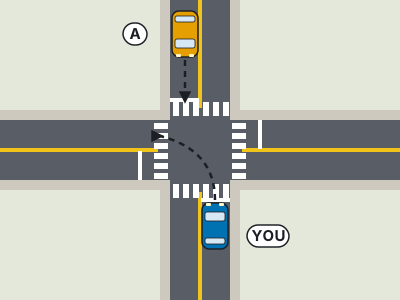
20. When turning left, which road users must you yield to?
- No one if your turn signal is on
- Only vehicles that are already stopped
- Only traffic approaching from behind
- Pedestrians and approaching vehicles close enough to be dangerous
Show answer
Pedestrians and approaching vehicles close enough to be dangerous. For a left turn, California says to check for pedestrians and yield to any pedestrian or approaching vehicle close enough to be dangerous. Having a turn signal on communicates intent, but it does not give priority over people or vehicles in the conflict path. The cue is waiting in the left turn position while oncoming traffic or pedestrians approach; turn only after the gap is safe.
New California driver? Insurance is the next step
Once the permit or license is in hand, the family policy changes. QualitySpace is an independent California broker (Kevin Vu, CDI #4037122): teen-driver additions, first-time policies, and multi-car bundles quoted across many carriers in one call.
Get a free quote or call 714-666-6669. English and Vietnamese.
Every question is written from the official California Driver's Handbook. Need paper? Printable CA practice test with answer key.
Last verified 2026-09-08. How we check every question · Study all 500 as flashcards
Frequently asked questions
How many questions are on this California practice test?
This fixed set has 20 questions. It is test 2 of 25 from the 500 question California bank. The real CA exam has 36 questions for applicants 18 and older and 46 for applicants under 18. A passing score is 80%.
What is the passing score for the real California test?
A passing score is 80%. That figure comes from the official California source cited on the DMV facts page.
How does this fixed test relate to the full California bank?
Each numbered test is a fixed set of 20 questions in a fixed order, so you can retake the same test later and compare. Every test mixes road signs and the other topics in about the same proportion as the full bank. Tests 1 to 25 together cover every question in the California bank once. The full practice page mixes the whole bank at random.
Last verified 2026-09-08. See the California DMV facts page for sourced state details.
Return to the full California practice test · Study road signs