
Test 13 of 25 · 20 questions · Free 2026
CA Permit Practice Test 13
Jump to the test ↓A fixed 20 question set from the California bank with answers and plain English explanations. The real CA exam has 36 questions for applicants 18 and older and 46 for applicants under 18. A passing score is 80%. Take the full length version on the main practice page.
Parent of a new California driver? Adding a teen to the family policy changes the price. Get a free quote or call 714-666-6669. English and Vietnamese.
Question 1 of 20 · 0 right so far
All 20 questions in test 13
Every question below comes from the California question bank on this page. Open a question to see the correct answer and the explanation. Nothing here is hidden behind a signup.
1. Your vehicle begins to skid on a slippery surface. What should you do with the brake pedal?
- Press it hard until the vehicle stops
- Tap it rapidly while turning away from the skid
- Avoid using it while you ease off the accelerator
- Hold it halfway down to keep the wheels straight
Show answer
Avoid using it while you ease off the accelerator. For a slippery-surface skid, ease off the accelerator and do not use the brakes. Braking can worsen the loss of traction and make steering less effective. The hard-brake option may feel natural in a surprise, but it can lock or overload the tires. A practical cue is the sideways slide: keep your eyes where you want to go, steer in the direction of the skid, and avoid sudden pedal inputs.
Study this in the handbook: Scanning, following distance and skids
2. What will the Freeway Service Patrol NOT do for you?
- Jump start a dead battery
- Report your collision to CHP
- Tow you to a private shop or home, or recommend repair businesses
- Give you a gallon of gas
Show answer
Tow you to a private shop or home, or recommend repair businesses. FSP keeps traffic moving rather than replacing private tow companies: if your car cannot be restarted, it goes free of charge only to a CHP-approved location, and CHP notifies your auto club or a tow service from there. Recommending shops would create conflicts of interest, so patrol drivers stay neutral. Gas, jump starts, and collision reports remain firmly on the provided list.
Study this in the handbook: School buses and railroad crossings
3. A yellow sign showing a small STOP sign ahead tells you to do what?

- Start slowing and prepare to make a full stop soon
- Maintain speed because it only marks a future parking rule
- Turn right at the next intersection without stopping
- Stop immediately at the warning sign itself
Show answer
Start slowing and prepare to make a full stop soon. A stop-ahead warning means the actual stop sign is coming soon, so start reducing speed and get ready for a complete stop at the proper line or crosswalk. Stopping immediately at the warning sign is the likely trap; the warning sign is advance notice, not the legal stop location. The cue is the miniature stop symbol on a yellow background, which gives you time to react before the red octagon appears.
4. Before opening a parked car door next to traffic, what should you check for?
- Motorcyclists near the traffic side of the vehicle.
- Only vehicles directly in front of you.
- Whether the curb is painted green.
- Whether your parking brake is released.
Show answer
Motorcyclists near the traffic side of the vehicle.. California specifically tells drivers to check for motorcyclists before opening a door next to traffic. The same habit also protects bicyclists and passing vehicles, but the handbook names motorcyclists in the motorcycle-sharing section. The front-only option is wrong because the danger comes from beside and behind the parked vehicle. Use the cue of any door opening into a lane: look back along the traffic side before the door moves.
Study this in the handbook: Trucks, emergency vehicles, bicycles and work zones
5. After a collision with no injuries, what should you do with a drivable vehicle?
- Leave it where it stopped until insurance arrives.
- Block the lane to preserve the scene.
- Drive home and report the collision later.
- Move it out of traffic and then call 911.
Show answer
Move it out of traffic and then call 911.. When no one is hurt in a collision, California tells drivers to move the vehicle out of traffic and then call 911. Leaving a drivable car in the lane can delay help and create another crash hazard. The preserve-the-scene option is wrong for this no-injury situation because the handbook prioritizes clearing traffic. Use the cue of no injuries and a vehicle that can move: get it out of the travel lane before making the call.
Study this in the handbook: Insurance, collisions and paperwork deadlines
6. How far may you drive in a California center left turn lane?
- Up to 500 feet
- Up to one block
- As far as needed to pass slow traffic
- Only 200 feet
Show answer
Only 200 feet. California limits travel in a center left turn lane to 200 feet. The lane exists to prepare for and make a left turn or U-turn, and it is not a regular traffic or passing lane. That rules out using it to pass slow traffic. Five hundred feet and a full block both exceed the limit. Before turning from the lane, look for vehicles coming toward you in the same center lane and signal.
Study this in the handbook: Lane markings and special lanes
7. Is driving after mixing alcohol with drugs illegal?
- Only illegal drugs count
- Any alcohol-drug combination that impairs safe driving
- Only alcohol above 0.08% matters
- Combinations are legal if prescribed
Show answer
Any alcohol-drug combination that impairs safe driving. Impairment is impairment whatever the recipe: alcohol plus prescriptions, over-the-counter pills, cannabis, or illegal drugs all trigger the same DUI law when they degrade driving ability. Prescribed status never excuses impaired driving, and combined substances often multiply each other's effects beyond what either would do alone. The handbook lists this combination ban alongside the standalone alcohol and drug rules. Tell your doctor about driving needs so prescriptions can avoid impairing options.
Study this in the handbook: Alcohol, drugs and DUI
8. May bicyclists ride on California freeways?
- Never, under any circumstance
- On certain sections with no alternate route, where not forbidden by law
- On all freeways at all times
- Only during daylight hours
Show answer
On certain sections with no alternate route, where not forbidden by law. Freeway cycling is the rare exception the handbook tolerates only where cyclists have no other path and no law closes that stretch. Expect these riders on rural connectors and bridge approaches, give them a full lane, and pass with care. Where alternate routes exist, bicycles belong off the freeway entirely. Rural connectors and bridge approaches are where freeway cyclists usually appear.
9. Two sets of double yellow lines sit two or more feet apart. What do they mean?
- Cross them to pass slower cars
- Park between the two sets
- Treat them as a barrier you may not drive on or over
- Use them as a turn lane
Show answer
Treat them as a barrier you may not drive on or over. Paired double-yellow sets with a wide gap function as a concrete-free median, separating opposing flows where head-on risk runs high. Crossing, straddling, or parking on the striped gap defeats the barrier's purpose. U-turns across it are banned along with every other crossing maneuver. U-turns and left turns across the striped gap are banned like every crossing. Painted medians like this separate opposing flows where head-on risk runs high.
Study this in the handbook: Lane markings and special lanes
10. What counts as one drink for BAC estimates?
- Any glass of any size
- 1.5 oz liquor, 12 oz beer, or 5 oz wine
- One bottle of anything
- One mixed drink of any strength
Show answer
1.5 oz liquor, 12 oz beer, or 5 oz wine. Standard-drink math lets the BAC table work: each listed serving carries roughly the same pure alcohol, so drink counts translate into BAC estimates by weight and sex. Oversized pours, doubles, and strong craft beers silently multiply the count, which is why personal BAC guesses run low. Food, pace, and body differences add further error on top. Heavy pours and high-alcohol craft drinks silently multiply the standard count.
Study this in the handbook: Alcohol, drugs and DUI
11. Your phone is legally mounted while you drive in California. How may you operate it?
- Type the destination while rolling slowly
- Use its single swipe or touch feature
- Hold it briefly to scroll the map
- Operate it freely whenever traffic is light
Show answer
Use its single swipe or touch feature. Mounting the phone buys you exactly one gesture: a single swipe or a single touch to start or end a function, nothing that turns into scrolling, tapping through menus, or typing. That one-touch budget is the compromise the law strikes between navigation you need and attention the road needs. Rolling slowly does not unlock typing, because a creeping car still arrives at crosswalks and bumpers, and light traffic has never repealed the rule. Set the destination before you move, then let voice guidance carry the trip while your one allowed touch handles the rest.
Study this in the handbook: Seat belts, child seats and cell phones
12. May you smoke in a car carrying someone under 18?
- Never smoke with a minor in the car; you can be fined
- Smoking is allowed with teens 16 and up
- Only the driver is banned from smoking
- Smoking bans apply only on freeways
Show answer
Never smoke with a minor in the car; you can be fined. Secondhand smoke concentrates fast in a car's small cabin, and children cannot consent to the exposure. The law bans smoking whenever any minor rides along, regardless of windows or road type. Fines punish violations, and the rule covers cigarettes, cigars, pipes, and vaping devices. The rule covers cigarettes, cigars, pipes, and vaping devices alike. Open windows never excuse smoking with a young passenger aboard.
Study this in the handbook: School buses and railroad crossings
13. When must a collision be reported to DMV within 10 days?
- When property damage is more than $1,000 or anyone is injured or killed
- Only when a driver is cited at the scene
- Only when damage is more than $5,000
- When police decide not to write a report
Show answer
When property damage is more than $1,000 or anyone is injured or killed. A DMV collision report is required within 10 days when property damage exceeds $1,000 or when anyone is injured or killed, even for minor injuries. Waiting for a citation is wrong because fault or enforcement action is not the trigger. The cue is the damage amount or injury outcome. Each driver must file the SR 1 or have a representative file it, even if the crash happened on private property.
Study this in the handbook: Insurance, collisions and paperwork deadlines
14. Why does the California handbook say never to start a vehicle inside a garage with the door closed?
- The battery drains faster in an enclosed space
- Garage fumes fog the windshield
- The engine cannot warm up properly
- Carbon monoxide from the exhaust is deadly and has no odor
Show answer
Carbon monoxide from the exhaust is deadly and has no odor. All gas-powered vehicles produce carbon monoxide, a deadly odorless gas released from the exhaust pipe, so never start your vehicle inside the garage with the door closed. Because it cannot be smelled, the first warning may be symptoms such as tiredness, yawning, dizziness, nausea, headache or ringing in the ears. If you notice them while driving, have the exhaust system checked. Battery, warm-up and fogging are not the danger the handbook describes.
Study this in the handbook: Seat belts, child seats and cell phones
15. You hit a parked vehicle and cannot find the owner. What must you do?
- Leave a note with your contact information and report it to law enforcement
- Drive away if the damage appears minor
- Wait exactly ten minutes, then notify your insurer only
- Leave your license plate number only on the windshield
Show answer
Leave a note with your contact information and report it to law enforcement. If you hit a parked vehicle or other property and cannot locate the owner, leave a secure note with your name, phone number, and address, then report the collision to law enforcement. Notifying only an insurer is incomplete because the handbook calls for the note and law enforcement report. A cue is the absent owner: once you cannot exchange information directly, create a written record at the scene.
Study this in the handbook: Insurance, collisions and paperwork deadlines
16. A railroad crossing gate is lowered, but no train is visible. What should you do?
- Drive around the gate after looking both ways.
- Wait, and call the posted railroad emergency number or 911 if no train appears.
- Cross slowly if another driver has already crossed.
- Stop 5 feet from the gate and then proceed.
Show answer
Wait, and call the posted railroad emergency number or 911 if no train appears.. A lowered railroad gate controls the crossing even when you cannot see a train. Do not drive around it or under it. California directs drivers to use the emergency phone number posted at the crossing, or 911, when gates stay down and no train is approaching. The option about following another driver is unsafe because a second vehicle's choice does not remove the warning. Use the gate position as the cue: down means stay off the tracks.
Study this in the handbook: School buses and railroad crossings
17. From which California roads are neighborhood electric vehicles (NEVs) and low-speed vehicles restricted?
- Roads where the speed limit is greater than 25 mph
- Any road with more than two lanes
- All roads outside a residential area
- Roads where the speed limit is greater than 35 mph
Show answer
Roads where the speed limit is greater than 35 mph. Neighborhood electric vehicles and low-speed vehicles reach a maximum speed of only 25 mph, so the handbook restricts them from roads where the speed limit is greater than 35 mph. The 25 mph choice confuses the vehicle's top speed with the road limit that bars it. Lane count and residential zoning are not the test. When you see NEV USE ONLY or NEV ROUTE signs, expect these slow vehicles nearby, adjust your speed, and leave room, because the gap between their pace and normal traffic is what makes them a hazard.
18. When parking uphill next to a curb, which way should you turn the front wheels?
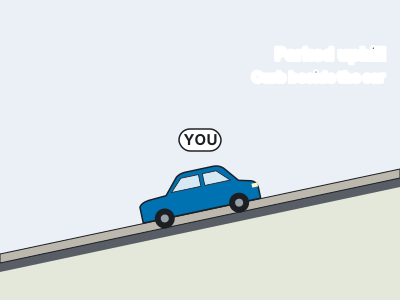
- Toward the curb before setting the brake
- Away from the curb, then let the vehicle roll back slightly
- Straight ahead with the transmission in neutral
- Toward the center only if the curb is red
Show answer
Away from the curb, then let the vehicle roll back slightly. Uphill parking with a curb calls for turning the front wheels away from the curb and letting the vehicle roll back a few inches until the wheel rests gently against the curb. Turning toward the curb is the downhill rule. The cue is the hill direction: uphill plus curb means wheels left, then parking brake and park or gear. This positions the curb to stop the vehicle if equipment fails.
Study this in the handbook: Parallel parking, hills and colored curbs
19. What are the handbook's steps for passing on an open highway?
- Honk, then pass on the shoulder
- Pass on the right at any time
- Signal, check blind spots, enter the lane, speed up, signal and return
- Follow closely until the car moves over
Show answer
Signal, check blind spots, enter the lane, speed up, signal and return. Each passing step manages one risk: the first signal announces intent, the shoulder check clears the blind spot, the lane entry commits only when clear, extra speed shortens exposure to oncoming traffic, and the final signal plus return ends the maneuver cleanly. Skipping the shoulder check or lingering beside the passed car are the two classic passing crashes. Never use the shoulder as a passing lane.
Study this in the handbook: Turns, U-turns, merging and passing
20. At a red YIELD sign, who must you let pass before proceeding?
- Only cars with passengers
- Only emergency vehicles
- Any vehicle, bicyclist, or pedestrian
- Only vehicles on your left
Show answer
Any vehicle, bicyclist, or pedestrian. A yield sign makes you the one who waits for the whole road: cars, trucks, motorcycles, bicycles, and people on foot all proceed before you. Slow on approach, be ready to stop, and merge or cross only when the way is fully clear. Unlike a stop sign, it does not always force a full halt, but it never lets you claim priority over anyone already in the intersection.
Study this in the handbook: Traffic lights and pedestrian signals
New California driver? Insurance is the next step
Once the permit or license is in hand, the family policy changes. QualitySpace is an independent California broker (Kevin Vu, CDI #4037122): teen-driver additions, first-time policies, and multi-car bundles quoted across many carriers in one call.
Get a free quote or call 714-666-6669. English and Vietnamese.
Every question is written from the official California Driver's Handbook. Need paper? Printable CA practice test with answer key.
Last verified 2026-10-12. How we check every question · Study all 506 as flashcards
Frequently asked questions
How many questions are on this California practice test?
This fixed set has 20 questions. It is test 13 of 25 from the 506 question California bank. The real CA exam has 36 questions for applicants 18 and older and 46 for applicants under 18. A passing score is 80%.
What is the passing score for the real California test?
A passing score is 80%. That figure comes from the official California source cited on the DMV facts page.
How does this fixed test relate to the full California bank?
Each numbered test is a fixed set of questions in a fixed order, so you can retake the same test later and compare. Every test mixes road signs and the other topics in about the same proportion as the full bank. Tests 1 to 25 together cover 500 of the 506 questions in the California bank, each once. The full practice page mixes the whole bank at random.
Last verified 2026-10-12. See the California DMV facts page for sourced state details.
Return to the full California practice test · Study road signs