
Test 9 of 10 · 20 questions · Free 2026
MN Permit Practice Test 9
Jump to the test ↓A fixed 20 question set from the Minnesota bank with answers and plain English explanations.
Question 1 of 20 · 0 right so far
All 20 questions in test 9
Every question below comes from the Minnesota question bank on this page. Open a question to see the correct answer and the explanation. Nothing here is hidden behind a signup.
1. At what alcohol concentration does a Minnesota ignition interlock device prevent the vehicle from starting?
- 0.08 percent or above
- 0.04 percent or above
- 0.02 percent or above
- Any amount above zero
Show answer
0.02 percent or above. The ignition interlock is connected to the vehicle's starter, and the driver must blow into it to start the car. If it detects an alcohol concentration at or above 0.02 percent, it prevents the vehicle from starting. Point zero eight is the DWI arrest level and 0.04 the commercial level, both higher than the device's cutoff. Any amount above zero is stricter than the stated setting.
Study this in the handbook: How alcohol affects you and the DWI law
2. About how fast does the body eliminate alcohol, according to the Minnesota manual?
- About three drinks per hour
- About one drink per hour
- Faster after coffee or a cold shower
- About one drink every 15 minutes
Show answer
About one drink per hour. The only way to reduce alcohol concentration is to wait. The manual says alcohol is generally eliminated at about one drink per hour, with the liver removing 95 percent by oxidation and the rest leaving through breathing, sweating and urination. Coffee, exercise and cold showers do not speed up oxidation. Three drinks per hour and one every 15 minutes both overstate how fast the body works.
Study this in the handbook: How alcohol affects you and the DWI law
3. A Minnesota driver gave false information on a license application. How long is the license canceled?
- Permanently
- 30 days, whichever comes first
- 60 days or until the correct information is provided, whichever is longer
- Until age 21
Show answer
60 days or until the correct information is provided, whichever is longer. Cancellation applies when a driver has no legal right to the license. If you give false or misleading information on the application, the license is canceled for 60 days or until the correct information is provided, whichever is longer. It is not permanent by default. Thirty days whichever comes first reverses both the number and the logic. Age 21 has no role here.
4. When may a driver exceed a 55 mph posted limit by up to 10 mph under Minnesota's speed rule?
- While lawfully passing another vehicle on a two-lane highway
- Whenever the road is empty
- When merging onto any freeway
- Whenever the driver is late
Show answer
While lawfully passing another vehicle on a two-lane highway. Minnesota permits the 10 mph increase only while lawfully passing another vehicle on a two-lane highway whose speed limit is 55 mph or higher. An empty road, a freeway merge, or a driver's schedule does not satisfy those conditions. The allowance is narrow and does not turn the posted limit into a general target above the sign. Confirm the highway has two lanes and that the pass itself is lawful before applying this exception.
Study this in the handbook: Speed limits and the basic speed law
5. When making a turn in Minnesota, how far before turning should you activate your signal?
- At least 10 feet before turning
- Only after entering the intersection
- At least 100 feet before turning
- Only when another driver is nearby
Show answer
At least 100 feet before turning. The manual sets a clear advance warning for turns: activate the signal at least 100 feet before turning, then keep signaling until the turn or lane change is complete. Waiting until the intersection or until another driver appears removes useful time for pedestrians and traffic to respond. Ten feet is far shorter than the stated distance and does not give the same warning. Signaling is not optional just because the road looks empty. A practical cue is to begin the signal before the final approach, then cancel it only after the maneuver has finished.
Study this in the handbook: Signaling, turns, roundabouts and U turns
6. Which format does Minnesota use for questions on the Class D written test?
- Essay responses and oral interviews
- Multiple choice and true-or-false
- Driving demonstrations only
- Fill-in-the-blank questions only
Show answer
Multiple choice and true-or-false. Minnesota describes the Class D written test as using multiple choice and true-or-false questions. It assesses knowledge of Minnesota traffic laws and road signs, so it is not an essay, oral-interview, or driving-demonstration-only assessment. The manual adds that the test may be taken on paper or on a computer, which changes how it is delivered but not the question formats. Study each rule closely enough to recognize both a selected answer and a true or false statement.
Study this in the handbook: The written test, vision screening and road test
7. What should a driver do as pavement changes from wet to snowy or icy?
- Adjust speed downward as the road becomes more hazardous
- Keep the posted speed because conditions do not change the rule
- Use cruise control to maintain traction on slippery surfaces
- Brake hard at every patch of wet pavement
Show answer
Adjust speed downward as the road becomes more hazardous. A driver should adjust speed to road conditions, reducing it as traction and control become more difficult. Wet pavement, packed snow, and ice each can require a more cautious pace, and the posted limit does not guarantee that speed is safe in every condition. The manual specifically says to avoid using cruise control on slippery roads. Braking hard at every wet patch can create a skid. The cue is the surface under the tires: slow smoothly, keep a safe distance from the vehicle in front, and avoid abrupt controls when grip is limited.
8. How should a driver respond to a flashing red traffic light in Minnesota?
- Use it as permission to turn without checking
- Treat it as a yield sign without stopping
- Continue if the cross street appears empty
- Treat it as a stop sign
Show answer
Treat it as a stop sign. A flashing red traffic light must be treated as a stop sign. That means the driver stops and then applies the ordinary right-of-way rules before proceeding. A yield-only response skips the required stop, while an empty-looking cross street does not cancel the signal. The signal also does not grant an unchecked turn. Make a complete stop at the proper point, scan for traffic and pedestrians, and continue only when the intersection is clear under the applicable priority rule.
Study this in the handbook: Stop rules, school buses and fleeing police
9. What nighttime restriction applies during the first six months of a Minnesota provisional license?
- No driving from midnight to 5 a.m. unless an exception applies
- No driving from 10 p.m. to 4 a.m. in every circumstance
- No driving from 1 a.m. to 6 a.m. only on weekends
- No driving after sunset until sunrise
Show answer
No driving from midnight to 5 a.m. unless an exception applies. During the first six months, a provisional driver must not drive from midnight to 5 a.m. unless one of the listed exceptions applies. Those exceptions include a licensed driver at least 25 years old, travel between home and work, certain school events, and employment. The choices “No driving from 10 p.m. to 4 a.m. in every circumstance” and “No driving from 1 a.m. to 6 a.m. only on weekends” change the clock, while the choice “No driving after sunset until sunrise” replaces the fixed curfew with a daylight rule. Check the purpose of the trip and who is supervising before driving during the restricted hours. The important cue is the midnight to 5 a.m. window, not merely darkness outside.
Study this in the handbook: Provisional license limits, Vanessa's Law and the under 21 license
10. If the broken yellow line is on your side and the solid yellow line is opposite, when may you pass?
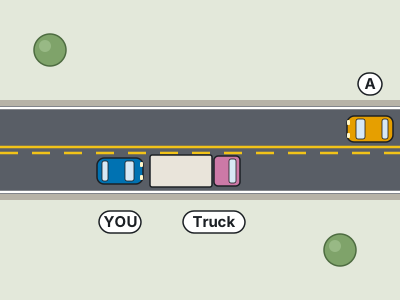
- Only when the other direction is also marked with dashes
- Never, because any yellow line forbids passing
- Only after crossing into the opposite lane without checking
- When passing is otherwise safe and legal
Show answer
When passing is otherwise safe and legal. Mixed yellow lines give different instructions to the two directions. A broken line on your side permits passing when the maneuver is safe and legal, while the solid line facing the other direction prohibits that traffic from passing. You still need adequate sight distance, room, and no separate restriction before moving around another vehicle. The presence of a yellow line alone does not answer the question; identify which marking is beside your lane. Check mirrors and oncoming traffic before using the permission represented by the broken line.
Study this in the handbook: Lines and lane markings
11. A Minnesota driver illegally passes a school bus with its red lights flashing. Within how long may an officer with probable cause arrest the driver?
- Within four hours
- Only at the moment of the violation
- Within 30 days
- Within 24 hours
Show answer
Within four hours. Minnesota lets a law enforcement officer who has probable cause to believe you illegally passed a school bus arrest you within four hours of the violation, so an officer does not need to catch you on the spot. Thirty days and 24 hours are not the stated window. The penalty on conviction is a fine of at least $500 and loss of driving privileges. On a divided roadway, traffic across the divider does not need to stop.
Study this in the handbook: Stop rules, school buses and fleeing police
12. Under Minnesota's Vanessa's Law, an unlicensed teen is convicted of an alcohol-related driving violation. When can the teen get a permit or license?
- After a 30 day wait
- After six months
- Not until age 18
- Immediately, after paying a fine
Show answer
Not until age 18. Vanessa's Law covers teens who commit an impaired driving crime or a crash-related moving violation. If the teen was driving without a license, a conviction for a crash-related moving violation or an alcohol or controlled substance violation, including Not a Drop, means no license, instruction permit or provisional license until age 18. Thirty days and six months are far shorter than the rule. Paying a fine does not restore eligibility.
Study this in the handbook: Provisional license limits, Vanessa's Law and the under 21 license
13. To upgrade from a Minnesota provisional license before 18, how long must the provisional license have been held?
- 12 consecutive months with no alcohol, drug or crash-related convictions
- Six months with no convictions at all
- Two years
- 90 days
Show answer
12 consecutive months with no alcohol, drug or crash-related convictions. The under 21 Class D license requires being at least 18, or holding a provisional license for 12 consecutive months with no convictions for alcohol violations, controlled substance violations or crash-related moving violations. The driver also may not have more than one conviction for a moving violation that is not crash-related. Six months is the permit holding time. Two years is how long the provisional license stays valid, not the upgrade point. Ninety days is from Vanessa's Law.
Study this in the handbook: Provisional license limits, Vanessa's Law and the under 21 license
14. What practice helps a driver maintain a safe distance behind another vehicle in ideal conditions?
- Wait until the lead vehicle brakes before choosing space
- Keep one car length regardless of speed or weather
- Match the lead vehicle's bumper distance exactly
- Use the three-second rule with a fixed roadside reference point
Show answer
Use the three-second rule with a fixed roadside reference point. The three-second rule gives the driver a time-based way to judge space. Select a fixed object beside the road, begin counting when the vehicle ahead passes it, and check whether your vehicle reaches that object before the count ends. Arriving too soon means you are following too closely, so gradually reduce speed. A single car length changes meaning with speed and does not account for conditions. Braking only after the lead vehicle brakes leaves no cushion for perception and reaction.
Study this in the handbook: Following distance, night driving and freeways
15. At a blinking red signal, which sequence applies before entering the intersection?
- Continue through without reducing speed
- Wait for a police officer before moving
- Treat it as a flashing yellow and continue with caution
- Stop completely, yield to earlier traffic and pedestrians, then proceed when clear
Show answer
Stop completely, yield to earlier traffic and pedestrians, then proceed when clear. Minnesota treats a flashing red signal as a stop sign. The driver must make a complete stop, then yield to vehicles and pedestrians that reached the intersection first. Movement can resume only after the intersection is clear. A flashing yellow signal has a different instruction, so carrying that rule over would remove the required stop. Waiting for an officer is unnecessary unless one is directing traffic. Use the practical cue that red means stop, even when the red light is blinking rather than steady.
Study this in the handbook: Traffic signals, lane use signals and ramp meters
16. What should you anticipate when this merging-traffic sign appears?

- Your lane is ending and you must stop immediately
- Vehicles may enter the roadway, so be prepared to allow them in
- New traffic will not have to merge because a lane is added
- Only motorcycles may enter from the side
Show answer
Vehicles may enter the roadway, so be prepared to allow them in. A merging-traffic warning means vehicles are entering the roadway on which you are traveling. Be alert, watch the adjacent entry area, and be prepared to adjust speed or position so another vehicle can merge safely. An ending lane is a separate warning, and an added-lane sign means new traffic has its own lane without an immediate merge. Nothing in this symbol reserves the entry for motorcycles. The useful cue is to check mirrors and the side area before the merge point, rather than reacting after a vehicle is beside you.
Study this in the handbook: Warning, school, construction and guide signs
17. What should a driver do after seeing a No Passing Zone sign on the left side of a two-way highway?
- Cross the center line whenever the road appears clear
- Pass quickly before reaching the next curve
- Use the shoulder to pass if the lane is busy
- Continue in your lane without passing in the no-passing zone
Show answer
Continue in your lane without passing in the no-passing zone. The No Passing Zone sign warns that the beginning of a no-passing zone is ahead, and the manual places this sign on the left side of a two-way highway. A driver should remain behind the vehicle ahead rather than rush to pass before a curve. The shoulder is not a passing lane, and an apparently clear road does not cancel the posted restriction. Use the sign as an advance cue to maintain position, manage following distance, and wait until the restriction ends and the markings permit a lawful pass. Patience is part of the required maneuver here.
Study this in the handbook: Warning, school, construction and guide signs
18. What general message does this yellow warning sign provide?

- It grants priority over all approaching traffic
- It alerts you to a possible hazard ahead
- It marks a service area where parking is required
- It gives the legal maximum speed for the road
Show answer
It alerts you to a possible hazard ahead. This is a warning sign, so its purpose is to alert the driver to a possible hazard ahead and prompt an appropriate response. It does not grant priority, require parking, or set a speed limit. Those functions belong to different sign categories and shapes. The safest response is to identify what the symbol represents, begin looking farther ahead, and adjust speed or position before the hazard is reached. A warning sign should change attention and preparation, even when no immediate action is yet required.
Study this in the handbook: Sign colors, shapes and regulatory signs
19. If a Minnesota driver does not have insurance information at a crash scene, when must it be provided?
- Within 30 days
- Within 72 hours
- Immediately or never
- Within one year
Show answer
Within 72 hours. At a crash you give the investigating officer your insurance carrier and agent, and if you do not have the information with you, you must provide it within 72 hours. A crash with property damage only does not require notifying law enforcement, but a disabled vehicle should be towed promptly. Owners of vehicles driven on public roads must carry no fault and liability insurance.
Study this in the handbook: Seat belts, child seats, airbags and window rules
20. Your gas pedal sticks, and hooking your toe under it to raise it does not free it. What should you do next?
- Press the accelerator repeatedly until it releases
- Turn the key off while traveling in the lane
- Apply the brakes, shift into neutral, and steer toward the shoulder
- Pull the parking brake sharply before steering
Show answer
Apply the brakes, shift into neutral, and steer toward the shoulder. The manual says a stuck gas pedal may be freed by hooking your toe under the pedal and raising it. If that does not work, apply the brakes and shift into neutral to disengage the engine, then choose a safe path and steer to the shoulder. Pressing the accelerator repeatedly does not solve the jam, and the manual does not list turning the key off in the travel lane or a sharp parking brake pull as the response. If the shoulder is not paved, switch on hazard lights and keep steering straight until you can pull over safely.
Study this in the handbook: Blowouts, brake failure and other vehicle emergencies
QualitySpace is expanding to Minnesota
We are a California-based independent insurance brokerage working on licensing in more states. We cannot help with Minnesota insurance yet. Leave your email and we will let you know when we can.
Every question is written from the official Minnesota Driver's Manual. Need paper? Printable MN practice test with answer key.
Last verified 2026-10-05. How we check every question · Study all 208 as flashcards
Frequently asked questions
How many questions are on this Minnesota practice test?
This fixed set has 20 questions. It is test 9 of 10 from the 208 question Minnesota bank.
How does this fixed test relate to the full Minnesota bank?
Each numbered test is a fixed set of questions in a fixed order, so you can retake the same test later and compare. Every test mixes road signs and the other topics in about the same proportion as the full bank. Tests 1 to 10 together cover 200 of the 208 questions in the Minnesota bank, each once. The full practice page mixes the whole bank at random.
Last verified 2026-10-05. See the Minnesota DMV facts page for sourced state details.
Return to the full Minnesota practice test · Study road signs