
Test 5 of 10 · 20 questions · Free 2026
MN Permit Practice Test 5
Jump to the test ↓A fixed 20 question set from the Minnesota bank with answers and plain English explanations.
Question 1 of 20 · 0 right so far
All 20 questions in test 5
Every question below comes from the Minnesota question bank on this page. Open a question to see the correct answer and the explanation. Nothing here is hidden behind a signup.
1. When a vehicle is used to violate Minnesota’s school-bus stopping law, who may be penalized as the owner?
- The owner automatically receives five license points
- The owner or leaseholder may be guilty of a petty misdemeanor
- The owner is never involved if another person was driving
- The owner must surrender the vehicle permanently
Show answer
The owner or leaseholder may be guilty of a petty misdemeanor. Minnesota allows the owner or leaseholder to be guilty of a petty misdemeanor when the vehicle is used to violate the school-bus stopping statute. The owner can avoid that owner-based charge by proving another person was driving, in which case the driver is charged. The claim that an owner is never involved overlooks this specific responsibility, and the manual does not impose automatic five-point treatment or permanent forfeiture here. Keep records of who operates a vehicle and take school-bus violations seriously. The cue is ownership creates exposure, subject to proof about the actual driver.
Study this in the handbook: Right of way and yielding
2. How close may an ordinary vehicle follow a firefighting vehicle on an emergency run?
- It may follow within 100 feet during daylight
- It may follow within 50 feet if its lights are on
- It may not follow within 500 feet
- It may follow at any distance if traffic is light
Show answer
It may not follow within 500 feet. Only vehicles on official emergency business may follow within 500 feet of a firefighting vehicle on an emergency run. An ordinary driver must stay outside that protected distance, even when traffic is light or daylight makes the vehicle easy to see. A 50 foot or 100 foot gap is still too close under the stated rule. The same passage also warns drivers not to drive over an unprotected fire hose unless directed by a law enforcement officer or fire department official. When approaching a fire response, increase space, slow down, and watch for equipment and personnel.
Study this in the handbook: Emergency vehicles, the Move Over Law and traffic stops
3. How many supervised driving hours must a Minnesota teen log if a parent completes the parent class?
- At least 40 hours including 15 nighttime hours; 50 hours without the parent class
- 10 hours
- 100 hours
- 20 hours with no night driving
Show answer
At least 40 hours including 15 nighttime hours; 50 hours without the parent class. Parents or guardians have two options: complete a parent class from a Minnesota approved driver education program and submit a log showing at least 40 hours of supervised driving including 15 nighttime hours, or skip the class and have the teen log at least 50 hours. After six months of practice, or three months at age 19 or older, the teen may take the road test.
Study this in the handbook: The instruction permit and provisional license
4. What does a green arrow at a Minnesota intersection mean?
- You may travel in any direction from the lane
- You must stop until a circular green light appears
- You may turn only after yielding to every vehicle behind you
- You may safely turn in the direction of the arrow
Show answer
You may safely turn in the direction of the arrow. A green arrow authorizes travel in the direction it points and protects the turn from oncoming or crossing traffic. It does not allow movement in every direction, and it is not a command to wait for a circular green signal. Traffic behind you is not the controlling conflict. Even with protection, scan the roadway and pedestrians before moving, because a safe turn still requires ordinary attention. Match the vehicle’s path to the arrow, remain in the designated lane, and complete only the indicated movement. The arrow’s direction is the key cue for what the signal permits.
Study this in the handbook: Traffic signals, lane use signals and ramp meters
5. What condition does the skidding-car symbol warn about?

- The road is reserved for emergency vehicles
- The road surface may be slippery when wet
- A gravel shoulder begins immediately
- The road is closed during rain
Show answer
The road surface may be slippery when wet. The symbol warns that moisture can make the road surface slippery, and the manual notes the sign is often located near bridges and overpasses. It does not announce a closure, a gravel shoulder, or an emergency only route. Reduce speed before reaching the slick area, increase following space, and use smooth steering and braking. The manual's slippery road advice is to slow down and keep a safe distance from the vehicle in front, and it also says to avoid using cruise control on slippery roads.
Study this in the handbook: Warning, school, construction and guide signs
6. What change in roadway operation does the opposing-arrow sign announce?
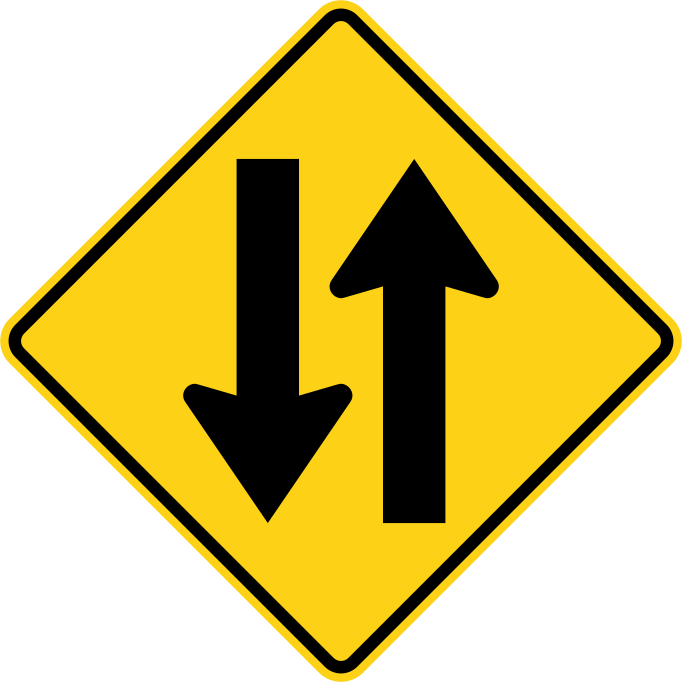
- Passing is permitted in both directions
- A divided highway is beginning immediately
- You are leaving a one-way road and entering a two-way road
- The lane becomes a center turn lane only
Show answer
You are leaving a one-way road and entering a two-way road. The opposing arrows warn that traffic will no longer be confined to one direction. The driver is leaving a one-way road and entering a two-way road, so staying to the right becomes especially important. The sign does not authorize passing, announce a divided highway, or convert the lane into a center turn lane. Check for oncoming traffic, keep right of the center line, and watch for additional markings that regulate passing or turning. The key cue is the change from one directional flow to opposing traffic.
7. A commercial driver has a detectable alcohol concentration below 0.04 percent. What Minnesota consequence is specified?
- The driver receives only a warning with no restriction
- The driver may continue after drinking coffee
- The driver is placed out of service for 24 hours
- The driver permanently loses every driving credential
Show answer
The driver is placed out of service for 24 hours. Minnesota places a commercial driver out of service for 24 hours when the alcohol concentration is below 0.04 percent but still detectable. Being below 0.04 does not make detectable alcohol irrelevant, so the warning-only choice is unsafe. Coffee cannot remove the restriction, and the manual's passage describes a 24-hour out-of-service period rather than automatic permanent loss of every credential. The practical cue is commercial vehicle plus any detectable alcohol: stop operating and observe the stated duration.
Study this in the handbook: How alcohol affects you and the DWI law
8. What cellphone use is allowed for a Minnesota driver under 18 with an instruction permit or provisional license?
- Handheld calls whenever traffic is stopped
- A call to 911 in an emergency
- Hands-free calls for any reason while moving
- Texting when the phone is mounted
Show answer
A call to 911 in an emergency. Drivers under 18 with an instruction permit or provisional license may not use a cell phone, handheld or hands-free, except to call 911 in an emergency. The choice “Handheld calls whenever traffic is stopped” ignores the age and license restriction and also treats stopped traffic as permission. The choice “Hands-free calls for any reason while moving” is specifically rejected because hands-free use is included in the prohibition. Mounting a phone does not authorize texting, so the option “Texting when the phone is mounted” remains illegal. The practical cue is to reserve the phone for an emergency 911 call and handle ordinary communication before the trip begins.
Study this in the handbook: Distraction, aggression, winter driving and skids
9. On a road with two lanes in your direction, where should you move when a stopped emergency vehicle with flashing lights is ahead?
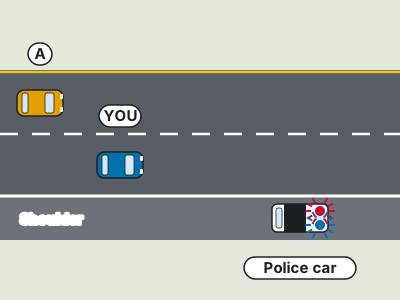
- Into the lane closest to the emergency vehicle to pass quickly
- To the shoulder beside the stopped vehicle
- To the lane farthest away from the stopped vehicle when safe
- Across the centerline regardless of opposing traffic
Show answer
To the lane farthest away from the stopped vehicle when safe. When a stopped emergency vehicle with flashing lights is on or next to a road with two lanes in the same direction, Minnesota's Move Over Law calls for moving to the lane farthest away when it is safe. The shoulder beside the vehicle provides less separation, and the choice “Into the lane closest to the emergency vehicle to pass quickly” moves toward the danger. Crossing the centerline without regard for opposing traffic is not a safe interpretation of the rule. Signal early, check mirrors and blind spots, then make the lane change only when it can be completed without creating a new conflict.
Study this in the handbook: Emergency vehicles, the Move Over Law and traffic stops
10. What action does this STOP sign require?

- Come to a complete stop, then wait for right-of-way traffic and pedestrians to clear
- Reduce speed and continue whenever the lane looks open
- Stop only if another vehicle is approaching
- Yield without stopping when the sign is at an intersection
Show answer
Come to a complete stop, then wait for right-of-way traffic and pedestrians to clear. A Minnesota STOP sign requires a complete stop and continued waiting until pedestrians and vehicles with the right of way have cleared the intersection. The choice “Reduce speed and continue whenever the lane looks open” treats the sign like a yield sign and removes the mandatory stop. The choice “Stop only if another vehicle is approaching” adds a condition that the sign does not contain, while the choice “Yield without stopping when the sign is at an intersection” replaces the stop with a yield. Stop at the marked line when one exists, otherwise stop before the crosswalk or intersection as required by the roadway layout. Then scan all directions before moving cautiously.
Study this in the handbook: Sign colors, shapes and regulatory signs
11. What is the minimum license revocation for a first DWI offense in Minnesota?
- One year minimum
- Three years
- Seven days
- 90 days, or 30 days if you plead guilty
Show answer
90 days, or 30 days if you plead guilty. A first DWI offense brings a minimum 90-day revocation, reduced to 30 days if you plead guilty. No work permit is issued until 15 days of revocation have passed, and none at all if the alcohol concentration was 0.16 percent or greater. One year is the second offense minimum, and three years the third. Seven days is the temporary license period before the revocation starts.
Study this in the handbook: Implied consent and DWI penalties
12. What does an orange traffic sign usually indicate in Minnesota?
- A recreational site or cultural attraction
- A construction or work zone condition
- A mandatory stop at a railroad crossing
- A route to food, fuel, or lodging
Show answer
A construction or work zone condition. Orange signs identify construction and work zone warnings. They can signal restricted lanes, detours, or other road work hazards, so drivers should slow down and follow the changed path. Brown signs point toward historic, cultural, or recreational locations, while blue signs describe motorist services. A railroad stop requirement is not the general meaning of orange. Watch for cones, drums, barriers, workers, and people giving directions near the orange sign. The sign color is an immediate cue that normal lane patterns or speeds may not continue through the area.
Study this in the handbook: Warning, school, construction and guide signs
13. Which vehicles does the Minnesota manual identify as permitted to use blue lights?
- Any passenger car traveling after sunset
- Snowplows, road maintenance equipment, and authorized emergency vehicles
- Taxi vehicles waiting at a curb
- Every vehicle with its hazard flashers operating
Show answer
Snowplows, road maintenance equipment, and authorized emergency vehicles. Blue lights are limited to snowplows, road maintenance equipment, and authorized emergency vehicles under the manual's prohibited-lights section. The choice “Any passenger car traveling after sunset” confuses nighttime visibility with legal authorization. A taxi does not gain blue-light authority by stopping, and hazard flashers do not transform an ordinary vehicle into one of the listed categories. The rule is about the vehicle's authorized function, not the driver's desire to be more visible. When you see blue lights, give the vehicle room and expect road work or an emergency response rather than treating the light as a normal accessory.
Study this in the handbook: Headlights, special lights and required equipment
14. How far ahead must Minnesota high beam headlights make objects visible?
- At least 100 feet
- At least 1,000 feet
- At least 350 feet
- At least 50 feet
Show answer
At least 350 feet. All motor vehicles except motorcycles must have two white headlights that work on high and low beam; high beam headlights must make objects visible on the road at least 350 feet ahead. Replace damaged headlights, since a cracked lens lets in moisture and dust that reduce light and increase glare, and clean them as often as the windshield. Clear lenses help illuminate the road without scattering light toward other drivers.
Study this in the handbook: Headlights, special lights and required equipment
15. What do white dashes between lanes of traffic traveling in the same direction mean?
- The lane is reserved for emergency vehicles only
- The lanes carry traffic in opposite directions
- Lane changes are prohibited until the next intersection
- A lane change is permitted where the marking is present
Show answer
A lane change is permitted where the marking is present. White lines separate lanes moving in the same direction, and white dashes indicate that a driver may change lanes at that location. The permission still depends on a safe gap, a signal, and a check for vehicles in the blind spot. The opposing-direction choice describes the function of yellow lines, while a prohibition would be associated with a solid or double solid white line. The emergency-only choice adds a restriction not conveyed by ordinary white dashes. The cue is the combination of color and pattern: white means same direction, and dashes mark a possible lane change.
Study this in the handbook: Lines and lane markings
16. What should a driver do when approaching an animal-drawn vehicle on the roadway?
- Reduce speed and pass slowly
- Sound the horn continuously to make it move faster
- Pass closely before another vehicle arrives
- Maintain speed because the animal must yield
Show answer
Reduce speed and pass slowly. Animal-drawn vehicles can move slowly and may react unpredictably to nearby traffic. The Minnesota guidance is to reduce speed and pass slowly, giving the driver more time to recognize the vehicle and avoid startling the animal or crowding its path. Continuous horn use and close passing add pressure and risk. The animal-drawn vehicle does not disappear from the driver’s duty to share the road safely. Look for the slow-moving vehicle emblem, ease off the accelerator, and provide a calm, wide passage.
Study this in the handbook: Warning, school, construction and guide signs
17. You fail to slow down while passing a stopped emergency vehicle with flashing lights in Minnesota. What is added to the speeding fine?
- A surcharge of at least $300
- Double the fine
- Nothing extra
- A surcharge of at least $25
Show answer
A surcharge of at least $25. Minnesota requires you to slow down when approaching or passing a stopped emergency vehicle with flashing emergency lights, and a surcharge of at least $25 is added to the speeding fine for breaking this law. Three hundred dollars is the extra fine for speeding in a work zone. Doubling the fine is not the rule the manual states, and nothing extra ignores the surcharge. Also slow down for flag persons, pedestrians, barricades, flares and reflectors.
Study this in the handbook: Speed limits and the basic speed law
18. When a funeral procession identifies itself with headlights or hazard warning lights, what must other drivers do?
- Yield to the entire procession
- Enter between vehicles whenever a gap appears
- Pass the procession on the shoulder
- Honk until the procession stops
Show answer
Yield to the entire procession. A marked funeral procession is treated as one continuous group for yielding purposes. When its vehicles use headlights or hazard warning lights to identify the procession, other drivers must yield to the entire line rather than treating each gap as an invitation to enter. Cutting between vehicles can disrupt the group and create conflicts with traffic that is following it. The shoulder and horn are not substitutes for yielding. Slow down, wait patiently, and allow the procession to clear before resuming travel.
Study this in the handbook: Right of way and yielding
19. A Minnesota driver is convicted a second time of texting while driving. What extra fine applies?
- $275 on top of the court fine
- $25 on top of the court fine
- $1,000 total
- No extra fine
Show answer
$275 on top of the court fine. Minnesota bans using a wireless device to compose, read or send electronic messages while driving, except for emergencies, reporting a crash or crime, or voice-activated or hands-free use. After two or more convictions, the driver must pay a $275 fine in addition to the court-specified fine. Twenty-five dollars is the emergency vehicle surcharge. A flat $1,000 is not the rule, and saying there is no extra fine ignores it.
20. How old must the supervising driver be for a Minnesota instruction permit holder who is under 18?
- 18 or older
- 25 or older
- 16 or older
- 21 or older
Show answer
21 or older. A Minnesota permit holder under 18 must be supervised by a driver aged 21 or older, and everyone in the vehicle must be buckled. Eighteen is the minimum supervisor age for a permit holder who is 18 or older, so it is the easy mix-up. Twenty-five is the age of the licensed driver who can ride along during a provisional driver's first six months at night. Sixteen is not a supervisor age. Permit holders under 18 also may not use a phone at all, even hands-free.
Study this in the handbook: The instruction permit and provisional license
QualitySpace is expanding to Minnesota
We are a California-based independent insurance brokerage working on licensing in more states. We cannot help with Minnesota insurance yet. Leave your email and we will let you know when we can.
Every question is written from the official Minnesota Driver's Manual. Need paper? Printable MN practice test with answer key.
Last verified 2026-10-05. How we check every question · Study all 208 as flashcards
Frequently asked questions
How many questions are on this Minnesota practice test?
This fixed set has 20 questions. It is test 5 of 10 from the 208 question Minnesota bank.
How does this fixed test relate to the full Minnesota bank?
Each numbered test is a fixed set of questions in a fixed order, so you can retake the same test later and compare. Every test mixes road signs and the other topics in about the same proportion as the full bank. Tests 1 to 10 together cover 200 of the 208 questions in the Minnesota bank, each once. The full practice page mixes the whole bank at random.
Last verified 2026-10-05. See the Minnesota DMV facts page for sourced state details.
Return to the full Minnesota practice test · Study road signs