
Test 12 of 25 · 20 questions · Free 2026
MN Permit Practice Test 12
Jump to the test ↓A fixed 20 question set from the Minnesota bank with answers and plain English explanations.
Question 1 of 20 · 0 right so far
All 20 questions in test 12
Every question below comes from the Minnesota question bank on this page. Open a question to see the correct answer and the explanation. Nothing here is hidden behind a signup.
1. Another driver begins to pass you on a two-lane road. What should you do?
- Speed up so the pass ends sooner
- Move left to block the pass
- Stay in your lane and do not speed up
- Flash your high beams as a warning
Show answer
Stay in your lane and do not speed up. When someone is trying to pass you, Minnesota says to stay in your own lane and not increase your speed. Speeding up stretches out the pass and can trap the other driver in the oncoming lane. Moving left to block is dangerous and can cause a head-on or side-swipe crash. Flashing your high beams does nothing to help and can distract the driver. Holding a steady speed and lane position lets the pass finish quickly.
Study this in the handbook: Passing, backing up and parking
2. Which symptoms can be early signs of carbon monoxide poisoning in a car?
- Sudden tiredness, headache, dizziness, nausea
- Itchy skin and constant sneezing
- Sharp chest pain and a high fever
- Blurry vision that occurs only at night
Show answer
Sudden tiredness, headache, dizziness, nausea. Carbon monoxide is a deadly gas from engines with no odor or color. Early symptoms of poisoning include sudden fatigue, headache, dizziness, and nausea. If you notice them, open the windows, turn off the ignition, and get out of the vehicle or garage as soon as possible, then have the exhaust system checked. Sneezing, fever, and night-only blurry vision are not the warning signs the manual lists.
Study this in the handbook: Blowouts, brake failure and other vehicle emergencies
3. Your car is stuck on ice or snow. What method does Minnesota suggest to free it?
- Floor the gas to spin through
- Turn the wheels side to side while accelerating
- Let air out of all four tires
- Rock it gently forward and back, wheels straight
Show answer
Rock it gently forward and back, wheels straight. If your vehicle gets stuck on ice or snow, try rocking it back and forth. Keep the front wheels straight and slowly drive forward, then backward, as far as you can without spinning the tires. Accelerate gently when the tires grip. Flooring the gas spins the wheels and digs you in deeper. Turning the wheels side to side while accelerating makes it harder to gain traction, and letting air out of the tires is not part of the method.
4. At night on a highway, you pass an orange diamond sign with black letters, but no workers are in sight. What should you do?
- Keep your speed since no crew is out
- Speed up to get through the area
- Slow down and watch for work zone hazards
- Ignore it until you see equipment
Show answer
Slow down and watch for work zone hazards. Orange signs with black letters are used in construction and work zones, and Minnesota says to slow down when you see one. Machinery operates day and night, and lanes may be shifted or narrowed even when no workers are visible. Keeping full speed or speeding up leaves you less time to react to cones, barriers, or a lane change. Do not wait to spot equipment before slowing.
Study this in the handbook: Warning, school, construction and guide signs
5. A bottle of liquor is labeled 100 proof. What percent alcohol does it contain?
- 100 percent
- 50 percent
- 25 percent
- 200 percent
Show answer
50 percent. The term proof refers to a drink's strength and equals twice its percentage of alcohol. So you divide proof by two: 100 proof means 50 percent alcohol, just as 80-proof whiskey is 40 percent. A 100-proof liquor is not pure alcohol, and 25 percent would be 50 proof. Two hundred percent is impossible. Stronger liquor means a standard serving holds more alcohol, which raises your alcohol concentration faster.
Study this in the handbook: How alcohol affects you and the DWI law
6. Vehicles that must display this emblem travel at what top speed?

- 30 mph or less
- 15 mph or less
- 25 mph or less
- 45 mph or less
Show answer
30 mph or less. The slow-moving vehicle emblem must be shown on all vehicles that travel at 30 mph or less when they use a public road, such as farm equipment and animal-drawn vehicles. When you see it, you are closing on that vehicle quickly, so adjust your speed or get ready to change lanes. Fifteen and twenty-five mph are too low, and forty-five mph is far above the figure in the rule.
Study this in the handbook: Warning, school, construction and guide signs
7. In a Minnesota work zone, what should you do when you see this sign?
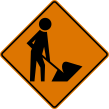
- Stop and wait for a flagger
- Slow down and keep away from workers
- Keep speed; crews are behind barriers
- Honk to alert the work crew
Show answer
Slow down and keep away from workers. This orange sign means workers are doing maintenance on the roadway. Slow down and adjust your lane position so you stay away from them. Reduced speed limits are often posted in work zones, and drivers who break them while workers are present face a fine. You do not need to stop unless a flagger directs you. Crews are not always behind barriers, and honking can startle someone working close to traffic.
Study this in the handbook: Warning, school, construction and guide signs
8. How much space does Minnesota suggest keeping between you and the steering wheel?
- At least 4 inches
- At least 18 inches
- At least 10 inches
- At least 2 feet
Show answer
At least 10 inches. Because the steering wheel holds an airbag, the manual suggests keeping at least 10 inches between yourself and the wheel. An airbag inflates very fast, and sitting too close can cause injury from the bag itself. Four inches is far too close. Eighteen inches and two feet are not the figures given and could leave short drivers unable to reach the pedals. Front passengers should move their seats as far back as possible.
Study this in the handbook: Seat belts, child seats, airbags and window rules
9. Signs show two lanes may turn left at an intersection. What must you do during the turn?
- Stay in your own lane throughout
- Drift into the inner lane once turning
- Finish in whichever lane is open
- Let the outer lane turn first
Show answer
Stay in your own lane throughout. Where signs or lane markings set up two or more turning lanes, you must stay in your lane for the whole turn. The driver beside you is turning at the same time, so drifting into the other lane mid-turn can cause a side-swipe. Ending in whatever lane looks open is the same mistake. There is no rule that one lane waits for the other; both lanes turn together on the signal, each keeping its own path.
Study this in the handbook: Signaling, turns, roundabouts and U turns
10. When may a driver use a bicycle lane in Minnesota?
- To pass slow traffic on the right side of the road
- To park where allowed, enter or leave the road, or turn
- Whenever no bicyclist is in sight ahead of you
- During rush hour to help ease heavy traffic
Show answer
To park where allowed, enter or leave the road, or turn. Driving in a bicycle lane is illegal except to park where parking is permitted, to enter or leave the road, or to prepare for a turn. Using it as a passing lane is not one of the exceptions, even when it looks empty. Rush hour congestion does not open the lane to cars. Before you cross a bicycle lane for one of the allowed reasons, make sure it is safe and yield to any approaching bicyclists.
Study this in the handbook: Pedestrians, bicyclists and motorcycles
11. Cannabis is legal for adults in Minnesota. May you drive while under its influence?
- No, driving under its influence is illegal
- Yes, if you are 21 or older
- Yes, if it came from a licensed store
- Only if you used it more than an hour ago
Show answer
No, driving under its influence is illegal. Minnesota makes it illegal to operate a vehicle while under the influence of a cannabis product, lower-potency hemp edible, hemp-derived consumer product, artificially derived cannabinoid, or THC. Being old enough to buy it legally, or buying it from a licensed store, does not make impaired driving legal. Waiting a set amount of time is not a legal test; the question is whether you are under its influence. Like alcohol, plan a sober ride.
Study this in the handbook: How alcohol affects you and the DWI law
12. A traffic officer holds up one hand, palm toward you, and gives one long whistle blast. What does it mean?
- Stop where you are
- Speed up and clear the area
- Turn right at the corner
- Pull over onto the shoulder
Show answer
Stop where you are. Most traffic officers tell drivers to stop by holding up one hand with the palm facing the vehicle and giving a long blast on the whistle. To start or keep traffic moving, they motion with the hand and give a series of short blasts. In low light, they may use a flashlight. A raised palm never means speed up, turn, or leave the road; it means stop.
Study this in the handbook: Lines and lane markings
13. Which of these is not allowed in Minnesota because it blocks the driver's view?
- A GPS unit near the bottom of the windshield
- A state park sticker on the windshield
- An object hanging between you and the windshield
- A safety monitor just behind the rearview mirror
Show answer
An object hanging between you and the windshield. Your view through the windshield and windows must be clear while driving, and Minnesota says not to hang objects between the driver and the windshield. Some items are allowed: stickers permitted by law, such as state park and inspection stickers, a GPS mounted near the bottom of the windshield, and safety monitoring equipment mounted just behind, slightly above, or slightly below the rearview mirror. A dangling item swings into your view and is not on the allowed list.
Study this in the handbook: Headlights, special lights and required equipment
14. Your front wheels stop responding when you turn the steering wheel. What should you do first?
- Brake hard right away to stop the car quickly
- Shift into a lower gear to slow down
- Turn off the ignition and coast
- Ease off the gas, brake only if needed
Show answer
Ease off the gas, brake only if needed. If the front wheels do not respond to the steering wheel, ease up on the accelerator and do not brake unless you must to avoid a crash. The car may balance itself and travel straight as it slows. If you have to brake, do it gently. Braking hard or shifting gears suddenly can throw the vehicle off balance and out of control. Turning off the ignition can lock the steering and remove power assist.
Study this in the handbook: Blowouts, brake failure and other vehicle emergencies
15. Besides passing, when does Minnesota allow you to drive in the left lane of a multi-lane road?
- When you are driving faster than most traffic
- When the right lane has slower trucks in it
- Any time the right lane looks crowded
- When preparing to turn left at an intersection or driveway
Show answer
When preparing to turn left at an intersection or driveway. On highways with more than one lane in your direction, Minnesota wants you in the right-hand lane when it is available. If you are in the left-most lane, move out of it when practical to let another vehicle pass. The listed exceptions include overtaking another vehicle in the same direction and preparing for a left turn at an intersection or into a private road or driveway. Driving faster than traffic or a crowded right lane is not on the list.
Study this in the handbook: Signaling, turns, roundabouts and U turns
16. What is special about a diverging diamond interchange?
- It has a roundabout at each end of the bridge
- Lanes cross so left turns avoid oncoming cars
- Left turns are banned at the whole interchange
- Every direction stops at a four-way stop
Show answer
Lanes cross so left turns avoid oncoming cars. A diverging diamond interchange is designed so traffic lanes cross over at each end of the bridge, which eliminates left turns across opposing traffic. Instead of a sharp left turn, you veer to the left to reach the ramp. The design reduces conflict points and makes wrong-way entry to ramps very difficult. It does not use roundabouts or four-way stops, and left turns are still possible, just without crossing oncoming lanes.
Study this in the handbook: Following distance, night driving and freeways
17. Your light turns yellow just as you reach the intersection, too late to stop safely. What should you do?
- Slam on the brakes right away
- Speed up to beat the red light
- Stop in the crosswalk
- Proceed through with caution
Show answer
Proceed through with caution. A steady yellow means the signal is about to turn red. If you can stop safely before the intersection, you should. If you cannot stop safely, Minnesota says to proceed through the intersection with caution. Slamming the brakes can cause a rear-end crash or leave you stopped in the crosswalk, blocking pedestrians. Speeding up to race the red adds danger; keep a steady speed and watch for others.
Study this in the handbook: Traffic signals, lane use signals and ramp meters
18. You have a green arrow to turn left, but a pedestrian is still in the crosswalk you will cross. What must you do?
- Turn; the arrow gives you priority
- Honk so the person hurries
- Yield to the pedestrian, then turn
- Turn behind the person quickly
Show answer
Yield to the pedestrian, then turn. When a green arrow lets you turn left, you must still yield to other vehicles or pedestrians already in the intersection. After yielding, you may continue in the direction of the arrow. The arrow protects you from oncoming traffic, but it does not let you push through a person who is already crossing. Honking or cutting closely behind the pedestrian can frighten or injure them.
Study this in the handbook: Right of way and yielding
19. At a four-way stop, you and a car on your right come to a stop at the same moment. Who has the right of way?
- You, because you are on the left
- Whichever vehicle is larger
- The driver who waves first
- The driver of the other car
Show answer
The driver of the other car. At all-way stops, and at intersections with flashing red lights, Minnesota uses the same tie-breaker: when two drivers arrive at the same time, the driver on the left yields to the driver on the right. Here you are on the left, so the other car goes first. Vehicle size does not matter. A wave is a courtesy, not the legal rule, and it can confuse other drivers about who should move.
Study this in the handbook: Right of way and yielding
20. You are passing a truck on a two-lane road when a car appears head-on. Where must you be when the car is within 100 feet?
- Alongside the truck's cab, still passing
- Back on the right side of the road
- On the left shoulder, off the pavement
- In the left lane, speeding up to finish
Show answer
Back on the right side of the road. Minnesota says you must return to the right side of the road before coming within 100 feet of an oncoming vehicle. If the oncoming car is already that close, your pass must be finished and your vehicle back on the right side. Staying alongside the truck means you have not completed the pass in time. The manual also says not to pass by driving on the shoulder or off the pavement, so leaving the road is not an option.
Study this in the handbook: Passing, backing up and parking
Every question is written from the official Minnesota Driver's Manual. Need paper? Printable MN practice test with answer key.
Last verified 2026-10-05. How we check every question · Study all 500 as flashcards
Frequently asked questions
How many questions are on this Minnesota practice test?
This fixed set has 20 questions. It is test 12 of 25 from the 500 question Minnesota bank.
How does this fixed test relate to the full Minnesota bank?
Each numbered test is a fixed set of questions in a fixed order, so you can retake the same test later and compare. Every test mixes road signs and the other topics in about the same proportion as the full bank. Tests 1 to 25 together cover every question in the Minnesota bank once. The full practice page mixes the whole bank at random.
Last verified 2026-10-05. See the Minnesota DMV facts page for sourced state details.
Return to the full Minnesota practice test · Study road signs